 Add to Chrome
 Add to Firefox
 Add to Edge
Height Control and Optimal Torque Planning for Jumping With Wheeled-Bipedal Robots
May 05, 2026
This paper mainly studies the accurate height jumping control of wheeled-bipedal robots based on torque planning and energy consumption optimization. Due to the characteristics of underactuated, nonlinear estimation, and instantaneous impact in the jumping process, accurate control of the wheeled-bipedal robot's jumping height is complicated. In reality, robots often jump at excessive height to ensure safety, causing additional motor loss, greater ground reaction force and more energy consumption. To solve this problem, a novel wheeled-bipedal jumping dynamical model(W-JBD) is proposed to achieve accurate height control. It performs well but not suitable for the real robot because the torque has a striking step. Therefore, the Bayesian optimization for torque planning method(BOTP) is proposed, which can obtain the optimal torque planning without accurate dynamic model and within few iterations. BOTP method can reduce 82.3% height error, 26.9% energy cost with continuous torque curve. This result is validated in the Webots simulation platform. Based on the torque curve obtained in the W-JBD model to narrow the searching space, BOTP can quickly converge (40 times on average). Cooperating W-JBD model and BOTP method, it is possible to achieve the height control of real robots with reasonable times of experiments.

Enhancing Prosthetic Safety and Environmental Adaptability: A Visual-Inertial Prosthesis Motion Estimation Approach on Uneven Terrains
Apr 29, 2024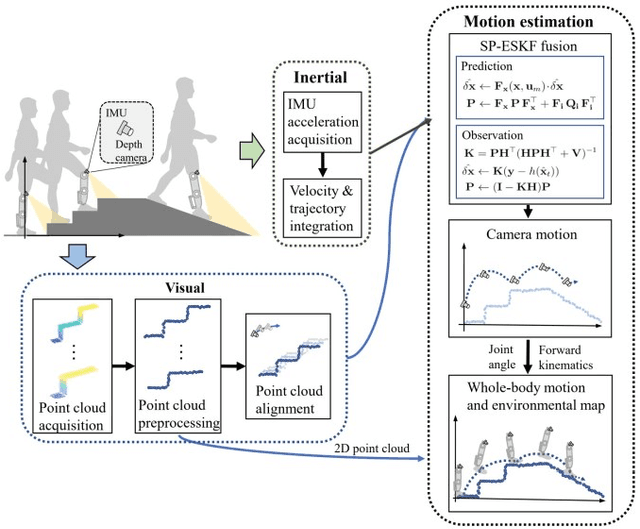
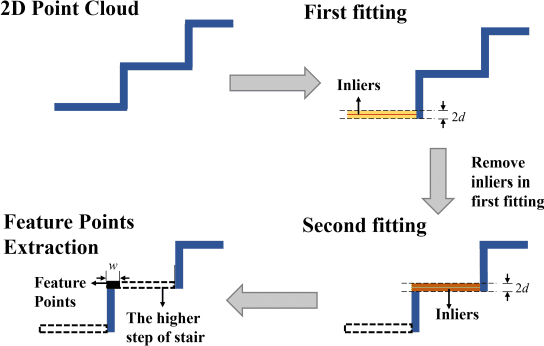
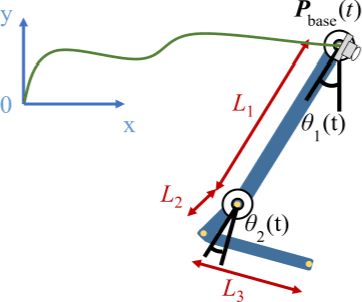
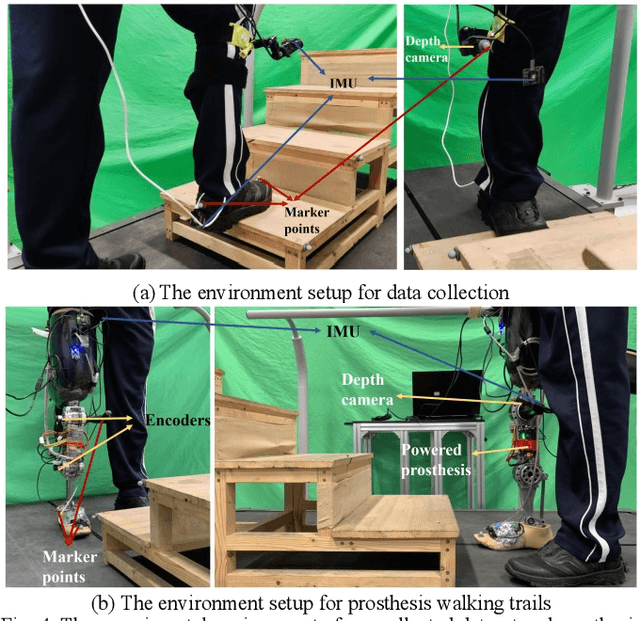
Environment awareness is crucial for enhancing walking safety and stability of amputee wearing powered prosthesis when crossing uneven terrains such as stairs and obstacles. However, existing environmental perception systems for prosthesis only provide terrain types and corresponding parameters, which fails to prevent potential collisions when crossing uneven terrains and may lead to falls and other severe consequences. In this paper, a visual-inertial motion estimation approach is proposed for prosthesis to perceive its movement and the changes of spatial relationship between the prosthesis and uneven terrain when traversing them. To achieve this, we estimate the knee motion by utilizing a depth camera to perceive the environment and align feature points extracted from stairs and obstacles. Subsequently, an error-state Kalman filter is incorporated to fuse the inertial data into visual estimations to reduce the feature extraction error and obtain a more robust estimation. The motion of prosthetic joint and toe are derived using the prosthesis model parameters. Experiment conducted on our collected dataset and stair walking trials with a powered prosthesis shows that the proposed method can accurately tracking the motion of the human leg and prosthesis with an average root-mean-square error of toe trajectory less than 5 cm. The proposed method is expected to enable the environmental adaptive control for prosthesis, thereby enhancing amputee's safety and mobility in uneven terrains.
Learning Task-adaptive Quasi-stiffness Control for A Powered Transfemoral Prosthesis
Nov 25, 2023While significant advancements have been made in the mechanical and task-specific controller designs of powered transfemoral prostheses, developing a task-adaptive control framework that generalizes across various locomotion modes and terrain conditions remains an open problem. This study proposes a task-adaptive learning quasi-stiffness control framework for powered prostheses that generalizes across tasks, including the torque-angle relationship reconstruction part and the quasi-stiffness controller design part. Quasi-stiffness is defined as the slope of the human joint's torque-angle relationship. To accurately obtain the torque-angle relationship in a new task, a Gaussian Process Regression (GPR) model is introduced to predict the target features of the human joint's angle and torque in the task. Then a Kernelized Movement Primitives (KMP) is employed to reconstruct the torque-angle relationship of a new task from multiple human demonstrations and estimated target features. Based on the torque-angle relationship of the new task, a quasi-stiffness control approach is designed for a powered prosthesis. Finally, the proposed framework is validated through practical examples, including varying speed and incline walking tasks. The proposed framework has the potential to expand to variable walking tasks in daily life for the transfemoral amputees.