 Add to Chrome
 Add to Firefox
 Add to Edge
R^3: Advertisement Compliance Rectification via Group-Relative Experience Extractor and Curriculum Reinforcement
Jul 08, 2026
Rigorous content moderation is crucial for online advertising but leads to millions of daily rejections. This scale renders manual rectification infeasible, particularly for video advertisements. However, existing safety-driven methods often suffer from aggressive over-editing, which compromises the advertiser's original semantic intent merely to satisfy compliance. In this work, we target the rectification of textual violations in video ads, covering both speech transcripts and on-screen text. We propose R^3, a novel framework designed to harmonize compliance with original semantic intent preservation. Our approach integrates three key innovations: (1) an experience-driven data synthesis framework that bootstraps high-quality supervision via a group-Relative compliance experience extractor; (2) a curriculum Reinforcement learning strategy with hierarchical rewards designed to enforce compliance while maximizing semantic consistency; and (3) a comprehensive video Rectification framework seamlessly integrating text recognition, rewriting, and re-rendering for industrial deployment. Extensive experiments on industrial datasets and online A/B testing demonstrate that R^3 significantly outperforms state-of-the-art baselines, achieving an optimal trade-off between violation rectification and intent preservation.

Decoding Multimodal Cues: Unveiling the Implicit Meaning Behind Hateful Videos
Jun 10, 2026Hateful videos have become prevalent on online platforms, highlighting an urgent need for effective detection. However, existing studies primarily focus on binary classification and fail to provide contextual rationales that reveal the implicit meanings behind these judgments, significantly undermining model explainability. To fill this gap, we aim to achieve explainable hateful video detection, enabling models to provide contextual rationales that integrate relevant evidence and logical reasoning alongside decisions. This approach can comprehensively enhance the understanding of video content and the explainability of the decision-making process. We first introduce two datasets, Ex-HateMM and Ex-ImpliHateVid, for explainable hateful video detection. Each dataset provides fine-grained annotations of multimodal harmful elements, along with contextual rationales. We then propose an Information Augmentation and Reasoning Enhancement (IARE) framework designed for explainable detection. The framework employs an information augmentation phase that leverages the multimodal chain-of-thought to integrate harmful elements, thereby enriching rationale evidence. Additionally, IARE incorporates a reasoning enhancement phase, in which Direct Preference Optimization guides the model toward correct reasoning paths and away from incorrect ones, thereby improving the logical coherence of its justifications. We conduct extensive experiments on the two datasets, comparing multiple baselines with our proposed IARE framework. The results demonstrate that IARE achieves state-of-the-art performance while also generating accurate rationales.
ARGUS: Policy-Adaptive Ad Governance via Evolving Reinforcement with Adversarial Umpiring
May 04, 2026Online advertising governance faces significant challenges due to the non-stationary nature of regulatory policies, where emerging mandates (e.g., restrictions on education or aesthetic anxiety) create severe label inconsistencies and reasoning ambiguities in historical datasets. In this paper, we propose ARGUS, a policy-adaptive governance system that enables evolving reinforcement through multi-agent adversarial umpiring. ARGUS addresses the sparsity of new policy data by employing a three-stage framework: (1) Policy Seeding for initial perception; (2) Adversarial Label Rectification, which utilizes a ``Prosecutor-Defender-Umpire'' architecture to resolve conflicts between stale labels and new mandates; and (3) Latent Knowledge Discovery, which employs a tripartite dialectical discussion to unearth sophisticated, ``gray-area'' violations. By leveraging RAG-enhanced policy knowledge and Chain-of-Thought synthesis as dynamic rewards for reinforcement learning, ARGUS synchronizes its reasoning pathways with evolving regulations. Extensive experiments on both industrial and public datasets demonstrate that ARGUS significantly outperforms traditional fine-tuning baselines, achieving superior policy-adaptive learning with minimal gold data.
Disentangling to Re-couple: Resolving the Similarity-Controllability Paradox in Subject-Driven Text-to-Image Generation
Apr 01, 2026Subject-Driven Text-to-Image (T2I) Generation aims to preserve a subject's identity while editing its context based on a text prompt. A core challenge in this task is the "similarity-controllability paradox", where enhancing textual control often degrades the subject's fidelity, and vice-versa. We argue this paradox stems from the ambiguous role of text prompts, which are often tasked with describing both the subject and the desired modifications, leading to conflicting signals for the model. To resolve this, we propose DisCo, a novel framework that first Disntangles and then re-Couples visual and textual information. First, our textual-visual decoupling module isolates the sources of information: subject identity is extracted exclusively from the reference image with the entity word of the subject, while the text prompt is simplified to contain only the modification command, where the subject refers to general pronouns, eliminating descriptive ambiguity. However, this strict separation can lead to unnatural compositions between the subject and its contexts. We address this by designing a dedicated reward signal and using reinforcement learning to seamlessly recouple the visually-defined subject and the textually-generated context. Our approach effectively resolves the paradox, enabling simultaneous high-fidelity subject preservation and precise textual control. Extensive experiments demonstrate that our method achieves state-of-the-art performance, producing highly realistic and coherent images.
DSH-Bench: A Difficulty- and Scenario-Aware Benchmark with Hierarchical Subject Taxonomy for Subject-Driven Text-to-Image Generation
Mar 09, 2026Significant progress has been achieved in subject-driven text-to-image (T2I) generation, which aims to synthesize new images depicting target subjects according to user instructions. However, evaluating these models remains a significant challenge. Existing benchmarks exhibit critical limitations: 1) insufficient diversity and comprehensiveness in subject images, 2) inadequate granularity in assessing model performance across different subject difficulty levels and prompt scenarios, and 3) a profound lack of actionable insights and diagnostic guidance for subsequent model refinement. To address these limitations, we propose DSH-Bench, a comprehensive benchmark that enables systematic multi-perspective analysis of subject-driven T2I models through four principal innovations: 1) a hierarchical taxonomy sampling mechanism ensuring comprehensive subject representation across 58 fine-grained categories, 2) an innovative classification scheme categorizing both subject difficulty level and prompt scenario for granular capability assessment, 3) a novel Subject Identity Consistency Score (SICS) metric demonstrating a 9.4\% higher correlation with human evaluation compared to existing measures in quantifying subject preservation, and 4) a comprehensive set of diagnostic insights derived from the benchmark, offering critical guidance for optimizing future model training paradigms and data construction strategies. Through an extensive empirical evaluation of 19 leading models, DSH-Bench uncovers previously obscured limitations in current approaches, establishing concrete directions for future research and development.
Towards Faithful Industrial RAG: A Reinforced Co-adaptation Framework for Advertising QA
Feb 26, 2026Industrial advertising question answering (QA) is a high-stakes task in which hallucinated content, particularly fabricated URLs, can lead to financial loss, compliance violations, and legal risk. Although Retrieval-Augmented Generation (RAG) is widely adopted, deploying it in production remains challenging because industrial knowledge is inherently relational, frequently updated, and insufficiently aligned with generation objectives. We propose a reinforced co-adaptation framework that jointly optimizes retrieval and generation through two components: (1) Graph-aware Retrieval (GraphRAG), which models entity-relation structure over a high-citation knowledge subgraph for multi-hop, domain-specific evidence selection; and (2) evidence-constrained reinforcement learning via Group Relative Policy Optimization (GRPO) with multi-dimensional rewards covering faithfulness, style compliance, safety, and URL validity. Experiments on an internal advertising QA dataset show consistent gains across expert-judged dimensions including accuracy, completeness, and safety, while reducing the hallucination rate by 72\%. A two-week online A/B test demonstrates a 28.6\% increase in like rate, a 46.2\% decrease in dislike rate, and a 92.7\% reduction in URL hallucination. The system has been running in production for over half a year and has served millions of QA interactions.
Search-P1: Path-Centric Reward Shaping for Stable and Efficient Agentic RAG Training
Feb 26, 2026Retrieval-Augmented Generation (RAG) enhances large language models (LLMs) by incorporating external knowledge, yet traditional single-round retrieval struggles with complex multi-step reasoning. Agentic RAG addresses this by enabling LLMs to dynamically decide when and what to retrieve, but current RL-based training methods suffer from sparse outcome rewards that discard intermediate signals and low sample efficiency where failed samples contribute nothing. We propose Search-P1, a framework that introduces path-centric reward shaping for agentic RAG training, comprising two key components: (1) Path-Centric Reward, which evaluates the structural quality of reasoning trajectories through order-agnostic step coverage and soft scoring that extracts learning signals even from failed samples, and (2) Dual-Track Path Scoring with offline-generated reference planners that assesses paths from both self-consistency and reference-alignment perspectives. Experiments on multiple QA benchmarks demonstrate that Search-P1 achieves significant improvements over Search-R1 and other strong baselines, with an average accuracy gain of 7.7 points.
AD-Bench: A Real-World, Trajectory-Aware Advertising Analytics Benchmark for LLM Agents
Feb 15, 2026While Large Language Model (LLM) agents have achieved remarkable progress in complex reasoning tasks, evaluating their performance in real-world environments has become a critical problem. Current benchmarks, however, are largely restricted to idealized simulations, failing to address the practical demands of specialized domains like advertising and marketing analytics. In these fields, tasks are inherently more complex, often requiring multi-round interaction with professional marketing tools. To address this gap, we propose AD-Bench, a benchmark designed based on real-world business requirements of advertising and marketing platforms. AD-Bench is constructed from real user marketing analysis requests, with domain experts providing verifiable reference answers and corresponding reference tool-call trajectories. The benchmark categorizes requests into three difficulty levels (L1-L3) to evaluate agents' capabilities under multi-round, multi-tool collaboration. Experiments show that on AD-Bench, Gemini-3-Pro achieves Pass@1 = 68.0% and Pass@3 = 83.0%, but performance drops significantly on L3 to Pass@1 = 49.4% and Pass@3 = 62.1%, with a trajectory coverage of 70.1%, indicating that even state-of-the-art models still exhibit substantial capability gaps in complex advertising and marketing analysis scenarios. AD-Bench provides a realistic benchmark for evaluating and improving advertising marketing agents, the leaderboard and code can be found at https://github.com/Emanual20/adbench-leaderboard.
Multi-Agent VLMs Guided Self-Training with PNU Loss for Low-Resource Offensive Content Detection
Nov 14, 2025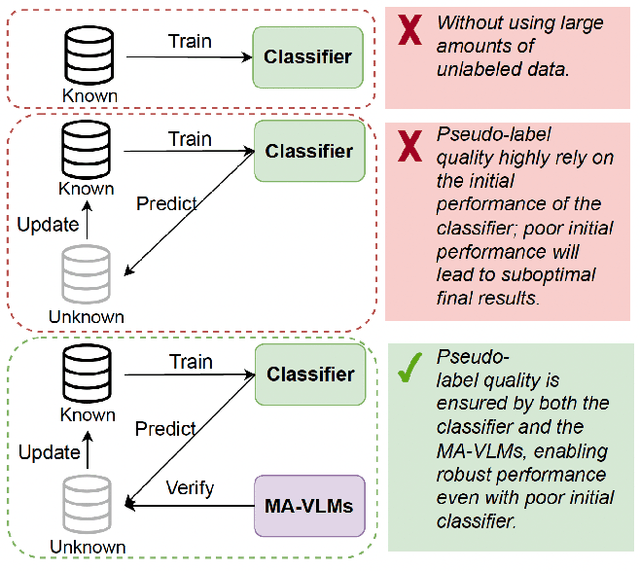
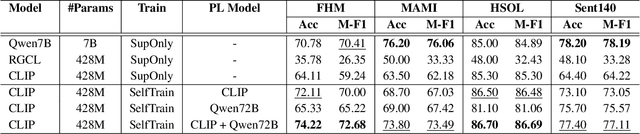
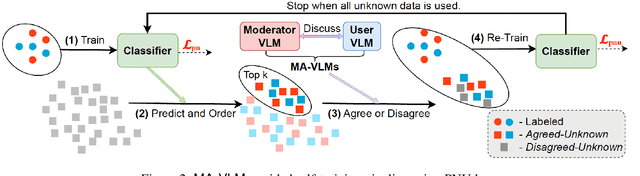

Accurate detection of offensive content on social media demands high-quality labeled data; however, such data is often scarce due to the low prevalence of offensive instances and the high cost of manual annotation. To address this low-resource challenge, we propose a self-training framework that leverages abundant unlabeled data through collaborative pseudo-labeling. Starting with a lightweight classifier trained on limited labeled data, our method iteratively assigns pseudo-labels to unlabeled instances with the support of Multi-Agent Vision-Language Models (MA-VLMs). Un-labeled data on which the classifier and MA-VLMs agree are designated as the Agreed-Unknown set, while conflicting samples form the Disagreed-Unknown set. To enhance label reliability, MA-VLMs simulate dual perspectives, moderator and user, capturing both regulatory and subjective viewpoints. The classifier is optimized using a novel Positive-Negative-Unlabeled (PNU) loss, which jointly exploits labeled, Agreed-Unknown, and Disagreed-Unknown data while mitigating pseudo-label noise. Experiments on benchmark datasets demonstrate that our framework substantially outperforms baselines under limited supervision and approaches the performance of large-scale models
Strengthened Symbol Binding Makes Large Language Models Reliable Multiple-Choice Selectors
Jun 03, 2024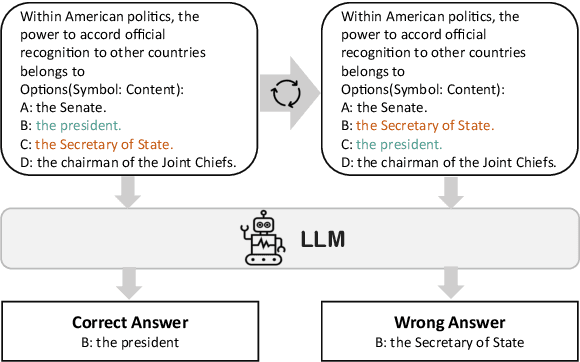
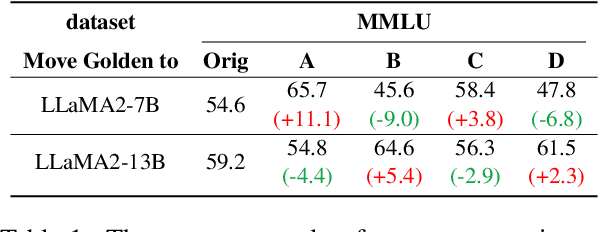
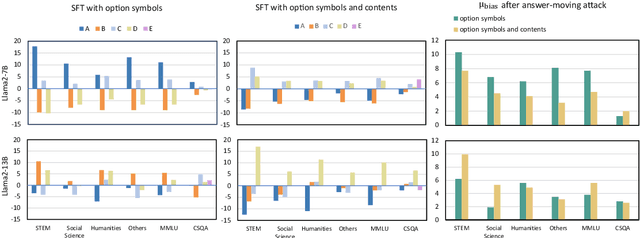

Multiple-Choice Questions (MCQs) constitute a critical area of research in the study of Large Language Models (LLMs). Previous works have investigated the selection bias problem in MCQs within few-shot scenarios, in which the LLM's performance may be influenced by the presentation of answer choices, leaving the selection bias during Supervised Fine-Tuning (SFT) unexplored. In this paper, we reveal that selection bias persists in the SFT phase , primarily due to the LLM's inadequate Multiple Choice Symbol Binding (MCSB) ability. This limitation implies that the model struggles to associate the answer options with their corresponding symbols (e.g., A/B/C/D) effectively. To enhance the model's MCSB capability, we first incorporate option contents into the loss function and subsequently adjust the weights of the option symbols and contents, guiding the model to understand the option content of the current symbol. Based on this, we introduce an efficient SFT algorithm for MCQs, termed Point-wise Intelligent Feedback (PIF). PIF constructs negative instances by randomly combining the incorrect option contents with all candidate symbols, and proposes a point-wise loss to provide feedback on these negative samples into LLMs. Our experimental results demonstrate that PIF significantly reduces the model's selection bias by improving its MCSB capability. Remarkably, PIF exhibits a substantial enhancement in the accuracy for MCQs.
* Accept at ACL2024 Main