 Add to Chrome
 Add to Firefox
 Add to Edge
HRGS: Hierarchical Gaussian Splatting for Memory-Efficient High-Resolution 3D Reconstruction
Jun 17, 2025
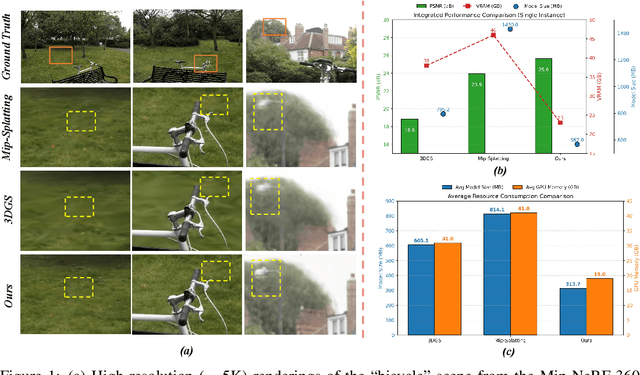

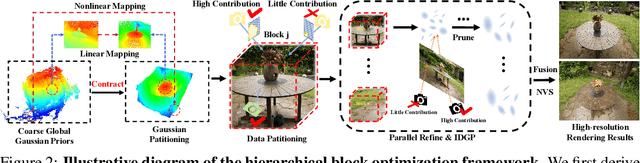
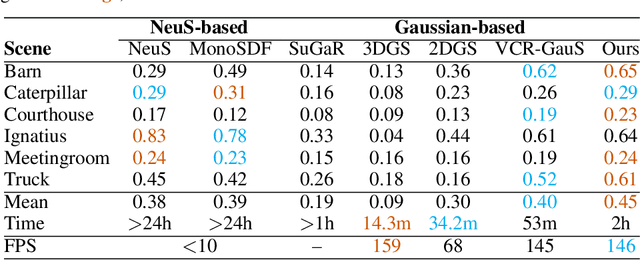
3D Gaussian Splatting (3DGS) has made significant strides in real-time 3D scene reconstruction, but faces memory scalability issues in high-resolution scenarios. To address this, we propose Hierarchical Gaussian Splatting (HRGS), a memory-efficient framework with hierarchical block-level optimization. First, we generate a global, coarse Gaussian representation from low-resolution data. Then, we partition the scene into multiple blocks, refining each block with high-resolution data. The partitioning involves two steps: Gaussian partitioning, where irregular scenes are normalized into a bounded cubic space with a uniform grid for task distribution, and training data partitioning, where only relevant observations are retained for each block. By guiding block refinement with the coarse Gaussian prior, we ensure seamless Gaussian fusion across adjacent blocks. To reduce computational demands, we introduce Importance-Driven Gaussian Pruning (IDGP), which computes importance scores for each Gaussian and removes those with minimal contribution, speeding up convergence and reducing memory usage. Additionally, we incorporate normal priors from a pretrained model to enhance surface reconstruction quality. Our method enables high-quality, high-resolution 3D scene reconstruction even under memory constraints. Extensive experiments on three benchmarks show that HRGS achieves state-of-the-art performance in high-resolution novel view synthesis (NVS) and surface reconstruction tasks.

SCISSOR: Mitigating Semantic Bias through Cluster-Aware Siamese Networks for Robust Classification
Jun 17, 2025Shortcut learning undermines model generalization to out-of-distribution data. While the literature attributes shortcuts to biases in superficial features, we show that imbalances in the semantic distribution of sample embeddings induce spurious semantic correlations, compromising model robustness. To address this issue, we propose SCISSOR (Semantic Cluster Intervention for Suppressing ShORtcut), a Siamese network-based debiasing approach that remaps the semantic space by discouraging latent clusters exploited as shortcuts. Unlike prior data-debiasing approaches, SCISSOR eliminates the need for data augmentation and rewriting. We evaluate SCISSOR on 6 models across 4 benchmarks: Chest-XRay and Not-MNIST in computer vision, and GYAFC and Yelp in NLP tasks. Compared to several baselines, SCISSOR reports +5.3 absolute points in F1 score on GYAFC, +7.3 on Yelp, +7.7 on Chest-XRay, and +1 on Not-MNIST. SCISSOR is also highly advantageous for lightweight models with ~9.5% improvement on F1 for ViT on computer vision datasets and ~11.9% for BERT on NLP. Our study redefines the landscape of model generalization by addressing overlooked semantic biases, establishing SCISSOR as a foundational framework for mitigating shortcut learning and fostering more robust, bias-resistant AI systems.
RealFactBench: A Benchmark for Evaluating Large Language Models in Real-World Fact-Checking
Jun 14, 2025Large Language Models (LLMs) hold significant potential for advancing fact-checking by leveraging their capabilities in reasoning, evidence retrieval, and explanation generation. However, existing benchmarks fail to comprehensively evaluate LLMs and Multimodal Large Language Models (MLLMs) in realistic misinformation scenarios. To bridge this gap, we introduce RealFactBench, a comprehensive benchmark designed to assess the fact-checking capabilities of LLMs and MLLMs across diverse real-world tasks, including Knowledge Validation, Rumor Detection, and Event Verification. RealFactBench consists of 6K high-quality claims drawn from authoritative sources, encompassing multimodal content and diverse domains. Our evaluation framework further introduces the Unknown Rate (UnR) metric, enabling a more nuanced assessment of models' ability to handle uncertainty and balance between over-conservatism and over-confidence. Extensive experiments on 7 representative LLMs and 4 MLLMs reveal their limitations in real-world fact-checking and offer valuable insights for further research. RealFactBench is publicly available at https://github.com/kalendsyang/RealFactBench.git.
AsFT: Anchoring Safety During LLM Fine-Tuning Within Narrow Safety Basin
Jun 11, 2025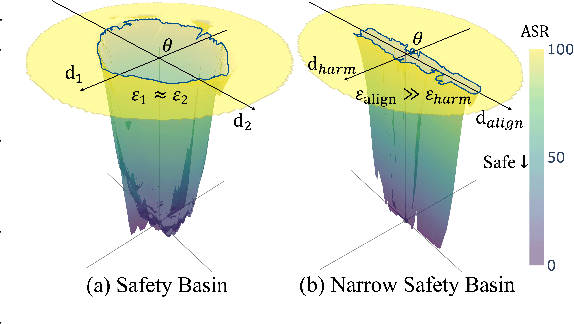
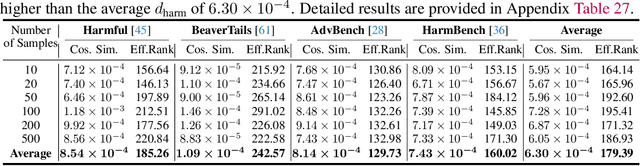
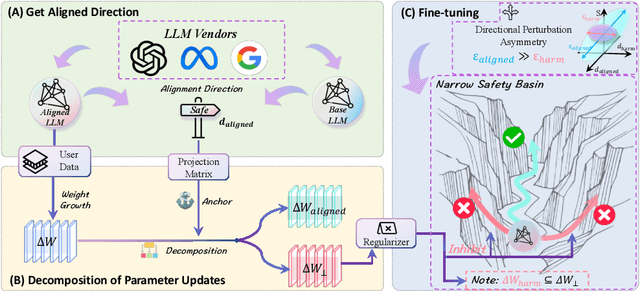
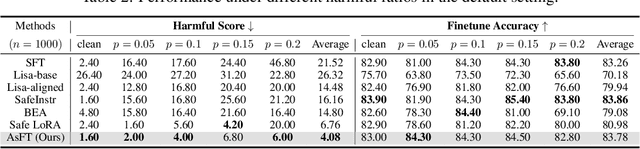
Large language models (LLMs) are vulnerable to safety risks during fine-tuning, where small amounts of malicious or harmless data can compromise safeguards. In this paper, building on the concept of alignment direction -- defined by the weight difference between aligned and unaligned models -- we observe that perturbations along this direction preserve model safety. In contrast, perturbations along directions orthogonal to this alignment are strongly linked to harmful direction perturbations, rapidly degrading safety and framing the parameter space as a narrow safety basin. Based on this insight, we propose a methodology for safety fine-tuning called AsFT (Anchoring Safety in Fine-Tuning), which integrates a regularization term into the training objective. This term uses the alignment direction as an anchor to suppress updates in harmful directions, ensuring that fine-tuning is constrained within the narrow safety basin. Extensive experiments on multiple datasets show that AsFT outperforms Safe LoRA, reducing harmful behavior by 7.60 percent, improving model performance by 3.44 percent, and maintaining robust performance across various experimental settings. Code is available at https://github.com/PKU-YuanGroup/AsFT
Hyperbolic Dual Feature Augmentation for Open-Environment
Jun 10, 2025Feature augmentation generates novel samples in the feature space, providing an effective way to enhance the generalization ability of learning algorithms with hyperbolic geometry. Most hyperbolic feature augmentation is confined to closed-environment, assuming the number of classes is fixed (\emph{i.e.}, seen classes) and generating features only for these classes. In this paper, we propose a hyperbolic dual feature augmentation method for open-environment, which augments features for both seen and unseen classes in the hyperbolic space. To obtain a more precise approximation of the real data distribution for efficient training, (1) we adopt a neural ordinary differential equation module, enhanced by meta-learning, estimating the feature distributions of both seen and unseen classes; (2) we then introduce a regularizer to preserve the latent hierarchical structures of data in the hyperbolic space; (3) we also derive an upper bound for the hyperbolic dual augmentation loss, allowing us to train a hyperbolic model using infinite augmentations for seen and unseen classes. Extensive experiments on five open-environment tasks: class-incremental learning, few-shot open-set recognition, few-shot learning, zero-shot learning, and general image classification, demonstrate that our method effectively enhances the performance of hyperbolic algorithms in open-environment.
LLM-powered Query Expansion for Enhancing Boundary Prediction in Language-driven Action Localization
May 30, 2025Language-driven action localization in videos requires not only semantic alignment between language query and video segment, but also prediction of action boundaries. However, the language query primarily describes the main content of an action and usually lacks specific details of action start and end boundaries, which increases the subjectivity of manual boundary annotation and leads to boundary uncertainty in training data. In this paper, on one hand, we propose to expand the original query by generating textual descriptions of the action start and end boundaries through LLMs, which can provide more detailed boundary cues for localization and thus reduce the impact of boundary uncertainty. On the other hand, to enhance the tolerance to boundary uncertainty during training, we propose to model probability scores of action boundaries by calculating the semantic similarities between frames and the expanded query as well as the temporal distances between frames and the annotated boundary frames. They can provide more consistent boundary supervision, thus improving the stability of training. Our method is model-agnostic and can be seamlessly and easily integrated into any existing models of language-driven action localization in an off-the-shelf manner. Experimental results on several datasets demonstrate the effectiveness of our method.
Chain-of-Thought for Autonomous Driving: A Comprehensive Survey and Future Prospects
May 26, 2025The rapid evolution of large language models in natural language processing has substantially elevated their semantic understanding and logical reasoning capabilities. Such proficiencies have been leveraged in autonomous driving systems, contributing to significant improvements in system performance. Models such as OpenAI o1 and DeepSeek-R1, leverage Chain-of-Thought (CoT) reasoning, an advanced cognitive method that simulates human thinking processes, demonstrating remarkable reasoning capabilities in complex tasks. By structuring complex driving scenarios within a systematic reasoning framework, this approach has emerged as a prominent research focus in autonomous driving, substantially improving the system's ability to handle challenging cases. This paper investigates how CoT methods improve the reasoning abilities of autonomous driving models. Based on a comprehensive literature review, we present a systematic analysis of the motivations, methodologies, challenges, and future research directions of CoT in autonomous driving. Furthermore, we propose the insight of combining CoT with self-learning to facilitate self-evolution in driving systems. To ensure the relevance and timeliness of this study, we have compiled a dynamic repository of literature and open-source projects, diligently updated to incorporate forefront developments. The repository is publicly available at https://github.com/cuiyx1720/Awesome-CoT4AD.
Sparse VideoGen2: Accelerate Video Generation with Sparse Attention via Semantic-Aware Permutation
May 24, 2025Diffusion Transformers (DiTs) are essential for video generation but suffer from significant latency due to the quadratic complexity of attention. By computing only critical tokens, sparse attention reduces computational costs and offers a promising acceleration approach. However, we identify that existing methods fail to approach optimal generation quality under the same computation budget for two reasons: (1) Inaccurate critical token identification: current methods cluster tokens based on position rather than semantics, leading to imprecise aggregated representations. (2) Excessive computation waste: critical tokens are scattered among non-critical ones, leading to wasted computation on GPUs, which are optimized for processing contiguous tokens. In this paper, we propose SVG2, a training-free framework that maximizes identification accuracy and minimizes computation waste, achieving a Pareto frontier trade-off between generation quality and efficiency. The core of SVG2 is semantic-aware permutation, which clusters and reorders tokens based on semantic similarity using k-means. This approach ensures both a precise cluster representation, improving identification accuracy, and a densified layout of critical tokens, enabling efficient computation without padding. Additionally, SVG2 integrates top-p dynamic budget control and customized kernel implementations, achieving up to 2.30x and 1.89x speedup while maintaining a PSNR of up to 30 and 26 on HunyuanVideo and Wan 2.1, respectively.
L-MTP: Leap Multi-Token Prediction Beyond Adjacent Context for Large Language Models
May 23, 2025Large language models (LLMs) have achieved notable progress. Despite their success, next-token prediction (NTP), the dominant method for LLM training and inference, is constrained in both contextual coverage and inference efficiency due to its inherently sequential process. To overcome these challenges, we propose leap multi-token prediction~(L-MTP), an innovative token prediction method that extends the capabilities of multi-token prediction (MTP) by introducing a leap-based mechanism. Unlike conventional MTP, which generates multiple tokens at adjacent positions, L-MTP strategically skips over intermediate tokens, predicting non-sequential ones in a single forward pass. This structured leap not only enhances the model's ability to capture long-range dependencies but also enables a decoding strategy specially optimized for non-sequential leap token generation, effectively accelerating inference. We theoretically demonstrate the benefit of L-MTP in improving inference efficiency. Experiments across diverse benchmarks validate its merit in boosting both LLM performance and inference speed. The source code will be publicly available.
MDVT: Enhancing Multimodal Recommendation with Model-Agnostic Multimodal-Driven Virtual Triplets
May 22, 2025The data sparsity problem significantly hinders the performance of recommender systems, as traditional models rely on limited historical interactions to learn user preferences and item properties. While incorporating multimodal information can explicitly represent these preferences and properties, existing works often use it only as side information, failing to fully leverage its potential. In this paper, we propose MDVT, a model-agnostic approach that constructs multimodal-driven virtual triplets to provide valuable supervision signals, effectively mitigating the data sparsity problem in multimodal recommendation systems. To ensure high-quality virtual triplets, we introduce three tailored warm-up threshold strategies: static, dynamic, and hybrid. The static warm-up threshold strategy exhaustively searches for the optimal number of warm-up epochs but is time-consuming and computationally intensive. The dynamic warm-up threshold strategy adjusts the warm-up period based on loss trends, improving efficiency but potentially missing optimal performance. The hybrid strategy combines both, using the dynamic strategy to find the approximate optimal number of warm-up epochs and then refining it with the static strategy in a narrow hyper-parameter space. Once the warm-up threshold is satisfied, the virtual triplets are used for joint model optimization by our enhanced pair-wise loss function without causing significant gradient skew. Extensive experiments on multiple real-world datasets demonstrate that integrating MDVT into advanced multimodal recommendation models effectively alleviates the data sparsity problem and improves recommendation performance, particularly in sparse data scenarios.