 Add to Chrome
 Add to Firefox
 Add to Edge
Event Tensor: A Unified Abstraction for Compiling Dynamic Megakernel
Apr 14, 2026
Modern GPU workloads, especially large language model (LLM) inference, suffer from kernel launch overheads and coarse synchronization that limit inter-kernel parallelism. Recent megakernel techniques fuse multiple operators into a single persistent kernel to eliminate launch gaps and expose inter-kernel parallelism, but struggle to handle dynamic shapes and data-dependent computation in real workloads. We present Event Tensor, a unified compiler abstraction for dynamic megakernels. Event Tensor encodes dependencies between tiled tasks, and enables first-class support for both shape and data-dependent dynamism. Built atop this abstraction, our Event Tensor Compiler (ETC) applies static and dynamic scheduling transformations to generate high-performance persistent kernels. Evaluations show that ETC achieves state-of-the-art LLM serving latency while significantly reducing system warmup overhead.

Quant VideoGen: Auto-Regressive Long Video Generation via 2-Bit KV-Cache Quantization
Feb 03, 2026Despite rapid progress in autoregressive video diffusion, an emerging system algorithm bottleneck limits both deployability and generation capability: KV cache memory. In autoregressive video generation models, the KV cache grows with generation history and quickly dominates GPU memory, often exceeding 30 GB, preventing deployment on widely available hardware. More critically, constrained KV cache budgets restrict the effective working memory, directly degrading long horizon consistency in identity, layout, and motion. To address this challenge, we present Quant VideoGen (QVG), a training free KV cache quantization framework for autoregressive video diffusion models. QVG leverages video spatiotemporal redundancy through Semantic Aware Smoothing, producing low magnitude, quantization friendly residuals. It further introduces Progressive Residual Quantization, a coarse to fine multi stage scheme that reduces quantization error while enabling a smooth quality memory trade off. Across LongCat Video, HY WorldPlay, and Self Forcing benchmarks, QVG establishes a new Pareto frontier between quality and memory efficiency, reducing KV cache memory by up to 7.0 times with less than 4% end to end latency overhead while consistently outperforming existing baselines in generation quality.
Jet-RL: Enabling On-Policy FP8 Reinforcement Learning with Unified Training and Rollout Precision Flow
Jan 20, 2026Reinforcement learning (RL) is essential for enhancing the complex reasoning capabilities of large language models (LLMs). However, existing RL training pipelines are computationally inefficient and resource-intensive, with the rollout phase accounting for over 70% of total training time. Quantized RL training, particularly using FP8 precision, offers a promising approach to mitigating this bottleneck. A commonly adopted strategy applies FP8 precision during rollout while retaining BF16 precision for training. In this work, we present the first comprehensive study of FP8 RL training and demonstrate that the widely used BF16-training + FP8-rollout strategy suffers from severe training instability and catastrophic accuracy collapse under long-horizon rollouts and challenging tasks. Our analysis shows that these failures stem from the off-policy nature of the approach, which introduces substantial numerical mismatch between training and inference. Motivated by these observations, we propose Jet-RL, an FP8 RL training framework that enables robust and stable RL optimization. The key idea is to adopt a unified FP8 precision flow for both training and rollout, thereby minimizing numerical discrepancies and eliminating the need for inefficient inter-step calibration. Extensive experiments validate the effectiveness of Jet-RL: our method achieves up to 33% speedup in the rollout phase, up to 41% speedup in the training phase, and a 16% end-to-end speedup over BF16 training, while maintaining stable convergence across all settings and incurring negligible accuracy degradation.
FrontierCS: Evolving Challenges for Evolving Intelligence
Dec 17, 2025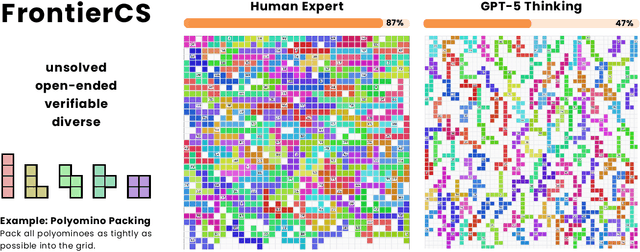

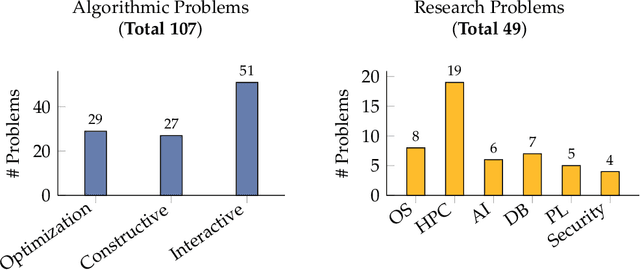

We introduce FrontierCS, a benchmark of 156 open-ended problems across diverse areas of computer science, designed and reviewed by experts, including CS PhDs and top-tier competitive programming participants and problem setters. Unlike existing benchmarks that focus on tasks with known optimal solutions, FrontierCS targets problems where the optimal solution is unknown, but the quality of a solution can be objectively evaluated. Models solve these tasks by implementing executable programs rather than outputting a direct answer. FrontierCS includes algorithmic problems, which are often NP-hard variants of competitive programming problems with objective partial scoring, and research problems with the same property. For each problem we provide an expert reference solution and an automatic evaluator. Combining open-ended design, measurable progress, and expert curation, FrontierCS provides a benchmark at the frontier of computer-science difficulty. Empirically, we find that frontier reasoning models still lag far behind human experts on both the algorithmic and research tracks, that increasing reasoning budgets alone does not close this gap, and that models often over-optimize for generating merely workable code instead of discovering high-quality algorithms and system designs.
LEANN: A Low-Storage Vector Index
Jun 09, 2025Embedding-based search is widely used in applications such as recommendation and retrieval-augmented generation (RAG). Recently, there is a growing demand to support these capabilities over personal data stored locally on devices. However, maintaining the necessary data structure associated with the embedding-based search is often infeasible due to its high storage overhead. For example, indexing 100 GB of raw data requires 150 to 700 GB of storage, making local deployment impractical. Reducing this overhead while maintaining search quality and latency becomes a critical challenge. In this paper, we present LEANN, a storage-efficient approximate nearest neighbor (ANN) search index optimized for resource-constrained personal devices. LEANN combines a compact graph-based structure with an efficient on-the-fly recomputation strategy to enable fast and accurate retrieval with minimal storage overhead. Our evaluation shows that LEANN reduces index size to under 5% of the original raw data, achieving up to 50 times smaller storage than standard indexes, while maintaining 90% top-3 recall in under 2 seconds on real-world question answering benchmarks.
Sparse VideoGen2: Accelerate Video Generation with Sparse Attention via Semantic-Aware Permutation
May 24, 2025Diffusion Transformers (DiTs) are essential for video generation but suffer from significant latency due to the quadratic complexity of attention. By computing only critical tokens, sparse attention reduces computational costs and offers a promising acceleration approach. However, we identify that existing methods fail to approach optimal generation quality under the same computation budget for two reasons: (1) Inaccurate critical token identification: current methods cluster tokens based on position rather than semantics, leading to imprecise aggregated representations. (2) Excessive computation waste: critical tokens are scattered among non-critical ones, leading to wasted computation on GPUs, which are optimized for processing contiguous tokens. In this paper, we propose SVG2, a training-free framework that maximizes identification accuracy and minimizes computation waste, achieving a Pareto frontier trade-off between generation quality and efficiency. The core of SVG2 is semantic-aware permutation, which clusters and reorders tokens based on semantic similarity using k-means. This approach ensures both a precise cluster representation, improving identification accuracy, and a densified layout of critical tokens, enabling efficient computation without padding. Additionally, SVG2 integrates top-p dynamic budget control and customized kernel implementations, achieving up to 2.30x and 1.89x speedup while maintaining a PSNR of up to 30 and 26 on HunyuanVideo and Wan 2.1, respectively.
Sparse VideoGen: Accelerating Video Diffusion Transformers with Spatial-Temporal Sparsity
Feb 03, 2025
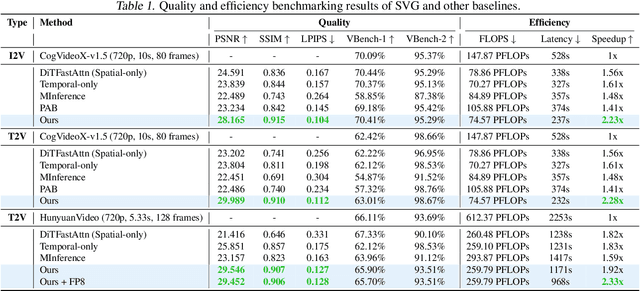

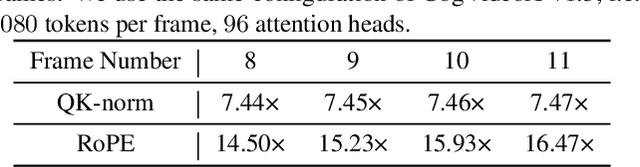
Diffusion Transformers (DiTs) dominate video generation but their high computational cost severely limits real-world applicability, usually requiring tens of minutes to generate a few seconds of video even on high-performance GPUs. This inefficiency primarily arises from the quadratic computational complexity of 3D Full Attention with respect to the context length. In this paper, we propose a training-free framework termed Sparse VideoGen (SVG) that leverages the inherent sparsity in 3D Full Attention to boost inference efficiency. We reveal that the attention heads can be dynamically classified into two groups depending on distinct sparse patterns: (1) Spatial Head, where only spatially-related tokens within each frame dominate the attention output, and (2) Temporal Head, where only temporally-related tokens across different frames dominate. Based on this insight, SVG proposes an online profiling strategy to capture the dynamic sparse patterns and predicts the type of attention head. Combined with a novel hardware-efficient tensor layout transformation and customized kernel implementations, SVG achieves up to 2.28x and 2.33x end-to-end speedup on CogVideoX-v1.5 and HunyuanVideo, respectively, while preserving generation quality.
BlendServe: Optimizing Offline Inference for Auto-regressive Large Models with Resource-aware Batching
Nov 25, 2024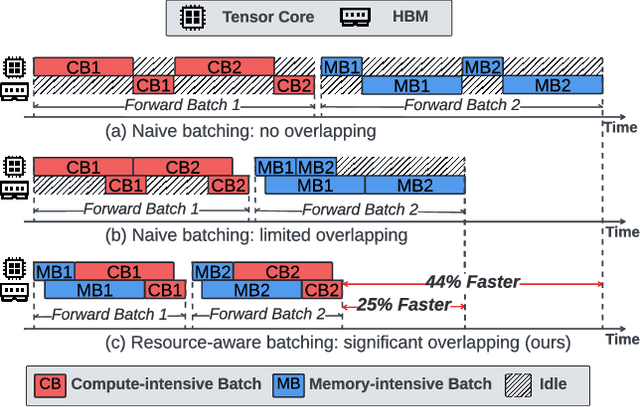


Offline batch inference, which leverages the flexibility of request batching to achieve higher throughput and lower costs, is becoming more popular for latency-insensitive applications. Meanwhile, recent progress in model capability and modality makes requests more diverse in compute and memory demands, creating unique opportunities for throughput improvement by resource overlapping. However, a request schedule that maximizes resource overlapping can conflict with the schedule that maximizes prefix sharing, a widely-used performance optimization, causing sub-optimal inference throughput. We present BlendServe, a system that maximizes resource utilization of offline batch inference by combining the benefits of resource overlapping and prefix sharing using a resource-aware prefix tree. BlendServe exploits the relaxed latency requirements in offline batch inference to reorder and overlap requests with varied resource demands while ensuring high prefix sharing. We evaluate BlendServe on a variety of synthetic multi-modal workloads and show that it provides up to $1.44\times$ throughput boost compared to widely-used industry standards, vLLM and SGLang.
XGrammar: Flexible and Efficient Structured Generation Engine for Large Language Models
Nov 22, 2024
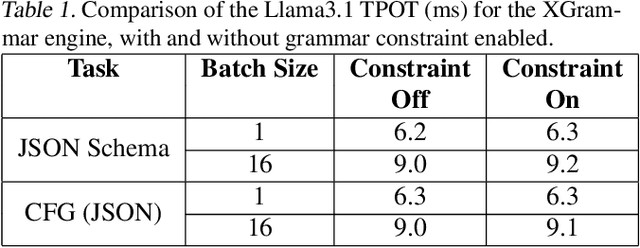


The applications of LLM Agents are becoming increasingly complex and diverse, leading to a high demand for structured outputs that can be parsed into code, structured function calls, and embodied agent commands. These developments bring significant demands for structured generation in LLM inference. Context-free grammar is a flexible approach to enable structured generation via constrained decoding. However, executing context-free grammar requires going through several stack states over all tokens in vocabulary during runtime, bringing non-negligible overhead for structured generation. In this paper, we propose XGrammar, a flexible and efficient structure generation engine for large language models. XGrammar accelerates context-free grammar execution by dividing the vocabulary into context-independent tokens that can be prechecked and context-dependent tokens that need to be interpreted during runtime. We further build transformations to expand the grammar context and reduce the number of context-independent tokens. Additionally, we build an efficient persistent stack to accelerate the context-dependent token checks. Finally, we co-design the grammar engine with LLM inference engine to overlap grammar computation with GPU executions. Evaluation results show that XGrammar can achieve up to 100x speedup over existing solutions. Combined with an LLM inference engine, it can generate near-zero overhead structure generation in end-to-end low-LLM serving.
A Large Language Model-based Framework for Semi-Structured Tender Document Retrieval-Augmented Generation
Oct 04, 2024
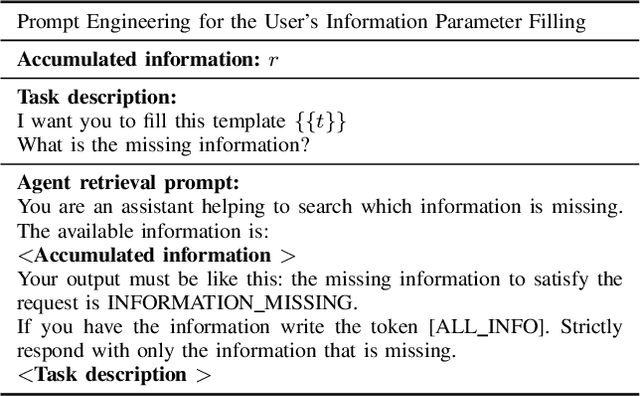
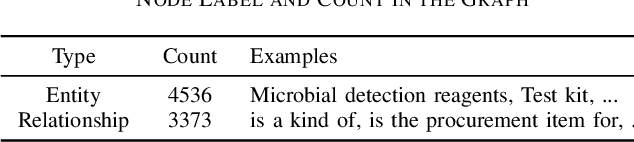

The drafting of documents in the procurement field has progressively become more complex and diverse, driven by the need to meet legal requirements, adapt to technological advancements, and address stakeholder demands. While large language models (LLMs) show potential in document generation, most LLMs lack specialized knowledge in procurement. To address this gap, we use retrieval-augmented techniques to achieve professional document generation, ensuring accuracy and relevance in procurement documentation.