 Add to Chrome
 Add to Firefox
 Add to Edge
InfraNet: Quality-Aware RGB Guidance for Efficient Infrared Object Detection
Jul 04, 2026
Robust object detection under adverse visual conditions remains a long-standing challenge for multi-modal perception systems. Existing fusion-based methods typically require both RGB and infrared (IR) inputs, and treat them equally during both training and inference, which compromises their robustness when the RGB modality becomes unreliable or unavailable. In this case, we propose \textbf{InfraNet}, an IR-centric quality-aware framework that regulates RGB guidance during training and supports flexible RGB--IR or IR-only deployment. InfraNet employs an asymmetric architecture where the primary IR pathway extracts multi-scale infrared features for predictions, while the auxiliary RGB pathway provides reliability-controlled supervisory signals. The core of InfraNet is \textbf{QualGate}, a quality-aware fusion module that learns a task-oriented control signal to suppress unreliable RGB guidance and compensate IR features during cross-modal training. Built upon InfraNet, we design two architectural variants: a lightweight IR-only architecture InfraNet-IR and an RGB--IR architecture InfraNet-RGB-IR. Our method is evaluated through extensive experiments on four benchmark datasets (LLVIP, FLIR-Aligned, M$^3$FD, and DroneVehicle), showing strong or competitive accuracy in challenging low-light and adverse weather conditions. Notably, InfraNet maintains high efficiency in IR-only inference, making it both accurate and computationally efficient.

Teaching Vision-Language-Action Models What to See and Where to Look
Jul 02, 2026Vision-Language-Action (VLA) models have emerged as a promising paradigm for end-to-end autonomous driving. However, existing VLAs' training relies heavily on text-centric visual question answering and chain-of-thought reasoning data, which emphasizes linguistic reasoning rather than action-grounded planning. As a result, the learned representations capture semantic knowledge but lack spatial dependencies crucial for reliable trajectory prediction. We propose DriveTeach-VLA, a framework that explicitly teaches VLAs what to see and where to look. Driving-aware Vision Distillation (DVD) injects driving-specific perceptual priors into the vision encoder, while 2D Trajectory-Guided Prompts (2D-TGP) provide spatial conditioning aligned with feasible driving trajectories. Together, they form a vision-guided learning pipeline: what to see (DVD pretraining) - where to look (TGP-guided SFT) - how to act (TGP-guided GRPO). DriveTeach-VLA achieves the state-of-the-art performance on NAVSIM and nuScenes. Our code is available at: https://github.com/ShivaTeam/DriveTeach-VLA.
EditSR: Enhancing Neural Symbolic Regression via Edit-based Rectification
Jun 06, 2026Neural symbolic regression models improve inference efficiency by shifting structural search to pretraining, but their one-pass autoregressive decoding is prone to error accumulation, which may lead to generating structurally incorrect expressions, especially in complex expression generation scenarios. Existing rectification strategies can alleviate this issue, but they often depend on restarting global search, thereby weakening the efficiency advantage of neural models, and remain susceptible to error accumulation. In this paper, we propose EditSR, a two-layer framework that combines a neural symbolic regression model in the first layer with an edit-based Rectifier in the second layer to achieve efficient prediction and post-hoc rectification. Instead of restarting the global search, we maintain rectification efficiency by pretraining the Rectifier. Specifically, we formulate the rectification process as a step-by-step state-transition chain starting from an incorrect expression, and develop a state-transition algorithm to construct supervised rectification chains for training the Rectifier. To ensure syntactic validity throughout rectification, each edit action is restricted to a syntactically valid space so that every edited expression remains parseable. In addition, because each edit decision is conditioned on the current state rather than the history, the Rectifier allows errors made in earlier steps to be rectified by subsequent edits, thereby reducing the risk of error accumulation. Extensive experiments and ablation studies show that EditSR substantially improves symbolic structure recovery with limited extra cost, with more pronounced gains on complex expressions, where one-pass autoregressive decoding is more susceptible to error accumulation.
Learning domain-invariant features through channel-level sparsification for Out-Of Distribution Generalization
Mar 26, 2026Out-of-Distribution (OOD) generalization has become a primary metric for evaluating image analysis systems. Since deep learning models tend to capture domain-specific context, they often develop shortcut dependencies on these non-causal features, leading to inconsistent performance across different data sources. Current techniques, such as invariance learning, attempt to mitigate this. However, they struggle to isolate highly mixed features within deep latent spaces. This limitation prevents them from fully resolving the shortcut learning problem.In this paper, we propose Hierarchical Causal Dropout (HCD), a method that uses channel-level causal masks to enforce feature sparsity. This approach allows the model to separate causal features from spurious ones, effectively performing a causal intervention at the representation level. The training is guided by a Matrix-based Mutual Information (MMI) objective to minimize the mutual information between latent features and domain labels, while simultaneously maximizing the information shared with class labels.To ensure stability, we incorporate a StyleMix-driven VICReg module, which prevents the masks from accidentally filtering out essential causal data. Experimental results on OOD benchmarks show that HCD performs better than existing top-tier methods.
Kirchhoff-Inspired Neural Networks for Evolving High-Order Perception
Mar 25, 2026Deep learning architectures are fundamentally inspired by neuroscience, particularly the structure of the brain's sensory pathways, and have achieved remarkable success in learning informative data representations. Although these architectures mimic the communication mechanisms of biological neurons, their strategies for information encoding and transmission are fundamentally distinct. Biological systems depend on dynamic fluctuations in membrane potential; by contrast, conventional deep networks optimize weights and biases by adjusting the strengths of inter-neural connections, lacking a systematic mechanism to jointly characterize the interplay among signal intensity, coupling structure, and state evolution. To tackle this limitation, we propose the Kirchhoff-Inspired Neural Network (KINN), a state-variable-based network architecture constructed based on Kirchhoff's current law. KINN derives numerically stable state updates from fundamental ordinary differential equations, enabling the explicit decoupling and encoding of higher-order evolutionary components within a single layer while preserving physical consistency, interpretability, and end-to-end trainability. Extensive experiments on partial differential equation (PDE) solving and ImageNet image classification validate that KINN outperforms state-of-the-art existing methods.
Weak-PDE-Net: Discovering Open-Form PDEs via Differentiable Symbolic Networks and Weak Formulation
Mar 24, 2026Discovering governing Partial Differential Equations (PDEs) from sparse and noisy data is a challenging issue in data-driven scientific computing. Conventional sparse regression methods often suffer from two major limitations: (i) the instability of numerical differentiation under sparse and noisy data, and (ii) the restricted flexibility of a pre-defined candidate library. We propose Weak-PDE-Net, an end-to-end differentiable framework that can robustly identify open-form PDEs. Weak-PDE-Net consists of two interconnected modules: a forward response learner and a weak-form PDE generator. The learner embeds learnable Gaussian kernels within a lightweight MLP, serving as a surrogate model that adaptively captures system dynamics from sparse observations. Meanwhile, the generator integrates a symbolic network with an integral module to construct weak-form PDEs, avoiding explicit numerical differentiation and improving robustness to noise. To relax the constraints of the pre-defined library, we leverage Differentiable Neural Architecture Search strategy during training to explore the functional space, which enables the efficient discovery of open-form PDEs. The capability of Weak-PDE-Net in multivariable systems discovery is further enhanced by incorporating Galilean Invariance constraints and symmetry equivariance hypotheses to ensure physical consistency. Experiments on several challenging PDE benchmarks demonstrate that Weak-PDE-Net accurately recovers governing equations, even under highly sparse and noisy observations.
Differentiable Adaptive Kalman Filtering via Optimal Transport
Aug 09, 2025Learning-based filtering has demonstrated strong performance in non-linear dynamical systems, particularly when the statistics of noise are unknown. However, in real-world deployments, environmental factors, such as changing wind conditions or electromagnetic interference, can induce unobserved noise-statistics drift, leading to substantial degradation of learning-based methods. To address this challenge, we propose OTAKNet, the first online solution to noise-statistics drift within learning-based adaptive Kalman filtering. Unlike existing learning-based methods that perform offline fine-tuning using batch pointwise matching over entire trajectories, OTAKNet establishes a connection between the state estimate and the drift via one-step predictive measurement likelihood, and addresses it using optimal transport. This leverages OT's geometry - aware cost and stable gradients to enable fully online adaptation without ground truth labels or retraining. We compare OTAKNet against classical model-based adaptive Kalman filtering and offline learning-based filtering. The performance is demonstrated on both synthetic and real-world NCLT datasets, particularly under limited training data.
Squeeze10-LLM: Squeezing LLMs' Weights by 10 Times via a Staged Mixed-Precision Quantization Method
Jul 24, 2025Deploying large language models (LLMs) is challenging due to their massive parameters and high computational costs. Ultra low-bit quantization can significantly reduce storage and accelerate inference, but extreme compression (i.e., mean bit-width <= 2) often leads to severe performance degradation. To address this, we propose Squeeze10-LLM, effectively "squeezing" 16-bit LLMs' weights by 10 times. Specifically, Squeeze10-LLM is a staged mixed-precision post-training quantization (PTQ) framework and achieves an average of 1.6 bits per weight by quantizing 80% of the weights to 1 bit and 20% to 4 bits. We introduce Squeeze10LLM with two key innovations: Post-Binarization Activation Robustness (PBAR) and Full Information Activation Supervision (FIAS). PBAR is a refined weight significance metric that accounts for the impact of quantization on activations, improving accuracy in low-bit settings. FIAS is a strategy that preserves full activation information during quantization to mitigate cumulative error propagation across layers. Experiments on LLaMA and LLaMA2 show that Squeeze10-LLM achieves state-of-the-art performance for sub-2bit weight-only quantization, improving average accuracy from 43% to 56% on six zero-shot classification tasks--a significant boost over existing PTQ methods. Our code will be released upon publication.
HRGS: Hierarchical Gaussian Splatting for Memory-Efficient High-Resolution 3D Reconstruction
Jun 17, 2025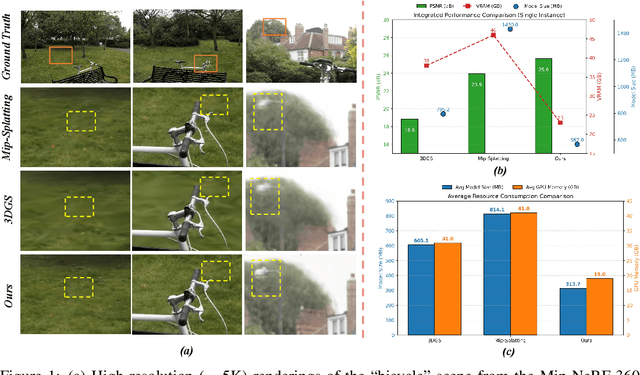

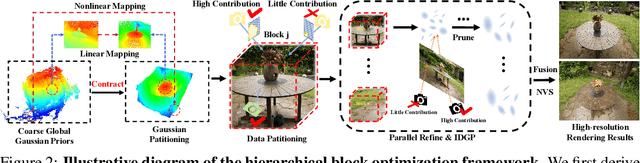
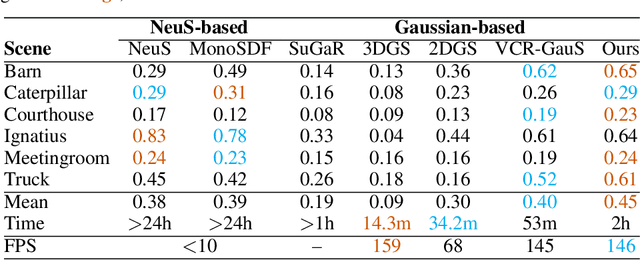
3D Gaussian Splatting (3DGS) has made significant strides in real-time 3D scene reconstruction, but faces memory scalability issues in high-resolution scenarios. To address this, we propose Hierarchical Gaussian Splatting (HRGS), a memory-efficient framework with hierarchical block-level optimization. First, we generate a global, coarse Gaussian representation from low-resolution data. Then, we partition the scene into multiple blocks, refining each block with high-resolution data. The partitioning involves two steps: Gaussian partitioning, where irregular scenes are normalized into a bounded cubic space with a uniform grid for task distribution, and training data partitioning, where only relevant observations are retained for each block. By guiding block refinement with the coarse Gaussian prior, we ensure seamless Gaussian fusion across adjacent blocks. To reduce computational demands, we introduce Importance-Driven Gaussian Pruning (IDGP), which computes importance scores for each Gaussian and removes those with minimal contribution, speeding up convergence and reducing memory usage. Additionally, we incorporate normal priors from a pretrained model to enhance surface reconstruction quality. Our method enables high-quality, high-resolution 3D scene reconstruction even under memory constraints. Extensive experiments on three benchmarks show that HRGS achieves state-of-the-art performance in high-resolution novel view synthesis (NVS) and surface reconstruction tasks.
UniSymNet: A Unified Symbolic Network Guided by Transformer
May 09, 2025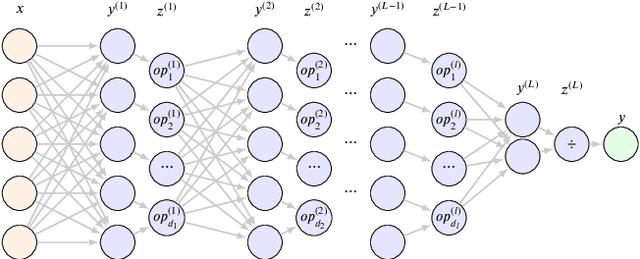
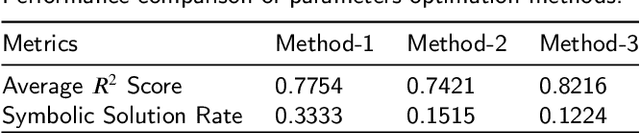
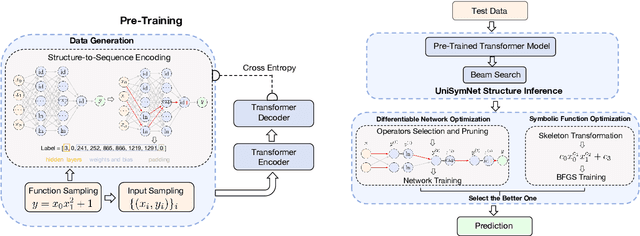
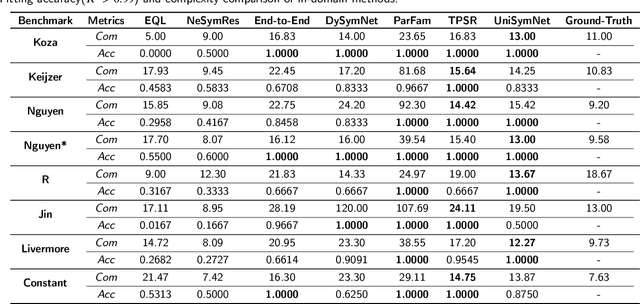
Symbolic Regression (SR) is a powerful technique for automatically discovering mathematical expressions from input data. Mainstream SR algorithms search for the optimal symbolic tree in a vast function space, but the increasing complexity of the tree structure limits their performance. Inspired by neural networks, symbolic networks have emerged as a promising new paradigm. However, most existing symbolic networks still face certain challenges: binary nonlinear operators $\{\times, \div\}$ cannot be naturally extended to multivariate operators, and training with fixed architecture often leads to higher complexity and overfitting. In this work, we propose a Unified Symbolic Network that unifies nonlinear binary operators into nested unary operators and define the conditions under which UniSymNet can reduce complexity. Moreover, we pre-train a Transformer model with a novel label encoding method to guide structural selection, and adopt objective-specific optimization strategies to learn the parameters of the symbolic network. UniSymNet shows high fitting accuracy, excellent symbolic solution rate, and relatively low expression complexity, achieving competitive performance on low-dimensional Standard Benchmarks and high-dimensional SRBench.