 Add to Chrome
 Add to Firefox
 Add to Edge
ParaTempo: Efficient Parallel Reasoning via Temporal Confidence
Aug 17, 2026
Parallel reasoning improves the accuracy and robustness of large reasoning models by exploring multiple solution paths, but its computational cost grows with reasoning depth and branch count. Existing methods for managing these parallel paths typically rely on final-answer consensus, local token confidence, or isolated intermediate probes. However, these signals are often delayed, weakly tied to actual reasoning progress, or too noisy for dynamic, branch-level control. To address these limitations, we introduce ParaTempo, a training-free asynchronous parallel reasoning framework. ParaTempo is driven by temporal confidence, a branch-local measure of answer-space convergence. Each branch is periodically probed for a tentative answer probability distribution, and temporal confidence quantifies how sharply the recent intermediate probes concentrate on a dominant answer. Once sufficient evidence has accumulated, ParaTempo drives its entire control process from this single signal: low-confidence branches are pruned, branches that persistently commit to their dominant answer are retired early, freed computation is reallocated by forking new branches, and generation stops globally once the confidence-weighted vote concentrates. Without requiring synchronization among reasoning trajectories, ParaTempo adaptively allocates computation based on branch-level convergence. Experiments on challenging mathematical and scientific reasoning benchmarks show that ParaTempo reduces average latency by 21.8-32.2% and total token usage by 18.1-30.3% while maintaining competitive accuracy. Moreover, temporal confidence exhibits stronger temporal stability and predictive power for future branch convergence than token-level and instantaneous signals.

ENPIRE: Agentic Robot Policy Self-Improvement in the Real World
Jun 18, 2026Achieving dexterous robotic manipulation in the real world heavily relies on human supervision and algorithm engineering, which becomes a central bottleneck in the pursuit of general physical intelligence. Although emerging coding agents can generate code to automate algorithm search, their successes remain largely confined in digital environments. We conjecture that the missing abstraction to automate robotics research is a repeatable feedback loop for real-world policy improvement: reset the scene, execute a policy, verify the outcome, and refine the next iteration. To bridge this gap, we introduce ENPIRE, a harness framework for coding agents that instantiates this physical feedback routine with four core modules: an Environment module (EN) for automatic reset and verification, a Policy Improvement module (PI) that launches policy refinement, a Rollout module (R) to evaluate policies with one or multiple physical robots operating in parallel, and an Evolution module (E) in which coding agents analyze logs, consult literature, improve training infrastructure and algorithm code to address failure modes. This closed-loop system transforms real-world manipulation learning into a controllable optimization procedure, minimizing human effort while allowing fair ablations across training recipe and agent variants. Powered by ENPIRE, frontier coding agents can autonomously train a policy to achieve a 99% success rate on challenging, dexterous manipulation tasks, such as organizing a pin box, fastening a zip tie, and tool use, a process that further accelerates when we dispatch an agent team on a robot fleet. Our results suggest a practical and scalable path toward deploying coding agents to autonomously advancing robotics in the physical world.
ReSkill: Reconciling Skill Creation with Policy Optimization in Agentic RL
Jun 01, 2026Agentic reinforcement learning (RL) enables LLM agents to improve continuously from environment rewards, yet the resulting policies do not systematically accumulate reusable strategies that generalize across tasks. Modular skills can provide such reusable strategies, yet existing skill-augmented RL methods decouple skill creation from policy optimization, risking adopting skills that conflict with the evolving policy. Inspired by Anthropic's Skill Creator, we introduce ReSkill, an RL-in-the-loop skill creation framework that reconciles skill evolution with policy learning. ReSkill exploits the group-wise structure of GRPO to naturally embed three mechanisms with only marginal additional overhead: (1) an assertion-driven skill creator that diagnoses failures from past experience and proposes conditional, trigger-based skill revisions; (2) within-group rollout sampling that enables controlled comparison of skill versions, capturing which version best supports the policy's ongoing learning; and (3) Thompson Sampling with adaptive discounting to balance exploration and exploitation in skill version selection as the policy evolves. Across several domains, ReSkill consistently outperforms existing memory and skill-based RL methods, with the largest gains on unseen tasks. Analysis of the skill lifecycle shows skills being automatically created, tested, refined, and pruned as the policy improves, demonstrating reconciled skill-policy co-evolution.
ShredBench: Evaluating the Semantic Reasoning Capabilities of Multimodal LLMs in Document Reconstruction
Apr 26, 2026Multimodal Large Language Models (MLLMs) have achieved remarkable performance in Visually Rich Document Understanding (VRDU) tasks, but their capabilities are mainly evaluated on pristine, well-structured document images. We consider content restoration from shredded fragments, a challenging VRDU setting that requires integrating visual pattern recognition with semantic reasoning under significant content discontinuities. To facilitate systematic evaluation of complex VRDU tasks, we introduce ShredBench, a benchmark supported by an automated generation pipeline that renders fragmented documents directly from Markdown. The proposed pipeline ensures evaluation validity by allowing the flexible integration of latest or unseen textual sources to prevent training data contamination. ShredBench assesses four scenarios (English, Chinese, Code, Table) with three fragmentation granularities (8, 12, 16 pieces). Empirical evaluations on state-of-the-art MLLMs reveal a significant performance gap: The method is effective on intact documents; however, once the document is shredded, restoration becomes a significant challenge, with NED dropping sharply as fragmentation increases. Our findings highlight that current MLLMs lack the fine-grained cross-modal reasoning required to bridge visual discontinuities, identifying a critical gap in robust VRDU research.
SenTSR-Bench: Thinking with Injected Knowledge for Time-Series Reasoning
Feb 23, 2026Time-series diagnostic reasoning is essential for many applications, yet existing solutions face a persistent gap: general reasoning large language models (GRLMs) possess strong reasoning skills but lack the domain-specific knowledge to understand complex time-series patterns. Conversely, fine-tuned time-series LLMs (TSLMs) understand these patterns but lack the capacity to generalize reasoning for more complicated questions. To bridge this gap, we propose a hybrid knowledge-injection framework that injects TSLM-generated insights directly into GRLM's reasoning trace, thereby achieving strong time-series reasoning with in-domain knowledge. As collecting data for knowledge injection fine-tuning is costly, we further leverage a reinforcement learning-based approach with verifiable rewards (RLVR) to elicit knowledge-rich traces without human supervision, then transfer such an in-domain thinking trace into GRLM for efficient knowledge injection. We further release SenTSR-Bench, a multivariate time-series-based diagnostic reasoning benchmark collected from real-world industrial operations. Across SenTSR-Bench and other public datasets, our method consistently surpasses TSLMs by 9.1%-26.1% and GRLMs by 7.9%-22.4%, delivering robust, context-aware time-series diagnostic insights.
DADP: Domain Adaptive Diffusion Policy
Feb 03, 2026Learning domain adaptive policies that can generalize to unseen transition dynamics, remains a fundamental challenge in learning-based control. Substantial progress has been made through domain representation learning to capture domain-specific information, thus enabling domain-aware decision making. We analyze the process of learning domain representations through dynamical prediction and find that selecting contexts adjacent to the current step causes the learned representations to entangle static domain information with varying dynamical properties. Such mixture can confuse the conditioned policy, thereby constraining zero-shot adaptation. To tackle the challenge, we propose DADP (Domain Adaptive Diffusion Policy), which achieves robust adaptation through unsupervised disentanglement and domain-aware diffusion injection. First, we introduce Lagged Context Dynamical Prediction, a strategy that conditions future state estimation on a historical offset context; by increasing this temporal gap, we unsupervisedly disentangle static domain representations by filtering out transient properties. Second, we integrate the learned domain representations directly into the generative process by biasing the prior distribution and reformulating the diffusion target. Extensive experiments on challenging benchmarks across locomotion and manipulation demonstrate the superior performance, and the generalizability of DADP over prior methods. More visualization results are available on the https://outsider86.github.io/DomainAdaptiveDiffusionPolicy/.
Enhanced DACER Algorithm with High Diffusion Efficiency
May 29, 2025Due to their expressive capacity, diffusion models have shown great promise in offline RL and imitation learning. Diffusion Actor-Critic with Entropy Regulator (DACER) extended this capability to online RL by using the reverse diffusion process as a policy approximator, trained end-to-end with policy gradient methods, achieving strong performance. However, this comes at the cost of requiring many diffusion steps, which significantly hampers training efficiency, while directly reducing the steps leads to noticeable performance degradation. Critically, the lack of inference efficiency becomes a significant bottleneck for applying diffusion policies in real-time online RL settings. To improve training and inference efficiency while maintaining or even enhancing performance, we propose a Q-gradient field objective as an auxiliary optimization target to guide the denoising process at each diffusion step. Nonetheless, we observe that the independence of the Q-gradient field from the diffusion time step negatively impacts the performance of the diffusion policy. To address this, we introduce a temporal weighting mechanism that enables the model to efficiently eliminate large-scale noise in the early stages and refine actions in the later stages. Experimental results on MuJoCo benchmarks and several multimodal tasks demonstrate that the DACER2 algorithm achieves state-of-the-art performance in most MuJoCo control tasks with only five diffusion steps, while also exhibiting stronger multimodality compared to DACER.
Chain-of-Thought for Autonomous Driving: A Comprehensive Survey and Future Prospects
May 26, 2025The rapid evolution of large language models in natural language processing has substantially elevated their semantic understanding and logical reasoning capabilities. Such proficiencies have been leveraged in autonomous driving systems, contributing to significant improvements in system performance. Models such as OpenAI o1 and DeepSeek-R1, leverage Chain-of-Thought (CoT) reasoning, an advanced cognitive method that simulates human thinking processes, demonstrating remarkable reasoning capabilities in complex tasks. By structuring complex driving scenarios within a systematic reasoning framework, this approach has emerged as a prominent research focus in autonomous driving, substantially improving the system's ability to handle challenging cases. This paper investigates how CoT methods improve the reasoning abilities of autonomous driving models. Based on a comprehensive literature review, we present a systematic analysis of the motivations, methodologies, challenges, and future research directions of CoT in autonomous driving. Furthermore, we propose the insight of combining CoT with self-learning to facilitate self-evolution in driving systems. To ensure the relevance and timeliness of this study, we have compiled a dynamic repository of literature and open-source projects, diligently updated to incorporate forefront developments. The repository is publicly available at https://github.com/cuiyx1720/Awesome-CoT4AD.
TD-M(PC)$^2$: Improving Temporal Difference MPC Through Policy Constraint
Feb 05, 2025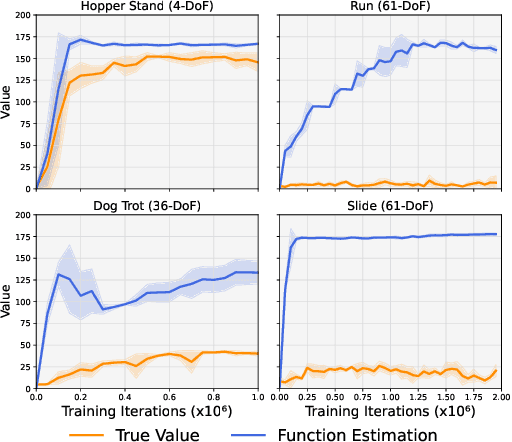

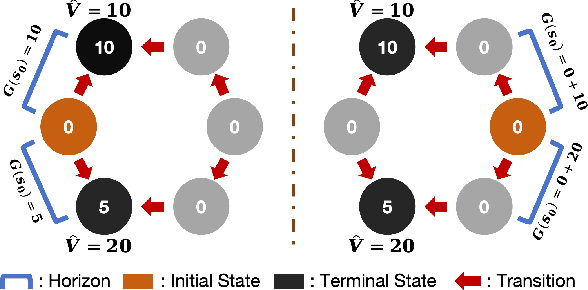
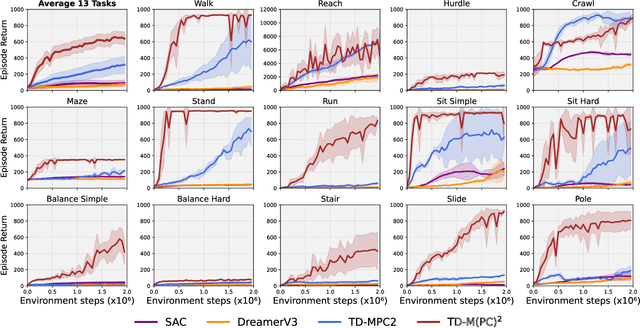
Model-based reinforcement learning algorithms that combine model-based planning and learned value/policy prior have gained significant recognition for their high data efficiency and superior performance in continuous control. However, we discover that existing methods that rely on standard SAC-style policy iteration for value learning, directly using data generated by the planner, often result in \emph{persistent value overestimation}. Through theoretical analysis and experiments, we argue that this issue is deeply rooted in the structural policy mismatch between the data generation policy that is always bootstrapped by the planner and the learned policy prior. To mitigate such a mismatch in a minimalist way, we propose a policy regularization term reducing out-of-distribution (OOD) queries, thereby improving value learning. Our method involves minimum changes on top of existing frameworks and requires no additional computation. Extensive experiments demonstrate that the proposed approach improves performance over baselines such as TD-MPC2 by large margins, particularly in 61-DoF humanoid tasks. View qualitative results at https://darthutopian.github.io/tdmpc_square/.
Model-Robust and Adaptive-Optimal Transfer Learning for Tackling Concept Shifts in Nonparametric Regression
Jan 18, 2025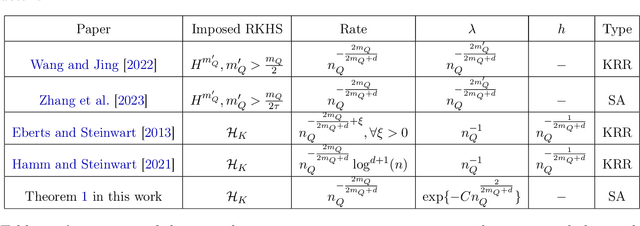
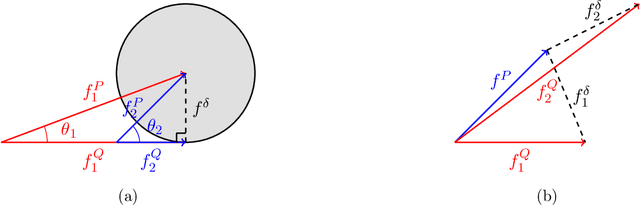
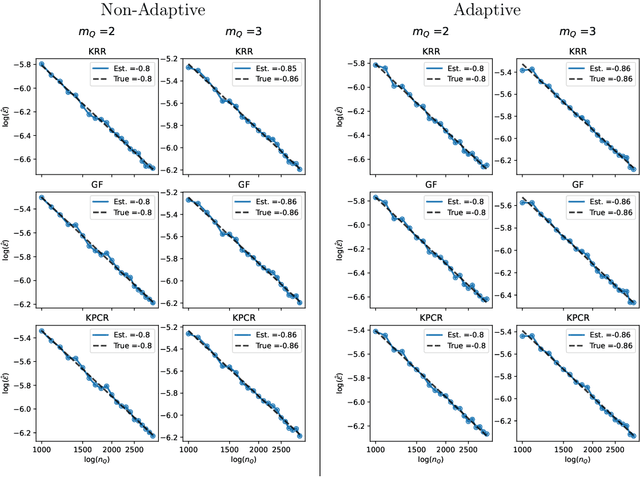
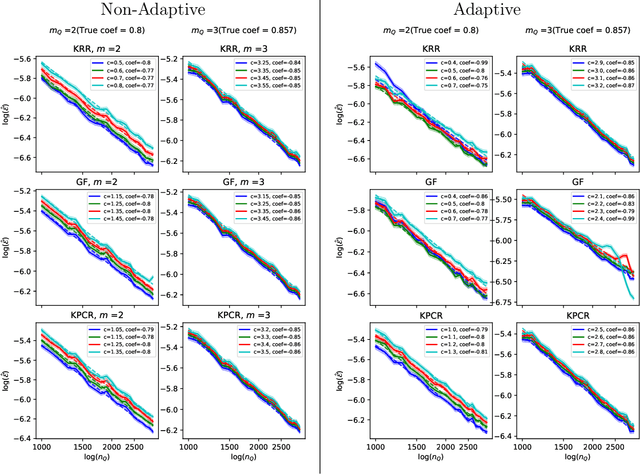
When concept shifts and sample scarcity are present in the target domain of interest, nonparametric regression learners often struggle to generalize effectively. The technique of transfer learning remedies these issues by leveraging data or pre-trained models from similar source domains. While existing generalization analyses of kernel-based transfer learning typically rely on correctly specified models, we present a transfer learning procedure that is robust against model misspecification while adaptively attaining optimality. To facilitate our analysis and avoid the risk of saturation found in classical misspecified results, we establish a novel result in the misspecified single-task learning setting, showing that spectral algorithms with fixed bandwidth Gaussian kernels can attain minimax convergence rates given the true function is in a Sobolev space, which may be of independent interest. Building on this, we derive the adaptive convergence rates of the excess risk for specifying Gaussian kernels in a prevalent class of hypothesis transfer learning algorithms. Our results are minimax optimal up to logarithmic factors and elucidate the key determinants of transfer efficiency.