 Add to Chrome
 Add to Firefox
 Add to Edge
Visual Geometry Transformer in the Wild: Distractor-Free 3D Reconstruction
Jun 22, 2026
Current end-to-end multi-view 3D reconstruction methods achieve impressive results, but rely on a restrictive static assumption: the scenes is entire distractor-free with perfect cross-view geometry. This reliance on idealized inputs causes even the most advanced methods to fail in real-world settings, where transient distractors and occlusions present. To address this, we propose Visual Geometry Transformer in the Wild (VGTW), an end-to-end framework for robust reconstruction from inconsistent views. At its core, we isolate and suppress distractor-affected regions while preserving the consistent components across views. Specifically, we introduce a Distractor-aware Training (DAT) strategy that separates clean features from distractor-contaminated ones in the attention mechanism while enforcing feature consistency across images. To enable this, we train the model with an auxiliary mask prediction head, using supervision from a new dataset we collected with pixel-level distractor masks. The resulting VGTW model is a feed-forward network that directly outputs clean, distractor-free point clouds. Remarkably, it requires no additional 3D supervision, remains computationally efficient, and is compatible with existing pipelines. Extensive experiments validate our approach, demonstrating state-of-the-art performance and robust generalization in diverse, real-world scenarios.

World Action Models: A Survey
Jun 18, 2026World Action Models (WAMs) are embodied predictive-action models that make a forecast of the future available to action. Recent WAMs repurpose large video generation models, and a parallel line relies on language or vision-language backbones without a video-generation core. This rapid expansion has blurred the boundary among broad world models, video generation models, action-grounded video world models, Vision-Language-Action policies, and WAMs. This survey gives the field a common account. It first clarifies these boundaries, then organizes existing works through two complementary views. The first view asks what each method is required to generate, spanning rendered futures, latent futures, and video-generation-free action reasoning. The second view decomposes each method by predictive substrate, backbone, action coupling, and deployment regime. This anatomy supports a unified discussion of interactability, causality, persistence, physical plausibility, and generalization, followed by data, evaluation, and open challenges. Across these axes, a consistent design pattern emerges: WAMs are not simply video generators with action heads, but predictive-action methods whose design choices trade representational richness against compute, memory, latency, and action-label cost. The field is moving toward methods that generate less of the future while preserving what control requires. The survey homepage is available at https://world-action-models.github.io/.
APEX: Autonomous Policy Exploration for Self-Evolving LLM Agents
May 20, 2026LLM agents have shown strong performance across a wide range of complex tasks, including interactive environments that require long-horizon decision making. But these agents cannot learn on the fly at test time. Self-evolving agents address this by accumulating memory and reflection across episodes rather than requiring model-weight updates. However, these agents often suffer from exploration collapse: as memory grows, behavior concentrates around familiar high-reward routines, reducing the chance of discovering better alternatives. To address this problem, we propose Autonomous Policy EXploration (APEX), which builds and maintains an explicit strategy space through a strategy map-a directed acyclic graph of milestones with prerequisite dependency edges. In APEX, Fork Discovery expands the map with evidence-grounded unexplored directions, while Policy Selection balances exploration and exploitation during planning. Evaluated on nine Jericho text-adventure games and WebArena, a realistic web interaction benchmark, APEX outperforms all baselines. Extensive ablations validate each component's contribution and demonstrate robustness across diverse settings, demonstrating APEX's effectiveness for sustained exploration in self-evolving agents.
Make Geometry Matter for Spatial Reasoning
Mar 27, 2026Empowered by large-scale training, vision-language models (VLMs) achieve strong image and video understanding, yet their ability to perform spatial reasoning in both static scenes and dynamic videos remains limited. Recent advances try to handle this limitation by injecting geometry tokens from pretrained 3D foundation models into VLMs. Nevertheless, we observe that naive token fusion followed by standard fine-tuning in this line of work often leaves such geometric cues underutilized for spatial reasoning, as VLMs tend to rely heavily on 2D visual cues. In this paper, we propose GeoSR, a framework designed to make geometry matter by encouraging VLMs to actively reason with geometry tokens. GeoSR introduces two key components: (1) Geometry-Unleashing Masking, which strategically masks portions of 2D vision tokens during training to weaken non-geometric shortcuts and force the model to consult geometry tokens for spatial reasoning; and (2) Geometry-Guided Fusion, a gated routing mechanism that adaptively amplifies geometry token contributions in regions where geometric evidence is critical. Together, these designs unleash the potential of geometry tokens for spatial reasoning tasks. Extensive experiments on both static and dynamic spatial reasoning benchmarks demonstrate that GeoSR consistently outperforms prior methods and establishes new state-of-the-art performance by effectively leveraging geometric information. The project page is available at https://suhzhang.github.io/GeoSR/.
Geometry-Aware Rotary Position Embedding for Consistent Video World Model
Feb 08, 2026Predictive world models that simulate future observations under explicit camera control are fundamental to interactive AI. Despite rapid advances, current systems lack spatial persistence: they fail to maintain stable scene structures over long trajectories, frequently hallucinating details when cameras revisit previously observed locations. We identify that this geometric drift stems from reliance on screen-space positional embeddings, which conflict with the projective geometry required for 3D consistency. We introduce \textbf{ViewRope}, a geometry-aware encoding that injects camera-ray directions directly into video transformer self-attention layers. By parameterizing attention with relative ray geometry rather than pixel locality, ViewRope provides a model-native inductive bias for retrieving 3D-consistent content across temporal gaps. We further propose \textbf{Geometry-Aware Frame-Sparse Attention}, which exploits these geometric cues to selectively attend to relevant historical frames, improving efficiency without sacrificing memory consistency. We also present \textbf{ViewBench}, a diagnostic suite measuring loop-closure fidelity and geometric drift. Our results demonstrate that ViewRope substantially improves long-term consistency while reducing computational costs.
MiroThinker: Pushing the Performance Boundaries of Open-Source Research Agents via Model, Context, and Interactive Scaling
Nov 18, 2025We present MiroThinker v1.0, an open-source research agent designed to advance tool-augmented reasoning and information-seeking capabilities. Unlike previous agents that only scale up model size or context length, MiroThinker explores interaction scaling at the model level, systematically training the model to handle deeper and more frequent agent-environment interactions as a third dimension of performance improvement. Unlike LLM test-time scaling, which operates in isolation and risks degradation with longer reasoning chains, interactive scaling leverages environment feedback and external information acquisition to correct errors and refine trajectories. Through reinforcement learning, the model achieves efficient interaction scaling: with a 256K context window, it can perform up to 600 tool calls per task, enabling sustained multi-turn reasoning and complex real-world research workflows. Across four representative benchmarks-GAIA, HLE, BrowseComp, and BrowseComp-ZH-the 72B variant achieves up to 81.9%, 37.7%, 47.1%, and 55.6% accuracy respectively, surpassing previous open-source agents and approaching commercial counterparts such as GPT-5-high. Our analysis reveals that MiroThinker benefits from interactive scaling consistently: research performance improves predictably as the model engages in deeper and more frequent agent-environment interactions, demonstrating that interaction depth exhibits scaling behaviors analogous to model size and context length. These findings establish interaction scaling as a third critical dimension for building next-generation open research agents, complementing model capacity and context windows.
C4D: 4D Made from 3D through Dual Correspondences
Oct 16, 2025Recovering 4D from monocular video, which jointly estimates dynamic geometry and camera poses, is an inevitably challenging problem. While recent pointmap-based 3D reconstruction methods (e.g., DUSt3R) have made great progress in reconstructing static scenes, directly applying them to dynamic scenes leads to inaccurate results. This discrepancy arises because moving objects violate multi-view geometric constraints, disrupting the reconstruction. To address this, we introduce C4D, a framework that leverages temporal Correspondences to extend existing 3D reconstruction formulation to 4D. Specifically, apart from predicting pointmaps, C4D captures two types of correspondences: short-term optical flow and long-term point tracking. We train a dynamic-aware point tracker that provides additional mobility information, facilitating the estimation of motion masks to separate moving elements from the static background, thus offering more reliable guidance for dynamic scenes. Furthermore, we introduce a set of dynamic scene optimization objectives to recover per-frame 3D geometry and camera parameters. Simultaneously, the correspondences lift 2D trajectories into smooth 3D trajectories, enabling fully integrated 4D reconstruction. Experiments show that our framework achieves complete 4D recovery and demonstrates strong performance across multiple downstream tasks, including depth estimation, camera pose estimation, and point tracking. Project Page: https://littlepure2333.github.io/C4D
WristWorld: Generating Wrist-Views via 4D World Models for Robotic Manipulation
Oct 08, 2025Wrist-view observations are crucial for VLA models as they capture fine-grained hand-object interactions that directly enhance manipulation performance. Yet large-scale datasets rarely include such recordings, resulting in a substantial gap between abundant anchor views and scarce wrist views. Existing world models cannot bridge this gap, as they require a wrist-view first frame and thus fail to generate wrist-view videos from anchor views alone. Amid this gap, recent visual geometry models such as VGGT emerge with geometric and cross-view priors that make it possible to address extreme viewpoint shifts. Inspired by these insights, we propose WristWorld, the first 4D world model that generates wrist-view videos solely from anchor views. WristWorld operates in two stages: (i) Reconstruction, which extends VGGT and incorporates our Spatial Projection Consistency (SPC) Loss to estimate geometrically consistent wrist-view poses and 4D point clouds; (ii) Generation, which employs our video generation model to synthesize temporally coherent wrist-view videos from the reconstructed perspective. Experiments on Droid, Calvin, and Franka Panda demonstrate state-of-the-art video generation with superior spatial consistency, while also improving VLA performance, raising the average task completion length on Calvin by 3.81% and closing 42.4% of the anchor-wrist view gap.
Query-Kontext: An Unified Multimodal Model for Image Generation and Editing
Sep 30, 2025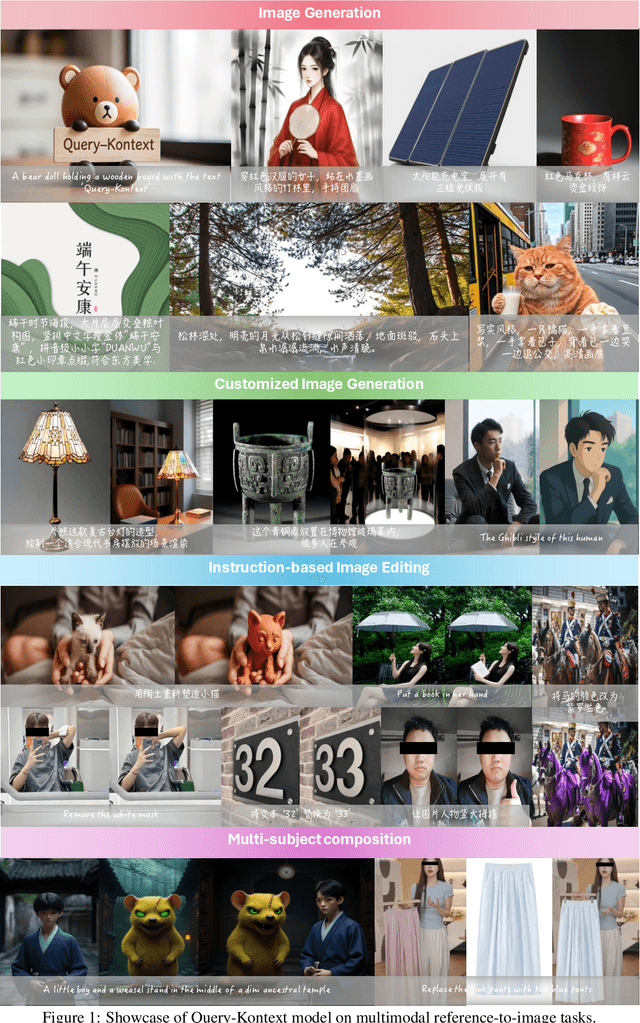
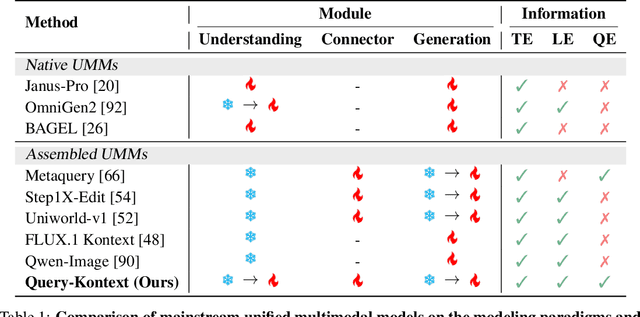
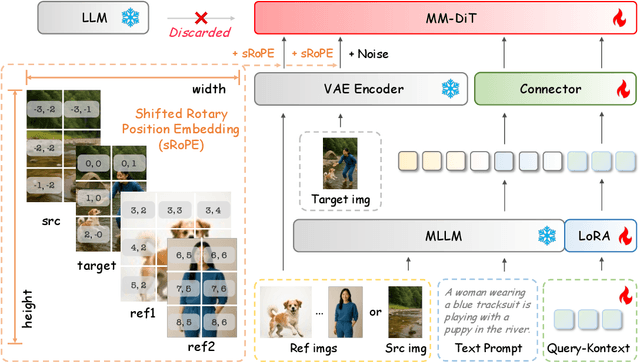
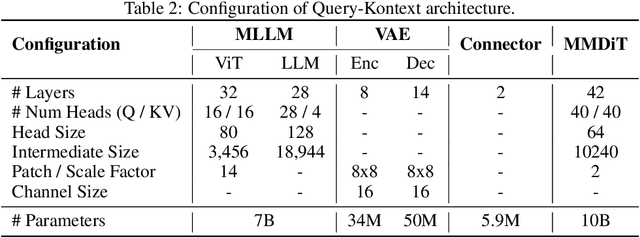
Unified Multimodal Models (UMMs) have demonstrated remarkable performance in text-to-image generation (T2I) and editing (TI2I), whether instantiated as assembled unified frameworks which couple powerful vision-language model (VLM) with diffusion-based generator, or as naive Unified Multimodal Models with an early fusion of understanding and generation modalities. We contend that in current unified frameworks, the crucial capability of multimodal generative reasoning which encompasses instruction understanding, grounding, and image referring for identity preservation and faithful reconstruction, is intrinsically entangled with high-fidelity synthesis. In this work, we introduce Query-Kontext, a novel approach that bridges the VLM and diffusion model via a multimodal ``kontext'' composed of semantic cues and coarse-grained image conditions encoded from multimodal inputs. This design delegates the complex ability of multimodal generative reasoning to powerful VLM while reserving diffusion model's role for high-quality visual synthesis. To achieve this, we propose a three-stage progressive training strategy. First, we connect the VLM to a lightweight diffusion head via multimodal kontext tokens to unleash the VLM's generative reasoning ability. Second, we scale this head to a large, pre-trained diffusion model to enhance visual detail and realism. Finally, we introduce a low-level image encoder to improve image fidelity and perform instruction tuning on downstream tasks. Furthermore, we build a comprehensive data pipeline integrating real, synthetic, and open-source datasets, covering diverse multimodal reference-to-image scenarios, including image generation, instruction-driven editing, customized generation, and multi-subject composition. Experiments show that our approach matches strong unified baselines and even outperforms task-specific state-of-the-art methods in several cases.
Test3R: Learning to Reconstruct 3D at Test Time
Jun 16, 2025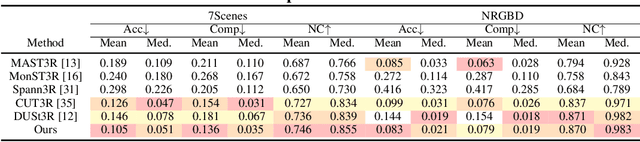
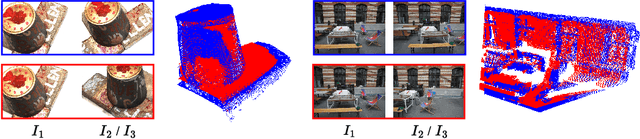
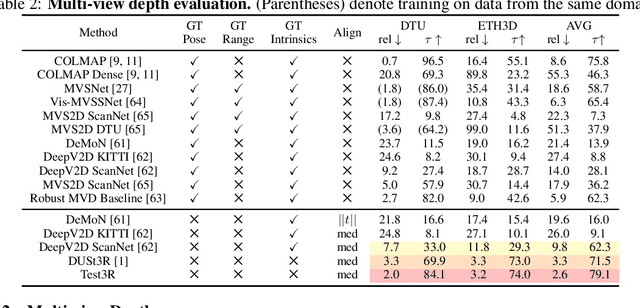
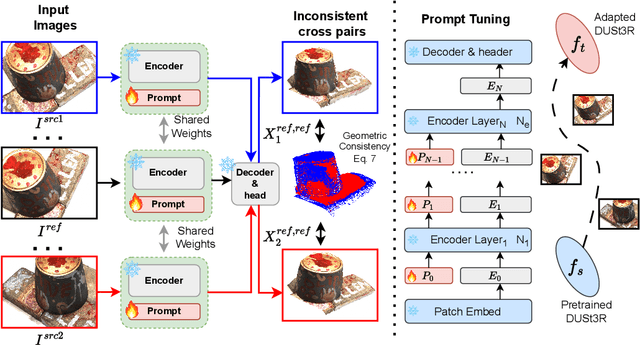
Dense matching methods like DUSt3R regress pairwise pointmaps for 3D reconstruction. However, the reliance on pairwise prediction and the limited generalization capability inherently restrict the global geometric consistency. In this work, we introduce Test3R, a surprisingly simple test-time learning technique that significantly boosts geometric accuracy. Using image triplets ($I_1,I_2,I_3$), Test3R generates reconstructions from pairs ($I_1,I_2$) and ($I_1,I_3$). The core idea is to optimize the network at test time via a self-supervised objective: maximizing the geometric consistency between these two reconstructions relative to the common image $I_1$. This ensures the model produces cross-pair consistent outputs, regardless of the inputs. Extensive experiments demonstrate that our technique significantly outperforms previous state-of-the-art methods on the 3D reconstruction and multi-view depth estimation tasks. Moreover, it is universally applicable and nearly cost-free, making it easily applied to other models and implemented with minimal test-time training overhead and parameter footprint. Code is available at https://github.com/nopQAQ/Test3R.