 Add to Chrome
 Add to Firefox
 Add to Edge
EDITBRIDGE: Towards Faithful and Efficient Ultra-High-Resolution Image Editing
Aug 18, 2026
High-resolution image editing is increasingly demanded in professional workflows, yet existing diffusion-based models remain constrained to resolutions below 1K due to quadratic attention complexity and prohibitive memory requirements. A prevalent workaround employs a two-stage pipeline: editing at low resolution followed by independent super-resolution. However, this approach suffers from two critical issues: information divergence, where hallucinated details contradict the original high-resolution (HR) source, and texture degradation, manifesting as over-smoothed or over-sharpened artifacts. We propose EditBridge, a diffusion bridge framework for efficient ultra high-resolution editing. Unlike conventional diffusion that regenerates from noise, we formulate refinement as structured data-to-data translation from the low-resolution (LR) edited result to its HR counterpart, explicitly conditioned on the original HR source to preserve authentic details. To efficiently incorporate HR source guidance, we introduce a prior-guided block-wise sparse attention mechanism that exploits semantic correspondence from first-stage editing to constrain cross-image interactions to spatially aligned regions, significantly reducing computational overhead. Extensive experiments demonstrate that EditBridge achieves high-fidelity editing with superior perceptual quality at resolutions up to 4K, delivering 3.6--8.4$\times$ speedup at 2K and enabling practical 4K editing in 61 seconds.

World Action Models: A Survey
Jun 18, 2026World Action Models (WAMs) are embodied predictive-action models that make a forecast of the future available to action. Recent WAMs repurpose large video generation models, and a parallel line relies on language or vision-language backbones without a video-generation core. This rapid expansion has blurred the boundary among broad world models, video generation models, action-grounded video world models, Vision-Language-Action policies, and WAMs. This survey gives the field a common account. It first clarifies these boundaries, then organizes existing works through two complementary views. The first view asks what each method is required to generate, spanning rendered futures, latent futures, and video-generation-free action reasoning. The second view decomposes each method by predictive substrate, backbone, action coupling, and deployment regime. This anatomy supports a unified discussion of interactability, causality, persistence, physical plausibility, and generalization, followed by data, evaluation, and open challenges. Across these axes, a consistent design pattern emerges: WAMs are not simply video generators with action heads, but predictive-action methods whose design choices trade representational richness against compute, memory, latency, and action-label cost. The field is moving toward methods that generate less of the future while preserving what control requires. The survey homepage is available at https://world-action-models.github.io/.
Gated Condition Injection without Multimodal Attention: Towards Controllable Linear-Attention Transformers
Mar 29, 2026Recent advances in diffusion-based controllable visual generation have led to remarkable improvements in image quality. However, these powerful models are typically deployed on cloud servers due to their large computational demands, raising serious concerns about user data privacy. To enable secure and efficient on-device generation, we explore in this paper controllable diffusion models built upon linear attention architectures, which offer superior scalability and efficiency, even on edge devices. Yet, our experiments reveal that existing controllable generation frameworks, such as ControlNet and OminiControl, either lack the flexibility to support multiple heterogeneous condition types or suffer from slow convergence on such linear-attention models. To address these limitations, we propose a novel controllable diffusion framework tailored for linear attention backbones like SANA. The core of our method lies in a unified gated conditioning module working in a dual-path pipeline, which effectively integrates multi-type conditional inputs, such as spatially aligned and non-aligned cues. Extensive experiments on multiple tasks and benchmarks demonstrate that our approach achieves state-of-the-art controllable generation performance based on linear-attention models, surpassing existing methods in terms of fidelity and controllability.
ViFeEdit: A Video-Free Tuner of Your Video Diffusion Transformer
Mar 16, 2026Diffusion Transformers (DiTs) have demonstrated remarkable scalability and quality in image and video generation, prompting growing interest in extending them to controllable generation and editing tasks. However, compared to the image counterparts, progress in video control and editing remains limited, mainly due to the scarcity of paired video data and the high computational cost of training video diffusion models. To address this issue, in this paper, we propose a video-free tuning framework termed ViFeEdit for video diffusion transformers. Without requiring any forms of video training data, ViFeEdit achieves versatile video generation and editing, adapted solely with 2D images. At the core of our approach is an architectural reparameterization that decouples spatial independence from the full 3D attention in modern video diffusion transformers, which enables visually faithful editing while maintaining temporal consistency with only minimal additional parameters. Moreover, this design operates in a dual-path pipeline with separate timestep embeddings for noise scheduling, exhibiting strong adaptability to diverse conditioning signals. Extensive experiments demonstrate that our method delivers promising results of controllable video generation and editing with only minimal training on 2D image data. Codes are available https://github.com/Lexie-YU/ViFeEdit.
SpotEdit: Selective Region Editing in Diffusion Transformers
Dec 26, 2025Diffusion Transformer models have significantly advanced image editing by encoding conditional images and integrating them into transformer layers. However, most edits involve modifying only small regions, while current methods uniformly process and denoise all tokens at every timestep, causing redundant computation and potentially degrading unchanged areas. This raises a fundamental question: Is it truly necessary to regenerate every region during editing? To address this, we propose SpotEdit, a training-free diffusion editing framework that selectively updates only the modified regions. SpotEdit comprises two key components: SpotSelector identifies stable regions via perceptual similarity and skips their computation by reusing conditional image features; SpotFusion adaptively blends these features with edited tokens through a dynamic fusion mechanism, preserving contextual coherence and editing quality. By reducing unnecessary computation and maintaining high fidelity in unmodified areas, SpotEdit achieves efficient and precise image editing.
FreeSwim: Revisiting Sliding-Window Attention Mechanisms for Training-Free Ultra-High-Resolution Video Generation
Nov 18, 2025The quadratic time and memory complexity of the attention mechanism in modern Transformer based video generators makes end-to-end training for ultra high resolution videos prohibitively expensive. Motivated by this limitation, we introduce a training-free approach that leverages video Diffusion Transformers pretrained at their native scale to synthesize higher resolution videos without any additional training or adaptation. At the core of our method lies an inward sliding window attention mechanism, which originates from a key observation: maintaining each query token's training scale receptive field is crucial for preserving visual fidelity and detail. However, naive local window attention, unfortunately, often leads to repetitive content and exhibits a lack of global coherence in the generated results. To overcome this challenge, we devise a dual-path pipeline that backs up window attention with a novel cross-attention override strategy, enabling the semantic content produced by local attention to be guided by another branch with a full receptive field and, therefore, ensuring holistic consistency. Furthermore, to improve efficiency, we incorporate a cross-attention caching strategy for this branch to avoid the frequent computation of full 3D attention. Extensive experiments demonstrate that our method delivers ultra-high-resolution videos with fine-grained visual details and high efficiency in a training-free paradigm. Meanwhile, it achieves superior performance on VBench, even compared to training-based alternatives, with competitive or improved efficiency. Codes are available at: https://github.com/WillWu111/FreeSwim
Image Editing As Programs with Diffusion Models
Jun 04, 2025While diffusion models have achieved remarkable success in text-to-image generation, they encounter significant challenges with instruction-driven image editing. Our research highlights a key challenge: these models particularly struggle with structurally inconsistent edits that involve substantial layout changes. To mitigate this gap, we introduce Image Editing As Programs (IEAP), a unified image editing framework built upon the Diffusion Transformer (DiT) architecture. At its core, IEAP approaches instructional editing through a reductionist lens, decomposing complex editing instructions into sequences of atomic operations. Each operation is implemented via a lightweight adapter sharing the same DiT backbone and is specialized for a specific type of edit. Programmed by a vision-language model (VLM)-based agent, these operations collaboratively support arbitrary and structurally inconsistent transformations. By modularizing and sequencing edits in this way, IEAP generalizes robustly across a wide range of editing tasks, from simple adjustments to substantial structural changes. Extensive experiments demonstrate that IEAP significantly outperforms state-of-the-art methods on standard benchmarks across various editing scenarios. In these evaluations, our framework delivers superior accuracy and semantic fidelity, particularly for complex, multi-step instructions. Codes are available at https://github.com/YujiaHu1109/IEAP.
Minute-Long Videos with Dual Parallelisms
May 29, 2025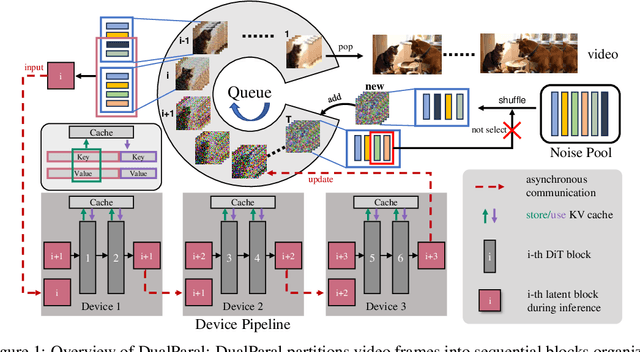
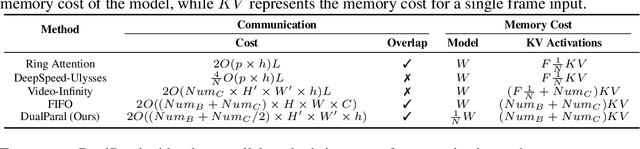
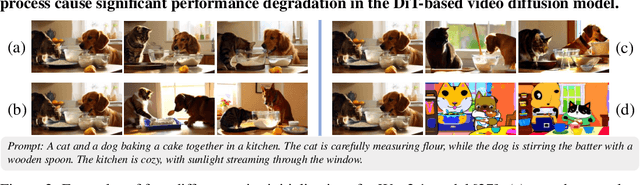
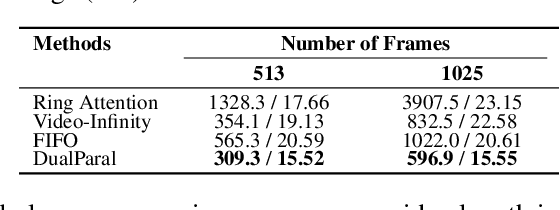
Diffusion Transformer (DiT)-based video diffusion models generate high-quality videos at scale but incur prohibitive processing latency and memory costs for long videos. To address this, we propose a novel distributed inference strategy, termed DualParal. The core idea is that, instead of generating an entire video on a single GPU, we parallelize both temporal frames and model layers across GPUs. However, a naive implementation of this division faces a key limitation: since diffusion models require synchronized noise levels across frames, this implementation leads to the serialization of original parallelisms. We leverage a block-wise denoising scheme to handle this. Namely, we process a sequence of frame blocks through the pipeline with progressively decreasing noise levels. Each GPU handles a specific block and layer subset while passing previous results to the next GPU, enabling asynchronous computation and communication. To further optimize performance, we incorporate two key enhancements. Firstly, a feature cache is implemented on each GPU to store and reuse features from the prior block as context, minimizing inter-GPU communication and redundant computation. Secondly, we employ a coordinated noise initialization strategy, ensuring globally consistent temporal dynamics by sharing initial noise patterns across GPUs without extra resource costs. Together, these enable fast, artifact-free, and infinitely long video generation. Applied to the latest diffusion transformer video generator, our method efficiently produces 1,025-frame videos with up to 6.54$\times$ lower latency and 1.48$\times$ lower memory cost on 8$\times$RTX 4090 GPUs.
Ultra-Resolution Adaptation with Ease
Mar 20, 2025Text-to-image diffusion models have achieved remarkable progress in recent years. However, training models for high-resolution image generation remains challenging, particularly when training data and computational resources are limited. In this paper, we explore this practical problem from two key perspectives: data and parameter efficiency, and propose a set of key guidelines for ultra-resolution adaptation termed \emph{URAE}. For data efficiency, we theoretically and empirically demonstrate that synthetic data generated by some teacher models can significantly promote training convergence. For parameter efficiency, we find that tuning minor components of the weight matrices outperforms widely-used low-rank adapters when synthetic data are unavailable, offering substantial performance gains while maintaining efficiency. Additionally, for models leveraging guidance distillation, such as FLUX, we show that disabling classifier-free guidance, \textit{i.e.}, setting the guidance scale to 1 during adaptation, is crucial for satisfactory performance. Extensive experiments validate that URAE achieves comparable 2K-generation performance to state-of-the-art closed-source models like FLUX1.1 [Pro] Ultra with only 3K samples and 2K iterations, while setting new benchmarks for 4K-resolution generation. Codes are available \href{https://github.com/Huage001/URAE}{here}.
OminiControl2: Efficient Conditioning for Diffusion Transformers
Mar 11, 2025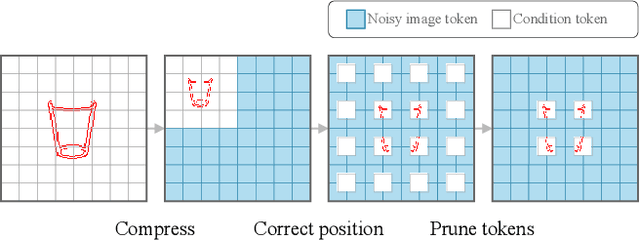
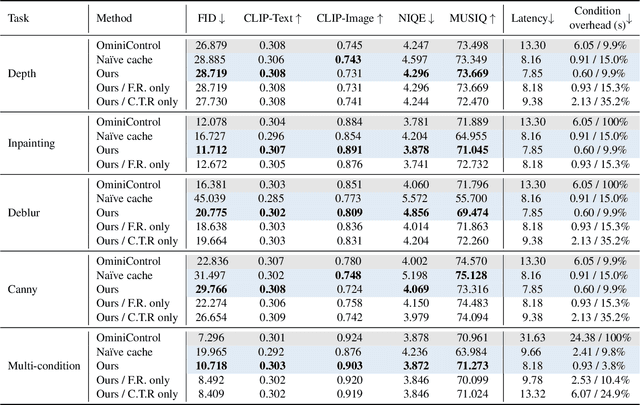
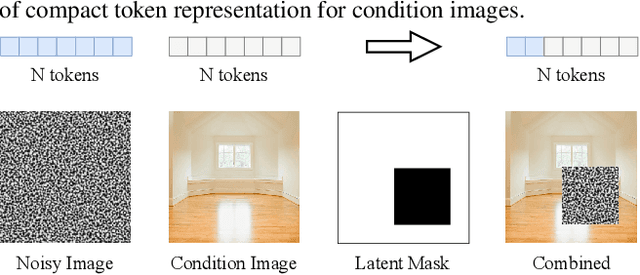
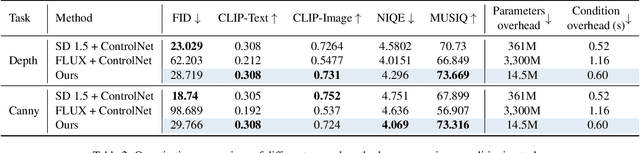
Fine-grained control of text-to-image diffusion transformer models (DiT) remains a critical challenge for practical deployment. While recent advances such as OminiControl and others have enabled a controllable generation of diverse control signals, these methods face significant computational inefficiency when handling long conditional inputs. We present OminiControl2, an efficient framework that achieves efficient image-conditional image generation. OminiControl2 introduces two key innovations: (1) a dynamic compression strategy that streamlines conditional inputs by preserving only the most semantically relevant tokens during generation, and (2) a conditional feature reuse mechanism that computes condition token features only once and reuses them across denoising steps. These architectural improvements preserve the original framework's parameter efficiency and multi-modal versatility while dramatically reducing computational costs. Our experiments demonstrate that OminiControl2 reduces conditional processing overhead by over 90% compared to its predecessor, achieving an overall 5.9$\times$ speedup in multi-conditional generation scenarios. This efficiency enables the practical implementation of complex, multi-modal control for high-quality image synthesis with DiT models.