 Add to Chrome
 Add to Firefox
 Add to Edge
World Action Models: A Survey
Jun 18, 2026
World Action Models (WAMs) are embodied predictive-action models that make a forecast of the future available to action. Recent WAMs repurpose large video generation models, and a parallel line relies on language or vision-language backbones without a video-generation core. This rapid expansion has blurred the boundary among broad world models, video generation models, action-grounded video world models, Vision-Language-Action policies, and WAMs. This survey gives the field a common account. It first clarifies these boundaries, then organizes existing works through two complementary views. The first view asks what each method is required to generate, spanning rendered futures, latent futures, and video-generation-free action reasoning. The second view decomposes each method by predictive substrate, backbone, action coupling, and deployment regime. This anatomy supports a unified discussion of interactability, causality, persistence, physical plausibility, and generalization, followed by data, evaluation, and open challenges. Across these axes, a consistent design pattern emerges: WAMs are not simply video generators with action heads, but predictive-action methods whose design choices trade representational richness against compute, memory, latency, and action-label cost. The field is moving toward methods that generate less of the future while preserving what control requires. The survey homepage is available at https://world-action-models.github.io/.

Muon Learns More Robust and Transferable Features than Adam
Jun 08, 2026Muon has recently emerged as a state-of-the-art optimizer for pretraining Large Language Models (LLMs) and vision classifiers. Despite its efficiency advantage over Adam and SGD, the feature-learning advantage of Muon remains unclear. This paper investigates Muon's feature-learning advantage through the lens of robustness and transferability. First, by evaluating pretrained models on corrupted images and texts, we show that features learned by Muon are consistently more robust than those learned by Adam and SGD across different architectures, including transformers and Convolutional Neural Networks (CNNs). Using trained layer-wise probes, we further show that this robustness advantage is reflected in larger logit margins across layers. Second, by training linear classifiers or fine-tuning full models from pretrained parameters on downstream tasks, we demonstrate that Muon-learned features transfer more effectively than those learned by Adam and SGD. This transferability advantage is further supported by the diversity of hidden states across layers, as measured by effective rank. Finally, in a representative classification problem with multi-component features, we prove that Muon attains larger margins and higher effective rank than Adam and SGD, providing theoretical support for our empirical findings.
Beyond Neural Collapse: Task-Intrinsic Geometry Governs Neural Representations in Modular Arithmetic
Jun 08, 2026While neural collapse (NC) predicts that a $K$-class-balanced classifier should organize terminal representations as a $(K-1)$-dimensional simplex equiangular tight frame (ETF), modular addition consistently enters a different regime: networks compress to a two-dimensional cyclic geometry in which both classifier weights and token embeddings lie on circles. We refine the explanation of this phenomenon in three directions. First, we formalize a layerwise non-uniform training mechanism: downstream classifier weights are driven by dense cross-entropy gradients into a rank-2 equiangular configuration before upstream embeddings fully reorganize, and once this classifier plane forms, backpropagated feature gradients constrain embedding motion to the same plane while weight decay suppresses orthogonal components. Second, after this subspace locking, the induced in-plane dynamics admit an entropy-regularized transport interpretation on $S^1$; combined with modular-addition labels, this reduces embedding formation to phase alignment, whose minimizers are single-frequency characters of $\mathbb{Z}/P\mathbb{Z}$ and hence equal-angle points on a circle. Third, we quantify why this solution prevails over NC: a simplex ETF gains only an $O(1)$ advantage in cross-entropy, whereas the cyclic rank-2 solution enjoys a $Θ(K)$ advantage under Schatten or weight-decay surrogates, yielding a critical threshold $λ_{\mathrm{crit}} = Θ(1/K)$. Our results explain both why classifier weights move first and why embeddings subsequently align with them, showing that grokking on modular arithmetic is governed not by maximal separation alone but by a task-structured trade-off between separation, symmetry, and complexity.
Deciphering Two Training Clocks in Grokking via Deep Linear Network Theory with Conditional ReLU Reduction
Jun 04, 2026Grokking suggests that fitting the training data and learning a simple underlying rule may occur on different time scales. We formalize this phenomenon by separating the fast decay of the classification loss from the slower simplification of the learned representation, and we call the resulting pair of stopping times two training clocks. For deep linear networks, we show that a post-margin gap-growth or one-step tail-contraction condition reduces the cross-entropy loss to level epsilon on a logarithmic time scale. In contrast, when layerwise weight decay is present, the induced regularization on the end-to-end map can be expressed as a Schatten-type penalty; under a sharp late-time Kurdyka-Lojasiewicz tail, this structural energy closes on a polynomial time scale. The two clocks, therefore, separate fitting from representation simplification. We then explain how the same mechanism can appear in ReLU MLPs. In regions where the activation patterns on the training set remain fixed, the network reduces to a linear model in the active coordinates. In a two-layer ReLU embedding model, chain-rule estimates further show that the classifier head can receive larger effective gradients than the embedding block under controlled downstream norms. This supports a two-stage mechanism in which the classifier fits first, while the representation continues to simplify later. We use modular addition as the main experimental setting. The deep linear theory provides the rigorous core of the analysis. But the ReLU results are formulated as conditional reductions that account for empirical behavior without claiming a global proof for nonlinear training dynamics.
Deciphering Shortcut Learning from an Evolutionary Game Theory Perspective
May 05, 2026Shortcut learning causes deep learning models to rely on non-essential features within the data. However, its formation in deep neural network training still lacks theoretical understanding. In this paper, we provide a formal definition of core and shortcut features and employ evolutionary game theory to analyze the origins of shortcut bias by modeling data samples as players and their corresponding neural tangent features as strategies, assuming the existence of core and shortcut subnetworks. We find that gradient descent (GD) and stochastic gradient descent (SGD) lead to two distinct stochastically stable states, each corresponding to a different strategy. The former primarily optimizes the shortcut subnetwork, while the latter primarily optimizes the core subnetwork. We investigate the influence of these strategies on shortcut bias through a continuous stochastic differential equation, and reveal the impact of data noise and optimization noise on the formation of shortcut bias. In brief, our work employs evolutionary game theory to characterize the dynamics of shortcut bias formation and provides a theoretical view on its mitigation.
Make Geometry Matter for Spatial Reasoning
Mar 27, 2026Empowered by large-scale training, vision-language models (VLMs) achieve strong image and video understanding, yet their ability to perform spatial reasoning in both static scenes and dynamic videos remains limited. Recent advances try to handle this limitation by injecting geometry tokens from pretrained 3D foundation models into VLMs. Nevertheless, we observe that naive token fusion followed by standard fine-tuning in this line of work often leaves such geometric cues underutilized for spatial reasoning, as VLMs tend to rely heavily on 2D visual cues. In this paper, we propose GeoSR, a framework designed to make geometry matter by encouraging VLMs to actively reason with geometry tokens. GeoSR introduces two key components: (1) Geometry-Unleashing Masking, which strategically masks portions of 2D vision tokens during training to weaken non-geometric shortcuts and force the model to consult geometry tokens for spatial reasoning; and (2) Geometry-Guided Fusion, a gated routing mechanism that adaptively amplifies geometry token contributions in regions where geometric evidence is critical. Together, these designs unleash the potential of geometry tokens for spatial reasoning tasks. Extensive experiments on both static and dynamic spatial reasoning benchmarks demonstrate that GeoSR consistently outperforms prior methods and establishes new state-of-the-art performance by effectively leveraging geometric information. The project page is available at https://suhzhang.github.io/GeoSR/.
Deep Learning Reforms Image Matching: A Survey and Outlook
Jun 05, 2025Image matching, which establishes correspondences between two-view images to recover 3D structure and camera geometry, serves as a cornerstone in computer vision and underpins a wide range of applications, including visual localization, 3D reconstruction, and simultaneous localization and mapping (SLAM). Traditional pipelines composed of ``detector-descriptor, feature matcher, outlier filter, and geometric estimator'' falter in challenging scenarios. Recent deep-learning advances have significantly boosted both robustness and accuracy. This survey adopts a unique perspective by comprehensively reviewing how deep learning has incrementally transformed the classical image matching pipeline. Our taxonomy highly aligns with the traditional pipeline in two key aspects: i) the replacement of individual steps in the traditional pipeline with learnable alternatives, including learnable detector-descriptor, outlier filter, and geometric estimator; and ii) the merging of multiple steps into end-to-end learnable modules, encompassing middle-end sparse matcher, end-to-end semi-dense/dense matcher, and pose regressor. We first examine the design principles, advantages, and limitations of both aspects, and then benchmark representative methods on relative pose recovery, homography estimation, and visual localization tasks. Finally, we discuss open challenges and outline promising directions for future research. By systematically categorizing and evaluating deep learning-driven strategies, this survey offers a clear overview of the evolving image matching landscape and highlights key avenues for further innovation.
Shadow Wireless Intelligence: Large Language Model-Driven Reasoning in Covert Communications
May 07, 2025Covert Communications (CC) can secure sensitive transmissions in industrial, military, and mission-critical applications within 6G wireless networks. However, traditional optimization methods based on Artificial Noise (AN), power control, and channel manipulation might not adapt to dynamic and adversarial environments due to the high dimensionality, nonlinearity, and stringent real-time covertness requirements. To bridge this gap, we introduce Shadow Wireless Intelligence (SWI), which integrates the reasoning capabilities of Large Language Models (LLMs) with retrieval-augmented generation to enable intelligent decision-making in covert wireless systems. Specifically, we utilize DeepSeek-R1, a mixture-of-experts-based LLM with RL-enhanced reasoning, combined with real-time retrieval of domain-specific knowledge to improve context accuracy and mitigate hallucinations. Our approach develops a structured CC knowledge base, supports context-aware retrieval, and performs semantic optimization, allowing LLMs to generate and adapt CC strategies in real time. In a case study on optimizing AN power in a full-duplex CC scenario, DeepSeek-R1 achieves 85% symbolic derivation accuracy and 94% correctness in the generation of simulation code, outperforming baseline models. These results validate SWI as a robust, interpretable, and adaptive foundation for LLM-driven intelligent covert wireless systems in 6G networks.
CoMatch: Dynamic Covisibility-Aware Transformer for Bilateral Subpixel-Level Semi-Dense Image Matching
Mar 31, 2025This prospective study proposes CoMatch, a novel semi-dense image matcher with dynamic covisibility awareness and bilateral subpixel accuracy. Firstly, observing that modeling context interaction over the entire coarse feature map elicits highly redundant computation due to the neighboring representation similarity of tokens, a covisibility-guided token condenser is introduced to adaptively aggregate tokens in light of their covisibility scores that are dynamically estimated, thereby ensuring computational efficiency while improving the representational capacity of aggregated tokens simultaneously. Secondly, considering that feature interaction with massive non-covisible areas is distracting, which may degrade feature distinctiveness, a covisibility-assisted attention mechanism is deployed to selectively suppress irrelevant message broadcast from non-covisible reduced tokens, resulting in robust and compact attention to relevant rather than all ones. Thirdly, we find that at the fine-level stage, current methods adjust only the target view's keypoints to subpixel level, while those in the source view remain restricted at the coarse level and thus not informative enough, detrimental to keypoint location-sensitive usages. A simple yet potent fine correlation module is developed to refine the matching candidates in both source and target views to subpixel level, attaining attractive performance improvement. Thorough experimentation across an array of public benchmarks affirms CoMatch's promising accuracy, efficiency, and generalizability.
Learning-Based TSP-Solvers Tend to Be Overly Greedy
Feb 02, 2025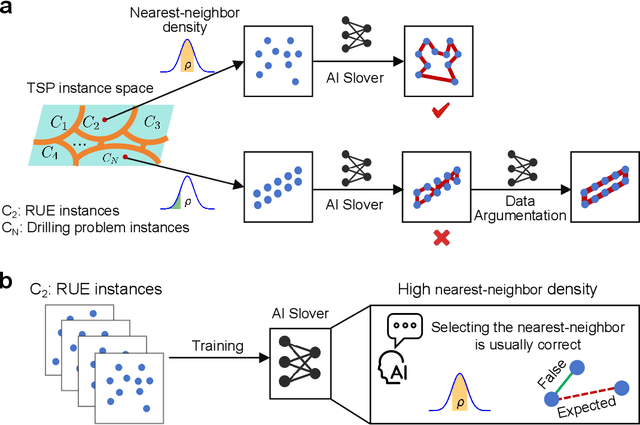
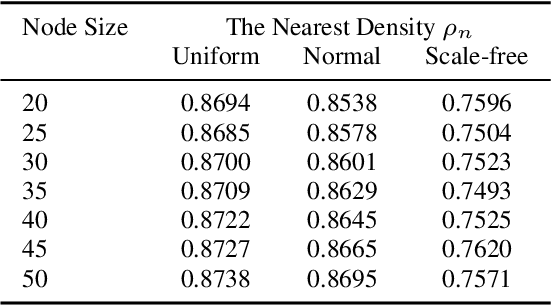
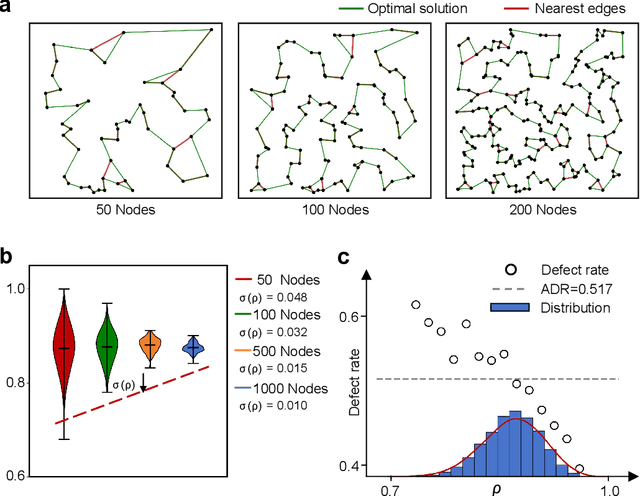
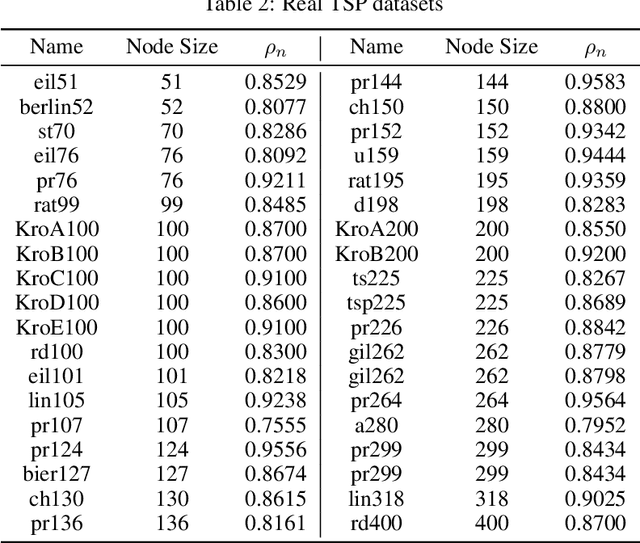
Deep learning has shown significant potential in solving combinatorial optimization problems such as the Euclidean traveling salesman problem (TSP). However, most training and test instances for existing TSP algorithms are generated randomly from specific distributions like uniform distribution. This has led to a lack of analysis and understanding of the performance of deep learning algorithms in out-of-distribution (OOD) generalization scenarios, which has a close relationship with the worst-case performance in the combinatorial optimization field. For data-driven algorithms, the statistical properties of randomly generated datasets are critical. This study constructs a statistical measure called nearest-neighbor density to verify the asymptotic properties of randomly generated datasets and reveal the greedy behavior of learning-based solvers, i.e., always choosing the nearest neighbor nodes to construct the solution path. Based on this statistical measure, we develop interpretable data augmentation methods that rely on distribution shifts or instance perturbations and validate that the performance of the learning-based solvers degenerates much on such augmented data. Moreover, fine-tuning learning-based solvers with augmented data further enhances their generalization abilities. In short, we decipher the limitations of learning-based TSP solvers tending to be overly greedy, which may have profound implications for AI-empowered combinatorial optimization solvers.