 Add to Chrome
 Add to Firefox
 Add to Edge
SpatialStack: Layered Geometry-Language Fusion for 3D VLM Spatial Reasoning
Mar 28, 2026
Large vision-language models (VLMs) still struggle with reliable 3D spatial reasoning, a core capability for embodied and physical AI systems. This limitation arises from their inability to capture fine-grained 3D geometry and spatial relationships. While recent efforts have introduced multi-view geometry transformers into VLMs, they typically fuse only the deep-layer features from vision and geometry encoders, discarding rich hierarchical signals and creating a fundamental bottleneck for spatial understanding. To overcome this, we propose SpatialStack, a general hierarchical fusion framework that progressively aligns vision, geometry, and language representations across the model hierarchy. Moving beyond conventional late-stage vision-geometry fusion, SpatialStack stacks and synchronizes multi-level geometric features with the language backbone, enabling the model to capture both local geometric precision and global contextual semantics. Building upon this framework, we develop VLM-SpatialStack, a model that achieves state-of-the-art performance on multiple 3D spatial reasoning benchmarks. Extensive experiments and ablations demonstrate that our multi-level fusion strategy consistently enhances 3D understanding and generalizes robustly across diverse spatial reasoning tasks, establishing SpatialStack as an effective and extensible design paradigm for vision-language-geometry integration in next-generation multimodal physical AI systems.

Anticipatory Planning for Multimodal AI Agents
Mar 17, 2026Recent advances in multimodal agents have improved computer-use interaction and tool-usage, yet most existing systems remain reactive, optimizing actions in isolation without reasoning about future states or long-term goals. This limits planning coherence and prevents agents from reliably solving high-level, multi-step tasks. We introduce TraceR1, a two-stage reinforcement learning framework that explicitly trains anticipatory reasoning by forecasting short-horizon trajectories before execution. The first stage performs trajectory-level reinforcement learning with rewards that enforce global consistency across predicted action sequences. The second stage applies grounded reinforcement fine-tuning, using execution feedback from frozen tool agents to refine step-level accuracy and executability. TraceR1 is evaluated across seven benchmarks, covering online computer-use, offline computer-use benchmarks, and multimodal tool-use reasoning tasks, where it achieves substantial improvements in planning stability, execution robustness, and generalization over reactive and single-stage baselines. These results show that anticipatory trajectory reasoning is a key principle for building multimodal agents that can reason, plan, and act effectively in complex real-world environments.
Egocentric World Model for Photorealistic Hand-Object Interaction Synthesis
Mar 13, 2026To serve as a scalable data source for embodied AI, world models should act as true simulators that infer interaction dynamics strictly from user actions, rather than mere conditional video generators relying on privileged future object states. In this context, egocentric Human-Object Interaction (HOI) world models are critical for predicting physically grounded first-person rollouts. However, building such models is profoundly challenging due to rapid head motions, severe occlusions, and high-DoF hand articulations that abruptly alter contact topologies. Consequently, existing approaches often circumvent these physics challenges by resorting to conditional video generation with access to known future object trajectories. We introduce EgoHOI, an egocentric HOI world model that breaks away from this shortcut to simulate photorealistic, contact-consistent interactions from action signals alone. To ensure physical accuracy without future-state inputs, EgoHOI distills geometric and kinematic priors from 3D estimates into physics-informed embeddings. These embeddings regularize the egocentric rollouts toward physically valid dynamics. Experiments on the HOT3D dataset demonstrate consistent gains over strong baselines, and ablations validate the effectiveness of our physics-informed design.
RC-NF: Robot-Conditioned Normalizing Flow for Real-Time Anomaly Detection in Robotic Manipulation
Mar 11, 2026Recent advances in Vision-Language-Action (VLA) models have enabled robots to execute increasingly complex tasks. However, VLA models trained through imitation learning struggle to operate reliably in dynamic environments and often fail under Out-of-Distribution (OOD) conditions. To address this issue, we propose Robot-Conditioned Normalizing Flow (RC-NF), a real-time monitoring model for robotic anomaly detection and intervention that ensures the robot's state and the object's motion trajectory align with the task. RC-NF decouples the processing of task-aware robot and object states within the normalizing flow. It requires only positive samples for unsupervised training and calculates accurate robotic anomaly scores during inference through the probability density function. We further present LIBERO-Anomaly-10, a benchmark comprising three categories of robotic anomalies for simulation evaluation. RC-NF achieves state-of-the-art performance across all anomaly types compared to previous methods in monitoring robotic tasks. Real-world experiments demonstrate that RC-NF operates as a plug-and-play module for VLA models (e.g., pi0), providing a real-time OOD signal that enables state-level rollback or task-level replanning when necessary, with a response latency under 100 ms. These results demonstrate that RC-NF noticeably enhances the robustness and adaptability of VLA-based robotic systems in dynamic environments.
ATLAS: A High-Difficulty, Multidisciplinary Benchmark for Frontier Scientific Reasoning
Nov 18, 2025The rapid advancement of Large Language Models (LLMs) has led to performance saturation on many established benchmarks, questioning their ability to distinguish frontier models. Concurrently, existing high-difficulty benchmarks often suffer from narrow disciplinary focus, oversimplified answer formats, and vulnerability to data contamination, creating a fidelity gap with real-world scientific inquiry. To address these challenges, we introduce ATLAS (AGI-Oriented Testbed for Logical Application in Science), a large-scale, high-difficulty, and cross-disciplinary evaluation suite composed of approximately 800 original problems. Developed by domain experts (PhD-level and above), ATLAS spans seven core scientific fields: mathematics, physics, chemistry, biology, computer science, earth science, and materials science. Its key features include: (1) High Originality and Contamination Resistance, with all questions newly created or substantially adapted to prevent test data leakage; (2) Cross-Disciplinary Focus, designed to assess models' ability to integrate knowledge and reason across scientific domains; (3) High-Fidelity Answers, prioritizing complex, open-ended answers involving multi-step reasoning and LaTeX-formatted expressions over simple multiple-choice questions; and (4) Rigorous Quality Control, employing a multi-stage process of expert peer review and adversarial testing to ensure question difficulty, scientific value, and correctness. We also propose a robust evaluation paradigm using a panel of LLM judges for automated, nuanced assessment of complex answers. Preliminary results on leading models demonstrate ATLAS's effectiveness in differentiating their advanced scientific reasoning capabilities. We plan to develop ATLAS into a long-term, open, community-driven platform to provide a reliable "ruler" for progress toward Artificial General Intelligence.
Simple Denoising Diffusion Language Models
Oct 27, 2025Diffusion models have recently been extended to language generation through Masked Diffusion Language Models (MDLMs), which achieve performance competitive with strong autoregressive models. However, MDLMs tend to degrade in the few-step regime and cannot directly adopt existing few-step distillation methods designed for continuous diffusion models, as they lack the intrinsic property of mapping from noise to data. Recent Uniform-state Diffusion Models (USDMs), initialized from a uniform prior, alleviate some limitations but still suffer from complex loss formulations that hinder scalability. In this work, we propose a simplified denoising-based loss for USDMs that optimizes only noise-replaced tokens, stabilizing training and matching ELBO-level performance. Furthermore, by framing denoising as self-supervised learning, we introduce a simple modification to our denoising loss with contrastive-inspired negative gradients, which is practical and yield additional improvements in generation quality.
MorphoSim: An Interactive, Controllable, and Editable Language-guided 4D World Simulator
Oct 05, 2025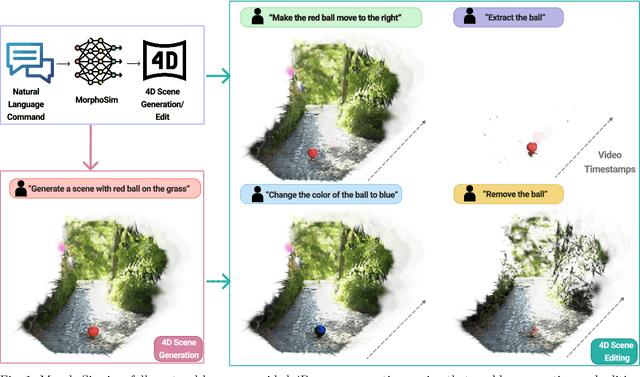
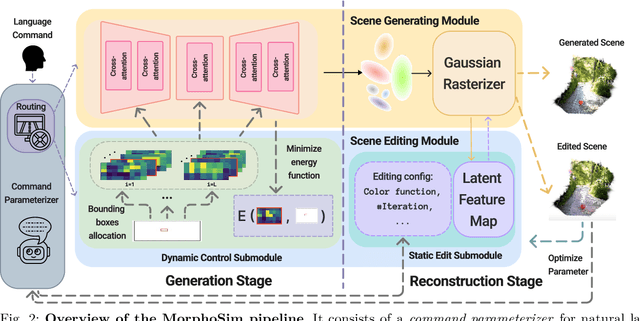
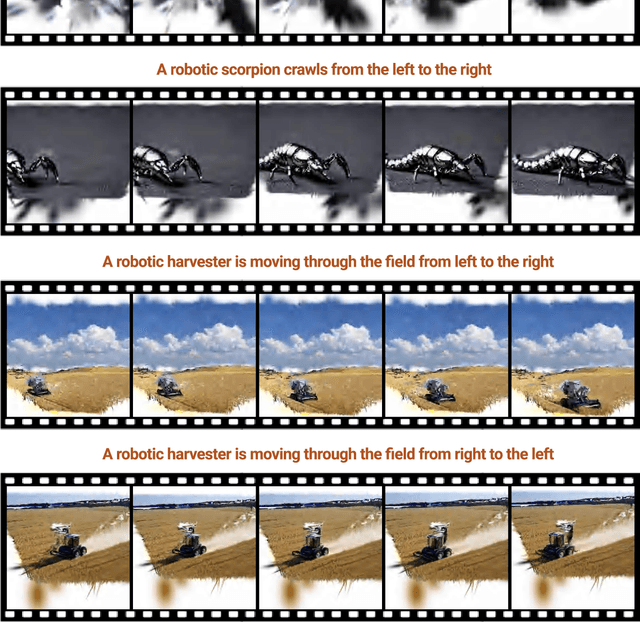
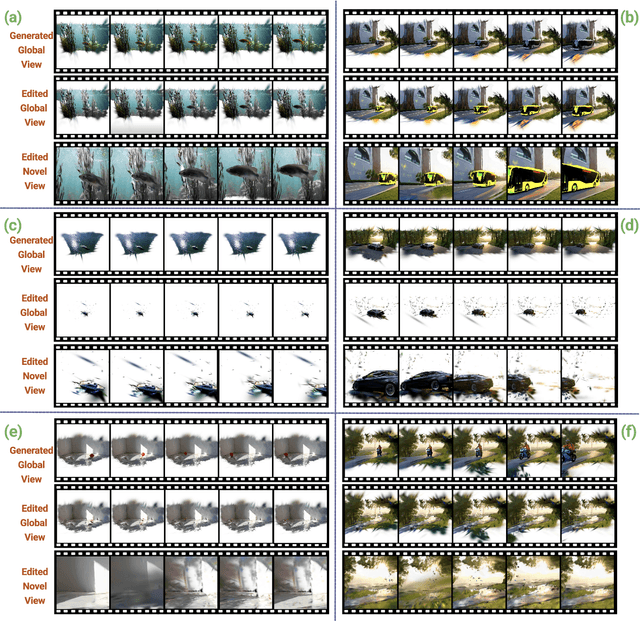
World models that support controllable and editable spatiotemporal environments are valuable for robotics, enabling scalable training data, repro ducible evaluation, and flexible task design. While recent text-to-video models generate realistic dynam ics, they are constrained to 2D views and offer limited interaction. We introduce MorphoSim, a language guided framework that generates 4D scenes with multi-view consistency and object-level controls. From natural language instructions, MorphoSim produces dynamic environments where objects can be directed, recolored, or removed, and scenes can be observed from arbitrary viewpoints. The framework integrates trajectory-guided generation with feature field dis tillation, allowing edits to be applied interactively without full re-generation. Experiments show that Mor phoSim maintains high scene fidelity while enabling controllability and editability. The code is available at https://github.com/eric-ai-lab/Morph4D.
SwarmAgentic: Towards Fully Automated Agentic System Generation via Swarm Intelligence
Jun 18, 2025The rapid progress of Large Language Models has advanced agentic systems in decision-making, coordination, and task execution. Yet, existing agentic system generation frameworks lack full autonomy, missing from-scratch agent generation, self-optimizing agent functionality, and collaboration, limiting adaptability and scalability. We propose SwarmAgentic, a framework for fully automated agentic system generation that constructs agentic systems from scratch and jointly optimizes agent functionality and collaboration as interdependent components through language-driven exploration. To enable efficient search over system-level structures, SwarmAgentic maintains a population of candidate systems and evolves them via feedback-guided updates, drawing inspiration from Particle Swarm Optimization (PSO). We evaluate our method on six real-world, open-ended, and exploratory tasks involving high-level planning, system-level coordination, and creative reasoning. Given only a task description and an objective function, SwarmAgentic outperforms all baselines, achieving a +261.8% relative improvement over ADAS on the TravelPlanner benchmark, highlighting the effectiveness of full automation in structurally unconstrained tasks. This framework marks a significant step toward scalable and autonomous agentic system design, bridging swarm intelligence with fully automated system multi-agent generation. Our code is publicly released at https://yaoz720.github.io/SwarmAgentic/.
Feature4X: Bridging Any Monocular Video to 4D Agentic AI with Versatile Gaussian Feature Fields
Mar 26, 2025Recent advancements in 2D and multimodal models have achieved remarkable success by leveraging large-scale training on extensive datasets. However, extending these achievements to enable free-form interactions and high-level semantic operations with complex 3D/4D scenes remains challenging. This difficulty stems from the limited availability of large-scale, annotated 3D/4D or multi-view datasets, which are crucial for generalizable vision and language tasks such as open-vocabulary and prompt-based segmentation, language-guided editing, and visual question answering (VQA). In this paper, we introduce Feature4X, a universal framework designed to extend any functionality from 2D vision foundation model into the 4D realm, using only monocular video input, which is widely available from user-generated content. The "X" in Feature4X represents its versatility, enabling any task through adaptable, model-conditioned 4D feature field distillation. At the core of our framework is a dynamic optimization strategy that unifies multiple model capabilities into a single representation. Additionally, to the best of our knowledge, Feature4X is the first method to distill and lift the features of video foundation models (e.g. SAM2, InternVideo2) into an explicit 4D feature field using Gaussian Splatting. Our experiments showcase novel view segment anything, geometric and appearance scene editing, and free-form VQA across all time steps, empowered by LLMs in feedback loops. These advancements broaden the scope of agentic AI applications by providing a foundation for scalable, contextually and spatiotemporally aware systems capable of immersive dynamic 4D scene interaction.
X-Dyna: Expressive Dynamic Human Image Animation
Jan 20, 2025We introduce X-Dyna, a novel zero-shot, diffusion-based pipeline for animating a single human image using facial expressions and body movements derived from a driving video, that generates realistic, context-aware dynamics for both the subject and the surrounding environment. Building on prior approaches centered on human pose control, X-Dyna addresses key shortcomings causing the loss of dynamic details, enhancing the lifelike qualities of human video animations. At the core of our approach is the Dynamics-Adapter, a lightweight module that effectively integrates reference appearance context into the spatial attentions of the diffusion backbone while preserving the capacity of motion modules in synthesizing fluid and intricate dynamic details. Beyond body pose control, we connect a local control module with our model to capture identity-disentangled facial expressions, facilitating accurate expression transfer for enhanced realism in animated scenes. Together, these components form a unified framework capable of learning physical human motion and natural scene dynamics from a diverse blend of human and scene videos. Comprehensive qualitative and quantitative evaluations demonstrate that X-Dyna outperforms state-of-the-art methods, creating highly lifelike and expressive animations. The code is available at https://github.com/bytedance/X-Dyna.