 Add to Chrome
 Add to Firefox
 Add to Edge
Cosmos 3: Omnimodal World Models for Physical AI
Jun 01, 2026
We introduce Cosmos 3, a family of omnimodal world models designed to jointly process and generate language, image, video, audio, and action sequences within a unified mixture-of-transformers architecture. By supporting highly flexible input-output configurations, Cosmos 3 seamlessly unifies critical modalities for Physical AI -- effectively subsuming vision-language models, video generators, world simulators, and world-action models into a single framework. Our evaluation demonstrates that Cosmos 3 establishes a new state-of-the-art across a diverse suite of understanding and generation tasks, demonstrating omnimodal world models as scalable, general-purpose backbones for embodied agents. Our post-trained Cosmos 3 models were ranked as the best open-source Text-to-Image and Image-to-Video models by Artificial Analysis, and the best policy model by RoboArena at the time the technical report was written. To accelerate open research and deployment in Physical AI, we make our code, model checkpoints, curated synthetic datasets, and evaluation benchmark available under the Linux Foundation's OpenMDW-1.1 https://openmdw.ai/license/1-1/ License at https://github.com/nvidia/cosmos}{github.com/nvidia/cosmos and https://huggingface.co/collections/nvidia/cosmos3 . The project website is available at https://research.nvidia.com/labs/cosmos-lab/cosmos3 .

Unlocking Strong Supervision: A Data-Centric Study of General-Purpose Audio Pre-Training Methods
Mar 26, 2026Current audio pre-training seeks to learn unified representations for broad audio understanding tasks, but it remains fragmented and is fundamentally bottlenecked by its reliance on weak, noisy, and scale-limited labels. Drawing lessons from vision's foundational pre-training blueprint, we argue that the audio field must first establish its own large-scale, strong supervision framework. We introduce a new data-centric pipeline that leverages a high-fidelity captioner to create SOTA-quality captions and the first Unified Tag System (UTS) that bridges speech, music, and environmental sounds. We then conduct a systematic comparative study of different pre-training objectives on these strong source data. Our experiments suggest that data quality and coverage are the primary drivers of performance, while the choice of objective dictates downstream task specialization.
DreamDojo: A Generalist Robot World Model from Large-Scale Human Videos
Feb 06, 2026Being able to simulate the outcomes of actions in varied environments will revolutionize the development of generalist agents at scale. However, modeling these world dynamics, especially for dexterous robotics tasks, poses significant challenges due to limited data coverage and scarce action labels. As an endeavor towards this end, we introduce DreamDojo, a foundation world model that learns diverse interactions and dexterous controls from 44k hours of egocentric human videos. Our data mixture represents the largest video dataset to date for world model pretraining, spanning a wide range of daily scenarios with diverse objects and skills. To address the scarcity of action labels, we introduce continuous latent actions as unified proxy actions, enhancing interaction knowledge transfer from unlabeled videos. After post-training on small-scale target robot data, DreamDojo demonstrates a strong understanding of physics and precise action controllability. We also devise a distillation pipeline that accelerates DreamDojo to a real-time speed of 10.81 FPS and further improves context consistency. Our work enables several important applications based on generative world models, including live teleoperation, policy evaluation, and model-based planning. Systematic evaluation on multiple challenging out-of-distribution (OOD) benchmarks verifies the significance of our method for simulating open-world, contact-rich tasks, paving the way for general-purpose robot world models.
Auden-Voice: General-Purpose Voice Encoder for Speech and Language Understanding
Nov 19, 2025Human voice encodes both identity and paralinguistic cues, yet encoders in large audio-language models (LALMs) rarely balance both aspects. In this work, we present a study toward building a general-purpose voice encoder that captures nuanced voice cues. Through a comprehensive evaluation, we find that multi-task training yields the most balanced representations, whereas contrastive language-audio pretraining (CLAP) primarily improves retrieval without enhancing paralinguistic understanding. Our final encoder, Auden-Voice, also demonstrates strong performance when integrated with LLMs. The code and training recipes will be released with the audio understanding toolkit Auden.
Scalable Policy Evaluation with Video World Models
Nov 17, 2025Training generalist policies for robotic manipulation has shown great promise, as they enable language-conditioned, multi-task behaviors across diverse scenarios. However, evaluating these policies remains difficult because real-world testing is expensive, time-consuming, and labor-intensive. It also requires frequent environment resets and carries safety risks when deploying unproven policies on physical robots. Manually creating and populating simulation environments with assets for robotic manipulation has not addressed these issues, primarily due to the significant engineering effort required and the often substantial sim-to-real gap, both in terms of physics and rendering. In this paper, we explore the use of action-conditional video generation models as a scalable way to learn world models for policy evaluation. We demonstrate how to incorporate action conditioning into existing pre-trained video generation models. This allows leveraging internet-scale in-the-wild online videos during the pre-training stage, and alleviates the need for a large dataset of paired video-action data, which is expensive to collect for robotic manipulation. Our paper examines the effect of dataset diversity, pre-trained weight and common failure cases for the proposed evaluation pipeline. Our experiments demonstrate that, across various metrics, including policy ranking and the correlation between actual policy values and predicted policy values, these models offer a promising approach for evaluating policies without requiring real-world interactions.
Probing the Robustness Properties of Neural Speech Codecs
May 30, 2025Neural speech codecs have revolutionized speech coding, achieving higher compression while preserving audio fidelity. Beyond compression, they have emerged as tokenization strategies, enabling language modeling on speech and driving paradigm shifts across various speech processing tasks. Despite these advancements, their robustness in noisy environments remains underexplored, raising concerns about their generalization to real-world scenarios. In this work, we systematically evaluate neural speech codecs under various noise conditions, revealing non-trivial differences in their robustness. We further examine their linearity properties, uncovering non-linear distortions which partly explain observed variations in robustness. Lastly, we analyze their frequency response to identify factors affecting audio fidelity. Our findings provide critical insights into codec behavior and future codec design, as well as emphasizing the importance of noise robustness for their real-world integration.
Cosmos World Foundation Model Platform for Physical AI
Jan 07, 2025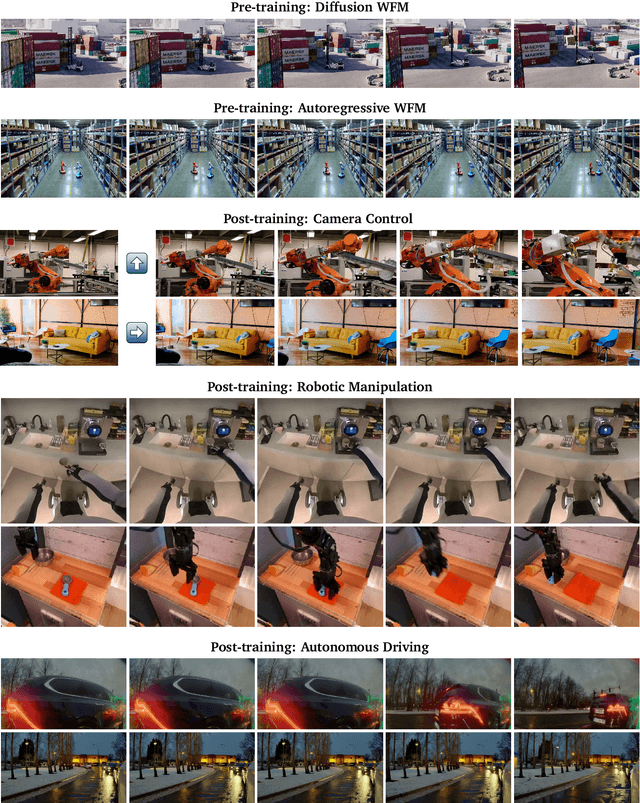
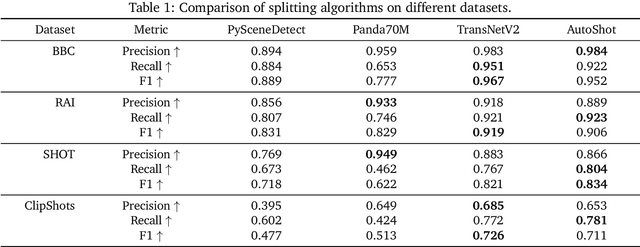
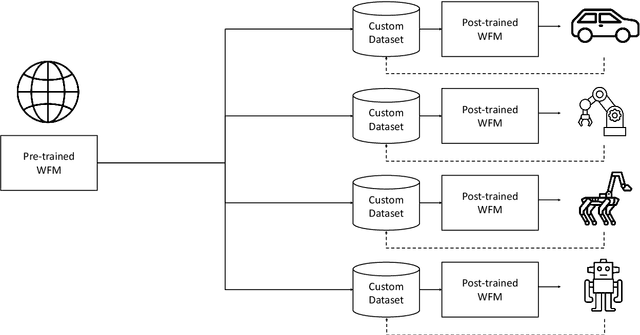

Physical AI needs to be trained digitally first. It needs a digital twin of itself, the policy model, and a digital twin of the world, the world model. In this paper, we present the Cosmos World Foundation Model Platform to help developers build customized world models for their Physical AI setups. We position a world foundation model as a general-purpose world model that can be fine-tuned into customized world models for downstream applications. Our platform covers a video curation pipeline, pre-trained world foundation models, examples of post-training of pre-trained world foundation models, and video tokenizers. To help Physical AI builders solve the most critical problems of our society, we make our platform open-source and our models open-weight with permissive licenses available via https://github.com/NVIDIA/Cosmos.
Dynamic-SUPERB Phase-2: A Collaboratively Expanding Benchmark for Measuring the Capabilities of Spoken Language Models with 180 Tasks
Nov 08, 2024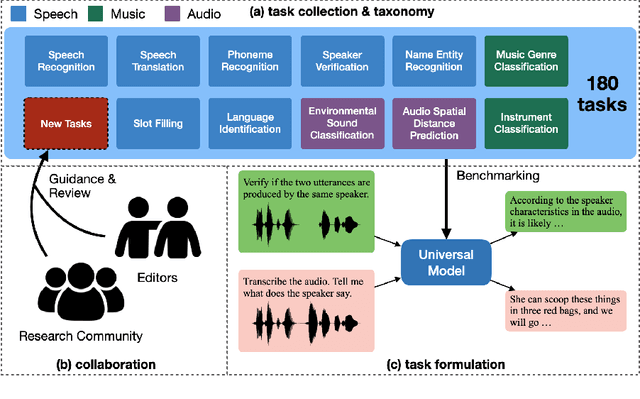
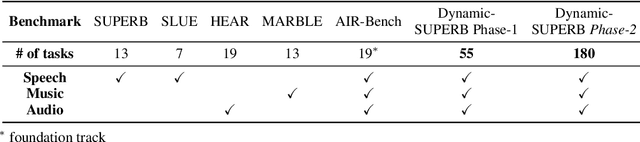
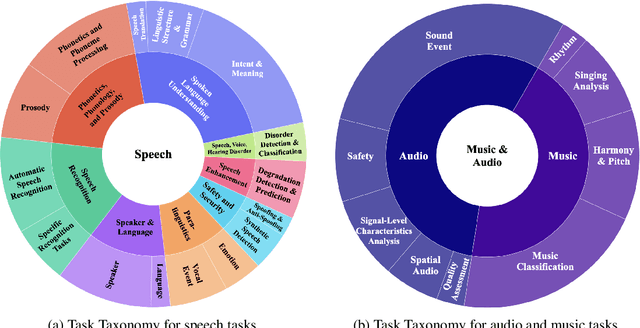
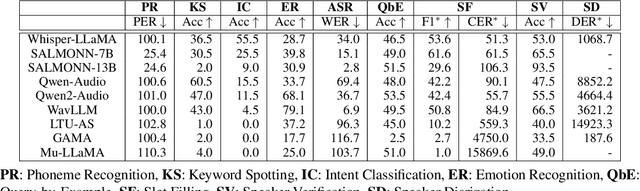
Multimodal foundation models, such as Gemini and ChatGPT, have revolutionized human-machine interactions by seamlessly integrating various forms of data. Developing a universal spoken language model that comprehends a wide range of natural language instructions is critical for bridging communication gaps and facilitating more intuitive interactions. However, the absence of a comprehensive evaluation benchmark poses a significant challenge. We present Dynamic-SUPERB Phase-2, an open and evolving benchmark for the comprehensive evaluation of instruction-based universal speech models. Building upon the first generation, this second version incorporates 125 new tasks contributed collaboratively by the global research community, expanding the benchmark to a total of 180 tasks, making it the largest benchmark for speech and audio evaluation. While the first generation of Dynamic-SUPERB was limited to classification tasks, Dynamic-SUPERB Phase-2 broadens its evaluation capabilities by introducing a wide array of novel and diverse tasks, including regression and sequence generation, across speech, music, and environmental audio. Evaluation results indicate that none of the models performed well universally. SALMONN-13B excelled in English ASR, while WavLLM demonstrated high accuracy in emotion recognition, but current models still require further innovations to handle a broader range of tasks. We will soon open-source all task data and the evaluation pipeline.
Gaussian Splatting Visual MPC for Granular Media Manipulation
Oct 13, 2024
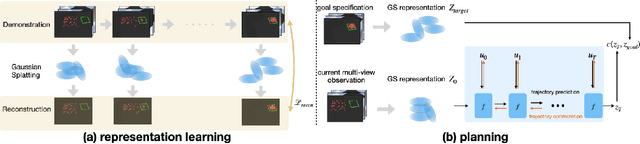


Recent advancements in learned 3D representations have enabled significant progress in solving complex robotic manipulation tasks, particularly for rigid-body objects. However, manipulating granular materials such as beans, nuts, and rice, remains challenging due to the intricate physics of particle interactions, high-dimensional and partially observable state, inability to visually track individual particles in a pile, and the computational demands of accurate dynamics prediction. Current deep latent dynamics models often struggle to generalize in granular material manipulation due to a lack of inductive biases. In this work, we propose a novel approach that learns a visual dynamics model over Gaussian splatting representations of scenes and leverages this model for manipulating granular media via Model-Predictive Control. Our method enables efficient optimization for complex manipulation tasks on piles of granular media. We evaluate our approach in both simulated and real-world settings, demonstrating its ability to solve unseen planning tasks and generalize to new environments in a zero-shot transfer. We also show significant prediction and manipulation performance improvements compared to existing granular media manipulation methods.
SpeechPrompt: Prompting Speech Language Models for Speech Processing Tasks
Aug 23, 2024


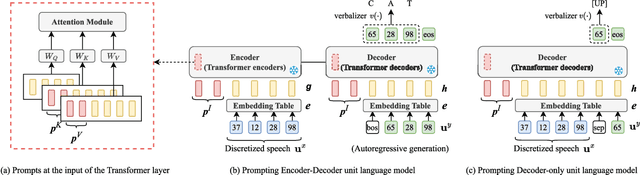
Prompting has become a practical method for utilizing pre-trained language models (LMs). This approach offers several advantages. It allows an LM to adapt to new tasks with minimal training and parameter updates, thus achieving efficiency in both storage and computation. Additionally, prompting modifies only the LM's inputs and harnesses the generative capabilities of language models to address various downstream tasks in a unified manner. This significantly reduces the need for human labor in designing task-specific models. These advantages become even more evident as the number of tasks served by the LM scales up. Motivated by the strengths of prompting, we are the first to explore the potential of prompting speech LMs in the domain of speech processing. Recently, there has been a growing interest in converting speech into discrete units for language modeling. Our pioneer research demonstrates that these quantized speech units are highly versatile within our unified prompting framework. Not only can they serve as class labels, but they also contain rich phonetic information that can be re-synthesized back into speech signals for speech generation tasks. Specifically, we reformulate speech processing tasks into speech-to-unit generation tasks. As a result, we can seamlessly integrate tasks such as speech classification, sequence generation, and speech generation within a single, unified prompting framework. The experiment results show that the prompting method can achieve competitive performance compared to the strong fine-tuning method based on self-supervised learning models with a similar number of trainable parameters. The prompting method also shows promising results in the few-shot setting. Moreover, with the advanced speech LMs coming into the stage, the proposed prompting framework attains great potential.
* Published in IEEE/ACM Transactions on Audio, Speech, and Language Processing (TASLP)