 Add to Chrome
 Add to Firefox
 Add to Edge
Causal-rCM: A Unified Teacher-Forcing and Self-Forcing Open Recipe for Autoregressive Diffusion Distillation in Streaming Video Generation and Interactive World Models
Jun 24, 2026
Autoregressive video diffusion with causal diffusion transformers has emerged as a major paradigm for real-time streaming video generation and action-conditioned interactive world models. In this work, we extend rCM, an advanced diffusion distillation framework, to autoregressive video diffusion. The core philosophy of rCM lies in the complementarity between forward and reverse divergences, represented by consistency models (CMs) and distribution matching distillation (DMD), respectively, in diffusion distillation. This philosophy naturally carries over to the autoregressive setting, where teacher-forcing (TF) provides an offline, forward-divergence causal training paradigm, while self-forcing (SF) corresponds to an on-policy, reverse-divergence refinement. Our contributions are: (1) through extensive experiments, we show that teacher-forcing CM is currently the best complement to self-forcing DMD as an initialization strategy (2) we present the first implementation of teacher-forcing-based continuous-time CMs (e.g., sCM/MeanFlow) for autoregressive video diffusion, enabled by our custom-mask FlashAttention-2 JVP kernel, achieving 10$\times$ faster convergence compared to discrete-time CMs (dCMs) (3) we introduce Causal-rCM, a leading, unified, and scalable algorithm-infrastructure open recipe for diffusion distillation and causal training (4) we achieve state-of-the-art streaming video generation performance in both frame-wise and chunk-wise settings, using only synthetic data for training. Notably, our distilled 2-step causal Wan2.1-1.3B model achieves a VBench-T2V score of 84.63 with only 1 or 2 sampling steps. We further apply Causal-rCM to Cosmos 3, an advanced omnimodal world foundation model for physical AI with action-conditioned generation capability, enabling an interactive world model.

Cosmos 3: Omnimodal World Models for Physical AI
Jun 01, 2026We introduce Cosmos 3, a family of omnimodal world models designed to jointly process and generate language, image, video, audio, and action sequences within a unified mixture-of-transformers architecture. By supporting highly flexible input-output configurations, Cosmos 3 seamlessly unifies critical modalities for Physical AI -- effectively subsuming vision-language models, video generators, world simulators, and world-action models into a single framework. Our evaluation demonstrates that Cosmos 3 establishes a new state-of-the-art across a diverse suite of understanding and generation tasks, demonstrating omnimodal world models as scalable, general-purpose backbones for embodied agents. Our post-trained Cosmos 3 models were ranked as the best open-source Text-to-Image and Image-to-Video models by Artificial Analysis, and the best policy model by RoboArena at the time the technical report was written. To accelerate open research and deployment in Physical AI, we make our code, model checkpoints, curated synthetic datasets, and evaluation benchmark available under the Linux Foundation's OpenMDW-1.1 https://openmdw.ai/license/1-1/ License at https://github.com/nvidia/cosmos}{github.com/nvidia/cosmos and https://huggingface.co/collections/nvidia/cosmos3 . The project website is available at https://research.nvidia.com/labs/cosmos-lab/cosmos3 .
DreamDojo: A Generalist Robot World Model from Large-Scale Human Videos
Feb 06, 2026Being able to simulate the outcomes of actions in varied environments will revolutionize the development of generalist agents at scale. However, modeling these world dynamics, especially for dexterous robotics tasks, poses significant challenges due to limited data coverage and scarce action labels. As an endeavor towards this end, we introduce DreamDojo, a foundation world model that learns diverse interactions and dexterous controls from 44k hours of egocentric human videos. Our data mixture represents the largest video dataset to date for world model pretraining, spanning a wide range of daily scenarios with diverse objects and skills. To address the scarcity of action labels, we introduce continuous latent actions as unified proxy actions, enhancing interaction knowledge transfer from unlabeled videos. After post-training on small-scale target robot data, DreamDojo demonstrates a strong understanding of physics and precise action controllability. We also devise a distillation pipeline that accelerates DreamDojo to a real-time speed of 10.81 FPS and further improves context consistency. Our work enables several important applications based on generative world models, including live teleoperation, policy evaluation, and model-based planning. Systematic evaluation on multiple challenging out-of-distribution (OOD) benchmarks verifies the significance of our method for simulating open-world, contact-rich tasks, paving the way for general-purpose robot world models.
Scenethesis: A Language and Vision Agentic Framework for 3D Scene Generation
May 05, 2025Synthesizing interactive 3D scenes from text is essential for gaming, virtual reality, and embodied AI. However, existing methods face several challenges. Learning-based approaches depend on small-scale indoor datasets, limiting the scene diversity and layout complexity. While large language models (LLMs) can leverage diverse text-domain knowledge, they struggle with spatial realism, often producing unnatural object placements that fail to respect common sense. Our key insight is that vision perception can bridge this gap by providing realistic spatial guidance that LLMs lack. To this end, we introduce Scenethesis, a training-free agentic framework that integrates LLM-based scene planning with vision-guided layout refinement. Given a text prompt, Scenethesis first employs an LLM to draft a coarse layout. A vision module then refines it by generating an image guidance and extracting scene structure to capture inter-object relations. Next, an optimization module iteratively enforces accurate pose alignment and physical plausibility, preventing artifacts like object penetration and instability. Finally, a judge module verifies spatial coherence. Comprehensive experiments show that Scenethesis generates diverse, realistic, and physically plausible 3D interactive scenes, making it valuable for virtual content creation, simulation environments, and embodied AI research.
Dynamic Camera Poses and Where to Find Them
Apr 24, 2025Annotating camera poses on dynamic Internet videos at scale is critical for advancing fields like realistic video generation and simulation. However, collecting such a dataset is difficult, as most Internet videos are unsuitable for pose estimation. Furthermore, annotating dynamic Internet videos present significant challenges even for state-of-theart methods. In this paper, we introduce DynPose-100K, a large-scale dataset of dynamic Internet videos annotated with camera poses. Our collection pipeline addresses filtering using a carefully combined set of task-specific and generalist models. For pose estimation, we combine the latest techniques of point tracking, dynamic masking, and structure-from-motion to achieve improvements over the state-of-the-art approaches. Our analysis and experiments demonstrate that DynPose-100K is both large-scale and diverse across several key attributes, opening up avenues for advancements in various downstream applications.
Cosmos World Foundation Model Platform for Physical AI
Jan 07, 2025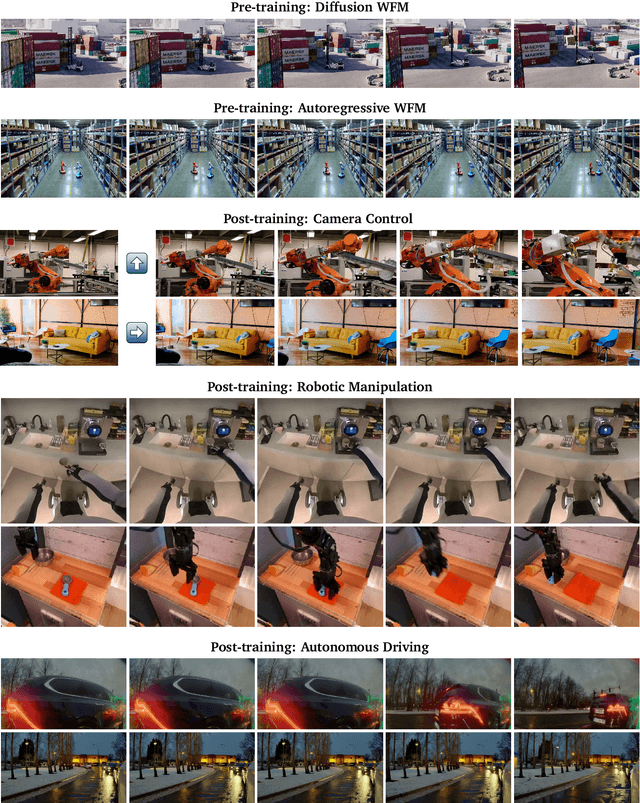
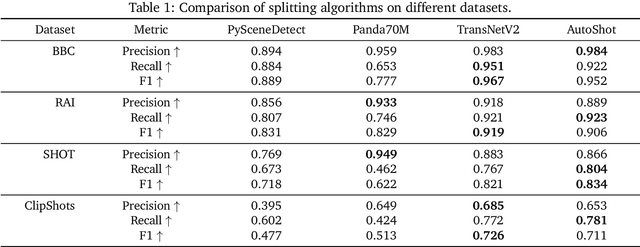
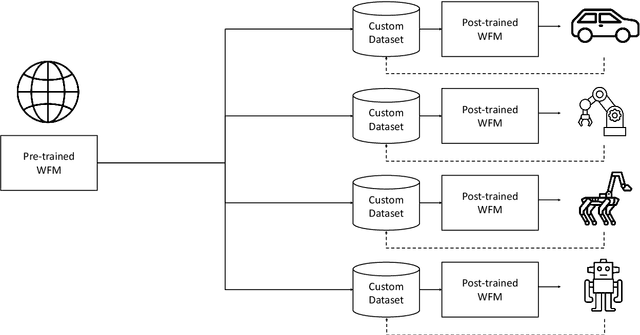

Physical AI needs to be trained digitally first. It needs a digital twin of itself, the policy model, and a digital twin of the world, the world model. In this paper, we present the Cosmos World Foundation Model Platform to help developers build customized world models for their Physical AI setups. We position a world foundation model as a general-purpose world model that can be fine-tuned into customized world models for downstream applications. Our platform covers a video curation pipeline, pre-trained world foundation models, examples of post-training of pre-trained world foundation models, and video tokenizers. To help Physical AI builders solve the most critical problems of our society, we make our platform open-source and our models open-weight with permissive licenses available via https://github.com/NVIDIA/Cosmos.
Edify 3D: Scalable High-Quality 3D Asset Generation
Nov 11, 2024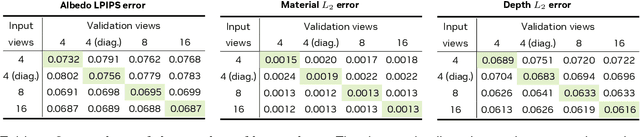
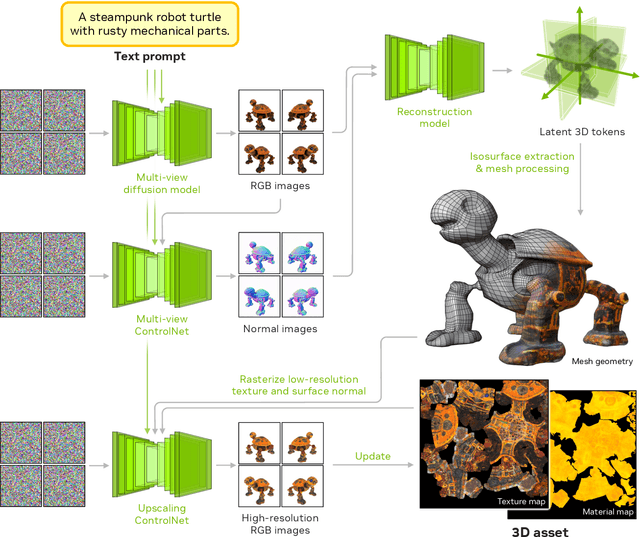
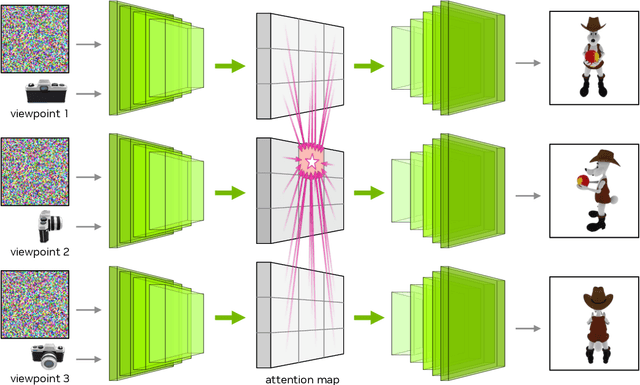
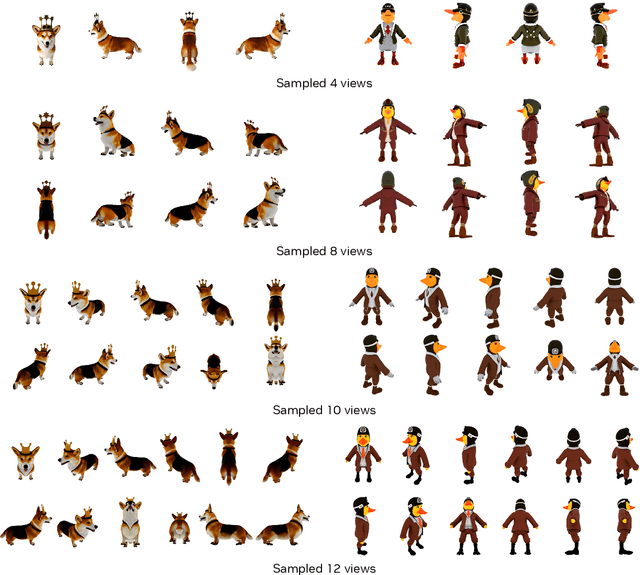
We introduce Edify 3D, an advanced solution designed for high-quality 3D asset generation. Our method first synthesizes RGB and surface normal images of the described object at multiple viewpoints using a diffusion model. The multi-view observations are then used to reconstruct the shape, texture, and PBR materials of the object. Our method can generate high-quality 3D assets with detailed geometry, clean shape topologies, high-resolution textures, and materials within 2 minutes of runtime.
Neuralangelo: High-Fidelity Neural Surface Reconstruction
Jun 12, 2023Neural surface reconstruction has been shown to be powerful for recovering dense 3D surfaces via image-based neural rendering. However, current methods struggle to recover detailed structures of real-world scenes. To address the issue, we present Neuralangelo, which combines the representation power of multi-resolution 3D hash grids with neural surface rendering. Two key ingredients enable our approach: (1) numerical gradients for computing higher-order derivatives as a smoothing operation and (2) coarse-to-fine optimization on the hash grids controlling different levels of details. Even without auxiliary inputs such as depth, Neuralangelo can effectively recover dense 3D surface structures from multi-view images with fidelity significantly surpassing previous methods, enabling detailed large-scale scene reconstruction from RGB video captures.
ATT3D: Amortized Text-to-3D Object Synthesis
Jun 06, 2023
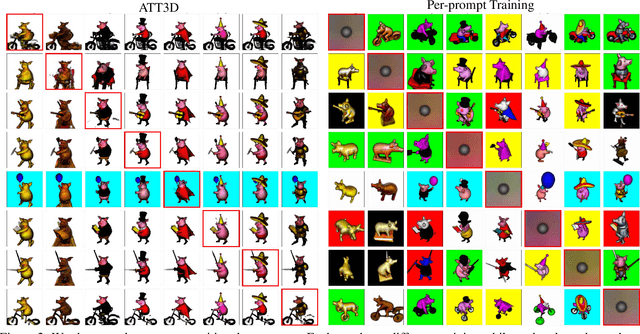
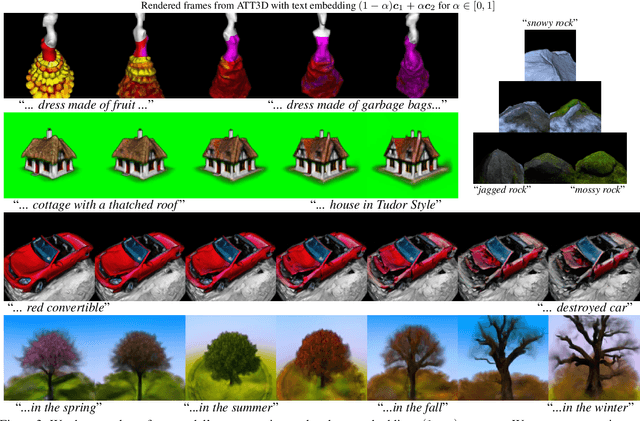
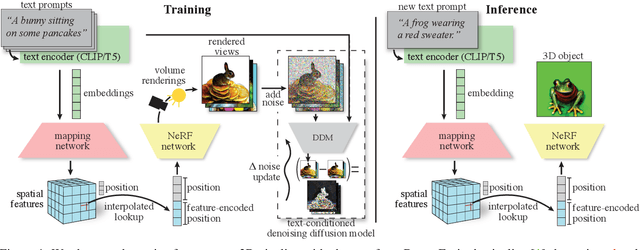
Text-to-3D modelling has seen exciting progress by combining generative text-to-image models with image-to-3D methods like Neural Radiance Fields. DreamFusion recently achieved high-quality results but requires a lengthy, per-prompt optimization to create 3D objects. To address this, we amortize optimization over text prompts by training on many prompts simultaneously with a unified model, instead of separately. With this, we share computation across a prompt set, training in less time than per-prompt optimization. Our framework - Amortized text-to-3D (ATT3D) - enables knowledge-sharing between prompts to generalize to unseen setups and smooth interpolations between text for novel assets and simple animations.
Magic3D: High-Resolution Text-to-3D Content Creation
Nov 18, 2022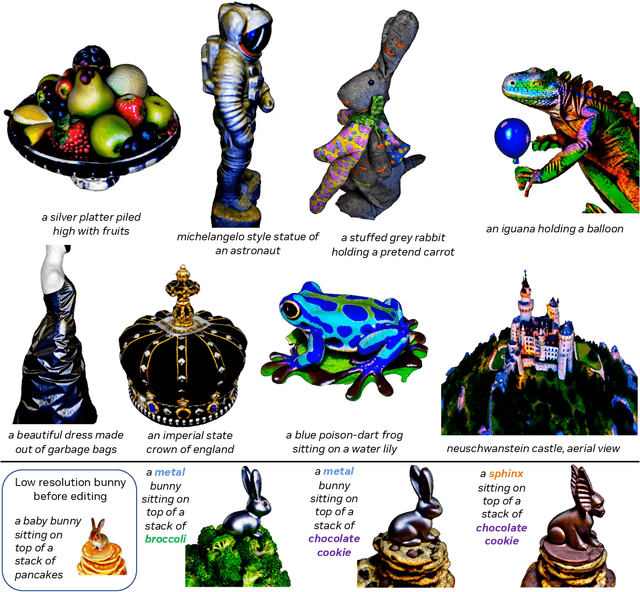
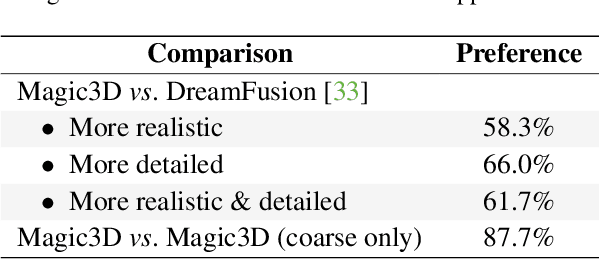
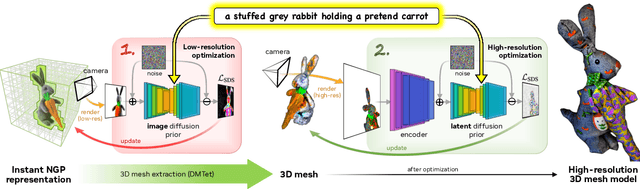
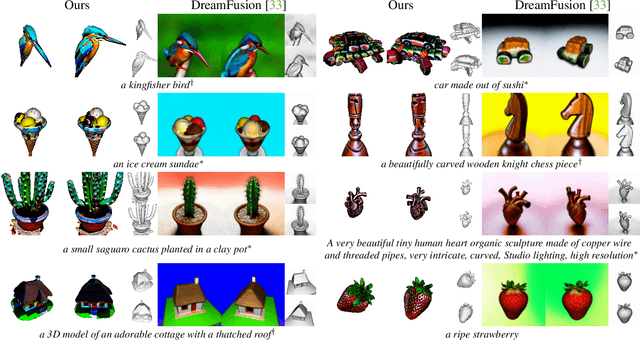
DreamFusion has recently demonstrated the utility of a pre-trained text-to-image diffusion model to optimize Neural Radiance Fields (NeRF), achieving remarkable text-to-3D synthesis results. However, the method has two inherent limitations: (a) extremely slow optimization of NeRF and (b) low-resolution image space supervision on NeRF, leading to low-quality 3D models with a long processing time. In this paper, we address these limitations by utilizing a two-stage optimization framework. First, we obtain a coarse model using a low-resolution diffusion prior and accelerate with a sparse 3D hash grid structure. Using the coarse representation as the initialization, we further optimize a textured 3D mesh model with an efficient differentiable renderer interacting with a high-resolution latent diffusion model. Our method, dubbed Magic3D, can create high quality 3D mesh models in 40 minutes, which is 2x faster than DreamFusion (reportedly taking 1.5 hours on average), while also achieving higher resolution. User studies show 61.7% raters to prefer our approach over DreamFusion. Together with the image-conditioned generation capabilities, we provide users with new ways to control 3D synthesis, opening up new avenues to various creative applications.