 Add to Chrome
 Add to Firefox
 Add to Edge
Mage-VL: An Efficient Codec-Native Streaming Multimodal Foundation Model
Jul 27, 2026
Standard vision-language models (VLMs) suffer from Moravec's paradox: they excel at complex offline visual reasoning but struggle with simple streaming perception tasks and process them inefficiently. We present Mage-VL, an efficient codec-native streaming foundation model for real-time multimodal understanding and interaction. At its core, our custom tokenizer, Mage-ViT, replaces uniform frame sampling by selectively encoding dynamic, entropy-rich regions using motion vectors and residual energy across sparse anchor (I) and predicted (P) frames. Operating at a 16 x 16 patch level, this reduces visual token consumption by over 75% while preserving spatiotemporal context. Trained from scratch on approximately 560M unlabeled images and 100M unlabeled video frames, Mage-ViT matches or outperforms flagship encoders trained on billions of image-text pairs. We establish AI4AI data pipelines encompassing prompt-code joint optimization for multimodal captioning and AI-driven performance diagnosis to guide training recipes. Furthermore, through a bio-inspired dual-system architecture - a lightweight System 1 event gate and a causal System 2 decoder - Mage-VL enables proactive streaming perception. Extensive evaluations show that Mage-VL-4B matches Qwen3-VL-4B on static tasks while achieving strong gains in video understanding and 2D/3D spatial reasoning, with up to a 3.5x wall-clock inference speedup, and comprehensively surpasses the 15B Phi-4-reasoning-vision baseline. Beyond model artifacts, we deliver seven key empirical findings covering pre-training data efficiency, variable-resolution scaling, codec system acceleration, VideoQA SFT redundancy, motion-spatial synergy, AI4AI data pipelines, and Zero-Vision SFT for multimodal RL.

Mage-Flow: An Efficient Native-Resolution Foundation Model for Image Generation and Editing
Jul 21, 2026Large-scale visual generators are increasingly capable but costly to train, fine-tune, and deploy. We introduce Mage-Flow, a compact 4B-scale generative stack for efficient text-to-image generation and instruction-based image editing. The stack is built from two co-designed components: Mage-VAE, a lightweight high-fidelity latent tokenizer, and a Native-Resolution Multimodal Diffusion Transformer trained with rectified flow matching. Mage-VAE uses one-step diffusion-style encoding and decoding with anchor-latent regularization, preserving the reconstruction quality of strong public VAEs while reducing tokenization cost by more than an order of magnitude. Together with native-resolution packing and stack-level CUDA kernel fusion, the stack supports flexible-resolution training and improves end-to-end training throughput by about $2.5\times$. Built on this foundation, we develop a complete model family with Base, RL-aligned, and Turbo variants for both generation and editing. Diffusion-NFT improves prompt following, text rendering, aesthetic quality, and editing fidelity, while few-step distillation with adversarial perceptual guidance produces 4-step Turbo models for low-latency inference. Despite its compact scale, Mage-Flow and Mage-Flow-Edit achieves competitive performance across standard generation and editing benchmarks. More importantly, the Turbo variants make high-resolution generation and editing practical for interactive use: at $1024^2$ resolution on a single NVIDIA A100 GPU, Mage-Flow-Turbo generates an image in 0.59s, and Mage-Flow-Edit-Turbo edits an image in 1.02s, while maintaining a small memory footprint. These results show that careful tokenizer--backbone--system co-design can deliver strong high-resolution generation and editing within an efficient 4B model family.
Ink3D: Sculpting 3D Assets with Extremely Complex Textures via Video Generative Models
Jul 01, 2026Recent 3D generative models can synthesize high-quality geometry but often struggle to reproduce intricate textures from reference images, largely due to the scarcity of large-scale 3D training data with rich surface appearance. In contrast, visual generative models are trained on datasets several orders of magnitude larger and excel at modeling complex visual patterns. Motivated by this gap, we introduce Ink3D, a framework that bridges 3D generation with large-scale video generative models to synthesize extremely complex textures. Ink3D first reconstructs a white-mesh geometry using an off-the-shelf 3D generation model. It then employs OrbitPainter, a conditional video generative model, to produce dense orbit-scan videos capturing object appearance across viewpoints. To convert these views into coherent textures, we introduce TextureOptimizer, a neural baking module that integrates dense multi-view observations while mitigating geometry inconsistencies arising from video generation. By decoupling geometry and texture synthesis and leveraging large-scale pretrained video priors, Ink3D enables significantly richer and more faithful texture generation than prior approaches.
Training-Free Image Editing with Visual Context Integration and Concept Alignment
Apr 06, 2026In image editing, it is essential to incorporate a context image to convey the user's precise requirements, such as subject appearance or image style. Existing training-based visual context-aware editing methods incur data collection effort and training cost. On the other hand, the training-free alternatives are typically established on diffusion inversion, which struggles with consistency and flexibility. In this work, we propose VicoEdit, a training-free and inversion-free method to inject the visual context into the pretrained text-prompted editing model. More specifically, VicoEdit directly transforms the source image into the target one based on the visual context, thereby eliminating the need for inversion that can lead to deviated trajectories. Moreover, we design a posterior sampling approach guided by concept alignment to enhance the editing consistency. Empirical results demonstrate that our training-free method achieves even better editing performance than the state-of-the-art training-based models.
Real-Time Human Frontal View Synthesis from a Single Image
Mar 16, 2026Photorealistic human novel view synthesis from a single image is crucial for democratizing immersive 3D telepresence, eliminating the need for complex multi-camera setups. However, current rendering-centric methods prioritize visual fidelity over explicit geometric understanding and struggle with intricate regions like faces and hands, leading to temporal instability. Meanwhile, human-centric frameworks suffer from memory bottlenecks since they typically rely on an auxiliary model to provide informative structural priors for geometric modeling, which limits real-time performance. To address these challenges, we propose PrismMirror, a geometry-guided framework for instant frontal view synthesis from a single image. By avoiding external geometric modeling and focusing on frontal view synthesis, our model optimizes visual integrity for telepresence. Specifically, PrismMirror introduces a novel cascade learning strategy that enables coarse-to-fine geometric feature learning. It first directly learns coarse geometric features, such as SMPL-X meshes and point clouds, and then refines textures through rendering supervision. To achieve real-time efficiency, we distill this unified framework into a lightweight linear attention model. Notably, PrismMirror is the first monocular human frontal view synthesis model that achieves real-time inference at 24 FPS, significantly outperforming previous methods in both visual authenticity and structural accuracy.
Token-level Data Selection for Safe LLM Fine-tuning
Mar 01, 2026Fine-tuning large language models (LLMs) on custom datasets has become a standard approach for adapting these models to specific domains and applications. However, recent studies have shown that such fine-tuning can lead to significant degradation in the model's safety. Existing defense methods operate at the sample level and often suffer from an unsatisfactory trade-off between safety and utility. To address this limitation, we perform a systematic token-level diagnosis of safety degradation during fine-tuning. Based on this, we propose token-level data selection for safe LLM fine-tuning (TOSS), a novel framework that quantifies the safety risk of each token by measuring the loss difference between a safety-degraded model and a utility-oriented model. This token-level granularity enables accurate identification and removal of unsafe tokens, thereby preserving valuable task-specific information. In addition, we introduce a progressive refinement strategy, TOSS-Pro, which iteratively enhances the safety-degraded model's ability to identify unsafe tokens. Extensive experiments demonstrate that our approach robustly safeguards LLMs during fine-tuning while achieving superior downstream task performance, significantly outperforming existing sample-level defense methods. Our code is available at https://github.com/Polly-LYP/TOSS.
Flash-VAED: Plug-and-Play VAE Decoders for Efficient Video Generation
Feb 22, 2026Latent diffusion models have enabled high-quality video synthesis, yet their inference remains costly and time-consuming. As diffusion transformers become increasingly efficient, the latency bottleneck inevitably shifts to VAE decoders. To reduce their latency while maintaining quality, we propose a universal acceleration framework for VAE decoders that preserves full alignment with the original latent distribution. Specifically, we propose (1) an independence-aware channel pruning method to effectively mitigate severe channel redundancy, and (2) a stage-wise dominant operator optimization strategy to address the high inference cost of the widely used causal 3D convolutions in VAE decoders. Based on these innovations, we construct a Flash-VAED family. Moreover, we design a three-phase dynamic distillation framework that efficiently transfers the capabilities of the original VAE decoder to Flash-VAED. Extensive experiments on Wan and LTX-Video VAE decoders demonstrate that our method outperforms baselines in both quality and speed, achieving approximately a 6$\times$ speedup while maintaining the reconstruction performance up to 96.9%. Notably, Flash-VAED accelerates the end-to-end generation pipeline by up to 36% with negligible quality drops on VBench-2.0.
Mon3tr: Monocular 3D Telepresence with Pre-built Gaussian Avatars as Amortization
Jan 12, 2026Immersive telepresence aims to transform human interaction in AR/VR applications by enabling lifelike full-body holographic representations for enhanced remote collaboration. However, existing systems rely on hardware-intensive multi-camera setups and demand high bandwidth for volumetric streaming, limiting their real-time performance on mobile devices. To overcome these challenges, we propose Mon3tr, a novel Monocular 3D telepresence framework that integrates 3D Gaussian splatting (3DGS) based parametric human modeling into telepresence for the first time. Mon3tr adopts an amortized computation strategy, dividing the process into a one-time offline multi-view reconstruction phase to build a user-specific avatar and a monocular online inference phase during live telepresence sessions. A single monocular RGB camera is used to capture body motions and facial expressions in real time to drive the 3DGS-based parametric human model, significantly reducing system complexity and cost. The extracted motion and appearance features are transmitted at < 0.2 Mbps over WebRTC's data channel, allowing robust adaptation to network fluctuations. On the receiver side, e.g., Meta Quest 3, we develop a lightweight 3DGS attribute deformation network to dynamically generate corrective 3DGS attribute adjustments on the pre-built avatar, synthesizing photorealistic motion and appearance at ~ 60 FPS. Extensive experiments demonstrate the state-of-the-art performance of our method, achieving a PSNR of > 28 dB for novel poses, an end-to-end latency of ~ 80 ms, and > 1000x bandwidth reduction compared to point-cloud streaming, while supporting real-time operation from monocular inputs across diverse scenarios. Our demos can be found at https://mon3tr3d.github.io.
Spatia: Video Generation with Updatable Spatial Memory
Dec 17, 2025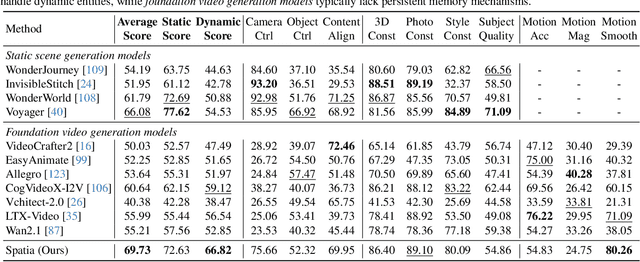
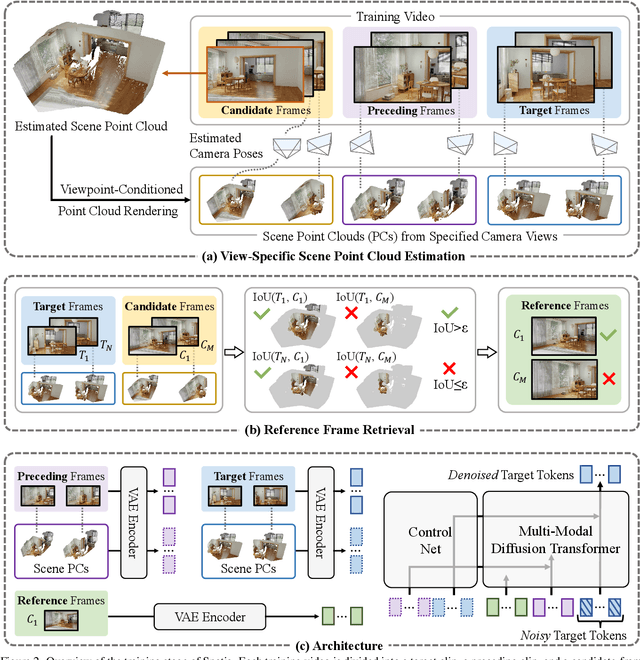
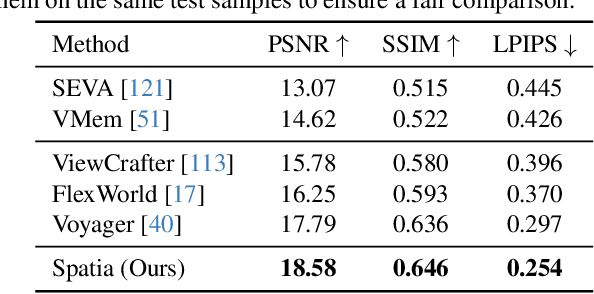
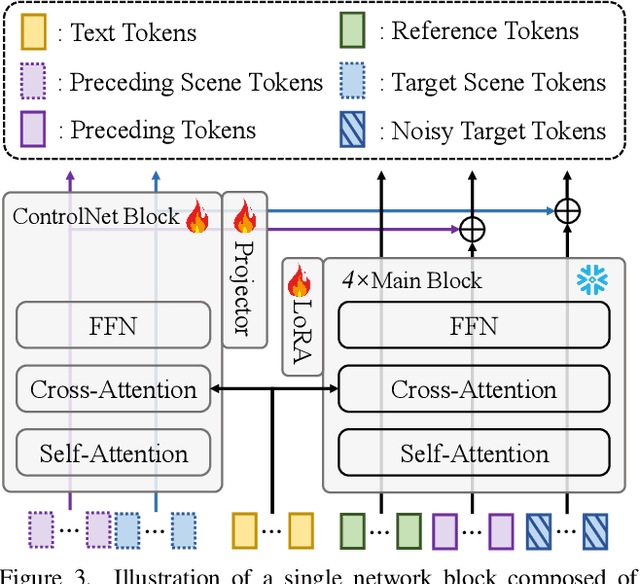
Existing video generation models struggle to maintain long-term spatial and temporal consistency due to the dense, high-dimensional nature of video signals. To overcome this limitation, we propose Spatia, a spatial memory-aware video generation framework that explicitly preserves a 3D scene point cloud as persistent spatial memory. Spatia iteratively generates video clips conditioned on this spatial memory and continuously updates it through visual SLAM. This dynamic-static disentanglement design enhances spatial consistency throughout the generation process while preserving the model's ability to produce realistic dynamic entities. Furthermore, Spatia enables applications such as explicit camera control and 3D-aware interactive editing, providing a geometrically grounded framework for scalable, memory-driven video generation.
Task-Oriented Feature Compression for Multimodal Understanding via Device-Edge Co-Inference
Mar 17, 2025With the rapid development of large multimodal models (LMMs), multimodal understanding applications are emerging. As most LMM inference requests originate from edge devices with limited computational capabilities, the predominant inference pipeline involves directly forwarding the input data to an edge server which handles all computations. However, this approach introduces high transmission latency due to limited uplink bandwidth of edge devices and significant computation latency caused by the prohibitive number of visual tokens, thus hindering delay-sensitive tasks and degrading user experience. To address this challenge, we propose a task-oriented feature compression (TOFC) method for multimodal understanding in a device-edge co-inference framework, where visual features are merged by clustering and encoded by a learnable and selective entropy model before feature projection. Specifically, we employ density peaks clustering based on K nearest neighbors to reduce the number of visual features, thereby minimizing both data transmission and computational complexity. Subsequently, a learnable entropy model with hyperprior is utilized to encode and decode merged features, further reducing transmission overhead. To enhance compression efficiency, multiple entropy models are adaptively selected based on the characteristics of the visual features, enabling a more accurate estimation of the probability distribution. Comprehensive experiments on seven visual question answering benchmarks validate the effectiveness of the proposed TOFC method. Results show that TOFC achieves up to 60% reduction in data transmission overhead and 50% reduction in system latency while maintaining identical task performance, compared with traditional image compression methods.