 Add to Chrome
 Add to Firefox
 Add to Edge
Visual-Seeker: Towards Visual-Native Multimodal Agentic Search via Active Visual Reasoning
Jun 13, 2026
Multimodal large language models (MLLMs) have demonstrated impressive capabilities in many visual tasks, but they often struggle with factual grounding when confronted with complex, open-world scenarios. While recent multimodal deep search agents attempt to address this issue by utilizing external tools, the visual-native search paradigm remains underexplored. Existing methods primarily rely on simple images with explicit semantics and text-only evidence trajectories, limiting the agent's ability to perform multi-hop, cross-modal reasoning and search. To address these limitations, we propose Visual-Seeker, a visual-native multimodal deep search agent via active visual reasoning. Rather than treating vision as a static input, our agent actively attends to fine-grained visual details, dynamically harvests visual evidence throughout the search process. To unlock its visual-native potential, we design an active visual reasoning data pipeline and synthesize 5K high-quality multimodal trajectories for model training. Extensive experiments demonstrate the state-of-the-art performance across five challenging multimodal search benchmarks, even surpassing several proprietary models, validating robust visual-native reasoning and search in real-world web environments. The code and data can be accessed at: https://github.com/ZhengboZhang/Visual-Seeker.

JobBench: Aligning Agent Work With Human Will
May 25, 2026Current benchmarks for occupational AI agents are scoped primarily by economic values, telling a replacement story. We introduce JobBench, which evaluates AI agents on the workflows that experts identify as high-priority for delegation, empowering humans based on their needs instead of replacing them with GDP value. JobBench covers 130 agentic tasks across 35 occupations. Each task is packaged as a workspace of heterogeneous reference files, requiring the agent to reason through the cluttered information streams of real professional work. Outputs are graded by a fact-anchored chain of rubrics, averaging 35.6 binary criteria per task. We evaluate 36 models; the strongest, Claude Opus~4.7 under Claude Code, reaches only 45.9 %. We hope JobBench shifts the community's target labour-market effect from replacement to enhancement: building agents that do what humans actually want delegated, not only what is most economically valuable.
The WidthWall: A Strict Expressivity Hierarchy for Hypergraph Neural Networks
May 13, 2026Hypergraphs provide a natural framework to model higher-order interactions in scientific, social, and biological systems. Hypergraph neural networks (HGNNs) aim to learn from such data, yet it remains unclear which higher-order structures these models can represent. We show that hypergraph expressivity is governed by which small patterns an architecture can detect and count. We formalize this via homomorphism densities, which measure how often a structural motif appears in a hypergraph. Combining classical homomorphism-count completeness with invariant approximation, we show that homomorphism densities generate all continuous hypergraph invariants and organize them into a strict hierarchy indexed by hypertree width. This yields a Width Wall: a fundamental architectural limit beyond which no hidden dimension, training procedure or fixed-depth HGNN can represent invariants requiring wider patterns. Our framework provides a unified characterization of 15 HGNN architectures, precisely identifies information lost by clique expansion, and motivates density-aware models that extend expressivity beyond bounded-width message passing. We experimentally validate this finding on an APPLICATION NODE CLASSIFICATION SUITE of real-world hypergraphs, where the Width Wall predicts when graph-reduction baselines fail and when density features help.
Polyhedral Instability Governs Regret in Online Learning
May 13, 2026Many online decision problems over combinatorial actions are addressed via convex relaxations, leading to online convex optimization with piecewise linear objectives and induced polyhedral structure. We show that regret in such problems is governed by \emph{polyhedral instability}: the number of changes of the active region. Under full information feedback and fixed partition assumptions, if $\mathrm{RS}_T$ denotes the number of region switches and $V_{\max}$ the maximum number of vertices per region, we prove $\Regret_T= Θ(\sqrt{(1+\mathrm{RS}_T)\,T\,\log V_{\max}})$ interpolating between experts-like and dimension-dependent OCO rates. For online submodular--concave games under Lovász convexification, this reduces to the permutation-switch count $\mathrm{SC}_T$, yielding the matching rate $\Regret_T= Θ(\sqrt{(1+\mathrm{SC}_T)\,T\,\log n})$. Experiments on synthetic and real combinatorial problems (shortest path, influence maximization) validate the predicted scaling and indicate that low-instability regimes can arise in practice without explicit enumeration of actions.
Visual Aesthetic Benchmark: Can Frontier Models Judge Beauty?
May 12, 2026Multimodal large language models (MLLMs) are now routinely deployed for visual understanding, generation, and curation. A substantial fraction of these applications require an explicit aesthetic judgment. Most existing solutions reduce this judgment to predicting a scalar score for a single image. We first ask whether such scores faithfully capture comparative preference: in a controlled study with eight expert annotators, score-derived rankings align poorly with the same annotators' direct comparisons, while direct ranking yields substantially higher inter-annotator agreement on best- and worst-image labels. Motivated by this finding, we introduce the Visual Aesthetic Benchmark (VAB), which casts aesthetic evaluation as comparative selection over candidate sets with matched subject matter. VAB contains 400 tasks and 1,195 images across fine art, photography, and illustration, with labels derived from the consensus of 10 independent expert judges per task. Evaluating 20 frontier MLLMs and six dedicated visual-quality reward models, we find that the strongest system identifies both the best and the worst image correctly across three random permutations of the candidate order in only 26.5% of tasks, far below the 68.9% achieved by human experts. Fine-tuning a 35B-parameter model on 2,000 expert examples brings its accuracy close to that of a 397B-parameter open-weight model, suggesting that the comparative signal in VAB is transferable. Together, these results expose a clear and measurable gap between current multimodal models and expert aesthetic judgment, and VAB provides the first set-based, expert-grounded testbed on which that gap can be tracked and closed.
World Action Models are Zero-shot Policies
Feb 17, 2026State-of-the-art Vision-Language-Action (VLA) models excel at semantic generalization but struggle to generalize to unseen physical motions in novel environments. We introduce DreamZero, a World Action Model (WAM) built upon a pretrained video diffusion backbone. Unlike VLAs, WAMs learn physical dynamics by predicting future world states and actions, using video as a dense representation of how the world evolves. By jointly modeling video and action, DreamZero learns diverse skills effectively from heterogeneous robot data without relying on repetitive demonstrations. This results in over 2x improvement in generalization to new tasks and environments compared to state-of-the-art VLAs in real robot experiments. Crucially, through model and system optimizations, we enable a 14B autoregressive video diffusion model to perform real-time closed-loop control at 7Hz. Finally, we demonstrate two forms of cross-embodiment transfer: video-only demonstrations from other robots or humans yield a relative improvement of over 42% on unseen task performance with just 10-20 minutes of data. More surprisingly, DreamZero enables few-shot embodiment adaptation, transferring to a new embodiment with only 30 minutes of play data while retaining zero-shot generalization.
Beyond Next-Token Alignment: Distilling Multimodal Large Language Models via Token Interactions
Feb 10, 2026Multimodal Large Language Models (MLLMs) demonstrate impressive cross-modal capabilities, yet their substantial size poses significant deployment challenges. Knowledge distillation (KD) is a promising solution for compressing these models, but existing methods primarily rely on static next-token alignment, neglecting the dynamic token interactions, which embed essential capabilities for multimodal understanding and generation. To this end, we introduce Align-TI, a novel KD framework designed from the perspective of Token Interactions. Our approach is motivated by the insight that MLLMs rely on two primary interactions: vision-instruction token interactions to extract relevant visual information, and intra-response token interactions for coherent generation. Accordingly, Align-TI introduces two components: IVA enables the student model to imitate the teacher's instruction-relevant visual information extract capability by aligning on salient visual regions. TPA captures the teacher's dynamic generative logic by aligning the sequential token-to-token transition probabilities. Extensive experiments demonstrate Align-TI's superiority. Notably, our approach achieves $2.6\%$ relative improvement over Vanilla KD, and our distilled Align-TI-2B even outperforms LLaVA-1.5-7B (a much larger MLLM) by $7.0\%$, establishing a new state-of-the-art distillation framework for training parameter-efficient MLLMs. Code is available at https://github.com/lchen1019/Align-TI.
DreamDojo: A Generalist Robot World Model from Large-Scale Human Videos
Feb 06, 2026Being able to simulate the outcomes of actions in varied environments will revolutionize the development of generalist agents at scale. However, modeling these world dynamics, especially for dexterous robotics tasks, poses significant challenges due to limited data coverage and scarce action labels. As an endeavor towards this end, we introduce DreamDojo, a foundation world model that learns diverse interactions and dexterous controls from 44k hours of egocentric human videos. Our data mixture represents the largest video dataset to date for world model pretraining, spanning a wide range of daily scenarios with diverse objects and skills. To address the scarcity of action labels, we introduce continuous latent actions as unified proxy actions, enhancing interaction knowledge transfer from unlabeled videos. After post-training on small-scale target robot data, DreamDojo demonstrates a strong understanding of physics and precise action controllability. We also devise a distillation pipeline that accelerates DreamDojo to a real-time speed of 10.81 FPS and further improves context consistency. Our work enables several important applications based on generative world models, including live teleoperation, policy evaluation, and model-based planning. Systematic evaluation on multiple challenging out-of-distribution (OOD) benchmarks verifies the significance of our method for simulating open-world, contact-rich tasks, paving the way for general-purpose robot world models.
DreamGen: Unlocking Generalization in Robot Learning through Neural Trajectories
May 19, 2025We introduce DreamGen, a simple yet highly effective 4-stage pipeline for training robot policies that generalize across behaviors and environments through neural trajectories - synthetic robot data generated from video world models. DreamGen leverages state-of-the-art image-to-video generative models, adapting them to the target robot embodiment to produce photorealistic synthetic videos of familiar or novel tasks in diverse environments. Since these models generate only videos, we recover pseudo-action sequences using either a latent action model or an inverse-dynamics model (IDM). Despite its simplicity, DreamGen unlocks strong behavior and environment generalization: a humanoid robot can perform 22 new behaviors in both seen and unseen environments, while requiring teleoperation data from only a single pick-and-place task in one environment. To evaluate the pipeline systematically, we introduce DreamGen Bench, a video generation benchmark that shows a strong correlation between benchmark performance and downstream policy success. Our work establishes a promising new axis for scaling robot learning well beyond manual data collection.
Anyprefer: An Agentic Framework for Preference Data Synthesis
Apr 27, 2025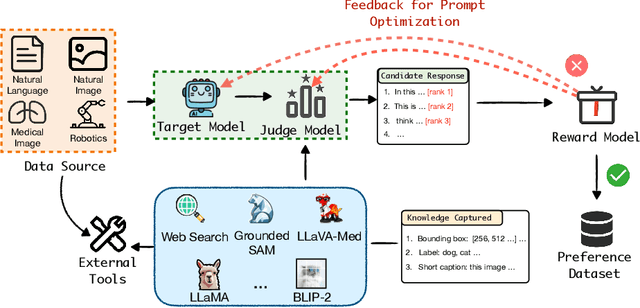
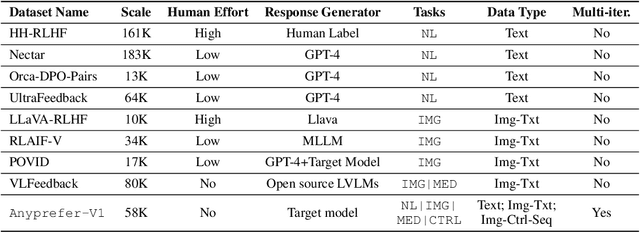
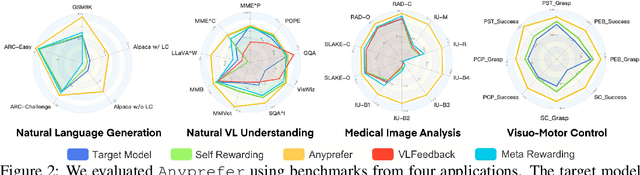
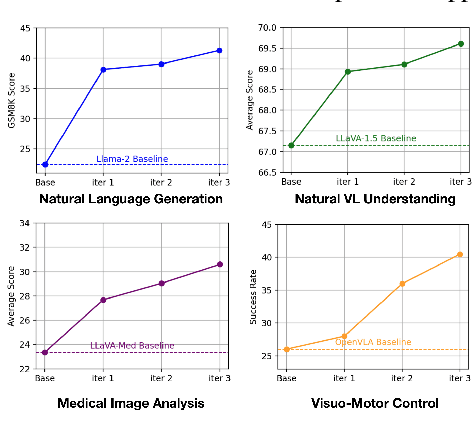
High-quality preference data is essential for aligning foundation models with human values through preference learning. However, manual annotation of such data is often time-consuming and costly. Recent methods often adopt a self-rewarding approach, where the target model generates and annotates its own preference data, but this can lead to inaccuracies since the reward model shares weights with the target model, thereby amplifying inherent biases. To address these issues, we propose Anyprefer, a framework designed to synthesize high-quality preference data for aligning the target model. Anyprefer frames the data synthesis process as a cooperative two-player Markov Game, where the target model and the judge model collaborate together. Here, a series of external tools are introduced to assist the judge model in accurately rewarding the target model's responses, mitigating biases in the rewarding process. In addition, a feedback mechanism is introduced to optimize prompts for both models, enhancing collaboration and improving data quality. The synthesized data is compiled into a new preference dataset, Anyprefer-V1, consisting of 58K high-quality preference pairs. Extensive experiments show that Anyprefer significantly improves model alignment performance across four main applications, covering 21 datasets, achieving average improvements of 18.55% in five natural language generation datasets, 3.66% in nine vision-language understanding datasets, 30.05% in three medical image analysis datasets, and 16.00% in four visuo-motor control tasks.