 Add to Chrome
 Add to Firefox
 Add to Edge
XPolicyLab: A Unified Standard and Open Ecosystem for Robot Policy Evaluation and Deployment
Aug 11, 2026
Robot policy evaluation and deployment remain fragmented by model-specific software dependencies, data representations, and runtime interfaces, so that connecting N policies to M evaluation environments requires O(NM) separate integrations. We present XPolicyLab, a unified standard and open ecosystem that reduces this cost to O(N+M). XPolicyLab specifies common observation, action, and trajectory schemas together with a minimal adapter interface for observation updates, action prediction, batched execution, and episode reset, while a dependency-isolated client/server architecture separates policy inference from environment execution, so that each side retains its native software stack and may run locally or remotely. The ecosystem integrates 42 robot policies and standardizes their installation, debugging, serving, and evaluation workflows. Across these adapters, model-specific code varies by an order of magnitude while the environment-facing loop stays within a few lines of a fixed reference, confirming that the contract confines heterogeneity to the policy side. In a controlled study, conforming to the standard reduces the integration effort of a representative policy from over five hours to two hours, and packaged agent skills reduce it further to thirty minutes. The same adapters serve RoboTwin, RoboDojo simulation, and standardized real-robot evaluation through one interface. XPolicyLab is released as shared infrastructure for reproducible policy comparison and standardized deployment across simulation and physical platforms. Project website: https://xpolicylab.github.io/.

Enfold: Folding World Model Imagination into Predictive Representations for Ultra-Efficient Embodied Control
Aug 03, 2026World generative models are typically used through what they produce: a rendered future, a video-conditioned action, or latent context computed by a costly generative branch. We argue that their more reusable asset is the computation that constructs a future. As a generator transforms a corrupted future into a coherent trajectory, its intermediate states organize appearance, spatial layout, and interaction across levels of abstraction. Can this future-generative computation be internalized in a representation inferred from the present alone? We present Enfold, which transfers this computation into a representation predicted from the current visual context and language instruction. During training, multi-level states exposed as the generator processes the observed future supervise a current-only encoder. The learned representation is fed back to condition future generation and is read by task heads without allowing task gradients to reshape the encoder. At deployment, action prediction no longer executes the generator. Across LIBERO, RoboTwin2.0, and real-robot tasks, Enfold supports strong control while reducing action latency by $3.7\times$ relative to Fast--WAM, Enfold-Flash reaches $10.1\times$. Representation analyses show that it suppresses nuisance variation and preferentially captures changes that emerge over longer horizons. When the current scene is altered by human intervention, both the generated continuation and the executed actions adapt, which is inconsistent with fixed trajectory replay. These results recast a world generator as a source of predictive control representations: its future need not be materialized at every step if its internal structure can be enfolded into the present.
Enfold: Folding World-Generator Computation into Predictive Representations for Efficient Embodied Control
Jul 29, 2026World generative models are typically used through what they produce: a rendered future, a video-conditioned action, or latent context computed by a costly generative branch. We argue that their more reusable asset is the computation that constructs a future. As a generator transforms a corrupted future into a coherent trajectory, its intermediate states organize appearance, spatial layout, and interaction across levels of abstraction. Can this future-generative computation be internalized in a representation inferred from the present alone? We present Enfold, which transfers this computation into a representation predicted from the current visual context and language instruction. During training, multi-level states exposed as the generator processes the observed future supervise a current-only encoder. The learned representation is fed back to condition future generation and is read by task heads without allowing task gradients to reshape the encoder. At deployment, action prediction no longer executes the generator. Across LIBERO, RoboTwin2.0, and real-robot tasks, Enfold supports strong control while reducing action latency by $3.7\times$ relative to Fast--WAM, Enfold-Flash reaches $10.1\times$. Representation analyses show that it suppresses nuisance variation and preferentially captures changes that emerge over longer horizons. When the current scene is altered by human intervention, both the generated continuation and the executed actions adapt, which is inconsistent with fixed trajectory replay. These results recast a world generator as a source of predictive control representations: its future need not be materialized at every step if its internal structure can be enfolded into the present.
AHA-WAM:Asynchronous Horizon-Adaptive World-Action Modeling with Observation-Guided Context Routing
Jun 08, 2026World-action models have emerged as a promising paradigm for robot manipulation, jointly modeling visual scene dynamics and actions to inject physical priors into policy learning. However, existing world-action models couple world prediction and action execution at the same temporal resolution, forcing the world branch to model near-term frame variations that are redundant and weakly informative. We posit that strictly binding world prediction and action execution to the same temporal rhythm may underutilize the potential of the video branch for embodied control. Therefore, we propose AHA-WAM, an Asynchronous Horizon-Adaptive World-Action Model built on a dual Diffusion Transformer (DiT) architecture that reorganizes world-action modeling around this temporal asymmetry. AHA-WAM instantiates the video DiT as a low-frequency world planner that maintains rolling key-value memory over past observations and exposes reusable layerwise latent context encoding long-horizon scene evolution, while a high-frequency action DiT executes short action chunks in closed loop by querying this context through layerwise joint attention. To support asynchronous execution, we introduce horizon-adaptive offset training and Observation-Guided Video-Context Routing (OVCR), which together let the action expert exploit long-horizon world context while remaining responsive to real-time execution state without rerunning the video DiT. Experiments on RoboTwin and real-world manipulation tasks show that AHA-WAM achieves state-of-the-art performance without any robot-data pretraining, attaining 92.80% average success on RoboTwin and 78.3% success across 4 real-world tasks, while reaching 24.17 Hz closed-loop control with a 4.59x speedup over Fast-WAM.
UniVLA: Learning to Act Anywhere with Task-centric Latent Actions
May 09, 2025A generalist robot should perform effectively across various environments. However, most existing approaches heavily rely on scaling action-annotated data to enhance their capabilities. Consequently, they are often limited to single physical specification and struggle to learn transferable knowledge across different embodiments and environments. To confront these limitations, we propose UniVLA, a new framework for learning cross-embodiment vision-language-action (VLA) policies. Our key innovation is to derive task-centric action representations from videos with a latent action model. This enables us to exploit extensive data across a wide spectrum of embodiments and perspectives. To mitigate the effect of task-irrelevant dynamics, we incorporate language instructions and establish a latent action model within the DINO feature space. Learned from internet-scale videos, the generalist policy can be deployed to various robots through efficient latent action decoding. We obtain state-of-the-art results across multiple manipulation and navigation benchmarks, as well as real-robot deployments. UniVLA achieves superior performance over OpenVLA with less than 1/20 of pretraining compute and 1/10 of downstream data. Continuous performance improvements are observed as heterogeneous data, even including human videos, are incorporated into the training pipeline. The results underscore UniVLA's potential to facilitate scalable and efficient robot policy learning.
AgiBot World Colosseo: A Large-scale Manipulation Platform for Scalable and Intelligent Embodied Systems
Mar 09, 2025We explore how scalable robot data can address real-world challenges for generalized robotic manipulation. Introducing AgiBot World, a large-scale platform comprising over 1 million trajectories across 217 tasks in five deployment scenarios, we achieve an order-of-magnitude increase in data scale compared to existing datasets. Accelerated by a standardized collection pipeline with human-in-the-loop verification, AgiBot World guarantees high-quality and diverse data distribution. It is extensible from grippers to dexterous hands and visuo-tactile sensors for fine-grained skill acquisition. Building on top of data, we introduce Genie Operator-1 (GO-1), a novel generalist policy that leverages latent action representations to maximize data utilization, demonstrating predictable performance scaling with increased data volume. Policies pre-trained on our dataset achieve an average performance improvement of 30% over those trained on Open X-Embodiment, both in in-domain and out-of-distribution scenarios. GO-1 exhibits exceptional capability in real-world dexterous and long-horizon tasks, achieving over 60% success rate on complex tasks and outperforming prior RDT approach by 32%. By open-sourcing the dataset, tools, and models, we aim to democratize access to large-scale, high-quality robot data, advancing the pursuit of scalable and general-purpose intelligence.
Towards Synergistic, Generalized, and Efficient Dual-System for Robotic Manipulation
Oct 10, 2024
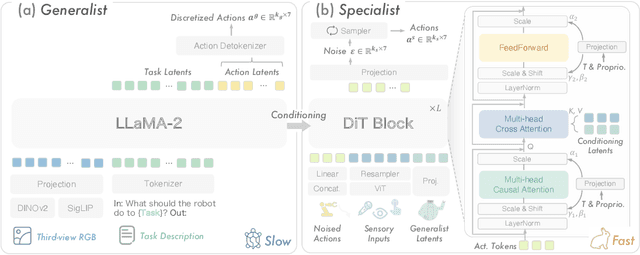
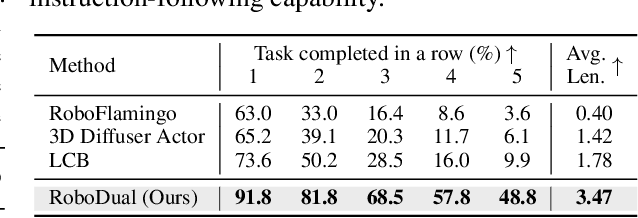
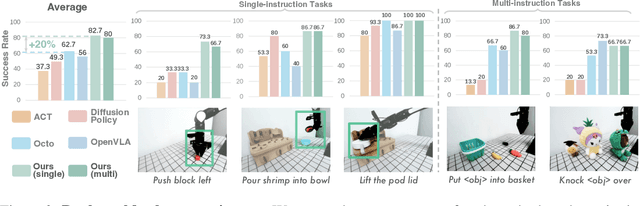
The increasing demand for versatile robotic systems to operate in diverse and dynamic environments has emphasized the importance of a generalist policy, which leverages a large cross-embodiment data corpus to facilitate broad adaptability and high-level reasoning. However, the generalist would struggle with inefficient inference and cost-expensive training. The specialist policy, instead, is curated for specific domain data and excels at task-level precision with efficiency. Yet, it lacks the generalization capacity for a wide range of applications. Inspired by these observations, we introduce RoboDual, a synergistic dual-system that supplements the merits of both generalist and specialist policy. A diffusion transformer-based specialist is devised for multi-step action rollouts, exquisitely conditioned on the high-level task understanding and discretized action output of a vision-language-action (VLA) based generalist. Compared to OpenVLA, RoboDual achieves 26.7% improvement in real-world setting and 12% gain on CALVIN by introducing a specialist policy with merely 20M trainable parameters. It maintains strong performance with 5% of demonstration data only, and enables a 3.8 times higher control frequency in real-world deployment. Code would be made publicly available. Our project page is hosted at: https://opendrivelab.com/RoboDual/
Heterogeneous Federated Learning with Convolutional and Spiking Neural Networks
Jun 14, 2024Federated learning (FL) has emerged as a promising paradigm for training models on decentralized data while safeguarding data privacy. Most existing FL systems, however, assume that all machine learning models are of the same type, although it becomes more likely that different edge devices adopt different types of AI models, including both conventional analogue artificial neural networks (ANNs) and biologically more plausible spiking neural networks (SNNs). This diversity empowers the efficient handling of specific tasks and requirements, showcasing the adaptability and versatility of edge computing platforms. One main challenge of such heterogeneous FL system lies in effectively aggregating models from the local devices in a privacy-preserving manner. To address the above issue, this work benchmarks FL systems containing both convoluntional neural networks (CNNs) and SNNs by comparing various aggregation approaches, including federated CNNs, federated SNNs, federated CNNs for SNNs, federated SNNs for CNNs, and federated CNNs with SNN fusion. Experimental results demonstrate that the CNN-SNN fusion framework exhibits the best performance among the above settings on the MNIST dataset. Additionally, intriguing phenomena of competitive suppression are noted during the convergence process of multi-model FL.