 Add to Chrome
 Add to Firefox
 Add to Edge
SoulX-Duplug: Plug-and-Play Streaming State Prediction Module for Realtime Full-Duplex Speech Conversation
Mar 16, 2026
Recent advances in spoken dialogue systems have brought increased attention to human-like full-duplex voice interactions. However, our comprehensive review of this field reveals several challenges, including the difficulty in obtaining training data, catastrophic forgetting, and limited scalability. In this work, we propose SoulX-Duplug, a plug-and-play streaming state prediction module for full-duplex spoken dialogue systems. By jointly performing streaming ASR, SoulX-Duplug explicitly leverages textual information to identify user intent, effectively serving as a semantic VAD. To promote fair evaluation, we introduce SoulX-Duplug-Eval, extending widely used benchmarks with improved bilingual coverage. Experimental results show that SoulX-Duplug enables low-latency streaming dialogue state control, and the system built upon it outperforms existing full-duplex models in overall turn management and latency performance. We have open-sourced SoulX-Duplug and SoulX-Duplug-Eval.

SLAM-Omni: Timbre-Controllable Voice Interaction System with Single-Stage Training
Dec 20, 2024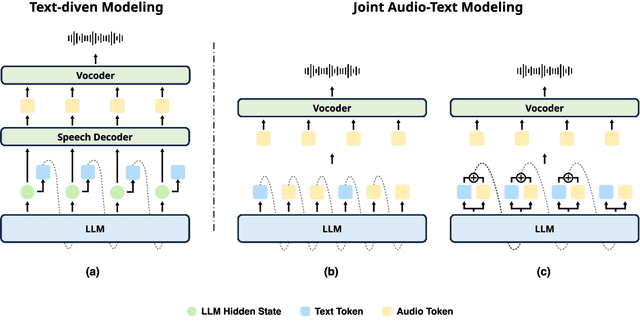
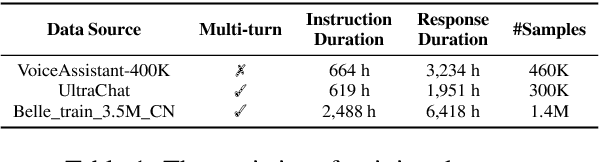
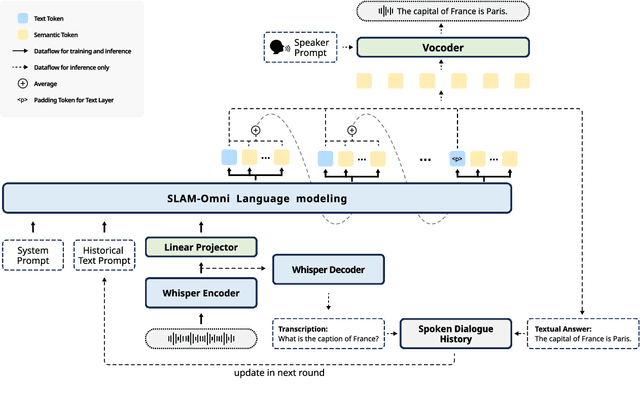
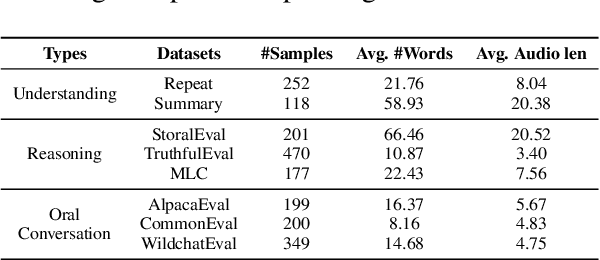
Recent advancements highlight the potential of end-to-end real-time spoken dialogue systems, showcasing their low latency and high quality. In this paper, we introduce SLAM-Omni, a timbre-controllable, end-to-end voice interaction system with single-stage training. SLAM-Omni achieves zero-shot timbre control by modeling spoken language with semantic tokens and decoupling speaker information to a vocoder. By predicting grouped speech semantic tokens at each step, our method significantly reduces the sequence length of audio tokens, accelerating both training and inference. Additionally, we propose historical text prompting to compress dialogue history, facilitating efficient multi-round interactions. Comprehensive evaluations reveal that SLAM-Omni outperforms prior models of similar scale, requiring only 15 hours of training on 4 GPUs with limited data. Notably, it is the first spoken dialogue system to achieve competitive performance with a single-stage training approach, eliminating the need for pre-training on TTS or ASR tasks. Further experiments validate its multilingual and multi-turn dialogue capabilities on larger datasets.