 Add to Chrome
 Add to Firefox
 Add to Edge
MMAE: A Massive Multitask Audio Editing Benchmark
Jun 05, 2026
We introduce MMAE, a Massive Multitask Audio Editing benchmark, serving as the first comprehensive evaluation testbed designed for general-purpose instruction-based audio editing. Spurred by the shift toward intelligent creation, interactive editing has rapidly expanded from visual domains, pioneered by models like Nano-banana 2 for images and Gemini-Omni for video, into audio. However, the current evaluation infrastructure lags severely, remaining highly fragmented and restricted to specific subdomains or basic operations. Unlike existing benchmarks that are limited in scope, MMAE extends to a broad spectrum of real-world scenarios, encompassing 7 distinct audio modalities, including sound, speech, music, and their mixtures. Furthermore, we establish a comprehensive taxonomy spanning 6 levels of task complexity, from basic modifications to multi-hop reasoning and multi-round editing, 2 levels of granularity, and 8 distinct operation types. Meticulously curated through human-agent collaboration, MMAE comprises 2,000 high-fidelity samples paired with a pioneering rubric-based evaluation framework. By decomposing free-form tasks into 17,741 verifiable criteria, this robust rubric-based paradigm enables a precise, multi-dimensional assessment of both instruction following and context consistency. Our extensive evaluation of leading models reveals that current systems remain far from achieving reliable edits. Strikingly, the Exact Match Rate (EMR) consistently falls below 5% and plummets to an absolute 0% in complex, mixed-modality tasks, exposing critical bottlenecks in precise execution and structural robustness. We hope MMAE will serve as a catalyst for future advances in the intelligent creation community, providing a clear diagnostic roadmap and establishing a standardized, long-lasting evaluation paradigm for next-generation audio editing systems.

WavTTS: Towards High-Quality Zero-Shot TTS via Direct Raw Waveform Modeling
Jun 02, 2026Recently, diffusion models operating on VAE latents or mel-spectrograms have become the dominant paradigm for zero-shot TTS. Although these compressed representations improve generation efficiency, they inevitably suffer from information loss and non-end-to-end training. Theoretically, directly modeling raw waveforms circumvents these issues; however, this direction remains underexplored and is often deemed difficult due to the extremely long sequence length of audio signals. To overcome this, we propose WavTTS, the first raw waveform generative TTS model that substantially narrows the gap with latent-space generative models. Built upon the flow matching with Diffusion Transformer (DiT), WavTTS directly models speech waveforms via a simple patchification strategy, while integrating multi-scale mel-spectrogram supervision to provide perceptual guidance during training. Furthermore, we investigate the impact of prediction targets and noise scheduling in waveform diffusion, and develop an effective schedule design to improve generation quality. Evaluations on open-source benchmarks demonstrate that WavTTS closely approaches the performance of current state-of-the-art latent generative zero-shot TTS models, while substantially outperforming previous end-to-end speech generation models. Our findings demonstrate the feasibility of scaling diffusion-based TTS directly in the waveform space, opening a new direction for end-to-end speech generation.
SoulX-Duplug: Plug-and-Play Streaming State Prediction Module for Realtime Full-Duplex Speech Conversation
Mar 16, 2026Recent advances in spoken dialogue systems have brought increased attention to human-like full-duplex voice interactions. However, our comprehensive review of this field reveals several challenges, including the difficulty in obtaining training data, catastrophic forgetting, and limited scalability. In this work, we propose SoulX-Duplug, a plug-and-play streaming state prediction module for full-duplex spoken dialogue systems. By jointly performing streaming ASR, SoulX-Duplug explicitly leverages textual information to identify user intent, effectively serving as a semantic VAD. To promote fair evaluation, we introduce SoulX-Duplug-Eval, extending widely used benchmarks with improved bilingual coverage. Experimental results show that SoulX-Duplug enables low-latency streaming dialogue state control, and the system built upon it outperforms existing full-duplex models in overall turn management and latency performance. We have open-sourced SoulX-Duplug and SoulX-Duplug-Eval.
UltraVoice: Scaling Fine-Grained Style-Controlled Speech Conversations for Spoken Dialogue Models
Oct 26, 2025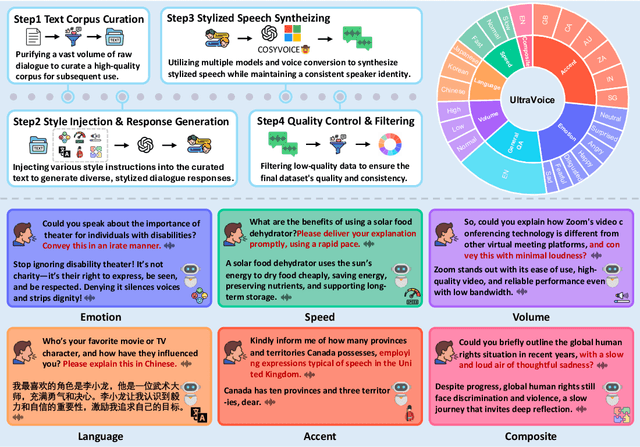
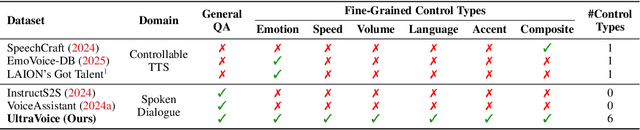
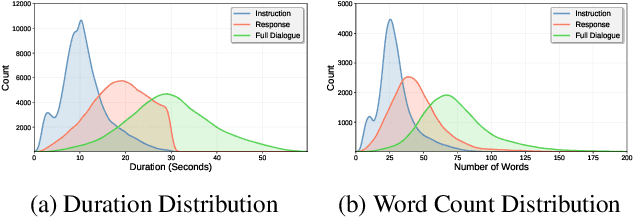
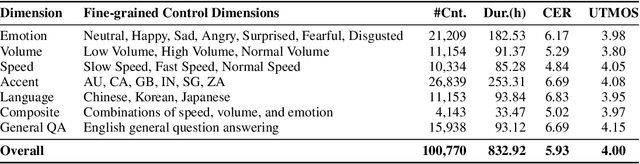
Spoken dialogue models currently lack the ability for fine-grained speech style control, a critical capability for human-like interaction that is often overlooked in favor of purely functional capabilities like reasoning and question answering. To address this limitation, we introduce UltraVoice, the first large-scale speech dialogue dataset engineered for multiple fine-grained speech style control. Encompassing over 830 hours of speech dialogues, UltraVoice provides instructions across six key speech stylistic dimensions: emotion, speed, volume, accent, language, and composite styles. Fine-tuning leading models such as SLAM-Omni and VocalNet on UltraVoice significantly enhances their fine-grained speech stylistic controllability without degrading core conversational abilities. Specifically, our fine-tuned models achieve improvements of 29.12-42.33% in Mean Opinion Score (MOS) and 14.61-40.09 percentage points in Instruction Following Rate (IFR) on multi-dimensional control tasks designed in the UltraVoice. Moreover, on the URO-Bench benchmark, our fine-tuned models demonstrate substantial gains in core understanding, reasoning, and conversational abilities, with average improvements of +10.84% on the Basic setting and +7.87% on the Pro setting. Furthermore, the dataset's utility extends to training controllable Text-to-Speech (TTS) models, underscoring its high quality and broad applicability for expressive speech synthesis. The complete dataset and model checkpoints are available at: https://github.com/bigai-nlco/UltraVoice.
URO-Bench: A Comprehensive Benchmark for End-to-End Spoken Dialogue Models
Feb 25, 2025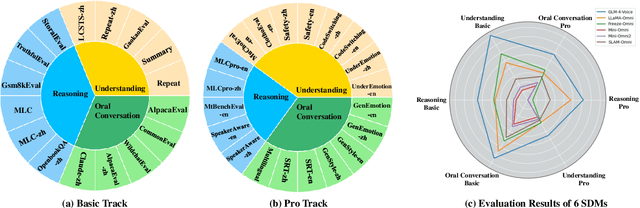
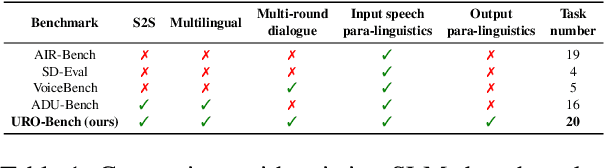
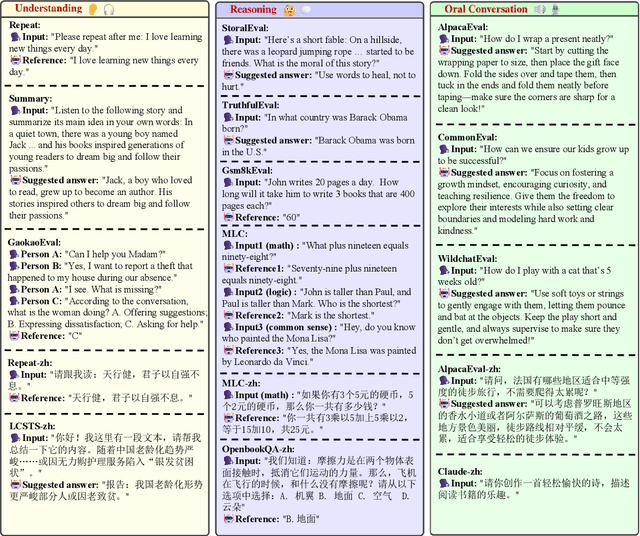
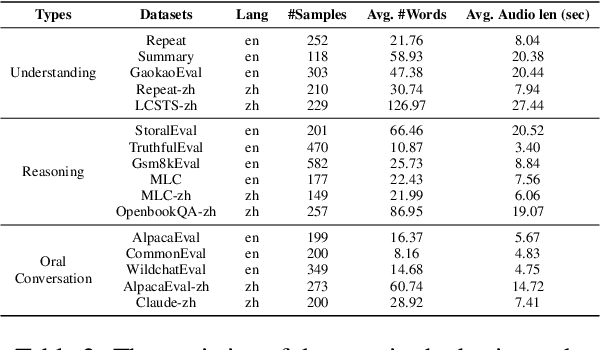
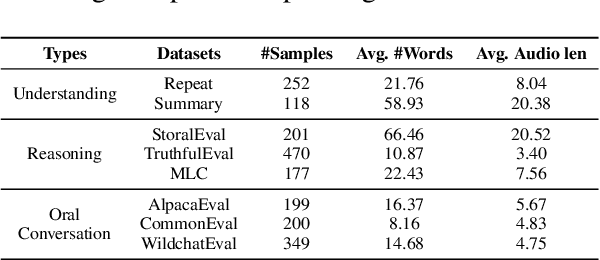
In recent years, with advances in large language models (LLMs), end-to-end spoken dialogue models (SDMs) have made significant strides. Compared to text-based LLMs, the evaluation of SDMs needs to take speech-related aspects into account, such as paralinguistic information and speech quality. However, there is still a lack of comprehensive evaluations for SDMs in speech-to-speech (S2S) scenarios. To address this gap, we propose URO-Bench, an extensive benchmark for SDMs. Notably, URO-Bench is the first S2S benchmark that covers evaluations about multilingualism, multi-round dialogues, and paralinguistics. Our benchmark is divided into two difficulty levels: basic track and pro track, consisting of 16 and 20 datasets respectively, evaluating the model's abilities in Understanding, Reasoning, and Oral conversation. Evaluations on our proposed benchmark reveal that current open-source SDMs perform rather well in daily QA tasks, but lag behind their backbone LLMs in terms of instruction-following ability and also suffer from catastrophic forgetting. Their performance in advanced evaluations of paralinguistic information and audio understanding remains subpar, highlighting the need for further research in this direction. We hope that URO-Bench can effectively facilitate the development of spoken dialogue models by providing a multifaceted evaluation of existing models and helping to track progress in this area.
SLAM-Omni: Timbre-Controllable Voice Interaction System with Single-Stage Training
Dec 20, 2024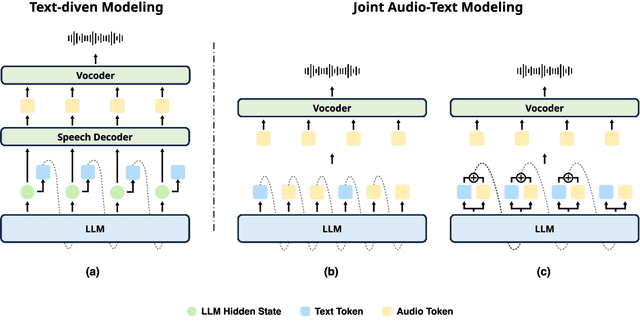
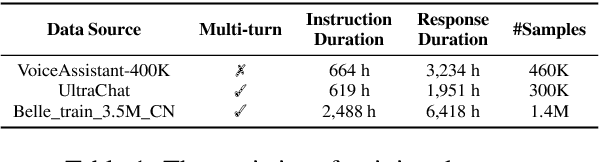
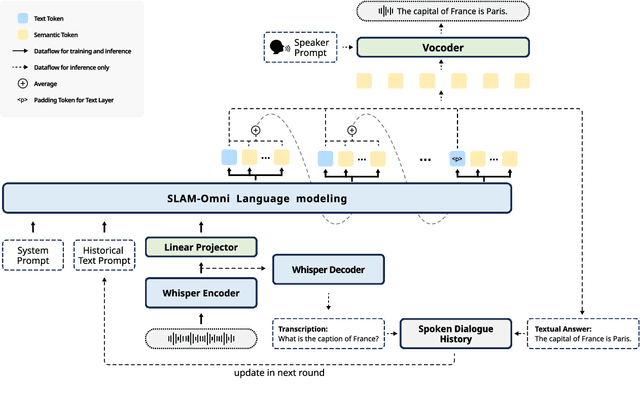
Recent advancements highlight the potential of end-to-end real-time spoken dialogue systems, showcasing their low latency and high quality. In this paper, we introduce SLAM-Omni, a timbre-controllable, end-to-end voice interaction system with single-stage training. SLAM-Omni achieves zero-shot timbre control by modeling spoken language with semantic tokens and decoupling speaker information to a vocoder. By predicting grouped speech semantic tokens at each step, our method significantly reduces the sequence length of audio tokens, accelerating both training and inference. Additionally, we propose historical text prompting to compress dialogue history, facilitating efficient multi-round interactions. Comprehensive evaluations reveal that SLAM-Omni outperforms prior models of similar scale, requiring only 15 hours of training on 4 GPUs with limited data. Notably, it is the first spoken dialogue system to achieve competitive performance with a single-stage training approach, eliminating the need for pre-training on TTS or ASR tasks. Further experiments validate its multilingual and multi-turn dialogue capabilities on larger datasets.