 Add to Chrome
 Add to Firefox
 Add to Edge
Combinatorial Synthesis: Scaling Code RLVR via Atomic Decomposition and Recombination
May 29, 2026
Reinforcement Learning with Verifiable Rewards (RLVR) has recently emerged as the cornerstone for shaping the remarkable coding abilities of Large Language Models (LLMs). However, the scalability of RLVR is severely constrained by the scarcity of sufficiently challenging verifiable code tasks that target near the model's edge of competence. Prior studies often rely on heuristic seed expansions for data synthesis, which severely limits both novelty and difficulty. Consequently, the training value of such data fails to scale proportionally with the size of its synthesis. To this end, we propose Atomic Decomposition and Recombination (ADR), a novel framework that generates verifiable code tasks via decomposition into atomic elements and controlled recombination, thereby enabling the generation of genuinely novel and challenging verifiable code tasks. Experiments and analysis demonstrate that ADR achieves superior originality, difficulty, diversity, and test quality over existing baselines, and consistently delivers greater improvements in code ability across RLVR in diverse downstream domains, including algorithmic programming, tool usage, and data science. Our work sheds light on a new paradigm for novel code task synthesis and scalable RLVR training.

Geometry Conflict: Explaining and Controlling Forgetting in LLM Continual Post-Training
May 10, 2026Continual post-training aims to extend large language models (LLMs) with new knowledge, skills, and behaviors, yet it remains unclear when sequential updates enable capability transfer and when they cause catastrophic forgetting. Existing methods mitigate forgetting through sequential fine-tuning, replay, regularization, or model merging, but offer limited criteria for determining when incorporating new updates is beneficial or harmful. In this work, we study LLM continual post-training through three questions: What drives forgetting? When do sequentially acquired capabilities transfer or interfere? How can compatibility be used to control update integration? We address these questions through task geometry: we represent each post-training task by its parameter update and study the covariance geometry induced by the update. Our central finding is that: forgetting can be considered as a state-relative update-integration failure, it arises when the covariance geometries induced by tasks misalign with the geometry of the evolving model state. Sequential updates transfer when they remain compatible with the model state shaped by previous updates, and interfere when state-relative geometry conflict becomes high. Motivated by this finding, we propose Geometry-Conflict Wasserstein Merging (GCWM), a data-free update-integration method that constructs a shared Wasserstein metric via Gaussian Wasserstein barycenters and uses geometry conflict to gate geometry-aware correction. Across Qwen3 0.6B--14B on domain-continual and capability-continual settings, GCWM consistently outperforms data-free baselines, improving retention and final performance without replay data. These results identify geometry conflict as both an explanatory signal for forgetting and a practical control signal for LLM continual post-training.
From What to How: Bridging User Requirements with Software Development Using Large Language Models
Feb 14, 2026Recently, large language models (LLMs) are extensively utilized to enhance development efficiency, leading to numerous benchmarks for evaluating their performance. However, these benchmarks predominantly focus on implementation, overlooking the equally critical aspect of software design. This gap raises two pivotal questions: (1) Can LLMs handle software design? (2) Can LLMs write code following the specific designs? To investigate these questions, this paper proposes DesBench, a design-aware benchmark for evaluating LLMs on three software design-related tasks: design-aware code generation, object-oriented modeling, and the design of acceptance test cases. DesBench comprises 30 manually crafted Java projects that include requirement documents, design models, implementations, and acceptance tests, amounting to a total of 30 design models, 194 Java classes, and 737 test cases. We evaluated seven state-of-the-art LLMs, including three DeepSeek R1, two Qwen2.5, and two GPT models, using DesBench. The results reveal that LLMs remain significantly challenged by the intricacies of software design: (1) For code generation, LLMs struggle to produce correct implementations when provided with only high-level or no designs. (2) In object-oriented modeling, while LLMs can accurately identify objects and classes, they face challenges in defining operations and inter-class relationships. (3) Acceptance test cases generated by LLMs from functional requirements achieve code coverage quality comparable to those written by humans. Our research highlights the current limitations of LLMs in managing software design and calls for further investigation into new design methodologies and languages suitable for LLM-based development.
ModelWisdom: An Integrated Toolkit for TLA+ Model Visualization, Digest and Repair
Feb 12, 2026Model checking in TLA+ provides strong correctness guarantees, yet practitioners continue to face significant challenges in interpreting counterexamples, understanding large state-transition graphs, and repairing faulty models. These difficulties stem from the limited explainability of raw model-checker output and the substantial manual effort required to trace violations back to source specifications. Although the TLA+ Toolbox includes a state diagram viewer, it offers only a static, fully expanded graph without folding, color highlighting, or semantic explanations, which limits its scalability and interpretability. We present ModelWisdom, an interactive environment that uses visualization and large language models to make TLA+ model checking more interpretable and actionable. ModelWisdom offers: (i) Model Visualization, with colorized violation highlighting, click-through links from transitions to TLA+ code, and mapping between violating states and broken properties; (ii) Graph Optimization, including tree-based structuring and node/edge folding to manage large models; (iii) Model Digest, which summarizes and explains subgraphs via large language models (LLMs) and performs preprocessing and partial explanations; and (iv) Model Repair, which extracts error information and supports iterative debugging. Together, these capabilities turn raw model-checker output into an interactive, explainable workflow, improving understanding and reducing debugging effort for nontrivial TLA+ specifications. The website to ModelWisdom is available: https://model-wisdom.pages.dev. A demonstrative video can be found at https://www.youtube.com/watch?v=plyZo30VShA.
Isolating Language-Coding from Problem-Solving: Benchmarking LLMs with PseudoEval
Feb 26, 2025Existing code generation benchmarks for Large Language Models (LLMs) such as HumanEval and MBPP are designed to study LLMs' end-to-end performance, where the benchmarks feed a problem description in natural language as input and examine the generated code in specific programming languages. However, the evaluation scores revealed in this way provide a little hint as to the bottleneck of the code generation -- whether LLMs are struggling with their problem-solving capability or language-coding capability. To answer this question, we construct PseudoEval, a multilingual code generation benchmark that provides a solution written in pseudocode as input. By doing so, the bottleneck of code generation in various programming languages could be isolated and identified. Our study yields several interesting findings. For example, we identify that the bottleneck of LLMs in Python programming is problem-solving, while Rust is struggling relatively more in language-coding. Also, our study indicates that problem-solving capability may transfer across programming languages, while language-coding needs more language-specific effort, especially for undertrained programming languages. Finally, we release the pipeline of constructing PseudoEval to facilitate the extension to existing benchmarks. PseudoEval is available at: https://anonymous.4open.science/r/PseudocodeACL25-7B74.
From Informal to Formal -- Incorporating and Evaluating LLMs on Natural Language Requirements to Verifiable Formal Proofs
Jan 27, 2025The research in AI-based formal mathematical reasoning has shown an unstoppable growth trend. These studies have excelled in mathematical competitions like IMO, showing significant progress. However, these studies intertwined multiple skills simultaneously, i.e., problem-solving, reasoning, and writing formal specifications, making it hard to precisely identify the LLMs' strengths and weaknesses in each task. This paper focuses on formal verification, an immediate application scenario of formal reasoning, and decomposes it into six sub-tasks. We constructed 18k high-quality instruction-response pairs across five mainstream formal specification languages (Coq, Lean4, Dafny, ACSL, and TLA+) in six formal-verification-related tasks by distilling GPT-4o. They are split into a 14k+ fine-tuning dataset FM-alpaca and a 4k benchmark FM-Bench. We found that LLMs are good at writing proof segments when given either the code, or the detailed description of proof steps. Also, the fine-tuning brought about a nearly threefold improvement at most. Interestingly, we observed that fine-tuning with formal data also enhances mathematics, reasoning, and coding abilities. We hope our findings inspire further research. Fine-tuned models are released to facilitate subsequent studies
How Should I Build A Benchmark?
Jan 18, 2025Various benchmarks have been proposed to assess the performance of large language models (LLMs) in different coding scenarios. We refer to them as code-related benchmarks. However, there are no systematic guidelines by which such a benchmark should be developed to ensure its quality, reliability, and reproducibility. We propose How2Bench, which is comprised of a 55- 55-criteria checklist as a set of guidelines to govern the development of code-related benchmarks comprehensively. Using HOW2BENCH, we profiled 274 benchmarks released within the past decade and found concerning issues. Nearly 70% of the benchmarks did not take measures for data quality assurance; over 10% did not even open source or only partially open source. Many highly cited benchmarks have loopholes, including duplicated samples, incorrect reference codes/tests/prompts, and unremoved sensitive/confidential information. Finally, we conducted a human study involving 49 participants, which revealed significant gaps in awareness of the importance of data quality, reproducibility, and transparency.
ICM-Assistant: Instruction-tuning Multimodal Large Language Models for Rule-based Explainable Image Content Moderation
Dec 24, 2024


Controversial contents largely inundate the Internet, infringing various cultural norms and child protection standards. Traditional Image Content Moderation (ICM) models fall short in producing precise moderation decisions for diverse standards, while recent multimodal large language models (MLLMs), when adopted to general rule-based ICM, often produce classification and explanation results that are inconsistent with human moderators. Aiming at flexible, explainable, and accurate ICM, we design a novel rule-based dataset generation pipeline, decomposing concise human-defined rules and leveraging well-designed multi-stage prompts to enrich short explicit image annotations. Our ICM-Instruct dataset includes detailed moderation explanation and moderation Q-A pairs. Built upon it, we create our ICM-Assistant model in the framework of rule-based ICM, making it readily applicable in real practice. Our ICM-Assistant model demonstrates exceptional performance and flexibility. Specifically, it significantly outperforms existing approaches on various sources, improving both the moderation classification (36.8\% on average) and moderation explanation quality (26.6\% on average) consistently over existing MLLMs. Code/Data is available at https://github.com/zhaoyuzhi/ICM-Assistant.
CODECLEANER: Elevating Standards with A Robust Data Contamination Mitigation Toolkit
Nov 16, 2024Data contamination presents a critical barrier preventing widespread industrial adoption of advanced software engineering techniques that leverage code language models (CLMs). This phenomenon occurs when evaluation data inadvertently overlaps with the public code repositories used to train CLMs, severely undermining the credibility of performance evaluations. For software companies considering the integration of CLM-based techniques into their development pipeline, this uncertainty about true performance metrics poses an unacceptable business risk. Code refactoring, which comprises code restructuring and variable renaming, has emerged as a promising measure to mitigate data contamination. It provides a practical alternative to the resource-intensive process of building contamination-free evaluation datasets, which would require companies to collect, clean, and label code created after the CLMs' training cutoff dates. However, the lack of automated code refactoring tools and scientifically validated refactoring techniques has hampered widespread industrial implementation. To bridge the gap, this paper presents the first systematic study to examine the efficacy of code refactoring operators at multiple scales (method-level, class-level, and cross-class level) and in different programming languages. In particular, we develop an open-sourced toolkit, CODECLEANER, which includes 11 operators for Python, with nine method-level, one class-level, and one cross-class-level operator. A drop of 65% overlap ratio is found when applying all operators in CODECLEANER, demonstrating their effectiveness in addressing data contamination. Additionally, we migrate four operators to Java, showing their generalizability to another language. We make CODECLEANER online available to facilitate further studies on mitigating CLM data contamination.
DOMAINEVAL: An Auto-Constructed Benchmark for Multi-Domain Code Generation
Aug 23, 2024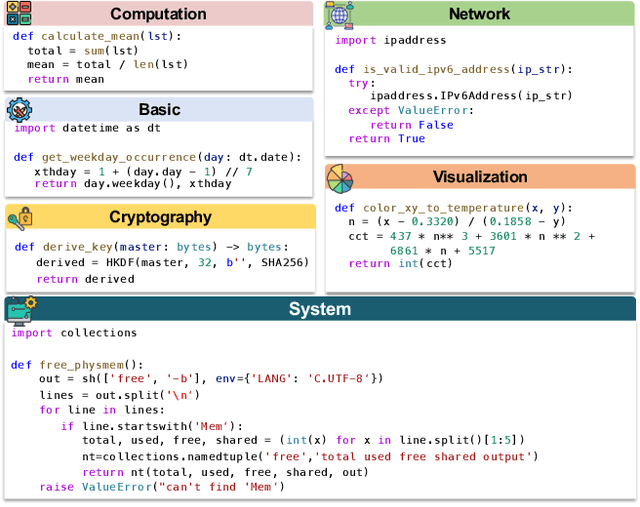
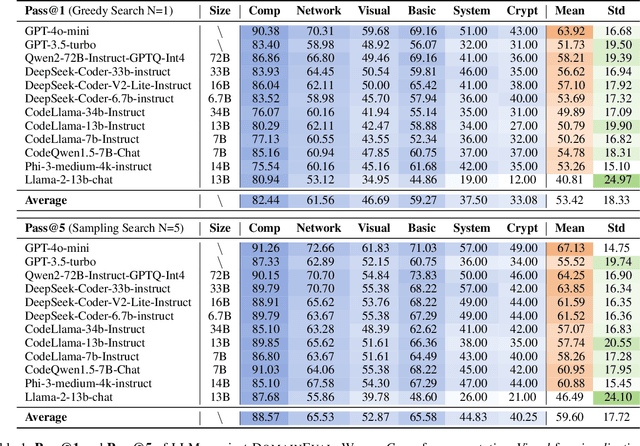
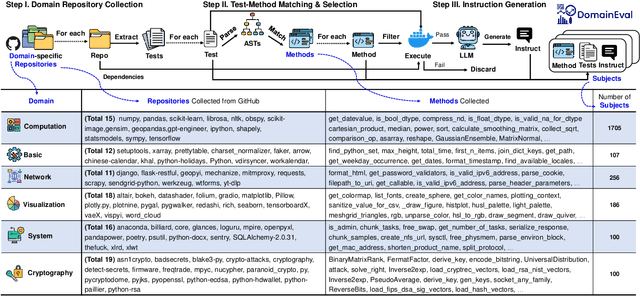
Code benchmarks such as HumanEval are widely adopted to evaluate the capabilities of Large Language Models (LLMs), providing insights into their strengths and weaknesses. However, current benchmarks primarily exercise LLMs' capability on common coding tasks (e.g., bubble sort, greatest common divisor), leaving domain-specific coding tasks (e.g., computation, system, cryptography) unexplored. To fill this gap, we propose a multi-domain code benchmark, DOMAINEVAL, designed to evaluate LLMs' coding capabilities thoroughly. Our pipeline works in a fully automated manner, enabling a push-bottom construction from code repositories into formatted subjects under study. Interesting findings are observed by evaluating 12 representative LLMs against DOMAINEVAL. We notice that LLMs are generally good at computation tasks while falling short on cryptography and system coding tasks. The performance gap can be as much as 68.94% (80.94% - 12.0%) in some LLMs. We also observe that generating more samples can increase the overall performance of LLMs, while the domain bias may even increase. The contributions of this study include a code generation benchmark dataset DOMAINEVAL, encompassing six popular domains, a fully automated pipeline for constructing code benchmarks, and an identification of the limitations of LLMs in code generation tasks based on their performance on DOMAINEVAL, providing directions for future research improvements. The leaderboard is available at https://domaineval.github.io/.