 Add to Chrome
 Add to Firefox
 Add to Edge
Uncovering Customer Issues through Topological Natural Language Analysis
Feb 24, 2024
E-commerce companies deal with a high volume of customer service requests daily. While a simple annotation system is often used to summarize the topics of customer contacts, thoroughly exploring each specific issue can be challenging. This presents a critical concern, especially during an emerging outbreak where companies must quickly identify and address specific issues. To tackle this challenge, we propose a novel machine learning algorithm that leverages natural language techniques and topological data analysis to monitor emerging and trending customer issues. Our approach involves an end-to-end deep learning framework that simultaneously tags the primary question sentence of each customer's transcript and generates sentence embedding vectors. We then whiten the embedding vectors and use them to construct an undirected graph. From there, we define trending and emerging issues based on the topological properties of each transcript. We have validated our results through various methods and found that they are highly consistent with news sources.

Contact Complexity in Customer Service
Feb 24, 2024Customers who reach out for customer service support may face a range of issues that vary in complexity. Routing high-complexity contacts to junior agents can lead to multiple transfers or repeated contacts, while directing low-complexity contacts to senior agents can strain their capacity to assist customers who need professional help. To tackle this, a machine learning model that accurately predicts the complexity of customer issues is highly desirable. However, defining the complexity of a contact is a difficult task as it is a highly abstract concept. While consensus-based data annotation by experienced agents is a possible solution, it is time-consuming and costly. To overcome these challenges, we have developed a novel machine learning approach to define contact complexity. Instead of relying on human annotation, we trained an AI expert model to mimic the behavior of agents and evaluate each contact's complexity based on how the AI expert responds. If the AI expert is uncertain or lacks the skills to comprehend the contact transcript, it is considered a high-complexity contact. Our method has proven to be reliable, scalable, and cost-effective based on the collected data.
Learning to Edit: Aligning LLMs with Knowledge Editing
Feb 19, 2024
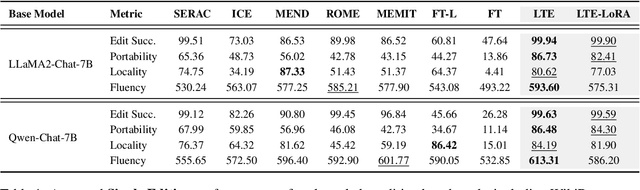
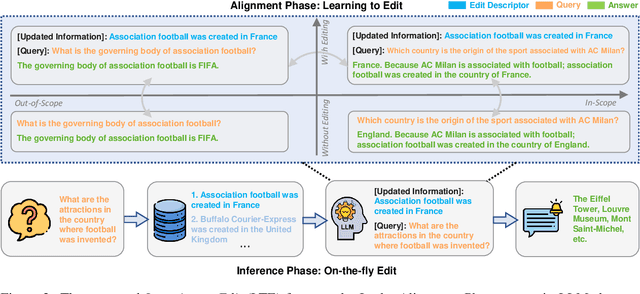
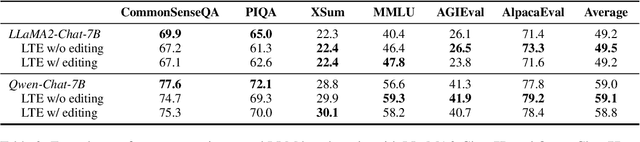
Knowledge editing techniques, aiming to efficiently modify a minor proportion of knowledge in large language models (LLMs) without negatively impacting performance across other inputs, have garnered widespread attention. However, existing methods predominantly rely on memorizing the updated knowledge, impeding LLMs from effectively combining the new knowledge with their inherent knowledge when answering questions. To this end, we propose a Learning to Edit (LTE) framework, focusing on teaching LLMs to apply updated knowledge into input questions, inspired by the philosophy of "Teach a man to fish." LTE features a two-phase process: (i) the Alignment Phase, which fine-tunes LLMs on a meticulously curated parallel dataset to make reliable, in-scope edits while preserving out-of-scope information and linguistic proficiency; and (ii) the Inference Phase, which employs a retrieval-based mechanism for real-time and mass knowledge editing. By comparing our approach with seven advanced baselines across four popular knowledge editing benchmarks and two LLM architectures, we demonstrate LTE's superiority in knowledge editing performance, robustness in both batch and sequential editing, minimal interference on general tasks, and rapid editing speeds. The data and code are available at https://github.com/YJiangcm/LTE.
Findings of the First Workshop on Simulating Conversational Intelligence in Chat
Feb 09, 2024The aim of this workshop is to bring together experts working on open-domain dialogue research. In this speedily advancing research area many challenges still exist, such as learning information from conversations, engaging in realistic and convincing simulation of human intelligence and reasoning. SCI-CHAT follows previous workshops on open domain dialogue but with a focus on the simulation of intelligent conversation as judged in a live human evaluation. Models aim to include the ability to follow a challenging topic over a multi-turn conversation, while positing, refuting and reasoning over arguments. The workshop included both a research track and shared task. The main goal of this paper is to provide an overview of the shared task and a link to an additional paper that will include an in depth analysis of the shared task results following presentation at the workshop.
MT-Eval: A Multi-Turn Capabilities Evaluation Benchmark for Large Language Models
Jan 30, 2024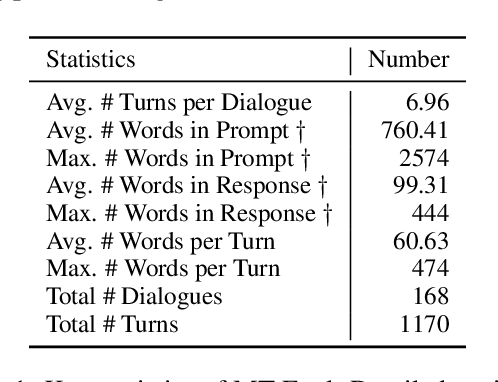
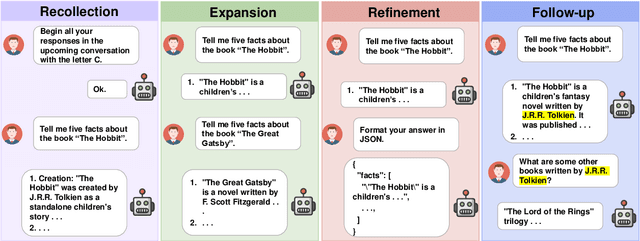
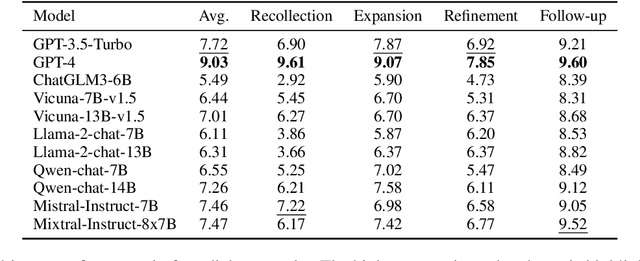
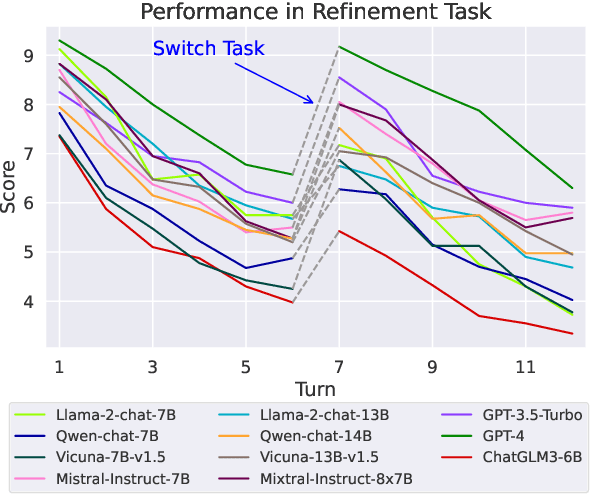
Large language models (LLMs) are increasingly relied upon for complex multi-turn conversations across diverse real-world applications. However, existing benchmarks predominantly focus on single-turn evaluations, overlooking the models' capabilities in multi-turn interactions. To address this gap, we introduce MT-Eval, a comprehensive benchmark designed to evaluate multi-turn conversational abilities. By analyzing human-LLM conversations, we categorize interaction patterns into four types: recollection, expansion, refinement, and follow-up. We construct multi-turn queries for each category either by augmenting existing datasets or by creating new examples with GPT-4 to avoid data leakage. To study the factors impacting multi-turn abilities, we create single-turn versions of the 1170 multi-turn queries and compare performance. Our evaluation of 11 well-known LLMs shows that while closed-source models generally surpass open-source ones, certain open-source models exceed GPT-3.5-Turbo in specific tasks. We observe significant performance degradation in multi-turn settings compared to single-turn settings in most models, which is not correlated with the models' fundamental capabilities. Moreover, we identify the distance to relevant content and susceptibility to error propagation as the key factors influencing multi-turn performance. MT-Eval is released publicly to encourage future research towards more robust conversational models.
Planning, Creation, Usage: Benchmarking LLMs for Comprehensive Tool Utilization in Real-World Complex Scenarios
Jan 30, 2024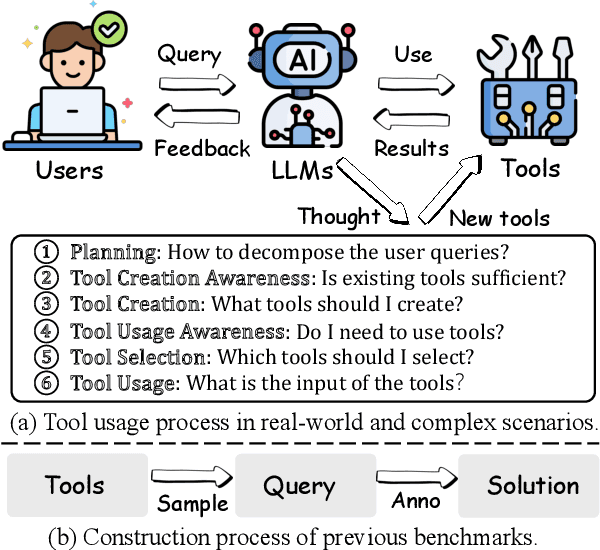
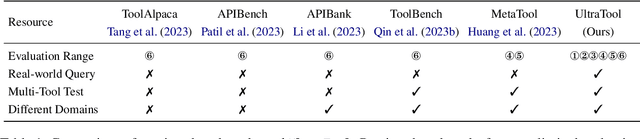
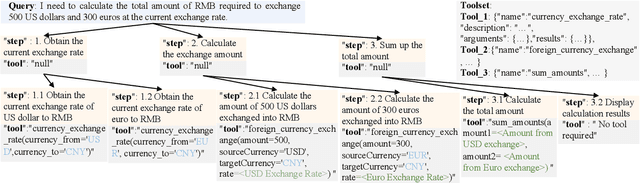
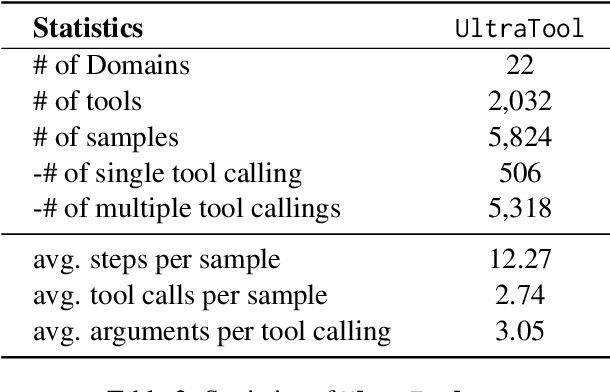
The recent trend of using Large Language Models (LLMs) as intelligent agents in real-world applications underscores the necessity for comprehensive evaluations of their capabilities, particularly in complex scenarios involving planning, creating, and using tools. However, existing benchmarks typically focus on simple synthesized queries that do not reflect real-world complexity, thereby offering limited perspectives in evaluating tool utilization. To address this issue, we present UltraTool, a novel benchmark designed to improve and evaluate LLMs' ability in tool utilization within real-world scenarios. UltraTool focuses on the entire process of using tools - from planning and creating to applying them in complex tasks. It emphasizes real-world complexities, demanding accurate, multi-step planning for effective problem-solving. A key feature of UltraTool is its independent evaluation of planning with natural language, which happens before tool usage and simplifies the task solving by mapping out the intermediate steps. Thus, unlike previous work, it eliminates the restriction of pre-defined toolset during planning. Through extensive experiments on various LLMs, we offer novel insights into the evaluation of capabilities of LLMs in tool utilization, thereby contributing a fresh perspective to this rapidly evolving field. The benchmark is publicly available at https://github.com/JoeYing1019/UltraTool.
YODA: Teacher-Student Progressive Learning for Language Models
Jan 28, 2024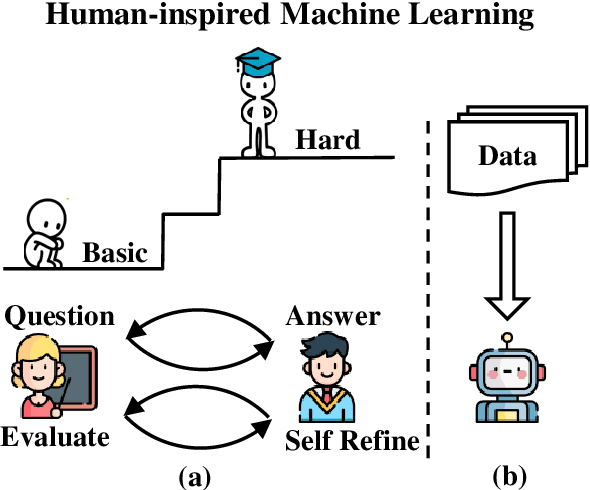
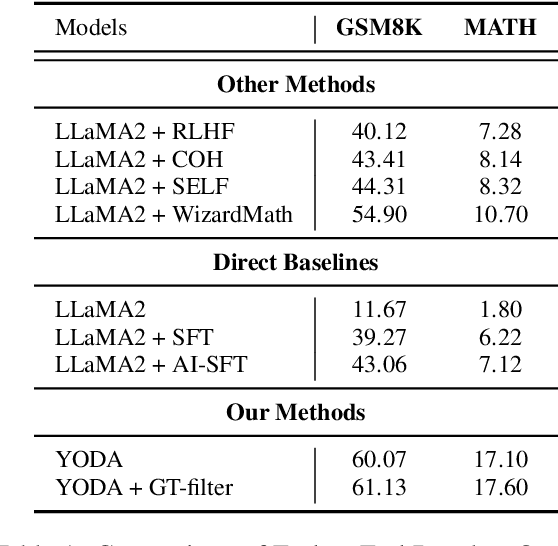
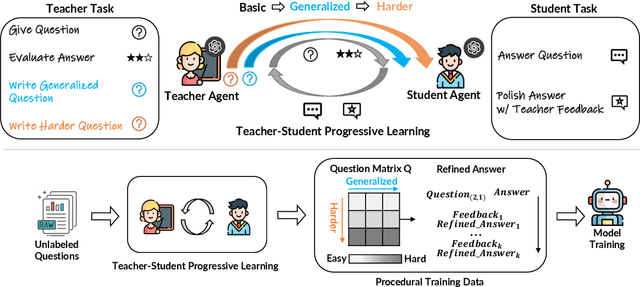
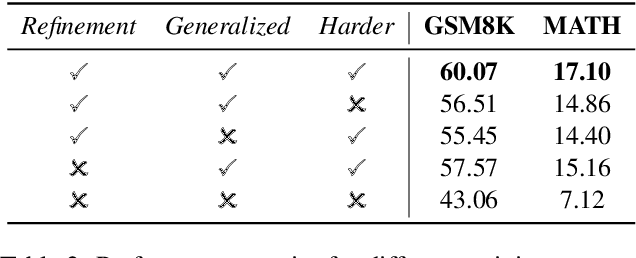
Although large language models (LLMs) have demonstrated adeptness in a range of tasks, they still lag behind human learning efficiency. This disparity is often linked to the inherent human capacity to learn from basic examples, gradually generalize and handle more complex problems, and refine their skills with continuous feedback. Inspired by this, this paper introduces YODA, a novel teacher-student progressive learning framework that emulates the teacher-student education process to improve the efficacy of model fine-tuning. The framework operates on an interactive \textit{basic-generalized-harder} loop. The teacher agent provides tailored feedback on the student's answers, and systematically organizes the education process. This process unfolds by teaching the student basic examples, reinforcing understanding through generalized questions, and then enhancing learning by posing questions with progressively enhanced complexity. With the teacher's guidance, the student learns to iteratively refine its answer with feedback, and forms a robust and comprehensive understanding of the posed questions. The systematic procedural data, which reflects the progressive learning process of humans, is then utilized for model training. Taking math reasoning as a testbed, experiments show that training LLaMA2 with data from YODA improves SFT with significant performance gain (+17.01\% on GSM8K and +9.98\% on MATH). In addition, we find that training with curriculum learning further improves learning robustness.
PROXYQA: An Alternative Framework for Evaluating Long-Form Text Generation with Large Language Models
Jan 26, 2024Large Language Models (LLMs) have exhibited remarkable success in long-form context comprehension tasks. However, their capacity to generate long contents, such as reports and articles, remains insufficiently explored. Current benchmarks do not adequately assess LLMs' ability to produce informative and comprehensive content, necessitating a more rigorous evaluation approach. In this study, we introduce \textsc{ProxyQA}, a framework for evaluating long-form text generation, comprising in-depth human-curated \textit{meta-questions} spanning various domains. Each meta-question contains corresponding \textit{proxy-questions} with annotated answers. LLMs are prompted to generate extensive content in response to these meta-questions. Utilizing an evaluator and incorporating generated content as background context, \textsc{ProxyQA} evaluates the quality of generated content based on the evaluator's performance in answering the \textit{proxy-questions}. We examine multiple LLMs, emphasizing \textsc{ProxyQA}'s demanding nature as a high-quality assessment tool. Human evaluation demonstrates that evaluating through \textit{proxy-questions} is a highly self-consistent and human-criteria-correlated validation method. The dataset and leaderboard will be available at \url{https://github.com/Namco0816/ProxyQA}.
Preparing Lessons for Progressive Training on Language Models
Jan 18, 2024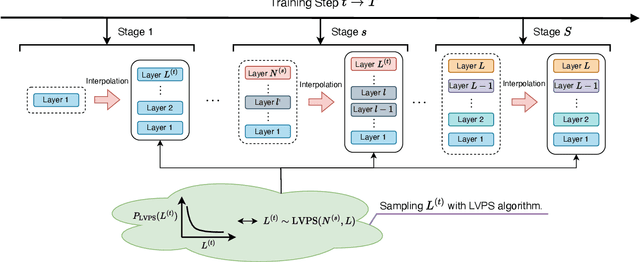
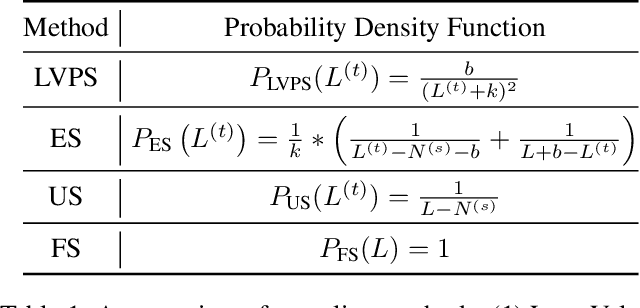


The rapid progress of Transformers in artificial intelligence has come at the cost of increased resource consumption and greenhouse gas emissions due to growing model sizes. Prior work suggests using pretrained small models to improve training efficiency, but this approach may not be suitable for new model structures. On the other hand, training from scratch can be slow, and progressively stacking layers often fails to achieve significant acceleration. To address these challenges, we propose a novel method called Apollo, which prep\textbf{a}res lessons for ex\textbf{p}anding \textbf{o}perations by \textbf{l}earning high-\textbf{l}ayer functi\textbf{o}nality during training of low layers. Our approach involves low-value-prioritized sampling (LVPS) to train different depths and weight sharing to facilitate efficient expansion. We also introduce an interpolation method for stable model depth extension. Experiments demonstrate that Apollo achieves state-of-the-art acceleration ratios, even rivaling methods using pretrained models, making it a universal and efficient solution for training deep models while reducing time, financial, and environmental costs.
PanGu-$π$: Enhancing Language Model Architectures via Nonlinearity Compensation
Dec 27, 2023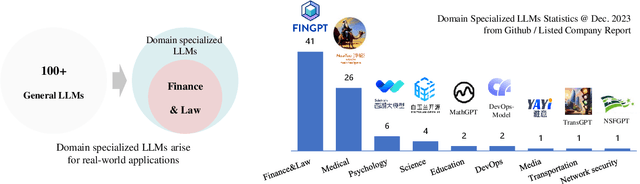
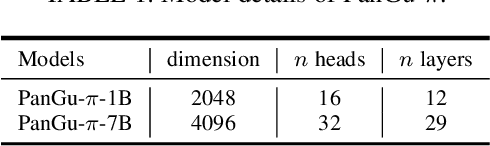
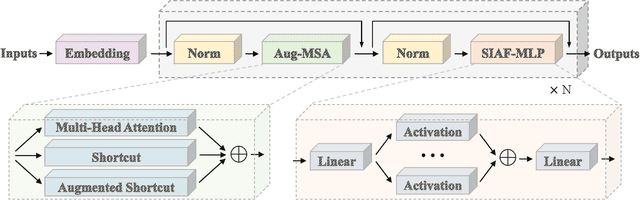
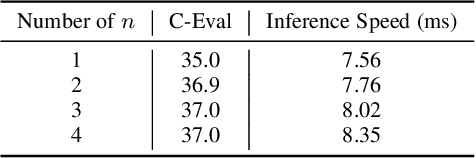
The recent trend of large language models (LLMs) is to increase the scale of both model size (\aka the number of parameters) and dataset to achieve better generative ability, which is definitely proved by a lot of work such as the famous GPT and Llama. However, large models often involve massive computational costs, and practical applications cannot afford such high prices. However, the method of constructing a strong model architecture for LLMs is rarely discussed. We first analyze the state-of-the-art language model architectures and observe the feature collapse problem. Based on the theoretical analysis, we propose that the nonlinearity is also very important for language models, which is usually studied in convolutional neural networks for vision tasks. The series informed activation function is then introduced with tiny calculations that can be ignored, and an augmented shortcut is further used to enhance the model nonlinearity. We then demonstrate that the proposed approach is significantly effective for enhancing the model nonlinearity through carefully designed ablations; thus, we present a new efficient model architecture for establishing modern, namely, PanGu-$\pi$. Experiments are then conducted using the same dataset and training strategy to compare PanGu-$\pi$ with state-of-the-art LLMs. The results show that PanGu-$\pi$-7B can achieve a comparable performance to that of benchmarks with about 10\% inference speed-up, and PanGu-$\pi$-1B can achieve state-of-the-art performance in terms of accuracy and efficiency. In addition, we have deployed PanGu-$\pi$-7B in the high-value domains of finance and law, developing an LLM named YunShan for practical application. The results show that YunShan can surpass other models with similar scales on benchmarks.