 Add to Chrome
 Add to Firefox
 Add to Edge
Federated Foundation Models Fine-Tuning with Heterogeneous Compressed Clients
Jul 31, 2026
Federated learning of foundation models faces a fundamental resource-asymmetry challenge: the institutions holding the most valuable domain-specific data cannot host billion-parameter models. Existing heterogeneous federated approaches attempt to bridge this gap through parameter-efficient tuning, model pruning, or knowledge distillation, yet each trades away a critical property, whether full-model memory reduction, architectural self-containedness, or representational fidelity, leaving the core tension unresolved. We propose FedSLM, a parameter-centric framework for federated fine-tuning with heterogeneous compressed clients. FedSLM uses SVD-based decomposition to produce self-contained client models, whose low-rank subspaces form nested manifolds that are structurally compatible for aggregation. It then applies a two-stage protocol that synchronizes lightweight adapters within compression groups and fuses full-rank reconstructions across groups via structural alignment. Finally, a weak-to-strong elicitation step with auxiliary confidence loss transfers the aggregated knowledge to the full-scale server, while an explicit bias--variance trade-off mitigates compression artifacts. We provide theoretical guarantees for adapter-level aggregation, subspace-alignment bounds for cross-group fusion, and a characterization of how the confidence loss mitigates weak-supervision noise. Experiments on natural language and vision--language benchmarks show that FedSLM outperforms existing federated baselines under both IID and non-IID partitions, while client models operate at roughly 50% of the GPU memory required by the full model.

DocMaster: A Hierarchical Structure-Aware System for Document Analysis
Jul 09, 2026Leveraging large language models (LLMs) to analyze complex documents -- such as academic papers, technical manuals, and financial reports -- has emerged as a mainstream and critical task in both research and industry. In practice, users must first filter relevant documents from large collections and then conduct in-depth analysis (e.g. question answering) over the selected subset, yet existing systems flatten documents into plain-text chunks, discarding the rich hierarchical structures (sections, tables, figures, equations) and degrading downstream performance. We present DocMaster, a hierarchical structure-aware document analysis system. DocMaster parses documents into hierarchical document trees preserving original layouts and constructs a structure-aware semantic index that enables accurate document filtering and in-depth analysis. We demonstrate DocMaster through an interactive web interface that enables users to upload document collections, construct tree-based and multi-view semantic indices, filter relevant documents via natural-language conditions, and perform follow-up question answering over the filtered results. The source code, data, and demo are available at https://doc-master.github.io/.
HETERQA: Benchmarking Record Retrieval over Multiple Heterogeneous Sources
Jul 03, 2026In emerging systems (e.g., social media and e-commerce platforms), data records are often drawn from heterogeneous sources, such as relational tables, text documents, image repositories, spatial databases, and knowledge graphs. Accordingly, retrieving target records for question-answering (QA) tasks requires us to jointly exploit these heterogeneous sources. However, most existing benchmarks are constructed from individual sources, and only a very few recent benchmarks have considered two or three sources. To alleviate this issue, we introduce HETERQA, a comprehensive benchmark with 857 QA pairs for record retrieval over five heterogeneous sources. HETERQA instantiates this setting with Yelp business records, each of which is grounded by multiple sources. We build HETERQA in an answer-driven manner: candidate records are first initialized with record-field constraints, then enriched through heterogeneous sources, and finally cross-verified across required sources before the natural-language question is retained. We validate the benchmark through contradiction detection and human validation, and further evaluate sparse, dense, hybrid, late-interaction, and agentic retrievers under the same metrics. The results show that HETERQA is challenging: hybrid retrieval achieves the strongest Recall@10, Self-RAG achieves the best MRR@10, and all evaluated methods remain far from saturating the benchmark. These findings indicate that HETERQA provides an effective testbed for record retrieval over heterogeneous sources and leaves substantial room for future retrieval methods. The benchmark dataset and source code are publicly available at https://huggingface.co/datasets/hanchang02/HeterQA and https://github.com/hanchang02/HeterQA, respectively.
Automating Database-Native Function Code Synthesis with LLMs
Apr 02, 2026Database systems incorporate an ever-growing number of functions in their kernels (a.k.a., database native functions) for scenarios like new application support and business migration. This growth causes an urgent demand for automatic database native function synthesis. While recent advances in LLM-based code generation (e.g., Claude Code) show promise, they are too generic for database-specific development. They often hallucinate or overlook critical context because database function synthesis is inherently complex and error-prone, where synthesizing a single function may involve registering multiple function units, linking internal references, and implementing logic correctly. To this end, we propose DBCooker, an LLM-based system for automatically synthesizing database native functions. It consists of three components. First, the function characterization module aggregates multi-source declarations, identifies function units that require specialized coding, and traces cross-unit dependencies. Second, we design operations to address the main synthesis challenges: (1) a pseudo-code-based coding plan generator that constructs structured implementation skeletons by identifying key elements such as reusable referenced functions; (2) a hybrid fill-in-the-blank model guided by probabilistic priors and component awareness to integrate core logic with reusable routines; and (3) three-level progressive validation, including syntax checking, standards compliance, and LLM-guided semantic verification. Finally, an adaptive orchestration strategy unifies these operations with existing tools and dynamically sequences them via the orchestration history of similar functions. Results show that DBCooker outperforms other methods on SQLite, PostgreSQL, and DuckDB (34.55% higher accuracy on average), and can synthesize new functions absent in the latest SQLite (v3.50).
LakeHopper: Cross Data Lakes Column Type Annotation through Model Adaptation
Feb 09, 2026Column type annotation is vital for tasks like data cleaning, integration, and visualization. Recent solutions rely on resource-intensive language models fine-tuned on well-annotated columns from a particular set of tables, i.e., a source data lake. In this paper, we study whether we can adapt an existing pre-trained LM-based model to a new (i.e., target) data lake to minimize the annotations required on the new data lake. However, challenges include the source-target knowledge gap, selecting informative target data, and fine-tuning without losing shared knowledge exist. We propose LakeHopper, a framework that identifies and resolves the knowledge gap through LM interactions, employs a cluster-based data selection scheme for unannotated columns, and uses an incremental fine-tuning mechanism that gradually adapts the source model to the target data lake. Our experimental results validate the effectiveness of LakeHopper on two different data lake transfers under both low-resource and high-resource settings.
VABench: A Comprehensive Benchmark for Audio-Video Generation
Dec 10, 2025Recent advances in video generation have been remarkable, enabling models to produce visually compelling videos with synchronized audio. While existing video generation benchmarks provide comprehensive metrics for visual quality, they lack convincing evaluations for audio-video generation, especially for models aiming to generate synchronized audio-video outputs. To address this gap, we introduce VABench, a comprehensive and multi-dimensional benchmark framework designed to systematically evaluate the capabilities of synchronous audio-video generation. VABench encompasses three primary task types: text-to-audio-video (T2AV), image-to-audio-video (I2AV), and stereo audio-video generation. It further establishes two major evaluation modules covering 15 dimensions. These dimensions specifically assess pairwise similarities (text-video, text-audio, video-audio), audio-video synchronization, lip-speech consistency, and carefully curated audio and video question-answering (QA) pairs, among others. Furthermore, VABench covers seven major content categories: animals, human sounds, music, environmental sounds, synchronous physical sounds, complex scenes, and virtual worlds. We provide a systematic analysis and visualization of the evaluation results, aiming to establish a new standard for assessing video generation models with synchronous audio capabilities and to promote the comprehensive advancement of the field.
FedAPM: Federated Learning via ADMM with Partial Model Personalization
Jun 05, 2025In federated learning (FL), the assumption that datasets from different devices are independent and identically distributed (i.i.d.) often does not hold due to user differences, and the presence of various data modalities across clients makes using a single model impractical. Personalizing certain parts of the model can effectively address these issues by allowing those parts to differ across clients, while the remaining parts serve as a shared model. However, we found that partial model personalization may exacerbate client drift (each client's local model diverges from the shared model), thereby reducing the effectiveness and efficiency of FL algorithms. We propose an FL framework based on the alternating direction method of multipliers (ADMM), referred to as FedAPM, to mitigate client drift. We construct the augmented Lagrangian function by incorporating first-order and second-order proximal terms into the objective, with the second-order term providing fixed correction and the first-order term offering compensatory correction between the local and shared models. Our analysis demonstrates that FedAPM, by using explicit estimates of the Lagrange multiplier, is more stable and efficient in terms of convergence compared to other FL frameworks. We establish the global convergence of FedAPM training from arbitrary initial points to a stationary point, achieving three types of rates: constant, linear, and sublinear, under mild assumptions. We conduct experiments using four heterogeneous and multimodal datasets with different metrics to validate the performance of FedAPM. Specifically, FedAPM achieves faster and more accurate convergence, outperforming the SOTA methods with average improvements of 12.3% in test accuracy, 16.4% in F1 score, and 18.0% in AUC while requiring fewer communication rounds.
Exploiting Text Semantics for Few and Zero Shot Node Classification on Text-attributed Graph
May 13, 2025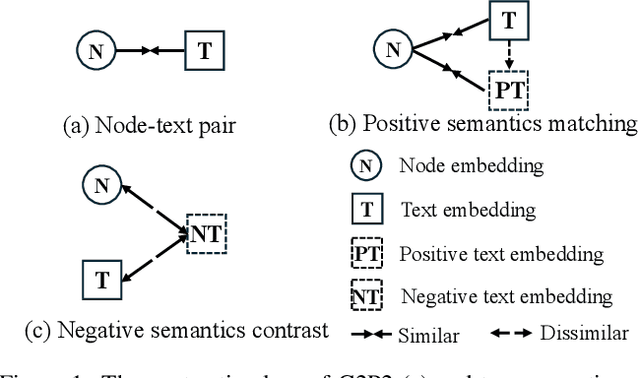
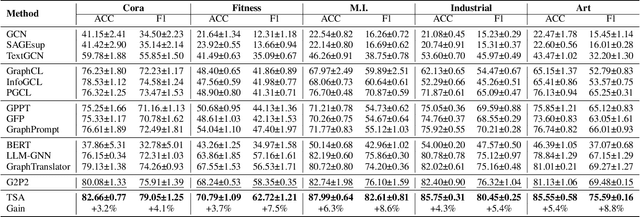
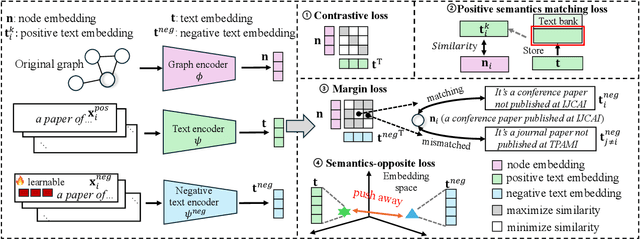

Text-attributed graph (TAG) provides a text description for each graph node, and few- and zero-shot node classification on TAGs have many applications in fields such as academia and social networks. Existing work utilizes various graph-based augmentation techniques to train the node and text embeddings, while text-based augmentations are largely unexplored. In this paper, we propose Text Semantics Augmentation (TSA) to improve accuracy by introducing more text semantic supervision signals. Specifically, we design two augmentation techniques, i.e., positive semantics matching and negative semantics contrast, to provide more reference texts for each graph node or text description. Positive semantic matching retrieves texts with similar embeddings to match with a graph node. Negative semantic contrast adds a negative prompt to construct a text description with the opposite semantics, which is contrasted with the original node and text. We evaluate TSA on 5 datasets and compare with 13 state-of-the-art baselines. The results show that TSA consistently outperforms all baselines, and its accuracy improvements over the best-performing baseline are usually over 5%.
Towards Scalable and Deep Graph Neural Networks via Noise Masking
Dec 19, 2024


In recent years, Graph Neural Networks (GNNs) have achieved remarkable success in many graph mining tasks. However, scaling them to large graphs is challenging due to the high computational and storage costs of repeated feature propagation and non-linear transformation during training. One commonly employed approach to address this challenge is model-simplification, which only executes the Propagation (P) once in the pre-processing, and Combine (C) these receptive fields in different ways and then feed them into a simple model for better performance. Despite their high predictive performance and scalability, these methods still face two limitations. First, existing approaches mainly focus on exploring different C methods from the model perspective, neglecting the crucial problem of performance degradation with increasing P depth from the data-centric perspective, known as the over-smoothing problem. Second, pre-processing overhead takes up most of the end-to-end processing time, especially for large-scale graphs. To address these limitations, we present random walk with noise masking (RMask), a plug-and-play module compatible with the existing model-simplification works. This module enables the exploration of deeper GNNs while preserving their scalability. Unlike the previous model-simplification works, we focus on continuous P and found that the noise existing inside each P is the cause of the over-smoothing issue, and use the efficient masking mechanism to eliminate them. Experimental results on six real-world datasets demonstrate that model-simplification works equipped with RMask yield superior performance compared to their original version and can make a good trade-off between accuracy and efficiency.
LAC: Graph Contrastive Learning with Learnable Augmentation in Continuous Space
Oct 20, 2024Graph Contrastive Learning frameworks have demonstrated success in generating high-quality node representations. The existing research on efficient data augmentation methods and ideal pretext tasks for graph contrastive learning remains limited, resulting in suboptimal node representation in the unsupervised setting. In this paper, we introduce LAC, a graph contrastive learning framework with learnable data augmentation in an orthogonal continuous space. To capture the representative information in the graph data during augmentation, we introduce a continuous view augmenter, that applies both a masked topology augmentation module and a cross-channel feature augmentation module to adaptively augment the topological information and the feature information within an orthogonal continuous space, respectively. The orthogonal nature of continuous space ensures that the augmentation process avoids dimension collapse. To enhance the effectiveness of pretext tasks, we propose an information-theoretic principle named InfoBal and introduce corresponding pretext tasks. These tasks enable the continuous view augmenter to maintain consistency in the representative information across views while maximizing diversity between views, and allow the encoder to fully utilize the representative information in the unsupervised setting. Our experimental results show that LAC significantly outperforms the state-of-the-art frameworks.