 Add to Chrome
 Add to Firefox
 Add to Edge
Fewer Clarifications, Better Code: Benchmarking Cross-Session Personalized Ambiguity Adaptation in Coding Assistants
Jul 29, 2026
AI-assisted coding increasingly translates informal user intent into executable software, yet coding requests often contain ambiguities that recur in user-specific ways across tasks and sessions. Existing disambiguation methods typically address each ambiguous request in isolation within the current coding session, often through eliciting additional clarification. However, whether resolved session history from the same user can serve as memory for resolving recurring personalized ambiguity in a newly opened session remains underexplored. We formulate personalized ambiguity adaptation as a new task: given a user's previously resolved coding sessions and a new ambiguous request, an assistant should identify the recurring ambiguity pattern, produce the intended executable solution, and minimize clarification. To benchmark this task, we introduce CAPA, which characterizes personalized coding ambiguity through six mechanisms and injects these mechanisms into unambiguous executable tasks using a controlled three-stage generation pipeline. CAPA contains 600 coding sessions across 60 balanced user--ambiguity cells, including 300 held-out evaluation sessions. We evaluate 12 recent LLMs under no-history and same-user-history conditions using executable success, first-turn success, and turns-to-completion. Our analyses examine task difficulty, user identity, and memory-based history use, and we further propose same-user history gating as a lightweight inference-time method. CAPA provides a foundation for developing long-term coding assistants that better align generated code with user intent while reducing repeated clarification.

Are LLMs Ready for Scientific Discovery? A Capability-Oriented Benchmark for AI Scientists
Jul 13, 2026Existing benchmarks for scientific data analysis evaluate LLMs primarily on code execution or workflow completion, overlooking that scientific analysis serves to support distinct types of scientific claims: hypothesis exploration, statistical inference, mechanistic explanation, each with different assumptions and validity criteria. We introduce SDABench, a benchmark that reorganizes evaluation around six capabilities (descriptive, exploratory, inferential, predictive, causal, and mechanistic) across five domains (Biology, Chemistry, Environment, Geography, Physics). SDABench comprises 527 real-data instances (SDA-Real) and 6000 synthetic instances (SDA-Synth), each in both multiple-choice and open-ended formats, constructed through an automated pipeline. Evaluating 15 representative LLMs, we find that models handle descriptive analysis well but degrade sharply on tasks requiring assumption selection, latent-process modeling, or mechanistic reasoning. SDABench further provides a five-stage error analysis framework that locates where LLMs fail: more advanced models more reliably identify the relevant scope and variables, but still struggle to select appropriate analytical procedures, model variable relationships, and draw valid conclusions.
When Classic Cache Policies Fail: Learning-Augmented Replacement for Semantic Retrieval Buffers
Jul 01, 2026LLM agents increasingly rely on retrieval buffers to store and reuse past experience, yet the cache management policies governing these buffers remain largely ad-hoc. We formalize this as an online semantic cache replacement problem with switching costs, where items are matched by embedding similarity and hit quality is continuous rather than binary. Through experiments on two datasets from MemoryBench-Full (LoCoMo, DialSim) with 8 replacement policies, we reveal a surprising finding: classic heuristics (LRU, LFU) \emph{consistently underperform} the naive FIFO baseline on semantic workloads, due to the absence of temporal locality and frequency concentration. We propose SOLAR, a learning-augmented framework that derives modification timing from regret accumulation (achieving $\sim$17\% modification rate) and content selection from Bayesian online learning over implicit retrieval feedback. We prove SOLAR achieves a constant competitive ratio $\leq 3$, independent of cache size and horizon (vs.\ $Ω(K)$ for FIFO), and eviction regret $O(\sqrt{KT\log T})$, matching the $Ω(\sqrt{KT})$ lower bound up to logarithmic factors. Experiments demonstrate 5--75\% relative improvement over FIFO at tight cache sizes, with a clearly characterized phase transition at the working set boundary. Synthetic experiments with 5000-item pools further reveal an inverted-U relationship between pool size and retrieval quality, justifying capacity constraints as a retrieval noise phenomenon rather than a storage limitation.
STALE: Can LLM Agents Know When Their Memories Are No Longer Valid?
May 07, 2026Large Language Model (LLM) agents are increasingly expected to maintain coherent, long-term personalized memory, yet current benchmarks primarily measure static fact retrieval, overlooking the ability to revise stored beliefs when new evidence emerges. We identify a critical and underexplored failure mode, Implicit Conflict: a later observation invalidates an earlier memory without explicit negation, requiring contextual inference and commonsense reasoning to detect. To rigorously evaluate this capability, we introduce STALE, a benchmark of 400 expert-validated conflict scenarios (1,200 evaluation queries across three probing dimensions) spanning over 100 everyday topics with contexts up to 150K tokens. We propose a three-dimensional probing framework that tests State Resolution (detecting that a prior belief is outdated), Premise Resistance (rejecting queries that falsely presuppose a stale state), and Implicit Policy Adaptation (proactively applying updated states in downstream behavior). A systematic evaluation of frontier LLMs and specialized memory frameworks reveals a pervasive gap between retrieving updated evidence and acting on it, with even the best evaluated model achieving only 55.2% overall accuracy. Models often accept outdated assumptions embedded in a user's query, and they struggle to recognize when a change in one aspect of the user's state should invalidate related memories. To establish an initial baseline for state-aware memory, we further present CUPMem, a prototype that strengthens write-time revision through structured state consolidation and propagation-aware search, suggesting that explicit state adjudication is a promising direction for robust agentic memory.
VeriLLMed: Interactive Visual Debugging of Medical Large Language Models with Knowledge Graphs
Apr 25, 2026Large language models (LLMs) show promise in medical diagnosis, but real-world deployment remains challenging due to high-stakes clinical decisions and imperfect reasoning reliability. As a result, careful inspection of model behavior is essential for assessing whether diagnostic reasoning is reliable and clinically grounded. However, debugging medical LLMs remains difficult. First, developers often lack sufficient medical domain expertise to interpret model errors in clinically meaningful terms. Second, models can fail across a large and diverse set of instances involving different input types, tasks, and reasoning steps, making it challenging for developers to prioritize which errors deserve focused inspection. Third, developers struggle to identify recurring error patterns across cases, as existing debugging practices are largely instance-centric and rely on manual inspection of isolated failures. To address these challenges, we present VeriLLMed, a visual analytics system that integrates external biomedical knowledge to audit and debug medical LLM diagnostic reasoning. VeriLLMed transforms model outputs into comparable reasoning paths, constructs knowledge graph-grounded reference paths, and identifies three recurring classes of diagnosis errors: relation errors, branch errors, and missing errors. Case studies and expert evaluation demonstrate that VeriLLMed helps developers identify clinically implausible reasoning and generate actionable insights that can inform the improvement of medical LLMs.
Navigating the Mirage: A Dual-Path Agentic Framework for Robust Misleading Chart Question Answering
Mar 30, 2026Despite the success of Vision-Language Models (VLMs), misleading charts remain a significant challenge due to their deceptive visual structures and distorted data representations. We present ChartCynics, an agentic dual-path framework designed to unmask visual deception via a "skeptical" reasoning paradigm. Unlike holistic models, ChartCynics decouples perception from verification: a Diagnostic Vision Path captures structural anomalies (e.g., inverted axes) through strategic ROI cropping, while an OCR-Driven Data Path ensures numerical grounding. To resolve cross-modal conflicts, we introduce an Agentic Summarizer optimized via a two-stage protocol: Oracle-Informed SFT for reasoning distillation and Deception-Aware GRPO for adversarial alignment. This pipeline effectively penalizes visual traps and enforces logical consistency. Evaluations on two benchmarks show that ChartCynics achieves 74.43% and 64.55% accuracy, providing an absolute performance boost of ~29% over the Qwen3-VL-8B backbone, outperforming state-of-the-art proprietary models. Our results demonstrate that specialized agentic workflows can grant smaller open-source models superior robustness, establishing a new foundation for trustworthy chart interpretation.
LakeHopper: Cross Data Lakes Column Type Annotation through Model Adaptation
Feb 09, 2026Column type annotation is vital for tasks like data cleaning, integration, and visualization. Recent solutions rely on resource-intensive language models fine-tuned on well-annotated columns from a particular set of tables, i.e., a source data lake. In this paper, we study whether we can adapt an existing pre-trained LM-based model to a new (i.e., target) data lake to minimize the annotations required on the new data lake. However, challenges include the source-target knowledge gap, selecting informative target data, and fine-tuning without losing shared knowledge exist. We propose LakeHopper, a framework that identifies and resolves the knowledge gap through LM interactions, employs a cluster-based data selection scheme for unannotated columns, and uses an incremental fine-tuning mechanism that gradually adapts the source model to the target data lake. Our experimental results validate the effectiveness of LakeHopper on two different data lake transfers under both low-resource and high-resource settings.
MedKGI: Iterative Differential Diagnosis with Medical Knowledge Graphs and Information-Guided Inquiring
Dec 30, 2025Recent advancements in Large Language Models (LLMs) have demonstrated significant promise in clinical diagnosis. However, current models struggle to emulate the iterative, diagnostic hypothesis-driven reasoning of real clinical scenarios. Specifically, current LLMs suffer from three critical limitations: (1) generating hallucinated medical content due to weak grounding in verified knowledge, (2) asking redundant or inefficient questions rather than discriminative ones that hinder diagnostic progress, and (3) losing coherence over multi-turn dialogues, leading to contradictory or inconsistent conclusions. To address these challenges, we propose MedKGI, a diagnostic framework grounded in clinical practices. MedKGI integrates a medical knowledge graph (KG) to constrain reasoning to validated medical ontologies, selects questions based on information gain to maximize diagnostic efficiency, and adopts an OSCE-format structured state to maintain consistent evidence tracking across turns. Experiments on clinical benchmarks show that MedKGI outperforms strong LLM baselines in both diagnostic accuracy and inquiry efficiency, improving dialogue efficiency by 30% on average while maintaining state-of-the-art accuracy.
KERAG: Knowledge-Enhanced Retrieval-Augmented Generation for Advanced Question Answering
Sep 05, 2025Retrieval-Augmented Generation (RAG) mitigates hallucination in Large Language Models (LLMs) by incorporating external data, with Knowledge Graphs (KGs) offering crucial information for question answering. Traditional Knowledge Graph Question Answering (KGQA) methods rely on semantic parsing, which typically retrieves knowledge strictly necessary for answer generation, thus often suffer from low coverage due to rigid schema requirements and semantic ambiguity. We present KERAG, a novel KG-based RAG pipeline that enhances QA coverage by retrieving a broader subgraph likely to contain relevant information. Our retrieval-filtering-summarization approach, combined with fine-tuned LLMs for Chain-of-Thought reasoning on knowledge sub-graphs, reduces noises and improves QA for both simple and complex questions. Experiments demonstrate that KERAG surpasses state-of-the-art solutions by about 7% in quality and exceeds GPT-4o (Tool) by 10-21%.
Are Large Language Models a Good Replacement of Taxonomies?
Jun 17, 2024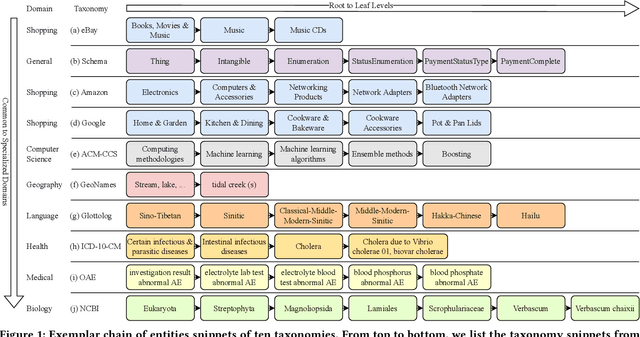
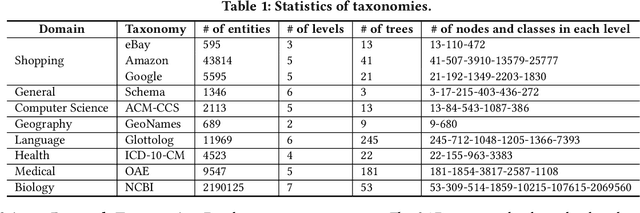
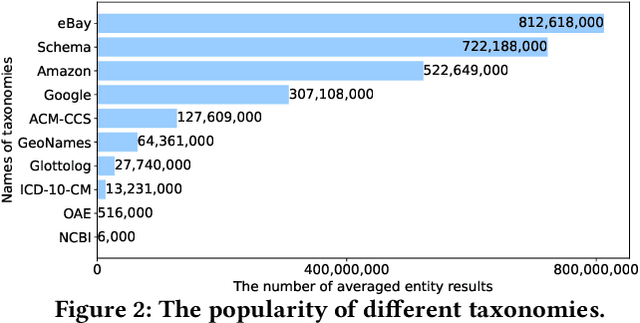
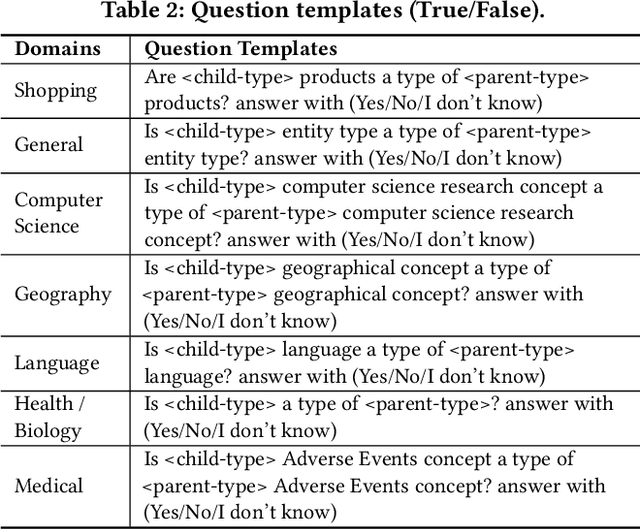
Large language models (LLMs) demonstrate an impressive ability to internalize knowledge and answer natural language questions. Although previous studies validate that LLMs perform well on general knowledge while presenting poor performance on long-tail nuanced knowledge, the community is still doubtful about whether the traditional knowledge graphs should be replaced by LLMs. In this paper, we ask if the schema of knowledge graph (i.e., taxonomy) is made obsolete by LLMs. Intuitively, LLMs should perform well on common taxonomies and at taxonomy levels that are common to people. Unfortunately, there lacks a comprehensive benchmark that evaluates the LLMs over a wide range of taxonomies from common to specialized domains and at levels from root to leaf so that we can draw a confident conclusion. To narrow the research gap, we constructed a novel taxonomy hierarchical structure discovery benchmark named TaxoGlimpse to evaluate the performance of LLMs over taxonomies. TaxoGlimpse covers ten representative taxonomies from common to specialized domains with in-depth experiments of different levels of entities in this taxonomy from root to leaf. Our comprehensive experiments of eighteen state-of-the-art LLMs under three prompting settings validate that LLMs can still not well capture the knowledge of specialized taxonomies and leaf-level entities.