 Add to Chrome
 Add to Firefox
 Add to Edge
AREX: Towards a Recursively Self-Improving Agent for Deep Research
Jul 24, 2026
Deep research requires agents to find answers that jointly satisfy multiple constraints. Discovering such answers is costly, whereas verifying a candidate can often be decomposed into tractable constraint-wise checks. This discovery--verification asymmetry suggests that a research agent should do more than simply search longer: it should recursively improve its current answer by verifying intermediate results and using the partially verified state to guide subsequent refinement. We introduce AREX, a family of Recursively Self-Improving (RSI) deep research agents. AREX alternates between an inner research loop that gathers evidence and constructs a provisional answer, and an outer self-improvement loop that audits the answer constraint-wise, identifies unresolved claims, and launches targeted follow-up research. To sustain RSI over long horizons, AREX learns an autonomous context-update tool that compresses growing interaction history into a compact improvement state preserving verified evidence and unresolved constraints, without relying on an external model. We train AREX on verified synthetic tasks and high-quality trajectories through agentic mid-training and long-horizon reinforcement learning. To mitigate sparse final rewards during long horizon learning, we emphasize key steps where decisive evidence is acquired or erroneous research directions are corrected. We instantiate a dense 4B model and a 122B-A10B Mixture-of-Experts model. Across BrowseComp, WideSearch, DeepSearchQA, Humanity's Last Exam (HLE), and other reasoning and tool-use benchmarks, AREX substantially outperforms comparable-scale baselines and remains competitive with models using substantially more activated parameters.

What Does Your Short-Answer VQA Score Actually Measure? Evaluator-Dependent Instability in Multimodal Short-Answer Benchmarks
Jul 11, 2026Short-answer VQA benchmarks conflate two distinct quantities: whether a model's answer is semantically correct, and whether that answer matches the surface form expected by the automatic evaluator. We study this conflation across six vision--language models and six benchmarks, using a human-validated semantic judge (97.6% precision) to audit over 37k official errors. A second text-only judge reproduces the same benchmark-level false-negative pattern, showing that the effect is not an artifact of a single audit model. On text-rich benchmarks, up to half of these errors are semantically acceptable answers penalized purely for surface-form mismatch. This instability is structured by answer type: extractive and multi-span answers are far more evaluator-sensitive than scalar answers. Benign prompt and context rewrites further destabilize official outcomes, flipping item-level correctness at substantial rates without changing the underlying task. A deterministic CPU-only contract repair confirms that the undercount is partially recoverable. These findings imply that official short-answer VQA scores should be accompanied by semantic audits and answer-type diagnostics to remain interpretable.
Beyond Metadata: CAPRA for Hidden Subgroup Analysis under Missing Metadata in Medical Imaging
Jul 10, 2026Medical imaging models are often deployed without the demographic, acquisition, and quality metadata needed for subgroup auditing. Once those metadata disappear, clinically critical failure modes can be masked by strong aggregate performance, and many robust-learning methods lose the group structure they rely on. We present CAPRA, a calibrated proxy-axis framework for hidden subgroup analysis under missing metadata. CAPRA predicts image-derived semantic axes, calibrates axis posteriors on a small metadata-labeled split via patient-level cross-fitting, and organizes those posteriors into a calibrated subgroup interface that supports both deployment-time failure analysis and downstream robust learning without requiring subgroup labels at deployment. Across fundus, dermoscopy, and chest radiography, CAPRA reveals disparity patterns missed by metadata-only slicing, remains informative under dataset shift, and produces subgroup partitions that align more closely with explicit failure axes than image-only or latent-slice baselines. The same interface can also be reused by downstream robust learners, although those gains are domain-dependent. Overall, CAPRA turns hidden subgroup analysis under missing metadata into a calibrated, interpretable, and reusable subgroup interface for deployment-time analysis and robust transfer.
Towards A Generalist Code Embedding Model Based On Massive Data Synthesis
May 19, 2025Code embedding models attract increasing attention due to the widespread popularity of retrieval-augmented generation (RAG) in software development. These models are expected to capture the rich semantic relationships inherent to code, which differ significantly from those found in text. However, existing models remain severely limited due to the scarcity of high-quality training data. In this work, we introduce \textbf{CodeR} (\underline{Code} \underline{R}etrieval), a state-of-the-art embedding model for general-purpose code retrieval. The superior performance of CodeR is built upon CodeR-Pile, a large-scale synthetic dataset constructed under the DRU (Diversity, Reliability, Usability) principle via a novel data synthesis pipeline. To optimize training effectiveness, we propose Annealing, a curriculum learning strategy that enables effective knowledge transfer across heterogeneous sources of data. We evaluate CodeR based on 16 diverse code retrieval tasks, where it significantly outperforms existing baselines and exhibits strong out-of-domain generalization performance. We have publicly released our code and the well-trained model to facilitate further research in this critical area. https://github.com/FlagOpen/FlagEmbedding/tree/master/research/BGE_Coder.
Reinforced Information Retrieval
Feb 17, 2025While retrieval techniques are widely used in practice, they still face significant challenges in cross-domain scenarios. Recently, generation-augmented methods have emerged as a promising solution to this problem. These methods enhance raw queries by incorporating additional information from an LLM-based generator, facilitating more direct retrieval of relevant documents. However, existing methods struggle with highly specialized situations that require extensive domain expertise. To address this problem, we present \textbf{Reinforced-IR}, a novel approach that jointly adapts a pre-trained retriever and generator for precise cross-domain retrieval. A key innovation of Reinforced-IR is its \textbf{Self-Boosting} framework, which enables retriever and generator to learn from each other's feedback. Specifically, the generator is reinforced to generate query augmentations that enhance the retriever's performance, while the retriever is trained to better discriminate the relevant documents identified by the generator. This iterative process allows the end-to-end retrieval performance to be progressively optimized using an unlabeled corpus from the target domain. In our experiment, Reinforced-IR outperforms existing domain adaptation methods by a large margin, leading to substantial improvements in retrieval quality across a wide range of application scenarios.
Matryoshka Re-Ranker: A Flexible Re-Ranking Architecture With Configurable Depth and Width
Jan 27, 2025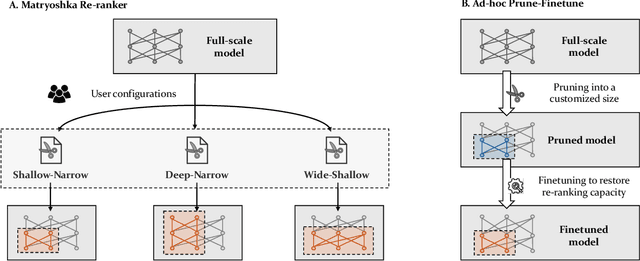
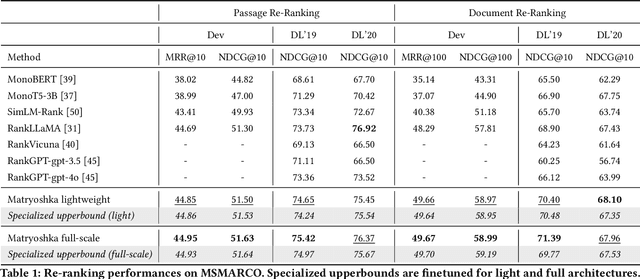
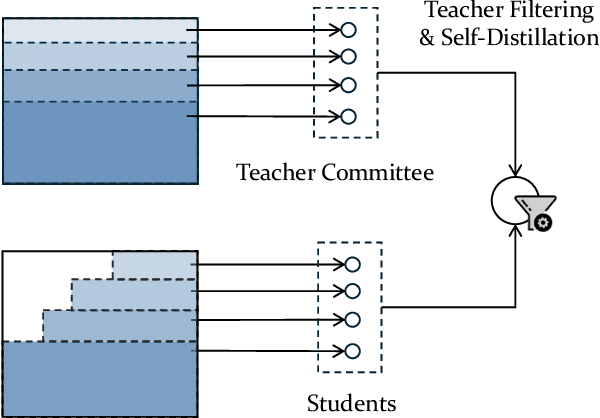
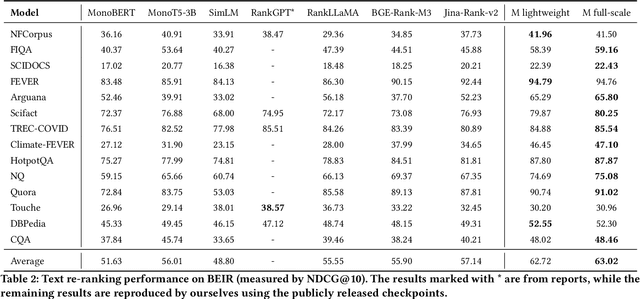
Large language models (LLMs) provide powerful foundations to perform fine-grained text re-ranking. However, they are often prohibitive in reality due to constraints on computation bandwidth. In this work, we propose a \textbf{flexible} architecture called \textbf{Matroyshka Re-Ranker}, which is designed to facilitate \textbf{runtime customization} of model layers and sequence lengths at each layer based on users' configurations. Consequently, the LLM-based re-rankers can be made applicable across various real-world situations. The increased flexibility may come at the cost of precision loss. To address this problem, we introduce a suite of techniques to optimize the performance. First, we propose \textbf{cascaded self-distillation}, where each sub-architecture learns to preserve a precise re-ranking performance from its super components, whose predictions can be exploited as smooth and informative teacher signals. Second, we design a \textbf{factorized compensation mechanism}, where two collaborative Low-Rank Adaptation modules, vertical and horizontal, are jointly employed to compensate for the precision loss resulted from arbitrary combinations of layer and sequence compression. We perform comprehensive experiments based on the passage and document retrieval datasets from MSMARCO, along with all public datasets from BEIR benchmark. In our experiments, Matryoshka Re-Ranker substantially outperforms the existing methods, while effectively preserving its superior performance across various forms of compression and different application scenarios.
LAC: Graph Contrastive Learning with Learnable Augmentation in Continuous Space
Oct 20, 2024Graph Contrastive Learning frameworks have demonstrated success in generating high-quality node representations. The existing research on efficient data augmentation methods and ideal pretext tasks for graph contrastive learning remains limited, resulting in suboptimal node representation in the unsupervised setting. In this paper, we introduce LAC, a graph contrastive learning framework with learnable data augmentation in an orthogonal continuous space. To capture the representative information in the graph data during augmentation, we introduce a continuous view augmenter, that applies both a masked topology augmentation module and a cross-channel feature augmentation module to adaptively augment the topological information and the feature information within an orthogonal continuous space, respectively. The orthogonal nature of continuous space ensures that the augmentation process avoids dimension collapse. To enhance the effectiveness of pretext tasks, we propose an information-theoretic principle named InfoBal and introduce corresponding pretext tasks. These tasks enable the continuous view augmenter to maintain consistency in the representative information across views while maximizing diversity between views, and allow the encoder to fully utilize the representative information in the unsupervised setting. Our experimental results show that LAC significantly outperforms the state-of-the-art frameworks.
DELIA: Diversity-Enhanced Learning for Instruction Adaptation in Large Language Models
Aug 19, 2024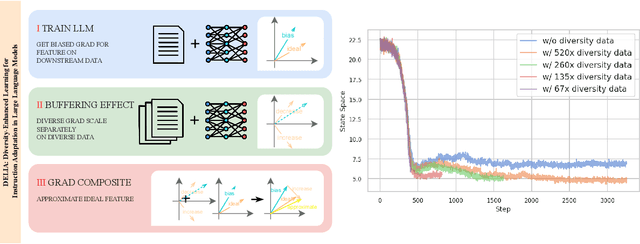

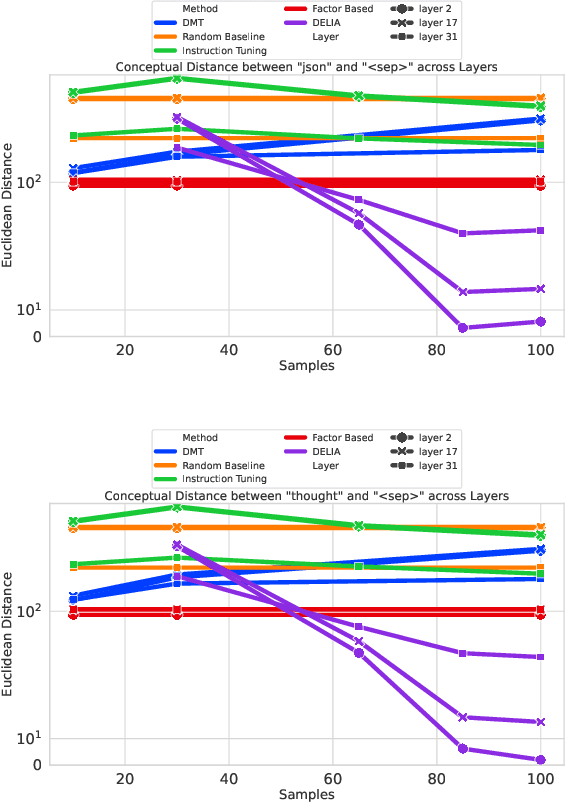
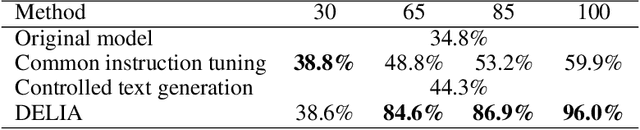
Although instruction tuning is widely used to adjust behavior in Large Language Models (LLMs), extensive empirical evidence and research indicates that it is primarily a process where the model fits to specific task formats, rather than acquiring new knowledge or capabilities. We propose that this limitation stems from biased features learned during instruction tuning, which differ from ideal task-specfic features, leading to learn less underlying semantics in downstream tasks. However, ideal features are unknown and incalculable, constraining past work to rely on prior knowledge to assist reasoning or training, which limits LLMs' capabilities to the developers' abilities, rather than data-driven scalable learning. In our paper, through our novel data synthesis method, DELIA (Diversity-Enhanced Learning for Instruction Adaptation), we leverage the buffering effect of extensive diverse data in LLMs training to transform biased features in instruction tuning into approximations of ideal features, without explicit prior ideal features. Experiments show DELIA's better performance compared to common instruction tuning and other baselines. It outperforms common instruction tuning by 17.07%-33.41% on Icelandic-English translation bleurt score (WMT-21 dataset, gemma-7b-it) and improves accuracy by 36.1% on formatted text generation (Llama2-7b-chat). Notably, among knowledge injection methods we've known, DELIA uniquely align the internal representations of new special tokens with their prior semantics.
Adversarial Contrastive Learning Based Physics-Informed Temporal Networks for Cuffless Blood Pressure Estimation
Aug 16, 2024Time series data mining is immensely important in extensive applications, such as traffic, medical, and e-commerce. In this paper, we focus on medical temporal variation modeling, \emph{i.e.,} cuffless blood pressure (BP) monitoring which has great value in cardiovascular healthcare. Although providing a comfortable user experience, such methods are suffering from the demand for a significant amount of realistic data to train an individual model for each subject, especially considering the invasive or obtrusive BP ground-truth measurements. To tackle this challenge, we introduce a novel physics-informed temporal network~(PITN) with adversarial contrastive learning to enable precise BP estimation with very limited data. Specifically, we first enhance the physics-informed neural network~(PINN) with the temporal block for investigating BP dynamics' multi-periodicity for personal cardiovascular cycle modeling and temporal variation. We then employ adversarial training to generate extra physiological time series data, improving PITN's robustness in the face of sparse subject-specific training data. Furthermore, we utilize contrastive learning to capture the discriminative variations of cardiovascular physiologic phenomena. This approach aggregates physiological signals with similar blood pressure values in latent space while separating clusters of samples with dissimilar blood pressure values. Experiments on three widely-adopted datasets with different modailties (\emph{i.e.,} bioimpedance, PPG, millimeter-wave) demonstrate the superiority and effectiveness of the proposed methods over previous state-of-the-art approaches. The code is available at~\url{https://github.com/Zest86/ACL-PITN}.
SpanGNN: Towards Memory-Efficient Graph Neural Networks via Spanning Subgraph Training
Jun 07, 2024
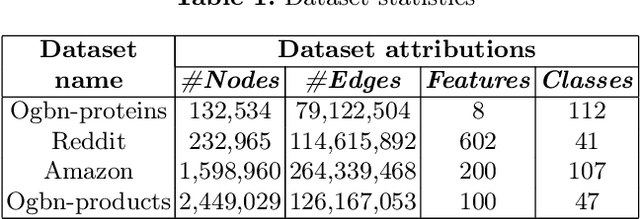
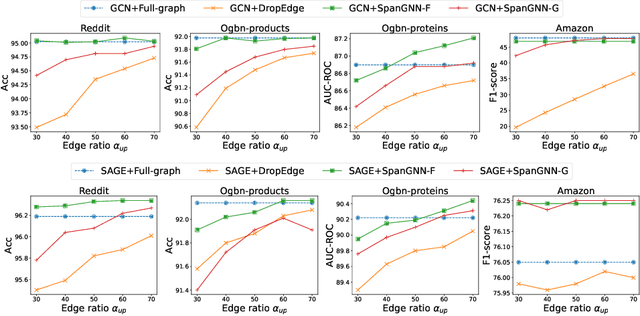
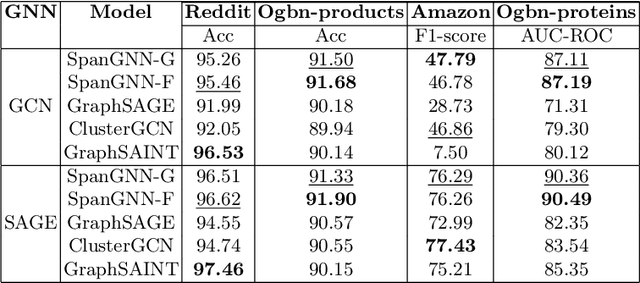
Graph Neural Networks (GNNs) have superior capability in learning graph data. Full-graph GNN training generally has high accuracy, however, it suffers from large peak memory usage and encounters the Out-of-Memory problem when handling large graphs. To address this memory problem, a popular solution is mini-batch GNN training. However, mini-batch GNN training increases the training variance and sacrifices the model accuracy. In this paper, we propose a new memory-efficient GNN training method using spanning subgraph, called SpanGNN. SpanGNN trains GNN models over a sequence of spanning subgraphs, which are constructed from empty structure. To overcome the excessive peak memory consumption problem, SpanGNN selects a set of edges from the original graph to incrementally update the spanning subgraph between every epoch. To ensure the model accuracy, we introduce two types of edge sampling strategies (i.e., variance-reduced and noise-reduced), and help SpanGNN select high-quality edges for the GNN learning. We conduct experiments with SpanGNN on widely used datasets, demonstrating SpanGNN's advantages in the model performance and low peak memory usage.