 Add to Chrome
 Add to Firefox
 Add to Edge
NextFund: A Unified Performance Tracking Platform for Agentic Portfolio Management
Jul 13, 2026
Large language models (LLMs) based agents are beginning to participate in portfolio construction and market analysis, where decisions must be justified under evolving information and risk constraints. Current assessment practice, however, remains poorly aligned with this setting: many studies rely on static examinations or report only terminal portfolio returns, while the intermediate evidence, analyst judgments, and execution steps that produced those returns stay largely invisible. We introduce NextFund, an evaluation platform that makes financial-agent behavior observable under live market conditions. The platform couples time-consistent market access, coordinated multi-agent analysis, and persistent logging of the full decision path from observation to trade. Through an interactive Trading Arena, users can compare models across markets, inspect equity curves, and drill from leaderboard outcomes down to individual justifications. We present NextFund on Hong Kong, U.S., and China A-share equities, illustrating how inspectable decision histories enable fairer benchmarking and more actionable diagnosis. Our demo is available at https://paradoox.cn/nextfund/.

NeuroEdge: Real-Time Hand Gesture Recognition with High-Density EMG Using Deep Learning at the Edge
May 28, 2026High-density electromyography (HD-EMG) has emerged as a powerful modality for decoding fine-grained neuromuscular activity, enabling real-time neural-machine interfaces (NMIs) for applications such as prosthetic control, rehabilitation, and augmented interaction. While deep learning approaches such as convolutional neural networks (CNNs)have demonstrated high classification accuracy for EMG-based gesture recognition, their deployment on embedded hardware remains a major challenge due to computational and memory constraints. This paper presents NeuroEdge, a real-time HD EMG-based NMI system that performs gesture recognition entirely on resource-constrained microcontrollers. The system features two custom-designed modules: the HD-EMG StreamBridge, a wireless communication interface that streams raw HD-EMG data from a Quattrocento amplifier to an ESP32 microcontroller; and the EdgeDL Inference Engine, a lightweight deep learning framework executing on a Sony Spresense microcontroller. A compact 1-dimensional CNN optimized for embedded inference processes, sliding windows of EMG data in real time. Data streaming and inference are pipelined and synchronized through an architecture that utilizes Direct Memory Access (DMA) for data transfer and Serial Peripheral Interface (SPI) burst communication between the ESP32 and Spresense, ensuring low-latency performance. Experimental results show that NeuroEdge achieves a real-time classification accuracy of 90% across seven hand gestures, with a total average latency of 83 ms using 192 channels of HD-EMG recorded from the forearm. Our system demonstrates the feasibility of deploying complex HD-EMG-based gesture recognition on microcontroller-based edge devices, bridging the gap between high-resolution biosignal acquisition and deep learning-based embedded inference for next-generation NMIs.
SignReasoner: Compositional Reasoning for Complex Traffic Sign Understanding via Functional Structure Units
Apr 12, 2026Accurate semantic understanding of complex traffic signs-including those with intricate layouts, multi-lingual text, and composite symbols-is critical for autonomous driving safety. Current models, both specialized small ones and large Vision Language Models (VLMs), suffer from a significant bottleneck: a lack of compositional generalization, leading to failure when encountering novel sign configurations. To overcome this, we propose SignReasoner, a novel paradigm that transforms general VLMs into expert traffic sign reasoners. Our core innovation is Functional Structure Unit (FSU), which shifts from common instance-based modeling to flexible function-based decomposition. By breaking down complex signs into minimal, core functional blocks (e.g., Direction, Notice, Lane), our model learns the underlying structural grammar, enabling robust generalization to unseen compositions. We define this decomposition as the FSU-Reasoning task and introduce a two-stage VLM post-training pipeline to maximize performance: Iterative Caption-FSU Distillation that enhances the model's accuracy in both FSU-reasoning and caption generation; FSU-GRPO that uses Tree Edit Distance (TED) to compute FSU differences as the rewards in GRPO algorithm, boosting reasoning abilities. Experiments on the newly proposed FSU-Reasoning benchmark, TrafficSignEval, show that SignReasoner achieves new SOTA with remarkable data efficiency and no architectural modification, significantly improving the traffic sign understanding in various VLMs.
Fine-Grained Evaluation of Large Vision-Language Models in Autonomous Driving
Mar 27, 2025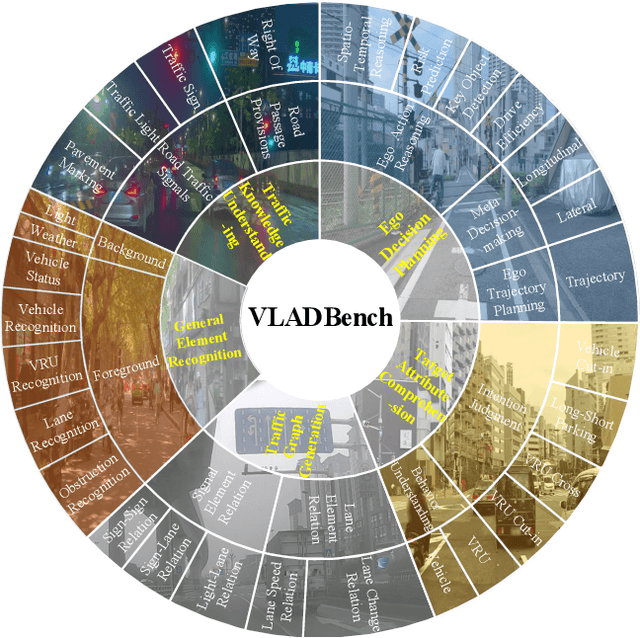
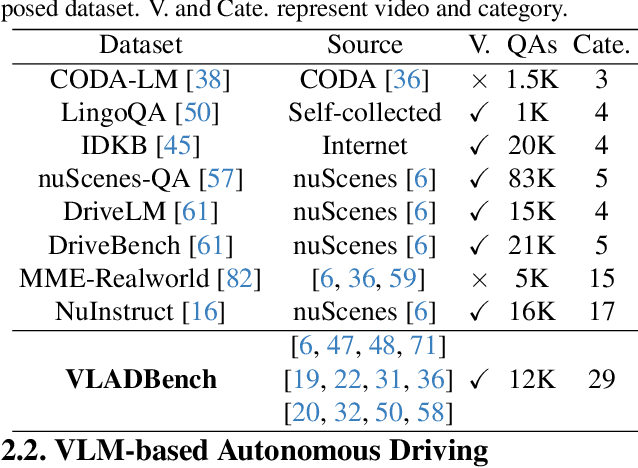
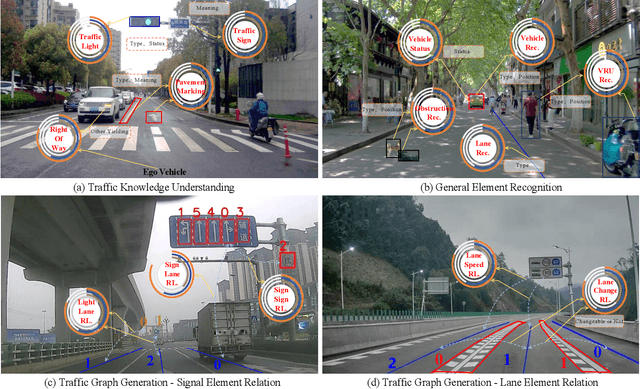
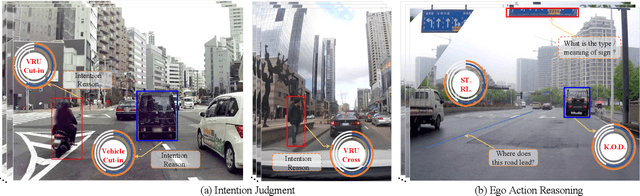
Existing benchmarks for Vision-Language Model (VLM) on autonomous driving (AD) primarily assess interpretability through open-form visual question answering (QA) within coarse-grained tasks, which remain insufficient to assess capabilities in complex driving scenarios. To this end, we introduce $\textbf{VLADBench}$, a challenging and fine-grained dataset featuring close-form QAs that progress from static foundational knowledge and elements to advanced reasoning for dynamic on-road situations. The elaborate $\textbf{VLADBench}$ spans 5 key domains: Traffic Knowledge Understanding, General Element Recognition, Traffic Graph Generation, Target Attribute Comprehension, and Ego Decision-Making and Planning. These domains are further broken down into 11 secondary aspects and 29 tertiary tasks for a granular evaluation. A thorough assessment of general and domain-specific (DS) VLMs on this benchmark reveals both their strengths and critical limitations in AD contexts. To further exploit the cognitive and reasoning interactions among the 5 domains for AD understanding, we start from a small-scale VLM and train the DS models on individual domain datasets (collected from 1.4M DS QAs across public sources). The experimental results demonstrate that the proposed benchmark provides a crucial step toward a more comprehensive assessment of VLMs in AD, paving the way for the development of more cognitively sophisticated and reasoning-capable AD systems.
LAC: Graph Contrastive Learning with Learnable Augmentation in Continuous Space
Oct 20, 2024Graph Contrastive Learning frameworks have demonstrated success in generating high-quality node representations. The existing research on efficient data augmentation methods and ideal pretext tasks for graph contrastive learning remains limited, resulting in suboptimal node representation in the unsupervised setting. In this paper, we introduce LAC, a graph contrastive learning framework with learnable data augmentation in an orthogonal continuous space. To capture the representative information in the graph data during augmentation, we introduce a continuous view augmenter, that applies both a masked topology augmentation module and a cross-channel feature augmentation module to adaptively augment the topological information and the feature information within an orthogonal continuous space, respectively. The orthogonal nature of continuous space ensures that the augmentation process avoids dimension collapse. To enhance the effectiveness of pretext tasks, we propose an information-theoretic principle named InfoBal and introduce corresponding pretext tasks. These tasks enable the continuous view augmenter to maintain consistency in the representative information across views while maximizing diversity between views, and allow the encoder to fully utilize the representative information in the unsupervised setting. Our experimental results show that LAC significantly outperforms the state-of-the-art frameworks.