 Add to Chrome
 Add to Firefox
 Add to Edge
Enabling Autonomic Microservice Management through Self-Learning Agents
Jan 31, 2025
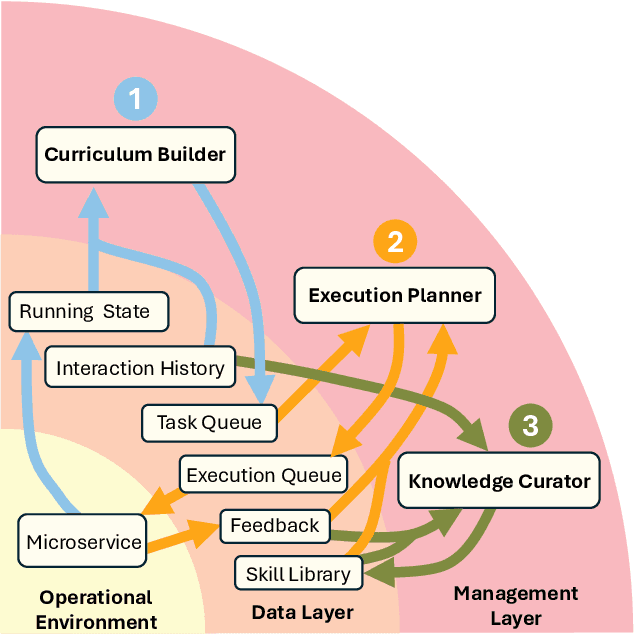
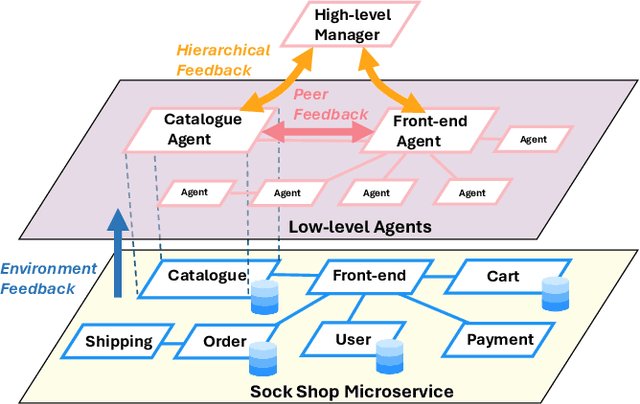

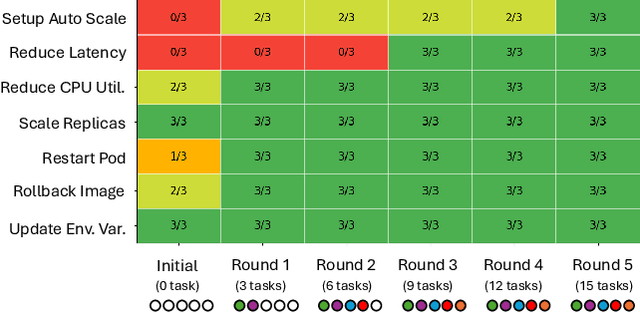
The increasing complexity of modern software systems necessitates robust autonomic self-management capabilities. While Large Language Models (LLMs) demonstrate potential in this domain, they often face challenges in adapting their general knowledge to specific service contexts. To address this limitation, we propose ServiceOdyssey, a self-learning agent system that autonomously manages microservices without requiring prior knowledge of service-specific configurations. By leveraging curriculum learning principles and iterative exploration, ServiceOdyssey progressively develops a deep understanding of operational environments, reducing dependence on human input or static documentation. A prototype built with the Sock Shop microservice demonstrates the potential of this approach for autonomic microservice management.

Amplifier: Bringing Attention to Neglected Low-Energy Components in Time Series Forecasting
Jan 28, 2025We propose an energy amplification technique to address the issue that existing models easily overlook low-energy components in time series forecasting. This technique comprises an energy amplification block and an energy restoration block. The energy amplification block enhances the energy of low-energy components to improve the model's learning efficiency for these components, while the energy restoration block returns the energy to its original level. Moreover, considering that the energy-amplified data typically displays two distinct energy peaks in the frequency spectrum, we integrate the energy amplification technique with a seasonal-trend forecaster to model the temporal relationships of these two peaks independently, serving as the backbone for our proposed model, Amplifier. Additionally, we propose a semi-channel interaction temporal relationship enhancement block for Amplifier, which enhances the model's ability to capture temporal relationships from the perspective of the commonality and specificity of each channel in the data. Extensive experiments on eight time series forecasting benchmarks consistently demonstrate our model's superiority in both effectiveness and efficiency compared to state-of-the-art methods.
Optimizing Sentence Embedding with Pseudo-Labeling and Model Ensembles: A Hierarchical Framework for Enhanced NLP Tasks
Jan 27, 2025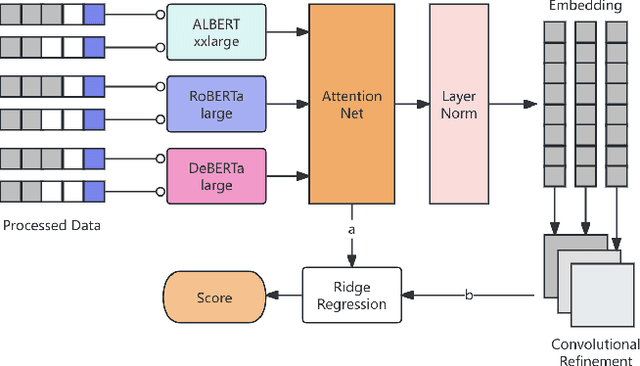
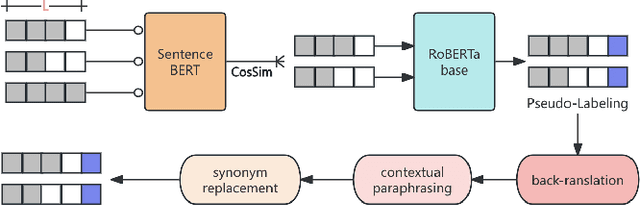
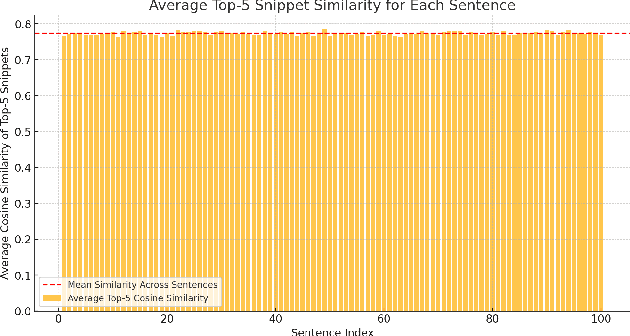
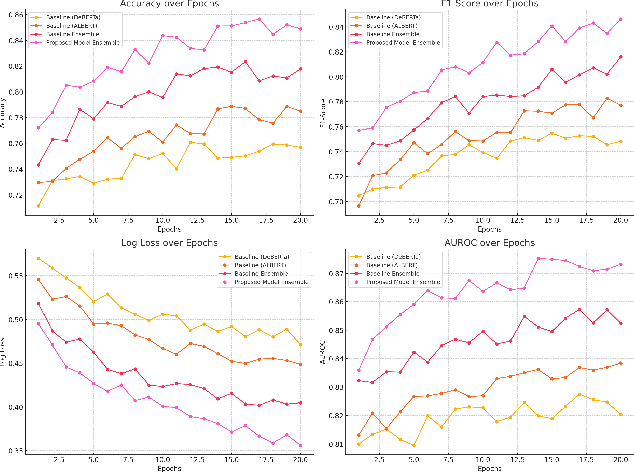
Sentence embedding tasks are important in natural language processing (NLP), but improving their performance while keeping them reliable is still hard. This paper presents a framework that combines pseudo-label generation and model ensemble techniques to improve sentence embeddings. We use external data from SimpleWiki, Wikipedia, and BookCorpus to make sure the training data is consistent. The framework includes a hierarchical model with an encoding layer, refinement layer, and ensemble prediction layer, using ALBERT-xxlarge, RoBERTa-large, and DeBERTa-large models. Cross-attention layers combine external context, and data augmentation techniques like synonym replacement and back-translation increase data variety. Experimental results show large improvements in accuracy and F1-score compared to basic models, and studies confirm that cross-attention and data augmentation make a difference. This work presents an effective way to improve sentence embedding tasks and lays the groundwork for future NLP research.
Skeleton-Guided-Translation: A Benchmarking Framework for Code Repository Translation with Fine-Grained Quality Evaluation
Jan 27, 2025


The advancement of large language models has intensified the need to modernize enterprise applications and migrate legacy systems to secure, versatile languages. However, existing code translation benchmarks primarily focus on individual functions, overlooking the complexities involved in translating entire repositories, such as maintaining inter-module coherence and managing dependencies. While some recent repository-level translation benchmarks attempt to address these challenges, they still face limitations, including poor maintainability and overly coarse evaluation granularity, which make them less developer-friendly. We introduce Skeleton-Guided-Translation, a framework for repository-level Java to C# code translation with fine-grained quality evaluation. It uses a two-step process: first translating the repository's structural "skeletons", then translating the full repository guided by these skeletons. Building on this, we present TRANSREPO-BENCH, a benchmark of high quality open-source Java repositories and their corresponding C# skeletons, including matching unit tests and build configurations. Our unit tests are fixed and can be applied across multiple or incremental translations without manual adjustments, enhancing automation and scalability in evaluations. Additionally, we develop fine-grained evaluation metrics that assess translation quality at the individual test case level, addressing traditional binary metrics' inability to distinguish when build failures cause all tests to fail. Evaluations using TRANSREPO-BENCH highlight key challenges and advance more accurate repository level code translation.
LLM-powered Multi-agent Framework for Goal-oriented Learning in Intelligent Tutoring System
Jan 27, 2025


Intelligent Tutoring Systems (ITSs) have revolutionized education by offering personalized learning experiences. However, as goal-oriented learning, which emphasizes efficiently achieving specific objectives, becomes increasingly important in professional contexts, existing ITSs often struggle to deliver this type of targeted learning experience. In this paper, we propose GenMentor, an LLM-powered multi-agent framework designed to deliver goal-oriented, personalized learning within ITS. GenMentor begins by accurately mapping learners' goals to required skills using a fine-tuned LLM trained on a custom goal-to-skill dataset. After identifying the skill gap, it schedules an efficient learning path using an evolving optimization approach, driven by a comprehensive and dynamic profile of learners' multifaceted status. Additionally, GenMentor tailors learning content with an exploration-drafting-integration mechanism to align with individual learner needs. Extensive automated and human evaluations demonstrate GenMentor's effectiveness in learning guidance and content quality. Furthermore, we have deployed it in practice and also implemented it as an application. Practical human study with professional learners further highlights its effectiveness in goal alignment and resource targeting, leading to enhanced personalization. Supplementary resources are available at https://github.com/GeminiLight/gen-mentor.
A Comprehensive Framework for Semantic Similarity Detection Using Transformer Architectures and Enhanced Ensemble Techniques
Jan 24, 2025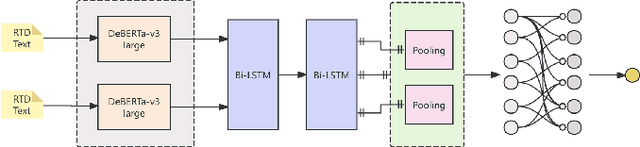
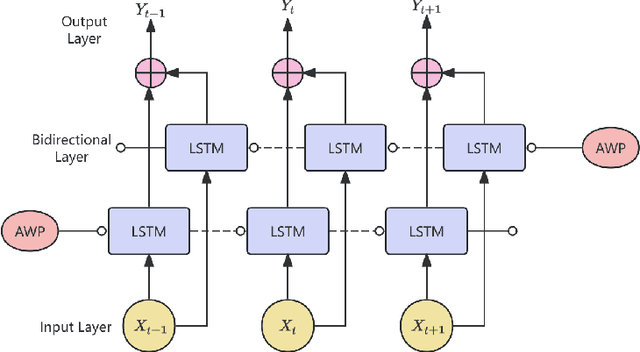
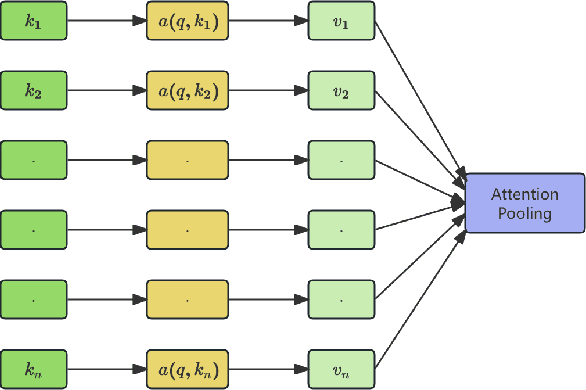
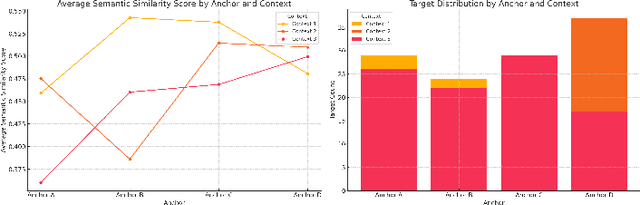
Detecting AI-generated text, especially in short-context documents, is difficult because there is not enough context for accurate classification. This paper presents a new teacher-student model that uses domain adaptation and data augmentation to solve these problems. The teacher model, which combines DeBERTa-v3-large and Mamba-790m, learns semantic knowledge through domain-specific fine-tuning. The student model handles short-context text more efficiently. The system uses a Mean Squared Error (MSE) loss function to guide the student's learning, improving both accuracy and efficiency. Also, data augmentation methods like spelling correction and error injection make the model more robust. Experimental results show that this approach works better than baseline methods, proving its usefulness for real-time AI-generated text detection and other text classification tasks.
Large-scale and Fine-grained Vision-language Pre-training for Enhanced CT Image Understanding
Jan 24, 2025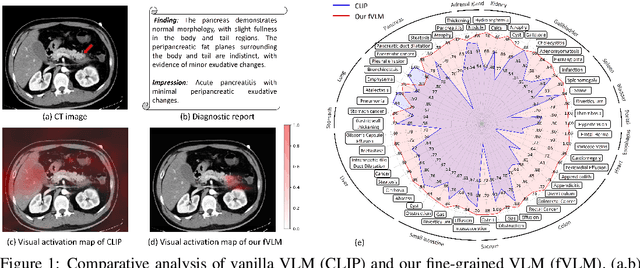
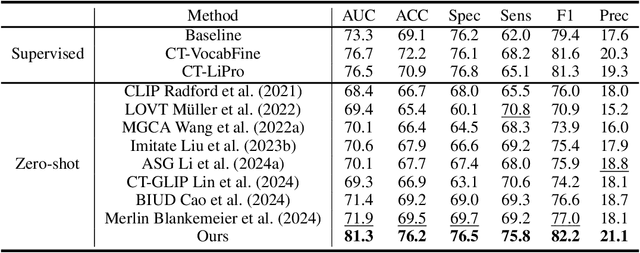
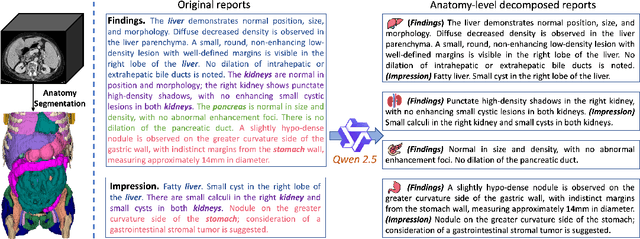
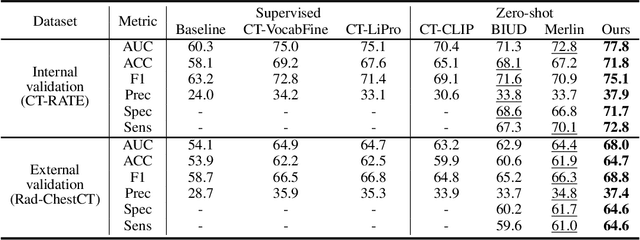
Artificial intelligence (AI) shows great potential in assisting radiologists to improve the efficiency and accuracy of medical image interpretation and diagnosis. However, a versatile AI model requires large-scale data and comprehensive annotations, which are often impractical in medical settings. Recent studies leverage radiology reports as a naturally high-quality supervision for medical images, using contrastive language-image pre-training (CLIP) to develop language-informed models for radiological image interpretation. Nonetheless, these approaches typically contrast entire images with reports, neglecting the local associations between imaging regions and report sentences, which may undermine model performance and interoperability. In this paper, we propose a fine-grained vision-language model (fVLM) for anatomy-level CT image interpretation. Specifically, we explicitly match anatomical regions of CT images with corresponding descriptions in radiology reports and perform contrastive pre-training for each anatomy individually. Fine-grained alignment, however, faces considerable false-negative challenges, mainly from the abundance of anatomy-level healthy samples and similarly diseased abnormalities. To tackle this issue, we propose identifying false negatives of both normal and abnormal samples and calibrating contrastive learning from patient-level to disease-aware pairing. We curated the largest CT dataset to date, comprising imaging and report data from 69,086 patients, and conducted a comprehensive evaluation of 54 major and important disease diagnosis tasks across 15 main anatomies. Experimental results demonstrate the substantial potential of fVLM in versatile medical image interpretation. In the zero-shot classification task, we achieved an average AUC of 81.3% on 54 diagnosis tasks, surpassing CLIP and supervised methods by 12.9% and 8.0%, respectively.
DI-BENCH: Benchmarking Large Language Models on Dependency Inference with Testable Repositories at Scale
Jan 23, 2025Large Language Models have advanced automated software development, however, it remains a challenge to correctly infer dependencies, namely, identifying the internal components and external packages required for a repository to successfully run. Existing studies highlight that dependency-related issues cause over 40\% of observed runtime errors on the generated repository. To address this, we introduce DI-BENCH, a large-scale benchmark and evaluation framework specifically designed to assess LLMs' capability on dependency inference. The benchmark features 581 repositories with testing environments across Python, C#, Rust, and JavaScript. Extensive experiments with textual and execution-based metrics reveal that the current best-performing model achieves only a 42.9% execution pass rate, indicating significant room for improvement. DI-BENCH establishes a new viewpoint for evaluating LLM performance on repositories, paving the way for more robust end-to-end software synthesis.
Generating with Fairness: A Modality-Diffused Counterfactual Framework for Incomplete Multimodal Recommendations
Jan 21, 2025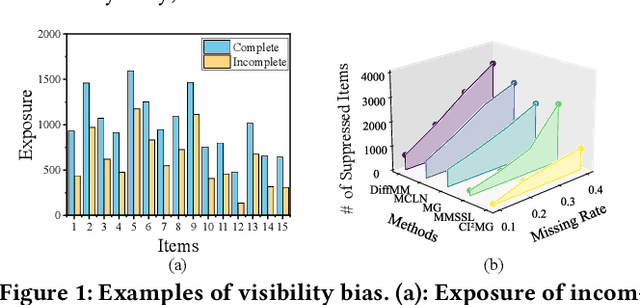
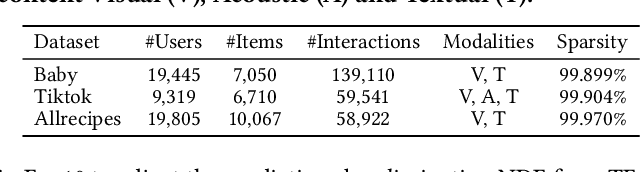
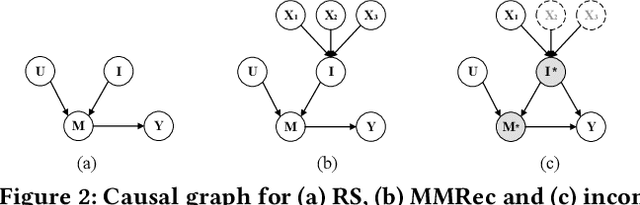
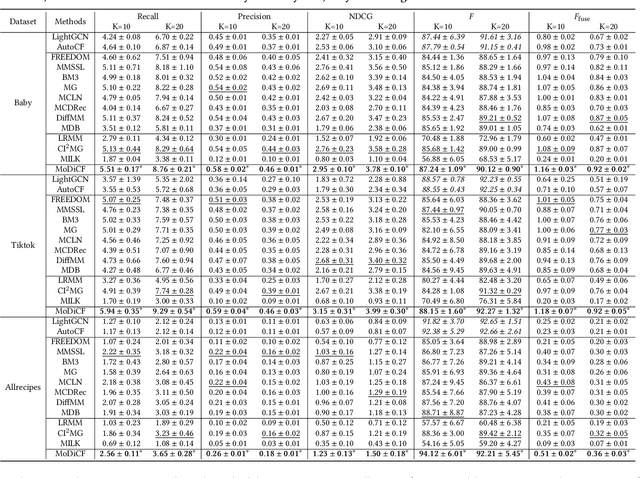
Incomplete scenario is a prevalent, practical, yet challenging setting in Multimodal Recommendations (MMRec), where some item modalities are missing due to various factors. Recently, a few efforts have sought to improve the recommendation accuracy by exploring generic structures from incomplete data. However, two significant gaps persist: 1) the difficulty in accurately generating missing data due to the limited ability to capture modality distributions; and 2) the critical but overlooked visibility bias, where items with missing modalities are more likely to be disregarded due to the prioritization of items' multimodal data over user preference alignment. This bias raises serious concerns about the fair treatment of items. To bridge these two gaps, we propose a novel Modality-Diffused Counterfactual (MoDiCF) framework for incomplete multimodal recommendations. MoDiCF features two key modules: a novel modality-diffused data completion module and a new counterfactual multimodal recommendation module. The former, equipped with a particularly designed multimodal generative framework, accurately generates and iteratively refines missing data from learned modality-specific distribution spaces. The latter, grounded in the causal perspective, effectively mitigates the negative causal effects of visibility bias and thus assures fairness in recommendations. Both modules work collaboratively to address the two aforementioned significant gaps for generating more accurate and fair results. Extensive experiments on three real-world datasets demonstrate the superior performance of MoDiCF in terms of both recommendation accuracy and fairness
GaussianAvatar-Editor: Photorealistic Animatable Gaussian Head Avatar Editor
Jan 17, 2025We introduce GaussianAvatar-Editor, an innovative framework for text-driven editing of animatable Gaussian head avatars that can be fully controlled in expression, pose, and viewpoint. Unlike static 3D Gaussian editing, editing animatable 4D Gaussian avatars presents challenges related to motion occlusion and spatial-temporal inconsistency. To address these issues, we propose the Weighted Alpha Blending Equation (WABE). This function enhances the blending weight of visible Gaussians while suppressing the influence on non-visible Gaussians, effectively handling motion occlusion during editing. Furthermore, to improve editing quality and ensure 4D consistency, we incorporate conditional adversarial learning into the editing process. This strategy helps to refine the edited results and maintain consistency throughout the animation. By integrating these methods, our GaussianAvatar-Editor achieves photorealistic and consistent results in animatable 4D Gaussian editing. We conduct comprehensive experiments across various subjects to validate the effectiveness of our proposed techniques, which demonstrates the superiority of our approach over existing methods. More results and code are available at: [Project Link](https://xiangyueliu.github.io/GaussianAvatar-Editor/).