 Add to Chrome
 Add to Firefox
 Add to Edge
GASE: Gaussian Splatting-Based Automated System for Reconstructing Embodied-Simulation Environments
Jun 16, 2026
Training embodied agents in the real world requires skilled operators and expensive hardware. Simulation environments offer a compelling alternative by enabling large-scale, cost-effective data augmentation. Consequently, rapidly constructing high-fidelity simulation scenes with a minimal sim-to-real gap has become a critical objective in robot learning. While reconstruction-based methods provide superior visual quality, current workflows are hindered by inefficient data acquisition and subpar foreground object extraction. We thus propose GASE, a highly automated system for simulation scene construction. GASE leverages multi-view video streams from panoramic camera arrays to enable rapid environment scanning. To ensure high-quality asset generation, our pipeline introduces a camera-pose-based strategy that robustly extracts objects across frames in the 2D domain, followed by high-fidelity scene inpainting. Foreground objects and the static background are then reconstructed independently and seamlessly imported into physics simulators for policy training. Extensive experiments demonstrate that GASE outperforms existing 3D Gaussian-based methods in segmentation accuracy by over 10\% while achieving state-of-the-art inpainting quality. Furthermore, real-robot deployments across manipulation and navigation tasks maintains a performance gap of less than 10\% compared to policies trained purely on real-world data. These results confirm that GASE provides an efficient and highly effective solution for bridging the sim-to-real gap. Code will be released.

FEnc$^2$: Unifying Data Packing for Efficient Private Inference via Convolution and Architecture-Aware Fragment Encoding
Jun 15, 2026Fully Homomorphic Encryption (FHE) enables privacy-preserving machine learning but incurs extreme computational and memory overhead. These costs come not only from expensive low-level primitives, including Number Theoretic Transform (NTT), rotation, and key-switching, but also from inefficient ciphertext packing at the application level. Existing packing strategies typically preserve either neighboring data elements or feature grouping, but not both, leading to wasted ciphertext slots, excessive rotations, and inflated ciphertext counts. We propose FEnc2, a unified and principled fragment-based encoding framework for CKKS-based private convolutional neural network inference. FEnc2 optimizes slot utilization, rotation complexity, and ciphertext density through two components: 1)Conv-aware Encoding, which analytically selects an optimal fragment size to decouple spatial dependencies and jointly minimize inner-outer rotations across layers, and 2)Arch-aware Ct Compression, which restores ciphertext density after feature- or channel-reduction layers. Together, these transformations reshape encrypted workload structure and reduce homomorphic operations by one to two orders of magnitude. With full memory capacity utilized, i.e., at maximum batch size, FEnc2 achieves end-to-end latency speedups over the state-of-the-art Orion of up to 228.83x on GPU and 226.06x on CPU for LeNet on MNIST, and up to 4.55x on GPU and 9.43x on CPU for MobileNet on ImageNet. FEnc2 is hardware-agnostic yet architecturally transformative: by optimizing encrypted tensor layout before execution, it reduces ciphertext count and workload pressure on hardware, complementing primitive-level optimizations such as NTT and keyswitch accelerators. These results show that application-level data layout is a first-order architectural design dimension for encrypted inference and an important enabler for next-generation FHE systems.
Ling and Ring 2.6 Technical Report: Efficient and Instant Agentic Intelligence at Trillion-Parameter Scale
Jun 13, 2026Efficient and scalable agentic intelligence requires models that can deliver both low-latency responses and strong reasoning capabilities while remaining practical to train, serve, and deploy. In this report, we present Ling-2.6 and Ring-2.6, a family of models designed to address this challenge at scale. Ling-2.6 is optimized for instant response generation and high capability per output token, whereas Ring-2.6 is tailored for deeper reasoning and more advanced agentic workflows. Instead of training from scratch, we upgrade the Ling-2.0 base model through architectural migration pre-training and large-scale post-training. This upgrade is guided by a unified co-design of model architecture, optimization objectives, serving systems, and agent training environments, enabling improvements in both model capability and deployment efficiency. At the architectural level, we introduce a hybrid linear attention design that integrates Lightning Attention with MLA, improving the efficiency of long-context training and decoding. To further enhance token efficiency, we optimize capability per output token through Evolutionary Chain-of-Thought, Linguistic Unit Policy Optimization, bidirectional preference alignment, and shortest-correct-response distillation. For agentic capabilities, we propose KPop, a reinforcement learning framework designed to support stable training of Ring-2.6-1T on large-scale environment-grounded data. KPop improves training efficiency through asynchronous scheduling across coding, search, tool use, and workflow execution, enabling scalable learning from complex agent-environment interactions. Together, Ling-2.6 and Ring-2.6 provide a practical pathway toward efficient, scalable, and open agentic systems. We open-source all checkpoints in the 2.6 family to support further research and development in practical agentic intelligence.
Reinforcement Learning with Robust Rubric Rewards
May 28, 2026While Reinforcement Learning with Verifiable Rewards (RLVR) is effective for deterministically checkable tasks, many vision-language tasks are partially verifiable, demanding multi-criteria supervision (e.g., perceptual details, reasoning steps, and constraints). Rubrics provide a natural interface for this fine-grained supervision, but their effectiveness depends on the execution accuracy during online RL. We propose Reinforcement Learning with Robust Rubric Rewards ($\text{RLR}^3$), extending RLVR from task-level verification to criterion-level verification. $\text{RLR}^3$ routes instance-specific rubrics through two execution paths: an LLM-as-an-extractor paired with a deterministic verifier, or an LLM-as-a-Judge for non-verifiable criteria. To ensure faithful scoring, $\text{RLR}^3$ introduce a minimal exposure strategy that masks ground truths from extractors and images from judges. Furthermore, $\text{RLR}^3$ employs hierarchical aggregation to prioritize essential criteria over additional criteria, and mitigates score saturation within rollout groups. Evaluated on Qwen3-VL-30B-A3B across 15 benchmarks, $\text{RLR}^3$ consistently outperforms RLVR, yielding a 4.7-point improvement over the base model and exceeding the official instruct-to-thinking model gap. Controlled audits confirm our deterministic verification and minimal exposure significantly reduce exploitable false positives.
Visual Preference Optimization with Rubric Rewards
Apr 14, 2026The effectiveness of Direct Preference Optimization (DPO) depends on preference data that reflect the quality differences that matter in multimodal tasks. Existing pipelines often rely on off-policy perturbations or coarse outcome-based signals, which are not well suited to fine-grained visual reasoning. We propose rDPO, a preference optimization framework based on instance-specific rubrics. For each image-instruction pair, we create a checklist-style rubric of essential and additional criteria to score responses from any possible policies. The instruction-rubric pool is built offline and reused during the construction of on-policy data. On public reward modeling benchmarks, rubric-based prompting massively improves a 30B-A3B judge and brings it close to GPT-5.4. On public downstream benchmarks, rubric-based filtering raises the macro average to 82.69, whereas outcome-based filtering drops it to 75.82 from 81.14. When evaluating scalability on a comprehensive benchmark, rDPO achieves 61.01, markedly outperforming the style-constrained baseline (52.36) and surpassing the 59.48 base model. Together, these results show that visual preference optimization benefits from combining on-policy data construction with instance-specific criterion-level feedback.
FloCA: Towards Faithful and Logically Consistent Flowchart Reasoning
Feb 15, 2026Flowchart-oriented dialogue (FOD) systems aim to guide users through multi-turn decision-making or operational procedures by following a domain-specific flowchart to achieve a task goal. In this work, we formalize flowchart reasoning in FOD as grounding user input to flowchart nodes at each dialogue turn while ensuring node transition is consistent with the correct flowchart path. Despite recent advances of LLMs in task-oriented dialogue systems, adapting them to FOD still faces two limitations: (1) LLMs lack an explicit mechanism to represent and reason over flowchart topology, and (2) they are prone to hallucinations, leading to unfaithful flowchart reasoning. To address these limitations, we propose FloCA, a zero-shot flowchart-oriented conversational agent. FloCA uses an LLM for intent understanding and response generation while delegating flowchart reasoning to an external tool that performs topology-constrained graph execution, ensuring faithful and logically consistent node transitions across dialogue turns. We further introduce an evaluation framework with an LLM-based user simulator and five new metrics covering reasoning accuracy and interaction efficiency. Extensive experiments on FLODIAL and PFDial datasets highlight the bottlenecks of existing LLM-based methods and demonstrate the superiority of FloCA. Our codes are available at https://github.com/Jinzi-Zou/FloCA-flowchart-reasoning.
Tokenization and Morphological Fidelity in Uralic NLP: A Cross-Lingual Evaluation
Feb 04, 2026Subword tokenization critically affects Natural Language Processing (NLP) performance, yet its behavior in morphologically rich and low-resource language families remains under-explored. This study systematically compares three subword paradigms -- Byte Pair Encoding (BPE), Overlap BPE (OBPE), and Unigram Language Model -- across six Uralic languages with varying resource availability and typological diversity. Using part-of-speech (POS) tagging as a controlled downstream task, we show that OBPE consistently achieves stronger morphological alignment and higher tagging accuracy than conventional methods, particularly within the Latin-script group. These gains arise from reduced fragmentation in open-class categories and a better balance across the frequency spectrum. Transfer efficacy further depends on the downstream tagging architecture, interacting with both training volume and genealogical proximity. Taken together, these findings highlight that morphology-sensitive tokenization is not merely a preprocessing choice but a decisive factor in enabling effective cross-lingual transfer for agglutinative, low-resource languages.
PPL: Point Cloud Supervised Proprioceptive Locomotion Reinforcement Learning for Legged Robots in Crawl Spaces
Aug 13, 2025The legged locomotion in spatially constrained structures (called crawl spaces) is challenging. In crawl spaces, current exteroceptive locomotion learning methods are limited by large noises and errors of the sensors in possible low visibility conditions, and current proprioceptive locomotion learning methods are difficult in traversing crawl spaces because only ground features are inferred. In this study, a point cloud supervised proprioceptive locomotion reinforcement learning method for legged robots in crawl spaces is proposed. A state estimation network is designed to estimate the robot's surrounding ground and spatial features as well as the robot's collision states using historical proprioceptive sensor data. The point cloud is represented in polar coordinate frame and a point cloud processing method is proposed to efficiently extract the ground and spatial features that are used to supervise the state estimation network learning. Comprehensive reward functions that guide the robot to traverse through crawl spaces after collisions are designed. Experiments demonstrate that, compared to existing methods, our method exhibits more agile locomotion in crawl spaces. This study enhances the ability of legged robots to traverse spatially constrained environments without requiring exteroceptive sensors.
Seed LiveInterpret 2.0: End-to-end Simultaneous Speech-to-speech Translation with Your Voice
Jul 24, 2025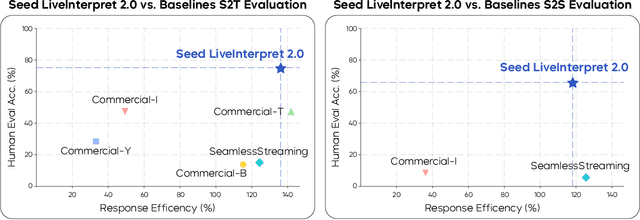
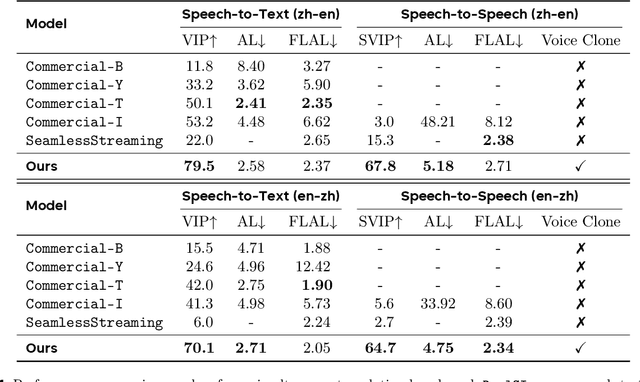
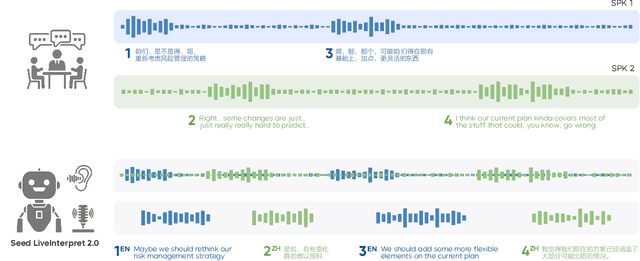
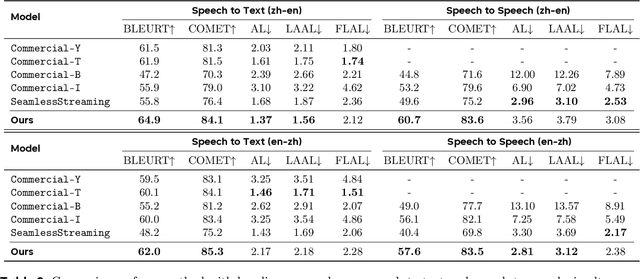
Simultaneous Interpretation (SI) represents one of the most daunting frontiers in the translation industry, with product-level automatic systems long plagued by intractable challenges: subpar transcription and translation quality, lack of real-time speech generation, multi-speaker confusion, and translated speech inflation, especially in long-form discourses. In this study, we introduce Seed-LiveInterpret 2.0, an end-to-end SI model that delivers high-fidelity, ultra-low-latency speech-to-speech generation with voice cloning capabilities. As a fully operational product-level solution, Seed-LiveInterpret 2.0 tackles these challenges head-on through our novel duplex speech-to-speech understanding-generating framework. Experimental results demonstrate that through large-scale pretraining and reinforcement learning, the model achieves a significantly better balance between translation accuracy and latency, validated by human interpreters to exceed 70% correctness in complex scenarios. Notably, Seed-LiveInterpret 2.0 outperforms commercial SI solutions by significant margins in translation quality, while slashing the average latency of cloned speech from nearly 10 seconds to a near-real-time 3 seconds, which is around a near 70% reduction that drastically enhances practical usability.
LaPON: A Lagrange's-mean-value-theorem-inspired operator network for solving PDEs and its application on NSE
May 18, 2025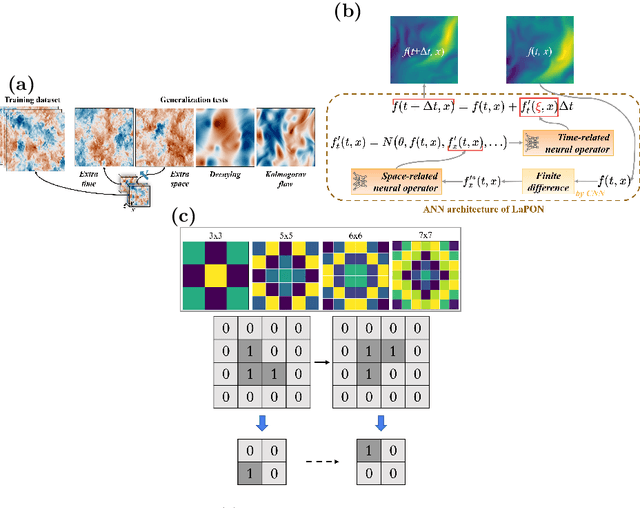
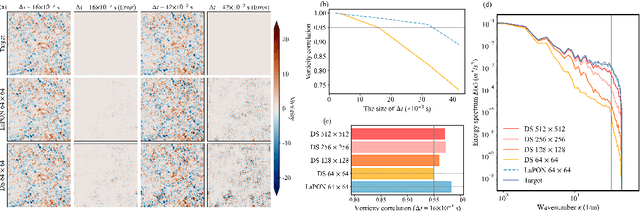
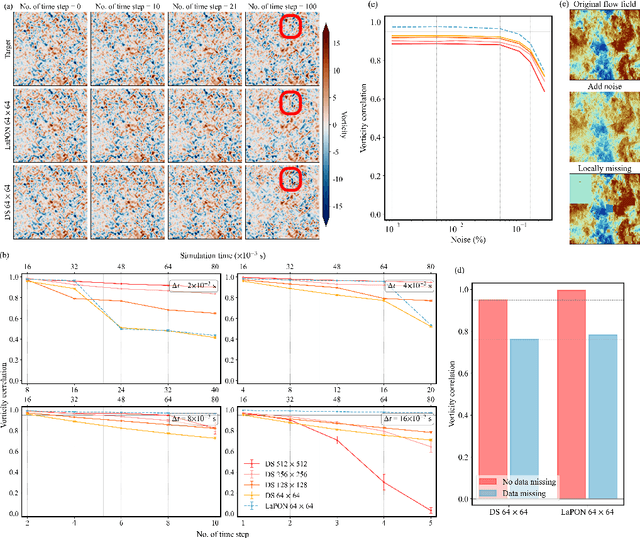
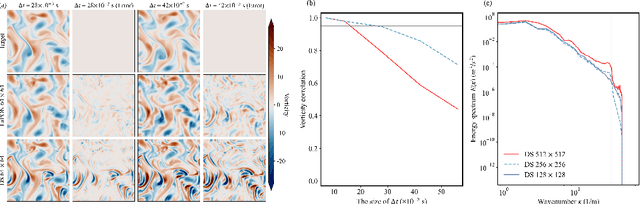
Accelerating the solution of nonlinear partial differential equations (PDEs) while maintaining accuracy at coarse spatiotemporal resolution remains a key challenge in scientific computing. Physics-informed machine learning (ML) methods such as Physics-Informed Neural Networks (PINNs) introduce prior knowledge through loss functions to ensure physical consistency, but their "soft constraints" are usually not strictly satisfied. Here, we propose LaPON, an operator network inspired by the Lagrange's mean value theorem, which embeds prior knowledge directly into the neural network architecture instead of the loss function, making the neural network naturally satisfy the given constraints. This is a hybrid framework that combines neural operators with traditional numerical methods, where neural operators are used to compensate for the effect of discretization errors on the analytical scale in under-resolution simulations. As evaluated on turbulence problem modeled by the Navier-Stokes equations (NSE), the multiple time step extrapolation accuracy and stability of LaPON exceed the direct numerical simulation baseline at 8x coarser grids and 8x larger time steps, while achieving a vorticity correlation of more than 0.98 with the ground truth. It is worth noting that the model can be well generalized to unseen flow states, such as turbulence with different forcing, without retraining. In addition, with the same training data, LaPON's comprehensive metrics on the out-of-distribution test set are at least approximately twice as good as two popular ML baseline methods. By combining numerical computing with machine learning, LaPON provides a scalable and reliable solution for high-fidelity fluid dynamics simulation, showing the potential for wide application in fields such as weather forecasting and engineering design.