 Add to Chrome
 Add to Firefox
 Add to Edge
DISC: Decoupling Instruction from State-Conditioned Control via Policy Generation
May 20, 2026
Language-conditioned manipulation policies typically process instructions and observations through shared network parameters. This task-state entanglement provides a pathway for observation leakage -- networks learn scene-to-action shortcuts that bypass language grounding entirely. DISC eliminates this failure structurally. Rather than conditioning a universal policy on language, DISC uses a hypernetwork to generate the entire parameter set of a task-specific visuomotor policy from the instruction alone. The generated policy never directly accesses language; therefore, its task-awareness must come from the language. Consequently, observation leakage has no pathway to emerge. On the other hand, generating coherent high-dimensional policy weights is itself a challenging problem. We address it with a two-stage hypernetwork whose refinement stage embeds the structure of gradient-based optimization as a feed-forward inductive bias, producing globally consistent parameters without actual gradient computation. Trained entirely from scratch on standard data budgets, DISC outperforms all entangled baselines on LIBERO-90 and Meta-World, with advantages that widen on complex, long-horizon tasks -- and surpasses the large-scale pretrained $π_0$ despite using no external pretraining data. On a real-world benchmark where all tasks share identical visual context, DISC substantially outperforms entangled alternatives, directly confirming that language-generated policy parameters, not visual shortcuts, drive behavior. The hypernetwork further learns a semantically structured parameter manifold that enables few-shot adaptation from minimal demonstrations and robust generalization across paraphrased instructions. Our code is available at: {https://github.com/ReNginx/DISC}.

Reinforcing Human Behavior Simulation via Verbal Feedback
May 19, 2026Humans learn social norms and behaviors from verbal feedback (e.g., a parent saying "that was rude" or a friend explaining "here's why that hurt"). Yet, learning from feedback for LLMs has largely focused on domains like code and math, where RL rewards are directly verifiable and condensed into scalar values. As LLMs are increasingly used to simulate human behavior, e.g., standing in for users, patients, students, and other personas, there is a pressing need to make them more human-like, which requires embracing a fundamentally different kind of signal: feedback that is verbal, subjective, and multi-faceted. We present DITTO, a model trained by treating verbal feedback as a first-class signal in reinforcement learning. After each rollout, DITTO receives verbal feedback and generates a feedback-conditioned improved rollout; both outputs are jointly optimized with GRPO, distilling verbal guidance into the base policy without requiring feedback at test time. We also introduce SOUL (Simulation gym Of hUman-Like behavior), a unified benchmark and training data suite spanning 10 tasks across six categories: Theory of Mind, character role play, social skill, learner simulation, user simulation, and persona simulation. DITTO achieves an average 36% improvement over the base model and exceeds GPT-5.4 on 6 of 10 SOUL benchmarks, demonstrating that RL with verbal feedback is a promising direction for training LLMs to simulate human behavior.
DexHoldem: Playing Texas Hold'em with Dexterous Embodied System
May 18, 2026Evaluating embodied systems on real dexterous hardware requires more than isolated primitive skills: an agent must perceive a changing tabletop scene, choose a context-appropriate action, execute it with a dexterous hand, and leave the scene usable for later decisions. We introduce DexHoldem, a real-world system-level benchmark built around Texas Hold'em dexterous manipulation with a ShadowHand. DexHoldem provides 1,470 teleoperated demonstrations across 14 Texas Hold'em manipulation primitives, a standardized physical policy benchmark, and an agentic perception benchmark that tests whether agents can recover the structured game state needed for embodied decision making. On primitive execution, $π_{0.5}$ obtains the highest task completion rate ($61.2\%$), while $π_{0.5}$ and $π_0$ tie on scene-preserving success rate ($47.5\%$). On agentic perception, Opus 4.7 obtains the best strict problem-level accuracy ($34.3\%$), while GPT 5.5 obtains the best average field-wise accuracy ($66.8\%$), exposing a gap between isolated visual sub-capabilities and complete routing-relevant state recovery. Finally, we instantiate the full embodied-agent loop in three case studies, where waiting, recovery dispatches, human-help requests, and repeated primitive execution reveal how perception and policy errors accumulate during closed-loop deployment. DexHoldem therefore evaluates dexterous tabletop execution, agentic perception, and embodied decision routing in a shared physical setting. Project page: https://dexholdem.github.io/Dexholdem/.
Evaluating LLM-Simulated Conversations in Modeling Inconsistent and Uncollaborative Behaviors in Human Social Interaction
Mar 17, 2026Simulating human conversations using large language models (LLMs) has emerged as a scalable methodology for modeling human social interaction. However, simulating human conversations is challenging because they inherently involve inconsistent and uncollaborative behaviors, such as misunderstandings and interruptions. Analysis comparing inconsistent and uncollaborative behaviors in human- and LLM-generated conversations remains limited, although reproducing these behaviors is integral to simulating human-like and complex social interaction. In this work, we introduce CoCoEval, an evaluation framework that analyzes LLM-simulated conversations by detecting 10 types of inconsistent and uncollaborative behaviors at the turn level using an LLM-as-a-Judge. Using CoCoEval, we evaluate GPT-4.1, GPT-5.1, and Claude Opus 4 by comparing the frequencies of detected behaviors in conversations simulated by each model and in human conversations across academic, business, and governmental meetings, as well as debates. Our analysis shows that (1) under vanilla prompting, LLM-simulated conversations exhibit far fewer inconsistent and uncollaborative behaviors than human conversations; (2) prompt engineering does not provide reliable control over these behaviors, as our results show that different prompts lead to their under- or overproduction; and (3) supervised fine-tuning on human conversations can lead LLMs to overproduce a narrow set of behaviors, such as repetition. Our findings highlight the difficulty of simulating human conversations, raising concerns about the use of LLMs as a proxy for human social interaction.
One Model, All Roles: Multi-Turn, Multi-Agent Self-Play Reinforcement Learning for Conversational Social Intelligence
Feb 03, 2026This paper introduces OMAR: One Model, All Roles, a reinforcement learning framework that enables AI to develop social intelligence through multi-turn, multi-agent conversational self-play. Unlike traditional paradigms that rely on static, single-turn optimizations, OMAR allows a single model to role-play all participants in a conversation simultaneously, learning to achieve long-term goals and complex social norms directly from dynamic social interaction. To ensure training stability across long dialogues, we implement a hierarchical advantage estimation that calculates turn-level and token-level advantages. Evaluations in the SOTOPIA social environment and Werewolf strategy games show that our trained models develop fine-grained, emergent social intelligence, such as empathy, persuasion, and compromise seeking, demonstrating the effectiveness of learning collaboration even under competitive scenarios. While we identify practical challenges like reward hacking, our results show that rich social intelligence can emerge without human supervision. We hope this work incentivizes further research on AI social intelligence in group conversations.
Beyond Output Critique: Self-Correction via Task Distillation
Jan 31, 2026Large language models (LLMs) have shown promising self-correction abilities, where iterative refinement improves the quality of generated responses. However, most existing approaches operate at the level of output critique, patching surface errors while often failing to correct deeper reasoning flaws. We propose SELF-THOUGHT, a framework that introduces an intermediate step of task abstraction before solution refinement. Given an input and an initial response, the model first distills the task into a structured template that captures key variables, constraints, and problem structure. This abstraction then guides solution instantiation, grounding subsequent responses in a clearer understanding of the task and reducing error propagation. Crucially, we show that these abstractions can be transferred across models: templates generated by larger models can serve as structured guides for smaller LLMs, which typically struggle with intrinsic self-correction. By reusing distilled task structures, smaller models achieve more reliable refinements without heavy fine-tuning or reliance on external verifiers. Experiments across diverse reasoning tasks demonstrate that SELF-THOUGHT improves accuracy, robustness, and generalization for both large and small models, offering a scalable path toward more reliable self-correcting language systems.
Spatial4D-Bench: A Versatile 4D Spatial Intelligence Benchmark
Dec 31, 20254D spatial intelligence involves perceiving and processing how objects move or change over time. Humans naturally possess 4D spatial intelligence, supporting a broad spectrum of spatial reasoning abilities. To what extent can Multimodal Large Language Models (MLLMs) achieve human-level 4D spatial intelligence? In this work, we present Spatial4D-Bench, a versatile 4D spatial intelligence benchmark designed to comprehensively assess the 4D spatial reasoning abilities of MLLMs. Unlike existing spatial intelligence benchmarks that are often small-scale or limited in diversity, Spatial4D-Bench provides a large-scale, multi-task evaluation benchmark consisting of ~40,000 question-answer pairs covering 18 well-defined tasks. We systematically organize these tasks into six cognitive categories: object understanding, scene understanding, spatial relationship understanding, spatiotemporal relationship understanding, spatial reasoning and spatiotemporal reasoning. Spatial4D-Bench thereby offers a structured and comprehensive benchmark for evaluating the spatial cognition abilities of MLLMs, covering a broad spectrum of tasks that parallel the versatility of human spatial intelligence. We benchmark various state-of-the-art open-source and proprietary MLLMs on Spatial4D-Bench and reveal their substantial limitations in a wide variety of 4D spatial reasoning aspects, such as route plan, action recognition, and physical plausibility reasoning. We hope that the findings provided in this work offer valuable insights to the community and that our benchmark can facilitate the development of more capable MLLMs toward human-level 4D spatial intelligence. More resources can be found on our project page.
Learning Human-Humanoid Coordination for Collaborative Object Carrying
Oct 16, 2025Human-humanoid collaboration shows significant promise for applications in healthcare, domestic assistance, and manufacturing. While compliant robot-human collaboration has been extensively developed for robotic arms, enabling compliant human-humanoid collaboration remains largely unexplored due to humanoids' complex whole-body dynamics. In this paper, we propose a proprioception-only reinforcement learning approach, COLA, that combines leader and follower behaviors within a single policy. The model is trained in a closed-loop environment with dynamic object interactions to predict object motion patterns and human intentions implicitly, enabling compliant collaboration to maintain load balance through coordinated trajectory planning. We evaluate our approach through comprehensive simulator and real-world experiments on collaborative carrying tasks, demonstrating the effectiveness, generalization, and robustness of our model across various terrains and objects. Simulation experiments demonstrate that our model reduces human effort by 24.7%. compared to baseline approaches while maintaining object stability. Real-world experiments validate robust collaborative carrying across different object types (boxes, desks, stretchers, etc.) and movement patterns (straight-line, turning, slope climbing). Human user studies with 23 participants confirm an average improvement of 27.4% compared to baseline models. Our method enables compliant human-humanoid collaborative carrying without requiring external sensors or complex interaction models, offering a practical solution for real-world deployment.
Skeleton-based sign language recognition using a dual-stream spatio-temporal dynamic graph convolutional network
Sep 10, 2025Isolated Sign Language Recognition (ISLR) is challenged by gestures that are morphologically similar yet semantically distinct, a problem rooted in the complex interplay between hand shape and motion trajectory. Existing methods, often relying on a single reference frame, struggle to resolve this geometric ambiguity. This paper introduces Dual-SignLanguageNet (DSLNet), a dual-reference, dual-stream architecture that decouples and models gesture morphology and trajectory in separate, complementary coordinate systems. Our approach utilizes a wrist-centric frame for view-invariant shape analysis and a facial-centric frame for context-aware trajectory modeling. These streams are processed by specialized networks-a topology-aware graph convolution for shape and a Finsler geometry-based encoder for trajectory-and are integrated via a geometry-driven optimal transport fusion mechanism. DSLNet sets a new state-of-the-art, achieving 93.70%, 89.97% and 99.79% accuracy on the challenging WLASL-100, WLASL-300 and LSA64 datasets, respectively, with significantly fewer parameters than competing models.
The Tenth NTIRE 2025 Image Denoising Challenge Report
Apr 16, 2025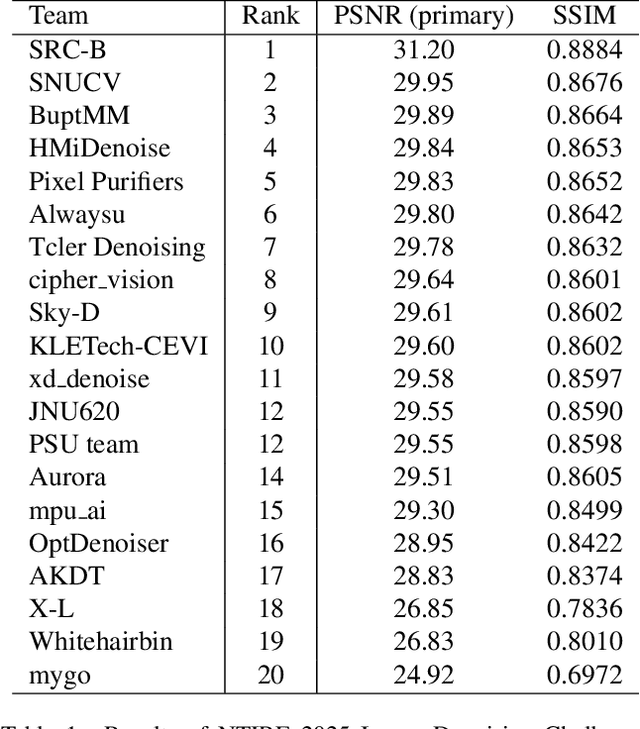
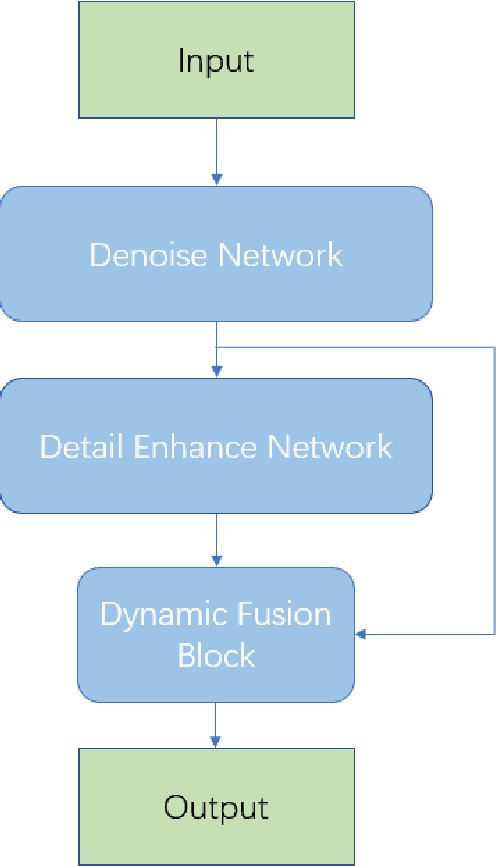
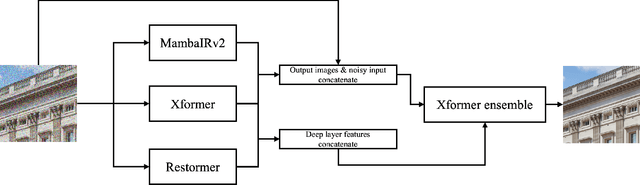
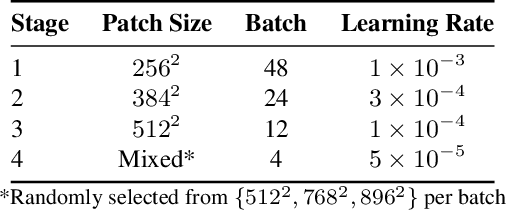
This paper presents an overview of the NTIRE 2025 Image Denoising Challenge ({\sigma} = 50), highlighting the proposed methodologies and corresponding results. The primary objective is to develop a network architecture capable of achieving high-quality denoising performance, quantitatively evaluated using PSNR, without constraints on computational complexity or model size. The task assumes independent additive white Gaussian noise (AWGN) with a fixed noise level of 50. A total of 290 participants registered for the challenge, with 20 teams successfully submitting valid results, providing insights into the current state-of-the-art in image denoising.