 Add to Chrome
 Add to Firefox
 Add to Edge
FlowPipe: LLM-Enhanced Conditional Generative Flow Networks for Data Preparation Pipeline Construction
Jun 24, 2026
Data preparation pipelines improve data quality in machine learning by transforming raw tables into learning-ready data through sequential cleaning and feature transformation operators. However, automatically constructing such pipelines is computationally difficult because operator sequences are combinatorial and end-to-end evaluation is expensive. Existing state-of-the-art (SOTA) Multi-DQN methods still face three key limitations: decoupled value estimators weaken long-horizon credit assignment, dataset context is only weakly injected into the policy, and exploration is inefficient in a sparse search space with many invalid states. To address these issues, we propose FlowPipe, a unified framework that formulates pipeline synthesis as conditional probabilistic flow generation over a directed acyclic graph. FlowPipe uses Conditional Generative Flow Networks (C-GFlowNets) with a Trajectory Balance objective to connect terminal validation rewards with early pipeline decisions. It further introduces Deep Semantic Modulation through Feature-wise Linear Modulation (FiLM), allowing LLM-derived logical priors to condition the policy's internal activations according to dataset semantics. In addition, FlowPipe incorporates failure awareness into the flow objective to avoid invalid states and concentrate search on high-potential regions. Experiments on two benchmark suites with 74 real-world datasets show that FlowPipe outperforms SOTA baselines, improving accuracy by 11.96% on average and achieving 12.5x faster training convergence. Source code is available at https://github.com/KunyuNi/FlowPipe.

NICE: A Theory-Grounded Diagnostic Benchmark for Social Intelligence of LLMs
May 28, 2026As large language models (LLMs) are increasingly applied in social contexts such as emotional companionship and customer service, measuring their social intelligence has become critical to the quality and safety of human-AI interaction. However, existing social intelligence benchmarks lack a unified framework that organizes social abilities into a unified structure, and therefore cannot enable fine-grained diagnosis. To build the first holistic diagnostic evaluation grounded in social theory, we first construct a social intelligence framework through a literature review and multi-stage expert validation guided by psychometric principles. The resulting framework includes 4 categories and 11 dimensions, each further specified by fine-grained capability facets. Building on this framework, we introduce NICE (Norm, Interaction, Cognition, Experience), a diagnostic benchmark of 137 items operationalized through representative Chinese contexts. Across 5 frontier LLMs and a human reference group, models score higher in aggregate accuracy yet show a consistent weakness in Communication, which the framework localizes to 3 specific capability facets: multi-turn communication, nonverbal communication, and synchrony. NICE thus reframes social intelligence evaluation toward theory-grounded diagnosis of socially consequential weaknesses in LLMs.
FinBoardBench: Benchmarking Dynamic Wealth Management and Strategic Financial Reasoning of LLMs via Board Game Simulations
May 27, 2026Recently, large language models (LLMs) have achieved superior performance in static financial reasoning and simple dynamic trading tasks. However, existing static financial benchmarks are insufficient to assess the dynamic wealth management and financial decision-making capabilities of LLMs in real-world environments. To bridge this gap, we present FinBoardBench, an evaluation suite based on three classic financial board games: Cashflow, Acquire, and Monopoly. FinBoardBench assesses a comprehensive set of financial skills, including personal cash flow management with debt balancing, corporate investment and acquisition forecasting, and competitive trade negotiations with asset auctions. Our experiments with 9 advanced LLMs reveal that while exhibiting basic long-term planning and investment logic, they fail to effectively leverage complex interactions for profit, and their strong static reasoning performance does not transform into successful dynamic decision-making. Notably, they tend to prioritize immediate asset acquisition over maintaining sufficient liquidity, making them vulnerable to financial crises triggered by random events. We hope that FinBoardBench can provide a valuable reference for more intelligent LLM-based decision-making systems in the future.
JD-BP: A Joint-Decision Generative Framework for Auto-Bidding and Pricing
Apr 07, 2026Auto-bidding services optimize real-time bidding strategies for advertisers under key performance indicator (KPI) constraints such as target return on investment and budget. However, uncertainties such as model prediction errors and feedback latency can cause bidding strategies to deviate from ex-post optimality, leading to inefficient allocation. To address this issue, we propose JD-BP, a Joint generative Decision framework for Bidding and Pricing. Unlike prior methods, JD-BP jointly outputs a bid value and a pricing correction term that acts additively with the payment rule such as GSP. To mitigate adverse effects of historical constraint violations, we design a memory-less Return-to-Go that encourages future value maximizing of bidding actions while the cumulated bias is handled by the pricing correction. Moreover, a trajectory augmentation algorithm is proposed to generate joint bidding-pricing trajectories from a (possibly arbitrary) base bidding policy, enabling efficient plug-and-play deployment of our algorithm from existing RL/generative bidding models. Finally, we employ an Energy-Based Direct Preference Optimization method in conjunction with a cross-attention module to enhance the joint learning performance of bidding and pricing correction. Offline experiments on the AuctionNet dataset demonstrate that JD-BP achieves state-of-the-art performance. Online A/B tests at JD.com confirm its practical effectiveness, showing a 4.70% increase in ad revenue and a 6.48% improvement in target cost.
$Δ$VLA: Prior-Guided Vision-Language-Action Models via World Knowledge Variation
Mar 09, 2026Recent vision-language-action (VLA) models have significantly advanced robotic manipulation by unifying perception, reasoning, and control. To achieve such integration, recent studies adopt a predictive paradigm that models future visual states or world knowledge to guide action generation. However, these models emphasize forecasting outcomes rather than reasoning about the underlying process of change, which is essential for determining how to act. To address this, we propose $Δ$VLA, a prior-guided framework that models world-knowledge variations relative to an explicit current-world knowledge prior for action generation, rather than regressing absolute future world states. Specifically, 1) to construct the current world knowledge prior, we propose the Prior-Guided WorldKnowledge Extractor (PWKE). It extracts manipulable regions, spatial relations, and semantic cues from the visual input, guided by auxiliary heads and prior pseudo labels, thus reducing redundancy. 2) Building upon this, to represent how world knowledge evolves under actions, we introduce the Latent World Variation Quantization (LWVQ). It learns a discrete latent space via a VQ-VAE objective to encode world knowledge variations, shifting prediction from full modalities to compact latent. 3)Moreover, to mitigate interference during variation modeling, we design the Conditional Variation Attention (CV-Atten), whichpromotes disentangled learning and preserves the independence of knowledge representations. Extensive experiments on both simulated benchmarks and real-world robotic tasks demonstrate $Δ$VLA achieves state-of-the-art performance while improving efficiency. Code and real-world execution videos are available at https://github.com/JiuTian-VL/DeltaVLA.
A data-driven approach to inferring travel trajectory during peak hours in urban rail transit systems
Dec 10, 2025Refined trajectory inference of urban rail transit is of great significance to the operation organization. In this paper, we develop a fully data-driven approach to inferring individual travel trajectories in urban rail transit systems. It utilizes data from the Automatic Fare Collection (AFC) and Automatic Vehicle Location (AVL) systems to infer key trajectory elements, such as selected train, access/egress time, and transfer time. The approach includes establishing train alternative sets based on spatio-temporal constraints, data-driven adaptive trajectory inference, and trave l trajectory construction. To realize data-driven adaptive trajectory inference, a data-driven parameter estimation method based on KL divergence combined with EM algorithm (KLEM) was proposed. This method eliminates the reliance on external or survey data for parameter fitting, enhancing the robustness and applicability of the model. Furthermore, to overcome the limitations of using synthetic data to validate the result, this paper employs real individual travel trajectory data for verification. The results show that the approach developed in this paper can achieve high-precision passenger trajectory inference, with an accuracy rate of over 90% in urban rail transit travel trajectory inference during peak hours.
CogVLA: Cognition-Aligned Vision-Language-Action Model via Instruction-Driven Routing & Sparsification
Aug 28, 2025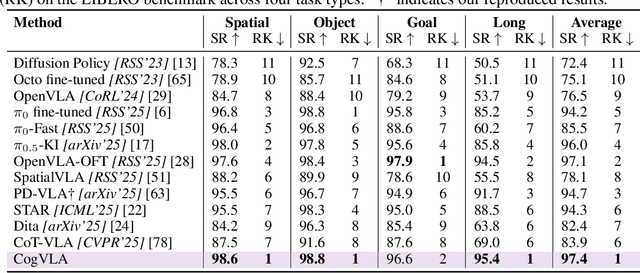
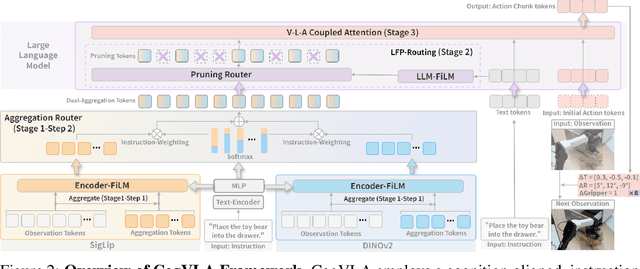
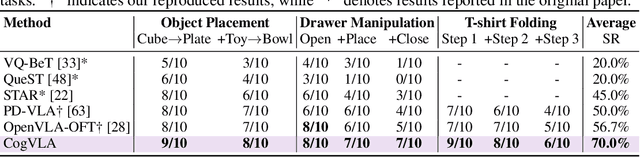
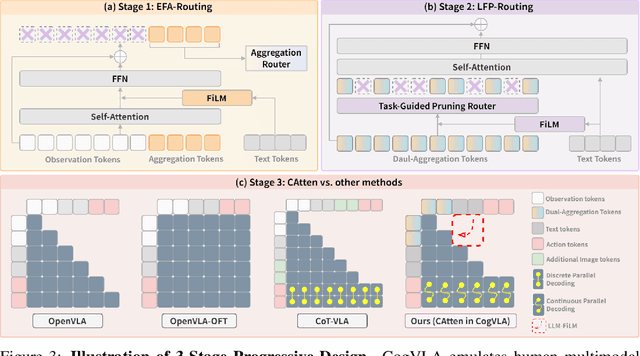
Recent Vision-Language-Action (VLA) models built on pre-trained Vision-Language Models (VLMs) require extensive post-training, resulting in high computational overhead that limits scalability and deployment.We propose CogVLA, a Cognition-Aligned Vision-Language-Action framework that leverages instruction-driven routing and sparsification to improve both efficiency and performance. CogVLA draws inspiration from human multimodal coordination and introduces a 3-stage progressive architecture. 1) Encoder-FiLM based Aggregation Routing (EFA-Routing) injects instruction information into the vision encoder to selectively aggregate and compress dual-stream visual tokens, forming a instruction-aware latent representation. 2) Building upon this compact visual encoding, LLM-FiLM based Pruning Routing (LFP-Routing) introduces action intent into the language model by pruning instruction-irrelevant visually grounded tokens, thereby achieving token-level sparsity. 3) To ensure that compressed perception inputs can still support accurate and coherent action generation, we introduce V-L-A Coupled Attention (CAtten), which combines causal vision-language attention with bidirectional action parallel decoding. Extensive experiments on the LIBERO benchmark and real-world robotic tasks demonstrate that CogVLA achieves state-of-the-art performance with success rates of 97.4% and 70.0%, respectively, while reducing training costs by 2.5-fold and decreasing inference latency by 2.8-fold compared to OpenVLA. CogVLA is open-sourced and publicly available at https://github.com/JiuTian-VL/CogVLA.
From Sufficiency to Reflection: Reinforcement-Guided Thinking Quality in Retrieval-Augmented Reasoning for LLMs
Jul 30, 2025Reinforcement learning-based retrieval-augmented generation (RAG) methods enhance the reasoning abilities of large language models (LLMs). However, most rely only on final-answer rewards, overlooking intermediate reasoning quality. This paper analyzes existing RAG reasoning models and identifies three main failure patterns: (1) information insufficiency, meaning the model fails to retrieve adequate support; (2) faulty reasoning, where logical or content-level flaws appear despite sufficient information; and (3) answer-reasoning inconsistency, where a valid reasoning chain leads to a mismatched final answer. We propose TIRESRAG-R1, a novel framework using a think-retrieve-reflect process and a multi-dimensional reward system to improve reasoning and stability. TIRESRAG-R1 introduces: (1) a sufficiency reward to encourage thorough retrieval; (2) a reasoning quality reward to assess the rationality and accuracy of the reasoning chain; and (3) a reflection reward to detect and revise errors. It also employs a difficulty-aware reweighting strategy and training sample filtering to boost performance on complex tasks. Experiments on four multi-hop QA datasets show that TIRESRAG-R1 outperforms prior RAG methods and generalizes well to single-hop tasks. The code and data are available at: https://github.com/probe2/TIRESRAG-R1.
FAMSeg: Fetal Femur and Cranial Ultrasound Segmentation Using Feature-Aware Attention and Mamba Enhancement
Jun 09, 2025Accurate ultrasound image segmentation is a prerequisite for precise biometrics and accurate assessment. Relying on manual delineation introduces significant errors and is time-consuming. However, existing segmentation models are designed based on objects in natural scenes, making them difficult to adapt to ultrasound objects with high noise and high similarity. This is particularly evident in small object segmentation, where a pronounced jagged effect occurs. Therefore, this paper proposes a fetal femur and cranial ultrasound image segmentation model based on feature perception and Mamba enhancement to address these challenges. Specifically, a longitudinal and transverse independent viewpoint scanning convolution block and a feature perception module were designed to enhance the ability to capture local detail information and improve the fusion of contextual information. Combined with the Mamba-optimized residual structure, this design suppresses the interference of raw noise and enhances local multi-dimensional scanning. The system builds global information and local feature dependencies, and is trained with a combination of different optimizers to achieve the optimal solution. After extensive experimental validation, the FAMSeg network achieved the fastest loss reduction and the best segmentation performance across images of varying sizes and orientations.
FPDANet: A Multi-Section Classification Model for Intelligent Screening of Fetal Ultrasound
Jun 06, 2025ResNet has been widely used in image classification tasks due to its ability to model the residual dependence of constant mappings for linear computation. However, the ResNet method adopts a unidirectional transfer of features and lacks an effective method to correlate contextual information, which is not effective in classifying fetal ultrasound images in the classification task, and fetal ultrasound images have problems such as low contrast, high similarity, and high noise. Therefore, we propose a bilateral multi-scale information fusion network-based FPDANet to address the above challenges. Specifically, we design the positional attention mechanism (DAN) module, which utilizes the similarity of features to establish the dependency of different spatial positional features and enhance the feature representation. In addition, we design a bilateral multi-scale (FPAN) information fusion module to capture contextual and global feature dependencies at different feature scales, thereby further improving the model representation. FPDANet classification results obtained 91.05\% and 100\% in Top-1 and Top-5 metrics, respectively, and the experimental results proved the effectiveness and robustness of FPDANet.