 Add to Chrome
 Add to Firefox
 Add to Edge
The Last Human-Written Paper: Agent-Native Research Artifacts
Apr 27, 2026
Scientific publication compresses a branching, iterative research process into a linear narrative, discarding the majority of what was discovered along the way. This compilation imposes two structural costs: a Storytelling Tax, where failed experiments, rejected hypotheses, and the branching exploration process are discarded to fit a linear narrative; and an Engineering Tax, where the gap between reviewer-sufficient prose and agent-sufficient specification leaves critical implementation details unwritten. Tolerable for human readers, these costs become critical when AI agents must understand, reproduce, and extend published work. We introduce the Agent-Native Research Artifact (Ara), a protocol that replaces the narrative paper with a machine-executable research package structured around four layers: scientific logic, executable code with full specifications, an exploration graph that preserves the failures compilation discards, and evidence grounding every claim in raw outputs. Three mechanisms support the ecosystem: a Live Research Manager that captures decisions and dead ends during ordinary development; an Ara Compiler that translates legacy PDFs and repos into Aras; and an Ara-native review system that automates objective checks so human reviewers can focus on significance, novelty, and taste. On PaperBench and RE-Bench, Ara raises question-answering accuracy from 72.4% to 93.7% and reproduction success from 57.4% to 64.4%. On RE-Bench's five open-ended extension tasks, preserved failure traces in Ara accelerate progress, but can also constrain a capable agent from stepping outside the prior-run box depending on the agent's capabilities.

Decocted Experience Improves Test-Time Inference in LLM Agents
Apr 06, 2026There is growing interest in improving LLMs without updating model parameters. One well-established direction is test-time scaling, where increased inference-time computation (e.g., longer reasoning, sampling, or search) is used to improve performance. However, for complex reasoning and agentic tasks, naively scaling test-time compute can substantially increase cost and still lead to wasted budget on suboptimal exploration. In this paper, we explore \emph{context} as a complementary scaling axis for improving LLM performance, and systematically study how to construct better inputs that guide reasoning through \emph{experience}. We show that effective context construction critically depends on \emph{decocted experience}. We present a detailed analysis of experience-augmented agents, studying how to derive context from experience, how performance scales with accumulated experience, what characterizes good context, and which data structures best support context construction. We identify \emph{decocted experience} as a key mechanism for effective context construction: extracting essence from experience, organizing it coherently, and retrieving salient information to build effective context. We validate our findings across reasoning and agentic tasks, including math reasoning, web browsing, and software engineering.
ChartNet: A Million-Scale, High-Quality Multimodal Dataset for Robust Chart Understanding
Mar 28, 2026Understanding charts requires models to jointly reason over geometric visual patterns, structured numerical data, and natural language -- a capability where current vision-language models (VLMs) remain limited. We introduce ChartNet, a high-quality, million-scale multimodal dataset designed to advance chart interpretation and reasoning. ChartNet leverages a novel code-guided synthesis pipeline to generate 1.5 million diverse chart samples spanning 24 chart types and 6 plotting libraries. Each sample consists of five aligned components: plotting code, rendered chart image, data table, natural language summary, and question-answering with reasoning, providing fine-grained cross-modal alignment. To capture the full spectrum of chart comprehension, ChartNet additionally includes specialized subsets encompassing human annotated data, real-world data, safety, and grounding. Moreover, a rigorous quality-filtering pipeline ensures visual fidelity, semantic accuracy, and diversity across chart representations. Fine-tuning on ChartNet consistently improves results across benchmarks, demonstrating its utility as large-scale supervision for multimodal models. As the largest open-source dataset of its kind, ChartNet aims to support the development of foundation models with robust and generalizable capabilities for data visualization understanding. The dataset is publicly available at https://huggingface.co/datasets/ibm-granite/ChartNet
MemoryArena: Benchmarking Agent Memory in Interdependent Multi-Session Agentic Tasks
Feb 18, 2026Existing evaluations of agents with memory typically assess memorization and action in isolation. One class of benchmarks evaluates memorization by testing recall of past conversations or text but fails to capture how memory is used to guide future decisions. Another class focuses on agents acting in single-session tasks without the need for long-term memory. However, in realistic settings, memorization and action are tightly coupled: agents acquire memory while interacting with the environment, and subsequently rely on that memory to solve future tasks. To capture this setting, we introduce MemoryArena, a unified evaluation gym for benchmarking agent memory in multi-session Memory-Agent-Environment loops. The benchmark consists of human-crafted agentic tasks with explicitly interdependent subtasks, where agents must learn from earlier actions and feedback by distilling experiences into memory, and subsequently use that memory to guide later actions to solve the overall task. MemoryArena supports evaluation across web navigation, preference-constrained planning, progressive information search, and sequential formal reasoning, and reveals that agents with near-saturated performance on existing long-context memory benchmarks like LoCoMo perform poorly in our agentic setting, exposing a gap in current evaluations for agents with memory.
SPARC: Separating Perception And Reasoning Circuits for Test-time Scaling of VLMs
Feb 06, 2026Despite recent successes, test-time scaling - i.e., dynamically expanding the token budget during inference as needed - remains brittle for vision-language models (VLMs): unstructured chains-of-thought about images entangle perception and reasoning, leading to long, disorganized contexts where small perceptual mistakes may cascade into completely wrong answers. Moreover, expensive reinforcement learning with hand-crafted rewards is required to achieve good performance. Here, we introduce SPARC (Separating Perception And Reasoning Circuits), a modular framework that explicitly decouples visual perception from reasoning. Inspired by sequential sensory-to-cognitive processing in the brain, SPARC implements a two-stage pipeline where the model first performs explicit visual search to localize question-relevant regions, then conditions its reasoning on those regions to produce the final answer. This separation enables independent test-time scaling with asymmetric compute allocation (e.g., prioritizing perceptual processing under distribution shift), supports selective optimization (e.g., improving the perceptual stage alone when it is the bottleneck for end-to-end performance), and accommodates compressed contexts by running global search at lower image resolutions and allocating high-resolution processing only to selected regions, thereby reducing total visual tokens count and compute. Across challenging visual reasoning benchmarks, SPARC outperforms monolithic baselines and strong visual-grounding approaches. For instance, SPARC improves the accuracy of Qwen3VL-4B on the $V^*$ VQA benchmark by 6.7 percentage points, and it surpasses "thinking with images" by 4.6 points on a challenging OOD task despite requiring a 200$\times$ lower token budget.
BOAD: Discovering Hierarchical Software Engineering Agents via Bandit Optimization
Dec 29, 2025Large language models (LLMs) have shown strong reasoning and coding capabilities, yet they struggle to generalize to real-world software engineering (SWE) problems that are long-horizon and out of distribution. Existing systems often rely on a single agent to handle the entire workflow-interpreting issues, navigating large codebases, and implementing fixes-within one reasoning chain. Such monolithic designs force the model to retain irrelevant context, leading to spurious correlations and poor generalization. Motivated by how human engineers decompose complex problems, we propose structuring SWE agents as orchestrators coordinating specialized sub-agents for sub-tasks such as localization, editing, and validation. The challenge lies in discovering effective hierarchies automatically: as the number of sub-agents grows, the search space becomes combinatorial, and it is difficult to attribute credit to individual sub-agents within a team. We address these challenges by formulating hierarchy discovery as a multi-armed bandit (MAB) problem, where each arm represents a candidate sub-agent and the reward measures its helpfulness when collaborating with others. This framework, termed Bandit Optimization for Agent Design (BOAD), enables efficient exploration of sub-agent designs under limited evaluation budgets. On SWE-bench-Verified, BOAD outperforms single-agent and manually designed multi-agent systems. On SWE-bench-Live, featuring more recent and out-of-distribution issues, our 36B system ranks second on the leaderboard at the time of evaluation, surpassing larger models such as GPT-4 and Claude. These results demonstrate that automatically discovered hierarchical multi-agent systems significantly improve generalization on challenging long-horizon SWE tasks. Code is available at https://github.com/iamxjy/BOAD-SWE-Agent.
WildFeedback: Aligning LLMs With In-situ User Interactions And Feedback
Aug 28, 2024


As large language models (LLMs) continue to advance, aligning these models with human preferences has emerged as a critical challenge. Traditional alignment methods, relying on human or LLM annotated datasets, are limited by their resource-intensive nature, inherent subjectivity, and the risk of feedback loops that amplify model biases. To overcome these limitations, we introduce WildFeedback, a novel framework that leverages real-time, in-situ user interactions to create preference datasets that more accurately reflect authentic human values. WildFeedback operates through a three-step process: feedback signal identification, preference data construction, and user-guided evaluation. We applied this framework to a large corpus of user-LLM conversations, resulting in a rich preference dataset that reflects genuine user preferences. This dataset captures the nuances of user preferences by identifying and classifying feedback signals within natural conversations, thereby enabling the construction of more representative and context-sensitive alignment data. Our extensive experiments demonstrate that LLMs fine-tuned on WildFeedback exhibit significantly improved alignment with user preferences, as evidenced by both traditional benchmarks and our proposed user-guided evaluation. By incorporating real-time feedback from actual users, WildFeedback addresses the scalability, subjectivity, and bias challenges that plague existing approaches, marking a significant step toward developing LLMs that are more responsive to the diverse and evolving needs of their users. In summary, WildFeedback offers a robust, scalable solution for aligning LLMs with true human values, setting a new standard for the development and evaluation of user-centric language models.
Large Scale Knowledge Washing
May 28, 2024Large language models show impressive abilities in memorizing world knowledge, which leads to concerns regarding memorization of private information, toxic or sensitive knowledge, and copyrighted content. We introduce the problem of Large Scale Knowledge Washing, focusing on unlearning an extensive amount of factual knowledge. Previous unlearning methods usually define the reverse loss and update the model via backpropagation, which may affect the model's fluency and reasoning ability or even destroy the model due to extensive training with the reverse loss. Existing works introduce additional data from downstream tasks to prevent the model from losing capabilities, which requires downstream task awareness. Controlling the tradeoff of unlearning and maintaining existing capabilities is also challenging. To this end, we propose LAW (Large Scale Washing) to update the MLP layers in decoder-only large language models to perform knowledge washing, as inspired by model editing methods and based on the hypothesis that knowledge and reasoning are disentanglable. We derive a new objective with the knowledge to be unlearned to update the weights of certain MLP layers. Experimental results demonstrate the effectiveness of LAW in forgetting target knowledge while maintaining reasoning ability. The code will be open-sourced at https://github.com/wangyu-ustc/LargeScaleWashing.
Cognitive Bias in High-Stakes Decision-Making with LLMs
Feb 25, 2024


Large language models (LLMs) offer significant potential as tools to support an expanding range of decision-making tasks. However, given their training on human (created) data, LLMs can inherit both societal biases against protected groups, as well as be subject to cognitive bias. Such human-like bias can impede fair and explainable decisions made with LLM assistance. Our work introduces BiasBuster, a framework designed to uncover, evaluate, and mitigate cognitive bias in LLMs, particularly in high-stakes decision-making tasks. Inspired by prior research in psychology and cognitive sciences, we develop a dataset containing 16,800 prompts to evaluate different cognitive biases (e.g., prompt-induced, sequential, inherent). We test various bias mitigation strategies, amidst proposing a novel method using LLMs to debias their own prompts. Our analysis provides a comprehensive picture on the presence and effects of cognitive bias across different commercial and open-source models. We demonstrate that our self-help debiasing effectively mitigate cognitive bias without having to manually craft examples for each bias type.
CAMELoT: Towards Large Language Models with Training-Free Consolidated Associative Memory
Feb 21, 2024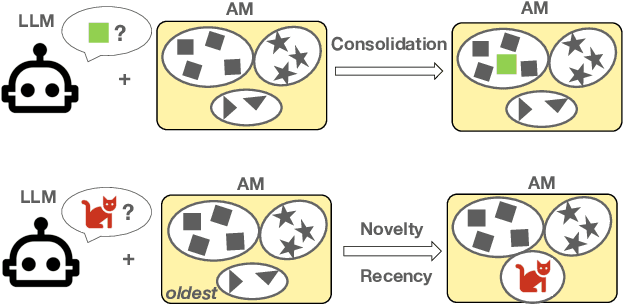
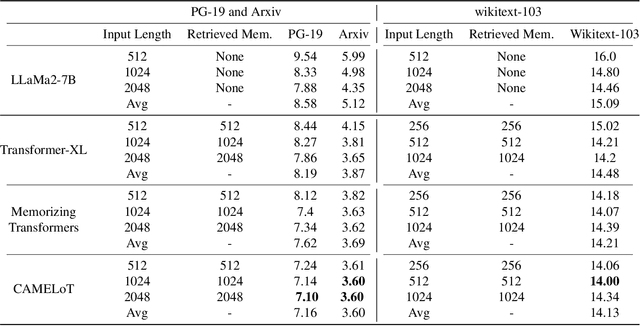
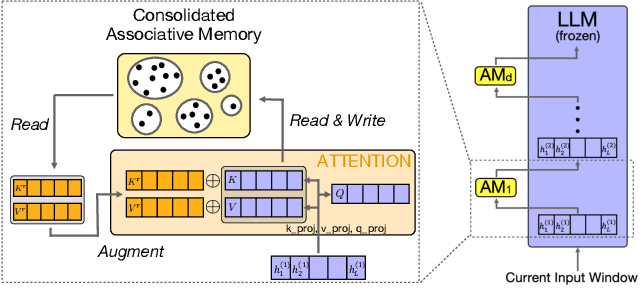
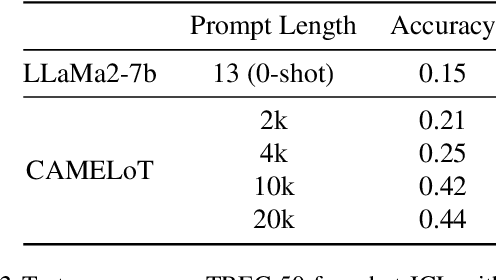
Large Language Models (LLMs) struggle to handle long input sequences due to high memory and runtime costs. Memory-augmented models have emerged as a promising solution to this problem, but current methods are hindered by limited memory capacity and require costly re-training to integrate with a new LLM. In this work, we introduce an associative memory module which can be coupled to any pre-trained (frozen) attention-based LLM without re-training, enabling it to handle arbitrarily long input sequences. Unlike previous methods, our associative memory module consolidates representations of individual tokens into a non-parametric distribution model, dynamically managed by properly balancing the novelty and recency of the incoming data. By retrieving information from this consolidated associative memory, the base LLM can achieve significant (up to 29.7% on Arxiv) perplexity reduction in long-context modeling compared to other baselines evaluated on standard benchmarks. This architecture, which we call CAMELoT (Consolidated Associative Memory Enhanced Long Transformer), demonstrates superior performance even with a tiny context window of 128 tokens, and also enables improved in-context learning with a much larger set of demonstrations.