 Add to Chrome
 Add to Firefox
 Add to Edge
UXBench: Benchmarking User Experience in AI Assistants
Jun 09, 2026
As AI assistants serve millions of users daily, evaluating user experience (UX) beyond general model capability has become increasingly important. We present UXBench, the first user-centric benchmark grounded in real user feedback signals for evaluating preference alignment and dialogue generation. The benchmark consists of three interconnected tasks, UX Judge, UX Eval, and UX Recovery, with 7,400 test instances extracted from over 70K interaction logs of a mainstream Chinese AI assistant. The dataset closely reflects real user distributions, covering 8 scenarios, 83 domains, and diverse failure patterns that pose severe challenges. Extensive experiments on 26 frontier language models provide novel insights into how well models perceive user experience and how improvements in model capability contribute to better dialogue engagement. Through comprehensive analysis of model behavior and performance gaps, we show that user feedback prediction is a learnable capability, where a reward model trained from in-the-wild feedback signals can achieve well-calibrated accuracy. We further document the systematic biases of LLM-as-a-judge evaluation protocols and compare typical response strategies that directly affect user experience. UXBench establishes a new evaluation landscape and calls for greater attention to tailored UX optimization, contributing to a user-centric scaling law that shapes the success of AI assistants.

TRACE: Discovering Task-Specific Parameter via Adaptation-Aware Probing for Continual Fine-Tuning
May 29, 2026In real-world deployment, LLMs are often adapted continually across tasks to keep LLMs up-to-date in production, where new fine-tuning should preserve previously learned skills. However, indiscriminately mixing tasks can dilute task specialization, while sequential fine-tuning (full-parameter or low rank adaptation) often causes catastrophic forgetting due to destructive overwriting. Replay-based continual tuning and maintaining separate task-specific adapters can mitigate forgetting, but introduce additional compute, storage, and management overhead. Recognizing the redundancy of LLM parameters for any single task, we reframe continual task adaptation as task-specific parameter discovery via adaptation-aware probing: a short warm-start probe exposes a task's adaptation trace, enabling us to identify and isolate the small subset of parameters essential for each task to mitigate catastrophic forgetting. Building on this view, we introduce TRACE, a novel approach for discovering Task-specific paRameters via Adaptation-aware probing for Continual finE-tuning. We perform a short warm-start fine-tune to derive task-specific core parameters by comparing the warm-started and pre-trained models. Core parameters are identified via two strategies: importance scoring (L$_2$ norm and Fisher Information) and specificity analysis (cosine similarity of parameter updates). In continual fine-tuning settings, only the active task's core parameters are updated while others remain frozen, preserving prior knowledge. We conduct extensive experiments across multiple standard benchmarks to demonstrate the superior performance of our proposed method. Additionally, we validate the generalization of our method through a cross-model and scale transferability study, demonstrating a "small-to-large" paradigm that guides the fine-tuning of large-scale models under resource constraints.
Parameter Importance is Not Static: Evolving Parameter Isolation for Supervised Fine-Tuning
Apr 15, 2026Supervised Fine-Tuning (SFT) of large language models often suffers from task interference and catastrophic forgetting. Recent approaches alleviate this issue by isolating task-critical parameters during training. However, these methods represent a static solution to a dynamic problem, assuming that parameter importance remains fixed once identified. In this work, we empirically demonstrate that parameter importance exhibits temporal drift over the course of training. To address this, we propose Evolving Parameter Isolation (EPI), a fine-tuning framework that adapts isolation decisions based on online estimates of parameter importance. Instead of freezing a fixed subset of parameters, EPI periodically updates isolation masks using gradient-based signals, enabling the model to protect emerging task-critical parameters while releasing outdated ones to recover plasticity. Experiments on diverse multi-task benchmarks demonstrate that EPI consistently reduces interference and forgetting compared to static isolation and standard fine-tuning, while improving overall generalization. Our analysis highlights the necessity of synchronizing isolation mechanisms with the evolving dynamics of learning diverse abilities.
Reason Only When Needed: Efficient Generative Reward Modeling via Model-Internal Uncertainty
Apr 11, 2026Recent advancements in the Generative Reward Model (GRM) have demonstrated its potential to enhance the reasoning abilities of LLMs through Chain-of-Thought (CoT) prompting. Despite these gains, existing implementations of GRM suffer from two critical limitations. First, CoT prompting is applied indiscriminately to all inputs regardless of their inherent complexity. This introduces unnecessary computational costs for tasks amenable to fast, direct inference. Second, existing approaches primarily rely on voting-based mechanisms to evaluate CoT outputs, which often lack granularity and precision in assessing reasoning quality. In this paper, we propose E-GRM, an efficient generative reward modeling framework grounded in model-internal uncertainty. E-GRM leverages the convergence behavior of parallel model generations to estimate uncertainty and selectively trigger CoT reasoning only when needed, without relying on handcrafted features or task-dependent signals. To improve reward fidelity, we introduce a lightweight discriminative scorer trained with a hybrid regression--ranking objective to provide fine-grained evaluation of reasoning paths. Experiments on multiple reasoning benchmarks show that E-GRM substantially reduces inference cost while consistently improving answer accuracy, demonstrating that model-internal uncertainty is an effective and general signal for efficient reasoning-aware reward modeling.
Why Supervised Fine-Tuning Fails to Learn: A Systematic Study of Incomplete Learning in Large Language Models
Apr 11, 2026Supervised Fine-Tuning (SFT) is the standard approach for adapting large language models (LLMs) to downstream tasks. However, we observe a persistent failure mode: even after convergence, models often fail to correctly reproduce a subset of their own supervised training data. We refer to this behavior as the Incomplete Learning Phenomenon(ILP). This paper presents the first systematic study of ILP in LLM fine-tuning. We formalize ILP as post-training failure to internalize supervised instances and demonstrate its prevalence across multiple model families, domains, and datasets. Through controlled analyses, we identify five recurrent sources of incomplete learning: (1) missing prerequisite knowledge in the pre-trained model, (2) conflicts between SFT supervision and pre-training knowledge, (3) internal inconsistencies within SFT data, (4) left-side forgetting during sequential fine-tuning, and (5) insufficient optimization for rare or complex patterns. We introduce a diagnostic-first framework that maps unlearned samples to these causes using observable training and inference signals, and study several targeted mitigation strategies as causal interventions. Experiments on Qwen, LLaMA, and OLMo2 show that incomplete learning is widespread and heterogeneous, and that improvements in aggregate metrics can mask persistent unlearned subsets. The findings highlight the need for fine-grained diagnosis of what supervised fine-tuning fails to learn, and why.
Reinforcement Learning Enhanced Multi-hop Reasoning for Temporal Knowledge Question Answering
Jan 03, 2026Temporal knowledge graph question answering (TKGQA) involves multi-hop reasoning over temporally constrained entity relationships in the knowledge graph to answer a given question. However, at each hop, large language models (LLMs) retrieve subgraphs with numerous temporally similar and semantically complex relations, increasing the risk of suboptimal decisions and error propagation. To address these challenges, we propose the multi-hop reasoning enhanced (MRE) framework, which enhances both forward and backward reasoning to improve the identification of globally optimal reasoning trajectories. Specifically, MRE begins with prompt engineering to guide the LLM in generating diverse reasoning trajectories for a given question. Valid reasoning trajectories are then selected for supervised fine-tuning, serving as a cold-start strategy. Finally, we introduce Tree-Group Relative Policy Optimization (T-GRPO), a recursive, tree-structured learning-by-exploration approach. At each hop, exploration establishes strong causal dependencies on the previous hop, while evaluation is informed by multi-path exploration feedback from subsequent hops. Experimental results on two TKGQA benchmarks indicate that the proposed MRE-based model consistently surpasses state-of-the-art (SOTA) approaches in handling complex multi-hop queries. Further analysis highlights improved interpretability and robustness to noisy temporal annotations.
Not All Parameters Are Created Equal: Smart Isolation Boosts Fine-Tuning Performance
Aug 29, 2025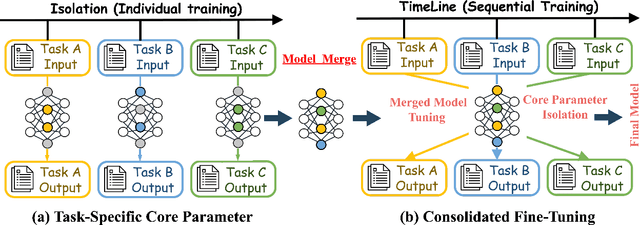
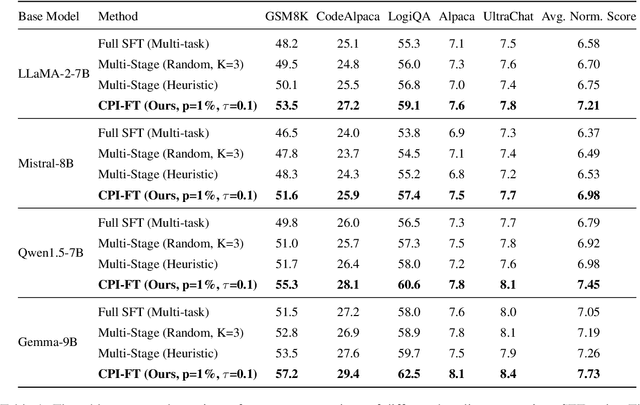
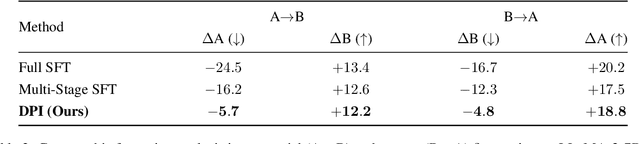
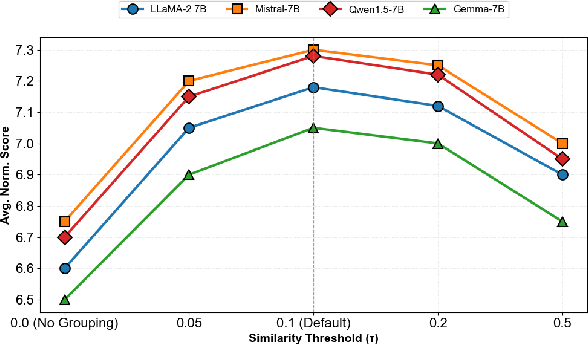
Supervised fine-tuning (SFT) is a pivotal approach to adapting large language models (LLMs) for downstream tasks; however, performance often suffers from the ``seesaw phenomenon'', where indiscriminate parameter updates yield progress on certain tasks at the expense of others. To address this challenge, we propose a novel \emph{Core Parameter Isolation Fine-Tuning} (CPI-FT) framework. Specifically, we first independently fine-tune the LLM on each task to identify its core parameter regions by quantifying parameter update magnitudes. Tasks with similar core regions are then grouped based on region overlap, forming clusters for joint modeling. We further introduce a parameter fusion technique: for each task, core parameters from its individually fine-tuned model are directly transplanted into a unified backbone, while non-core parameters from different tasks are smoothly integrated via Spherical Linear Interpolation (SLERP), mitigating destructive interference. A lightweight, pipelined SFT training phase using mixed-task data is subsequently employed, while freezing core regions from prior tasks to prevent catastrophic forgetting. Extensive experiments on multiple public benchmarks demonstrate that our approach significantly alleviates task interference and forgetting, consistently outperforming vanilla multi-task and multi-stage fine-tuning baselines.
Tool Graph Retriever: Exploring Dependency Graph-based Tool Retrieval for Large Language Models
Aug 07, 2025With the remarkable advancement of AI agents, the number of their equipped tools is increasing rapidly. However, integrating all tool information into the limited model context becomes impractical, highlighting the need for efficient tool retrieval methods. In this regard, dominant methods primarily rely on semantic similarities between tool descriptions and user queries to retrieve relevant tools. However, they often consider each tool independently, overlooking dependencies between tools, which may lead to the omission of prerequisite tools for successful task execution. To deal with this defect, in this paper, we propose Tool Graph Retriever (TGR), which exploits the dependencies among tools to learn better tool representations for retrieval. First, we construct a dataset termed TDI300K to train a discriminator for identifying tool dependencies. Then, we represent all candidate tools as a tool dependency graph and use graph convolution to integrate the dependencies into their representations. Finally, these updated tool representations are employed for online retrieval. Experimental results on several commonly used datasets show that our TGR can bring a performance improvement to existing dominant methods, achieving SOTA performance. Moreover, in-depth analyses also verify the importance of tool dependencies and the effectiveness of our TGR.
Shall Your Data Strategy Work? Perform a Swift Study
Feb 19, 2025This work presents a swift method to assess the efficacy of particular types of instruction-tuning data, utilizing just a handful of probe examples and eliminating the need for model retraining. This method employs the idea of gradient-based data influence estimation, analyzing the gradient projections of probe examples from the chosen strategy onto evaluation examples to assess its advantages. Building upon this method, we conducted three swift studies to investigate the potential of Chain-of-thought (CoT) data, query clarification data, and response evaluation data in enhancing model generalization. Subsequently, we embarked on a validation study to corroborate the findings of these swift studies. In this validation study, we developed training datasets tailored to each studied strategy and compared model performance with and without the use of these datasets. The results of the validation study aligned with the findings of the swift studies, validating the efficacy of our proposed method.
One2set + Large Language Model: Best Partners for Keyphrase Generation
Oct 04, 2024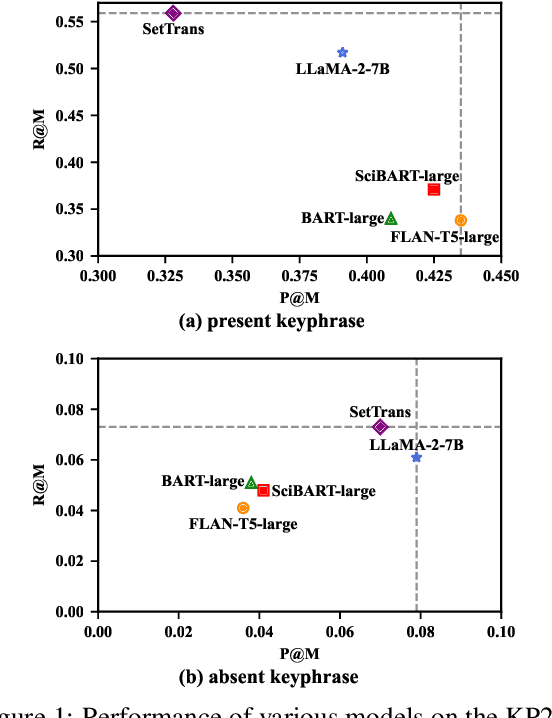
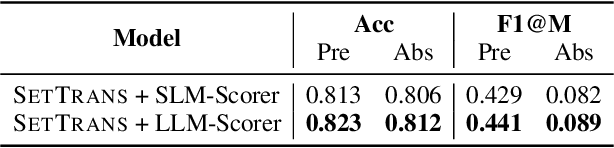
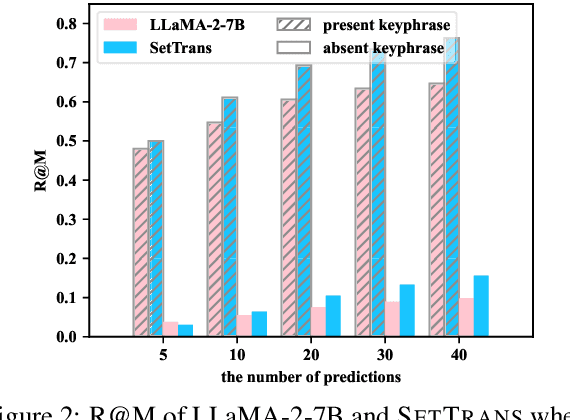
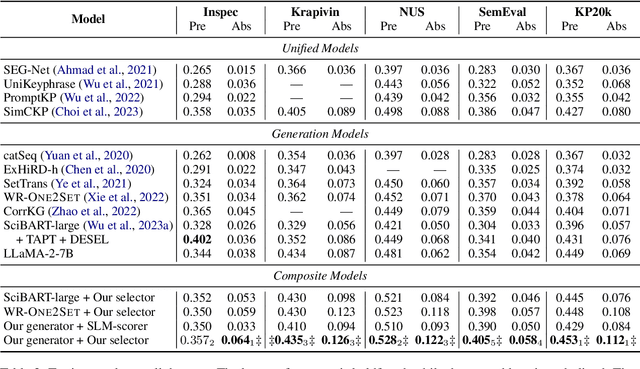
Keyphrase generation (KPG) aims to automatically generate a collection of phrases representing the core concepts of a given document. The dominant paradigms in KPG include one2seq and one2set. Recently, there has been increasing interest in applying large language models (LLMs) to KPG. Our preliminary experiments reveal that it is challenging for a single model to excel in both recall and precision. Further analysis shows that: 1) the one2set paradigm owns the advantage of high recall, but suffers from improper assignments of supervision signals during training; 2) LLMs are powerful in keyphrase selection, but existing selection methods often make redundant selections. Given these observations, we introduce a generate-then-select framework decomposing KPG into two steps, where we adopt a one2set-based model as generator to produce candidates and then use an LLM as selector to select keyphrases from these candidates. Particularly, we make two important improvements on our generator and selector: 1) we design an Optimal Transport-based assignment strategy to address the above improper assignments; 2) we model the keyphrase selection as a sequence labeling task to alleviate redundant selections. Experimental results on multiple benchmark datasets show that our framework significantly surpasses state-of-the-art models, especially in absent keyphrase prediction.