 Add to Chrome
 Add to Firefox
 Add to Edge
LongCat-Next: Lexicalizing Modalities as Discrete Tokens
Mar 29, 2026
The prevailing Next-Token Prediction (NTP) paradigm has driven the success of large language models through discrete autoregressive modeling. However, contemporary multimodal systems remain language-centric, often treating non-linguistic modalities as external attachments, leading to fragmented architectures and suboptimal integration. To transcend this limitation, we introduce Discrete Native Autoregressive (DiNA), a unified framework that represents multimodal information within a shared discrete space, enabling a consistent and principled autoregressive modeling across modalities. A key innovation is the Discrete Native Any-resolution Visual Transformer (dNaViT), which performs tokenization and de-tokenization at arbitrary resolutions, transforming continuous visual signals into hierarchical discrete tokens. Building on this foundation, we develop LongCat-Next, a native multimodal model that processes text, vision, and audio under a single autoregressive objective with minimal modality-specific design. As an industrial-strength foundation model, it excels at seeing, painting, and talking within a single framework, achieving strong performance across a wide range of multimodal benchmarks. In particular, LongCat-Next addresses the long-standing performance ceiling of discrete vision modeling on understanding tasks and provides a unified approach to effectively reconcile the conflict between understanding and generation. As an attempt toward native multimodality, we open-source the LongCat-Next and its tokenizers, hoping to foster further research and development in the community. GitHub: https://github.com/meituan-longcat/LongCat-Next

LongCat-Flash-Prover: Advancing Native Formal Reasoning via Agentic Tool-Integrated Reinforcement Learning
Mar 22, 2026We introduce LongCat-Flash-Prover, a flagship 560-billion-parameter open-source Mixture-of- Experts (MoE) model that advances Native Formal Reasoning in Lean4 through agentic tool-integrated reasoning (TIR). We decompose the native formal reasoning task into three independent formal capabilities, i.e., auto-formalization, sketching, and proving. To facilitate these capabilities, we propose a Hybrid-Experts Iteration Framework to expand high-quality task trajectories, including generating a formal statement based on a given informal problem, producing a whole-proof directly from the statement, or a lemma-style sketch. During agentic RL, we present a Hierarchical Importance Sampling Policy Optimization (HisPO) algorithm, which aims to stabilize the MoE model training on such long-horizon tasks. It employs a gradient masking strategy that accounts for the policy staleness and the inherent train-inference engine discrepancies at both sequence and token levels. Additionally, we also incorporate theorem consistency and legality detection mechanisms to eliminate reward hacking issues. Extensive evaluations show that our LongCat-Flash-Prover sets a new state-of-the-art for open-weights models in both auto-formalization and theorem proving. Demonstrating remarkable sample efficiency, it achieves a 97.1% pass rate on MiniF2F-Test using only 72 inference budget per problem. On more challenging benchmarks, it solves 70.8% of ProverBench and 41.5% of PutnamBench with no more than 220 attempts per problem, significantly outperforming existing open-weights baselines.
Scaling Embeddings Outperforms Scaling Experts in Language Models
Jan 29, 2026While Mixture-of-Experts (MoE) architectures have become the standard for sparsity scaling in large language models, they increasingly face diminishing returns and system-level bottlenecks. In this work, we explore embedding scaling as a potent, orthogonal dimension for scaling sparsity. Through a comprehensive analysis and experiments, we identify specific regimes where embedding scaling achieves a superior Pareto frontier compared to expert scaling. We systematically characterize the critical architectural factors governing this efficacy -- ranging from parameter budgeting to the interplay with model width and depth. Moreover, by integrating tailored system optimizations and speculative decoding, we effectively convert this sparsity into tangible inference speedups. Guided by these insights, we introduce LongCat-Flash-Lite, a 68.5B parameter model with ~3B activated trained from scratch. Despite allocating over 30B parameters to embeddings, LongCat-Flash-Lite not only surpasses parameter-equivalent MoE baselines but also exhibits exceptional competitiveness against existing models of comparable scale, particularly in agentic and coding domains.
LongCat-Flash-Thinking-2601 Technical Report
Jan 23, 2026We introduce LongCat-Flash-Thinking-2601, a 560-billion-parameter open-source Mixture-of-Experts (MoE) reasoning model with superior agentic reasoning capability. LongCat-Flash-Thinking-2601 achieves state-of-the-art performance among open-source models on a wide range of agentic benchmarks, including agentic search, agentic tool use, and tool-integrated reasoning. Beyond benchmark performance, the model demonstrates strong generalization to complex tool interactions and robust behavior under noisy real-world environments. Its advanced capability stems from a unified training framework that combines domain-parallel expert training with subsequent fusion, together with an end-to-end co-design of data construction, environments, algorithms, and infrastructure spanning from pre-training to post-training. In particular, the model's strong generalization capability in complex tool-use are driven by our in-depth exploration of environment scaling and principled task construction. To optimize long-tailed, skewed generation and multi-turn agentic interactions, and to enable stable training across over 10,000 environments spanning more than 20 domains, we systematically extend our asynchronous reinforcement learning framework, DORA, for stable and efficient large-scale multi-environment training. Furthermore, recognizing that real-world tasks are inherently noisy, we conduct a systematic analysis and decomposition of real-world noise patterns, and design targeted training procedures to explicitly incorporate such imperfections into the training process, resulting in improved robustness for real-world applications. To further enhance performance on complex reasoning tasks, we introduce a Heavy Thinking mode that enables effective test-time scaling by jointly expanding reasoning depth and width through intensive parallel thinking.
Unlocking Implicit Experience: Synthesizing Tool-Use Trajectories from Text
Jan 15, 2026Enabling Large Language Models (LLMs) to effectively utilize tools in multi-turn interactions is essential for building capable autonomous agents. However, acquiring diverse and realistic multi-turn tool-use data remains a significant challenge. In this work, we propose a novel text-based paradigm. We observe that textual corpora naturally contain rich, multi-step problem-solving experiences, which can serve as an untapped, scalable, and authentic data source for multi-turn tool-use tasks. Based on this insight, we introduce GEM, a data synthesis pipeline that enables the generation and extraction of multi-turn tool-use trajectories from text corpora through a four-stage process: relevance filtering, workflow & tool extraction, trajectory grounding, and complexity refinement. To reduce the computational cost, we further train a specialized Trajectory Synthesizer via supervised fine-tuning. This model distills the complex generation pipeline into an efficient, end-to-end trajectory generator. Experiments demonstrate that our GEM-32B achieve a 16.5% improvement on the BFCL V3 Multi-turn benchmark. Our models partially surpass the performance of models trained on τ - bench (Airline and Retail) in-domain data, highlighting the superior generalization capability derived from our text-based synthesis paradigm. Notably, our Trajectory Synthesizer matches the quality of the full pipeline while significantly reducing inference latency and costs.
A Survey on LLM Mid-training
Oct 27, 2025Recent advances in foundation models have highlighted the significant benefits of multi-stage training, with a particular emphasis on the emergence of mid-training as a vital stage that bridges pre-training and post-training. Mid-training is distinguished by its use of intermediate data and computational resources, systematically enhancing specified capabilities such as mathematics, coding, reasoning, and long-context extension, while maintaining foundational competencies. This survey provides a formal definition of mid-training for large language models (LLMs) and investigates optimization frameworks that encompass data curation, training strategies, and model architecture optimization. We analyze mainstream model implementations in the context of objective-driven interventions, illustrating how mid-training serves as a distinct and critical stage in the progressive development of LLM capabilities. By clarifying the unique contributions of mid-training, this survey offers a comprehensive taxonomy and actionable insights, supporting future research and innovation in the advancement of LLMs.
Selecting Demonstrations for Many-Shot In-Context Learning via Gradient Matching
Jun 05, 2025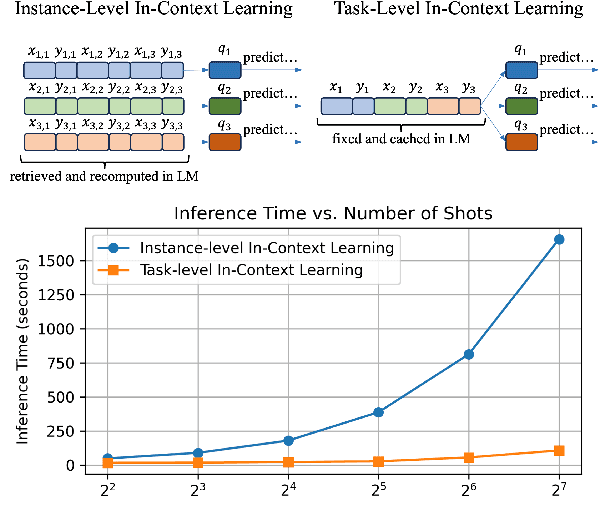
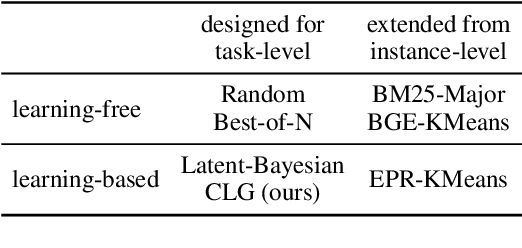
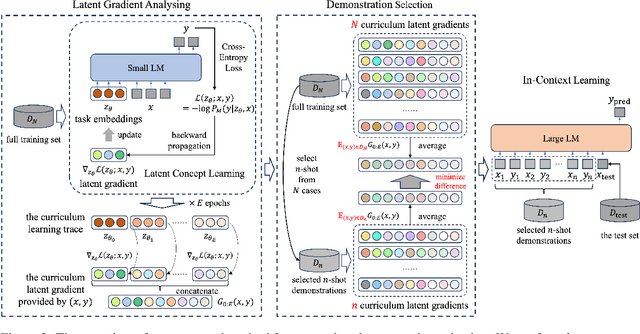
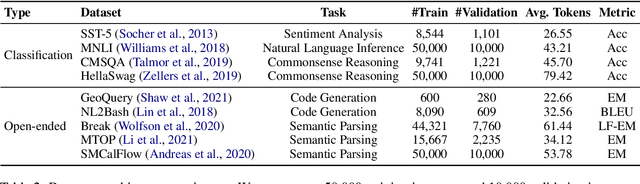
In-Context Learning (ICL) empowers Large Language Models (LLMs) for rapid task adaptation without Fine-Tuning (FT), but its reliance on demonstration selection remains a critical challenge. While many-shot ICL shows promising performance through scaled demonstrations, the selection method for many-shot demonstrations remains limited to random selection in existing work. Since the conventional instance-level retrieval is not suitable for many-shot scenarios, we hypothesize that the data requirements for in-context learning and fine-tuning are analogous. To this end, we introduce a novel gradient matching approach that selects demonstrations by aligning fine-tuning gradients between the entire training set of the target task and the selected examples, so as to approach the learning effect on the entire training set within the selected examples. Through gradient matching on relatively small models, e.g., Qwen2.5-3B or Llama3-8B, our method consistently outperforms random selection on larger LLMs from 4-shot to 128-shot scenarios across 9 diverse datasets. For instance, it surpasses random selection by 4% on Qwen2.5-72B and Llama3-70B, and by around 2% on 5 closed-source LLMs. This work unlocks more reliable and effective many-shot ICL, paving the way for its broader application.
XBOUND: Exploring the Capability Boundaries of Device-Control Agents through Trajectory Tree Exploration
May 27, 2025Recent advancements in vision-language models (VLMs) have spurred increased interest in Device-Control Agents (DC agents), such as utilizing in-the-wild device control to manage graphical user interfaces. Conventional methods for assessing the capabilities of DC agents, such as computing step-wise action accuracy and overall task success rates, provide a macroscopic view of DC agents' performance; however, they fail to offer microscopic insights into potential errors that may occur in real-world applications. Conducting a finer-grained performance evaluation of DC agents presents significant challenges. This study introduces a new perspective on evaluation methods for DC agents by proposing the XBOUND evaluation method, which employs the calculation of a novel Explore Metric to delineate the capability boundaries of DC agents. Compared to previous evaluation methods, XBOUND focuses on individual states to assess the proficiency of DC agents in mastering these states. Furthermore, we have developed a ``pseudo'' episode tree dataset derived from Android Control test data. Utilizing this dataset and XBOUND, we comprehensively evaluate the OS-Atlas and UI-TARS series, examining both the overall and specific performance across five common tasks. Additionally, we select representative cases to highlight the current deficiencies and limitations inherent in both series. Code is available at https://github.com/sqzhang-lazy/XBOUND.
Disentangling Preference Representation and Text Generation for Efficient Individual Preference Alignment
Dec 30, 2024Aligning Large Language Models (LLMs) with general human preferences has been proved crucial in improving the interaction quality between LLMs and human. However, human values are inherently diverse among different individuals, making it insufficient to align LLMs solely with general preferences. To address this, personalizing LLMs according to individual feedback emerges as a promising solution. Nonetheless, this approach presents challenges in terms of the efficiency of alignment algorithms. In this work, we introduce a flexible paradigm for individual preference alignment. Our method fundamentally improves efficiency by disentangling preference representation from text generation in LLMs. We validate our approach across multiple text generation tasks and demonstrate that it can produce aligned quality as well as or better than PEFT-based methods, while reducing additional training time for each new individual preference by $80\%$ to $90\%$ in comparison with them.
SEAS: Self-Evolving Adversarial Safety Optimization for Large Language Models
Aug 05, 2024As large language models (LLMs) continue to advance in capability and influence, ensuring their security and preventing harmful outputs has become crucial. A promising approach to address these concerns involves training models to automatically generate adversarial prompts for red teaming. However, the evolving subtlety of vulnerabilities in LLMs challenges the effectiveness of current adversarial methods, which struggle to specifically target and explore the weaknesses of these models. To tackle these challenges, we introduce the $\mathbf{S}\text{elf-}\mathbf{E}\text{volving }\mathbf{A}\text{dversarial }\mathbf{S}\text{afety }\mathbf{(SEAS)}$ optimization framework, which enhances security by leveraging data generated by the model itself. SEAS operates through three iterative stages: Initialization, Attack, and Adversarial Optimization, refining both the Red Team and Target models to improve robustness and safety. This framework reduces reliance on manual testing and significantly enhances the security capabilities of LLMs. Our contributions include a novel adversarial framework, a comprehensive safety dataset, and after three iterations, the Target model achieves a security level comparable to GPT-4, while the Red Team model shows a marked increase in attack success rate (ASR) against advanced models.