 Add to Chrome
 Add to Firefox
 Add to Edge
ReaORE: Reasoning-Guided Progressive Open Relation Extraction Empowered by Large Reasoning Models
Jun 25, 2026
Open Relation Extraction (OpenRE) requires a model to extract unseen relations between head and tail entities from unstructured text for real-world applications. The core challenge of OpenRE lies in achieving reliable generalization to unseen relation types. Current OpenRE approaches either employ clustering techniques, which cannot generate relation labels and suffer from poor generalization, or rely on direct relation label generation via Large Language Models (LLMs), which lack sufficient discriminative capacity to distinguish easily confused relations. To address these limitations, we propose Reasoning-guided progressive OpenRE (ReaORE), a framework for performing relation extraction through coarse-to-fine relation reasoning. Specifically, ReaORE consists of two key stages: (i) relation filtering, which reasons over multiple aspects to understand relations and instances, yielding an initial relation set, and further supplements and filters relations via embedding-based similarity to ensure the target relation is included; (ii) relation prediction, which aims to predict the target relations from the above set via fine-grained comparative reasoning to better distinguish easily confused relations. Extensive experiments on two widely used OpenRE datasets demonstrate that ReaORE outperforms existing baselines.

HCRE: LLM-based Hierarchical Classification for Cross-Document Relation Extraction with a Prediction-then-Verification Strategy
Apr 09, 2026Cross-document relation extraction (RE) aims to identify relations between the head and tail entities located in different documents. Existing approaches typically adopt the paradigm of ``\textit{Small Language Model (SLM) + Classifier}''. However, the limited language understanding ability of SLMs hinders further improvement of their performance. In this paper, we conduct a preliminary study to explore the performance of Large Language Models (LLMs) in cross-document RE. Despite their extensive parameters, our findings indicate that LLMs do not consistently surpass existing SLMs. Further analysis suggests that the underperformance is largely attributed to the challenges posed by the numerous predefined relations. To overcome this issue, we propose an LLM-based \underline{H}ierarchical \underline{C}lassification model for cross-document \underline{RE} (HCRE), which consists of two core components: 1) an LLM for relation prediction and 2) a \textit{hierarchical relation tree} derived from the predefined relation set. This tree enables the LLM to perform hierarchical classification, where the target relation is inferred level by level. Since the number of child nodes is much smaller than the size of the entire predefined relation set, the hierarchical relation tree significantly reduces the number of relation options that LLM needs to consider during inference. However, hierarchical classification introduces the risk of error propagation across levels. To mitigate this, we propose a \textit{prediction-then-verification} inference strategy that improves prediction reliability through multi-view verification at each level. Extensive experiments show that HCRE outperforms existing baselines, validating its effectiveness.
RASR: Retrieval-Augmented Semantic Reasoning for Fake News Video Detection
Apr 08, 2026Multimodal fake news video detection is a crucial research direction for maintaining the credibility of online information. Existing studies primarily verify content authenticity by constructing multimodal feature fusion representations or utilizing pre-trained language models to analyze video-text consistency. However, these methods still face the following limitations: (1) lacking cross-instance global semantic correlations, making it difficult to effectively utilize historical associative evidence to verify the current video; (2) semantic discrepancies across domains hinder the transfer of general knowledge, lacking the guidance of domain-specific expert knowledge. To this end, we propose a novel Retrieval-Augmented Semantic Reasoning (RASR) framework. First, a Cross-instance Semantic Parser and Retriever (CSPR) deconstructs the video into high-level semantic primitives and retrieves relevant associative evidence from a dynamic memory bank. Subsequently, a Domain-Guided Multimodal Reasoning (DGMP) module incorporates domain priors to drive an expert multimodal large language model in generating domain-aware, in-depth analysis reports. Finally, a Multi-View Feature Decoupling and Fusion (MVDFF) module integrates multi-dimensional features through an adaptive gating mechanism to achieve robust authenticity determination. Extensive experiments on the FakeSV and FakeTT datasets demonstrate that RASR significantly outperforms state-of-the-art baselines, achieves superior cross-domain generalization, and improves the overall detection accuracy by up to 0.93%.
One2set + Large Language Model: Best Partners for Keyphrase Generation
Oct 04, 2024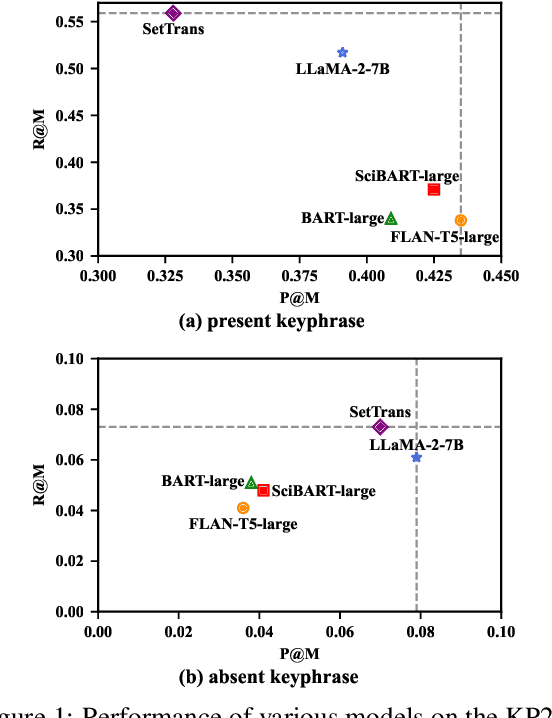
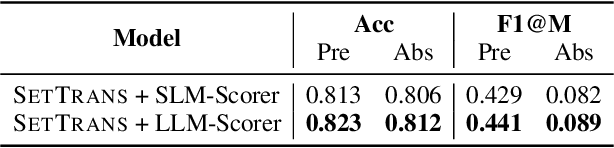
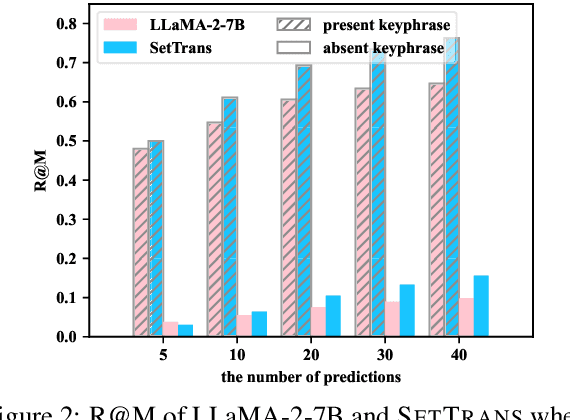
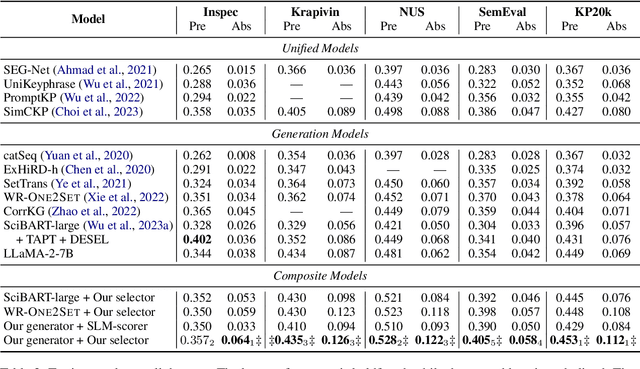
Keyphrase generation (KPG) aims to automatically generate a collection of phrases representing the core concepts of a given document. The dominant paradigms in KPG include one2seq and one2set. Recently, there has been increasing interest in applying large language models (LLMs) to KPG. Our preliminary experiments reveal that it is challenging for a single model to excel in both recall and precision. Further analysis shows that: 1) the one2set paradigm owns the advantage of high recall, but suffers from improper assignments of supervision signals during training; 2) LLMs are powerful in keyphrase selection, but existing selection methods often make redundant selections. Given these observations, we introduce a generate-then-select framework decomposing KPG into two steps, where we adopt a one2set-based model as generator to produce candidates and then use an LLM as selector to select keyphrases from these candidates. Particularly, we make two important improvements on our generator and selector: 1) we design an Optimal Transport-based assignment strategy to address the above improper assignments; 2) we model the keyphrase selection as a sequence labeling task to alleviate redundant selections. Experimental results on multiple benchmark datasets show that our framework significantly surpasses state-of-the-art models, especially in absent keyphrase prediction.