 Add to Chrome
 Add to Firefox
 Add to Edge
SeekBrain: An Autonomous Multi-Agent System for Accelerating Neuroscience Discovery
Jul 31, 2026
Modern neuroscience relies on integrating multi-scale, multimodal datasets to uncover the neural principles underlying intelligence. However, analytical challenges posed by highly heterogeneous data and fragmented workflows increasingly constrain discoveries. Here we introduce SeekBrain, an autonomous multi-agent framework designed to accelerate neuroscience discovery through domain-grounded hierarchical planning and cross-modal data analysis. SeekBrain dynamically constructs a repertoire of analysis recipes extracted from code-paper pairs. By coupling this codified expertise with agentic planning and execution engines, the framework scalably generates hypotheses and analytical pipelines on demand. Systematic evaluation on the expert-annotated BrainArena benchmark demonstrates that SeekBrain substantially outperforms state-of-the-art agent baselines across various analysis tasks. Crucially, when deployed in real-world research, SeekBrain integrated behavioral, neural, and anatomical data to reveal structured, distributed neural representations of larval zebrafish behavior and a shared axis of regional decoding strength across the brain in a mouse decision-making task. These results establish SeekBrain as a scalable and practical tool for accelerating data-driven discoveries in neuroscience.

Token-Sparse Medical Multimodal Reasoning via Dual-Stream Reinforcement Learning
Jun 30, 2026Vision-language models (VLMs) combining reinforcement learning (RL) ignite remarkable progress in multimodal reasoning, yet still struggle with medical images, which typically exhibit extremely sparse visual evidence to inform clinical decision-making. We recognize that pruning visual tokens outside the grounding region greatly enhances medical reasoning. However, a united RL framework for active visual token pruning (VTP) and medical multimodal reasoning remains unestablished. Here, we propose a dual-stream RL framework, ViToS, to fulfill token pruning and question answering. ViToS trains one policy model with two task branches, where one focuses on grounding while the other conducts token-sparse reasoning after VTP. Furthermore, we solve the coupled policy learning problem by introducing the cross-feedback sequential optimization, avoiding gradient conflict and facilitating convergence of the shared policy model. Evaluated on seven medical benchmarks, our method reduces visual tokens to 77% of the original sequence length while achieving a 108.27% relative performance on Lingshu-7B and 104.16% relative performance on HuatuoGPT-Vision-7B. Overall, ViToS delivers superior performance and inference speedup, establishing an efficient paradigm for medical multimodal reasoning.
BrainJanus: A Unified Model for Understanding and Generation across Brain, Vision, and Language
Jun 29, 2026Modeling the bidirectional correspondence between external sensory stimuli and internal neural activity has emerged as a critical frontier in neuroscience. However, existing approaches predominantly treat brain encoding and decoding as isolated tasks, relying heavily on unimodal alignment and external priors while overlooking the brain's intrinsic nature as a multimodal integration system. To address these limitations, we propose BrainJanus, the first unified brain model that integrates brain, vision, and language within a single framework. Specifically, we introduce a Unified Brain Tokenizer to quantize continuous neural dynamics into discrete tokens aligned with visual and linguistic representations in a shared Omni space. Building on this, we utilize an All-in-One autoregressive architecture that leverages next-token prediction to enable seamless any-to-any generation, which encompasses image-to-brain and text-to-brain encoding, and brain-to-image and brain-to-text decoding. Extensive experiments demonstrate that BrainJanus achieves superior performance across diverse benchmarks. Furthermore, our framework exhibits zero-shot generalization and preserves interpretable biological topography, highlighting its potential as a general-purpose brain modeling paradigm. The code is available at \href{https://github.com/HaitaoWuTJU/BrainJanus}{GitHub}.
Timestep Rescheduling in Diffusion Inversion
Jun 13, 2026Diffusion inversion, which maps images back to the Gaussian latent space of a diffusion model, is a critical task for image reconstruction and editing. While DDIM enables fast deterministic inversion, it inherently introduces deviations that accumulate into noticeable inversion errors. Existing methods often address this by solving a fixed-point problem but largely overlook how the selection of the diffusion timestep in the noise scheduler influences inversion fidelity. In this work, we reveal that the deviation scale in diffusion inversion is strongly dependent on the timestep size, and exhibits a parabolic trend, with larger errors concentrated at both small and large timesteps. Based on this finding, we propose a simple yet effective nonuniform timestep scheduler that integrates a global rescaling with a local dynamic programming based rescheduling, enabling a strategic allocation of computational effort that minimizes the overall inversion error and preserves higher inversion accuracy. Our method serves as an off-the-shelf enhancement for existing inversion techniques and requires no extra parameters or computational overhead. Through extensive experiments, we verify that integrating our scheduler consistently boosts the performance of existing inversion methods, achieving superior results in image reconstruction and editing.
Experience Makes Skillful: Enabling Generalizable Medical Agent Reasoning via Self-Evolving Skill Memory
Jun 08, 2026Medical agent systems are increasingly expected to support interactive clinical decision making rather than only static question answering. In such settings, effective agents must reuse prior experience across evolving cases, yet existing memory mechanisms often retain raw historical traces that are redundant, noisy, and difficult to govern. More importantly, they rarely distinguish which memories are truly useful for future reasoning. This limits their ability to accumulate compact and reliable experience for long-horizon clinical reasoning. To close this gap, we propose SkeMex, a post-deployment self-evolution framework that improves medical agents through a skill-based memory without updating model weights. SkeMex distills informative interaction trajectories into structured skills that encode reusable procedural knowledge, and organizes them into a multi-branch repository spanning general, task-specific, and action-level experience. To determine which memories should be reused and retained, SkeMex estimates context-dependent utility from environment feedback and uses it to guide value-aware retrieval and repository governance. A closed-loop ``Read--Write--Assess--Govern" lifecycle further supports continual evolution by writing new skills, updating utilities, promoting useful memories, and removing harmful entries. Experiments across diverse clinical tasks show that SkeMex consistently outperforms representative memory-based agents in both offline and online settings. It also generalizes across model backbones and supports transferable skill memory. All data and code will be released publicly.
Project Imaging-X: A Survey of 1000+ Open-Access Medical Imaging Datasets for Foundation Model Development
Mar 29, 2026Foundation models have demonstrated remarkable success across diverse domains and tasks, primarily due to the thrive of large-scale, diverse, and high-quality datasets. However, in the field of medical imaging, the curation and assembling of such medical datasets are highly challenging due to the reliance on clinical expertise and strict ethical and privacy constraints, resulting in a scarcity of large-scale unified medical datasets and hindering the development of powerful medical foundation models. In this work, we present the largest survey to date of medical image datasets, covering over 1,000 open-access datasets with a systematic catalog of their modalities, tasks, anatomies, annotations, limitations, and potential for integration. Our analysis exposes a landscape that is modest in scale, fragmented across narrowly scoped tasks, and unevenly distributed across organs and modalities, which in turn limits the utility of existing medical image datasets for developing versatile and robust medical foundation models. To turn fragmentation into scale, we propose a metadata-driven fusion paradigm (MDFP) that integrates public datasets with shared modalities or tasks, thereby transforming multiple small data silos into larger, more coherent resources. Building on MDFP, we release an interactive discovery portal that enables end-to-end, automated medical image dataset integration, and compile all surveyed datasets into a unified, structured table that clearly summarizes their key characteristics and provides reference links, offering the community an accessible and comprehensive repository. By charting the current terrain and offering a principled path to dataset consolidation, our survey provides a practical roadmap for scaling medical imaging corpora, supporting faster data discovery, more principled dataset creation, and more capable medical foundation models.
InternAgent-1.5: A Unified Agentic Framework for Long-Horizon Autonomous Scientific Discovery
Feb 09, 2026We introduce InternAgent-1.5, a unified system designed for end-to-end scientific discovery across computational and empirical domains. The system is built on a structured architecture composed of three coordinated subsystems for generation, verification, and evolution. These subsystems are supported by foundational capabilities for deep research, solution optimization, and long horizon memory. The architecture allows InternAgent-1.5 to operate continuously across extended discovery cycles while maintaining coherent and improving behavior. It also enables the system to coordinate computational modeling and laboratory experimentation within a single unified system. We evaluate InternAgent-1.5 on scientific reasoning benchmarks such as GAIA, HLE, GPQA, and FrontierScience, and the system achieves leading performance that demonstrates strong foundational capabilities. Beyond these benchmarks, we further assess two categories of discovery tasks. In algorithm discovery tasks, InternAgent-1.5 autonomously designs competitive methods for core machine learning problems. In empirical discovery tasks, it executes complete computational or wet lab experiments and produces scientific findings in earth, life, biological, and physical domains. Overall, these results show that InternAgent-1.5 provides a general and scalable framework for autonomous scientific discovery.
PathOrchestra: A Comprehensive Foundation Model for Computational Pathology with Over 100 Diverse Clinical-Grade Tasks
Mar 31, 2025The complexity and variability inherent in high-resolution pathological images present significant challenges in computational pathology. While pathology foundation models leveraging AI have catalyzed transformative advancements, their development demands large-scale datasets, considerable storage capacity, and substantial computational resources. Furthermore, ensuring their clinical applicability and generalizability requires rigorous validation across a broad spectrum of clinical tasks. Here, we present PathOrchestra, a versatile pathology foundation model trained via self-supervised learning on a dataset comprising 300K pathological slides from 20 tissue and organ types across multiple centers. The model was rigorously evaluated on 112 clinical tasks using a combination of 61 private and 51 public datasets. These tasks encompass digital slide preprocessing, pan-cancer classification, lesion identification, multi-cancer subtype classification, biomarker assessment, gene expression prediction, and the generation of structured reports. PathOrchestra demonstrated exceptional performance across 27,755 WSIs and 9,415,729 ROIs, achieving over 0.950 accuracy in 47 tasks, including pan-cancer classification across various organs, lymphoma subtype diagnosis, and bladder cancer screening. Notably, it is the first model to generate structured reports for high-incidence colorectal cancer and diagnostically complex lymphoma-areas that are infrequently addressed by foundational models but hold immense clinical potential. Overall, PathOrchestra exemplifies the feasibility and efficacy of a large-scale, self-supervised pathology foundation model, validated across a broad range of clinical-grade tasks. Its high accuracy and reduced reliance on extensive data annotation underline its potential for clinical integration, offering a pathway toward more efficient and high-quality medical services.
End-to-end Triple-domain PET Enhancement: A Hybrid Denoising-and-reconstruction Framework for Reconstructing Standard-dose PET Images from Low-dose PET Sinograms
Dec 04, 2024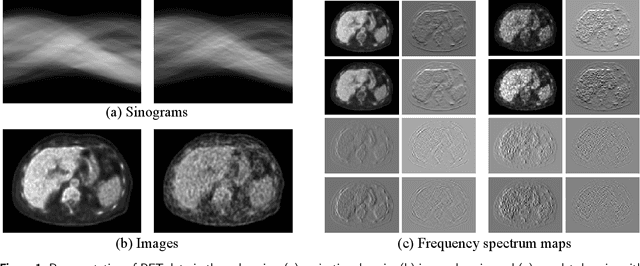
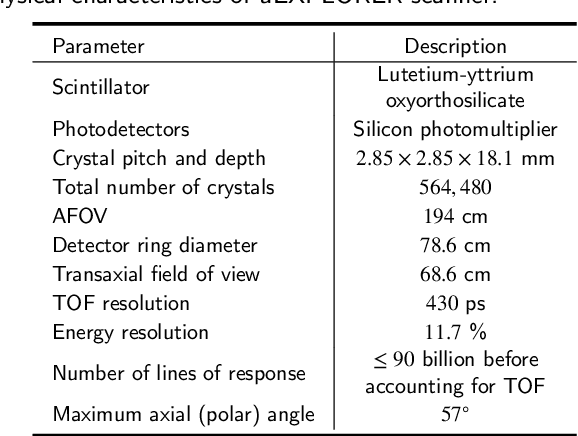
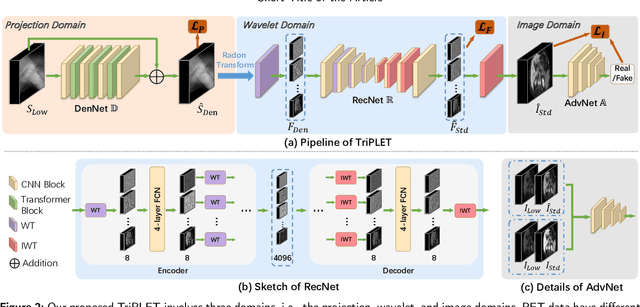
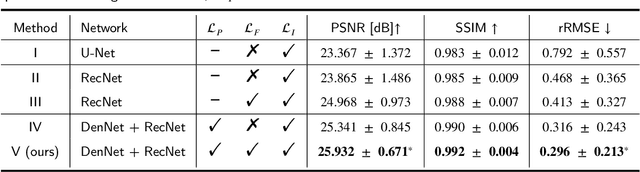
As a sensitive functional imaging technique, positron emission tomography (PET) plays a critical role in early disease diagnosis. However, obtaining a high-quality PET image requires injecting a sufficient dose (standard dose) of radionuclides into the body, which inevitably poses radiation hazards to patients. To mitigate radiation hazards, the reconstruction of standard-dose PET (SPET) from low-dose PET (LPET) is desired. According to imaging theory, PET reconstruction process involves multiple domains (e.g., projection domain and image domain), and a significant portion of the difference between SPET and LPET arises from variations in the noise levels introduced during the sampling of raw data as sinograms. In light of these two facts, we propose an end-to-end TriPle-domain LPET EnhancemenT (TriPLET) framework, by leveraging the advantages of a hybrid denoising-and-reconstruction process and a triple-domain representation (i.e., sinograms, frequency spectrum maps, and images) to reconstruct SPET images from LPET sinograms. Specifically, TriPLET consists of three sequentially coupled components including 1) a Transformer-assisted denoising network that denoises the inputted LPET sinograms in the projection domain, 2) a discrete-wavelet-transform-based reconstruction network that further reconstructs SPET from LPET in the wavelet domain, and 3) a pair-based adversarial network that evaluates the reconstructed SPET images in the image domain. Extensive experiments on the real PET dataset demonstrate that our proposed TriPLET can reconstruct SPET images with the highest similarity and signal-to-noise ratio to real data, compared with state-of-the-art methods.
BrainMVP: Multi-modal Vision Pre-training for Brain Image Analysis using Multi-parametric MRI
Oct 14, 2024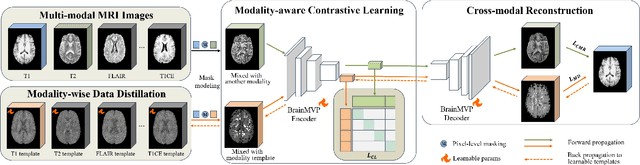
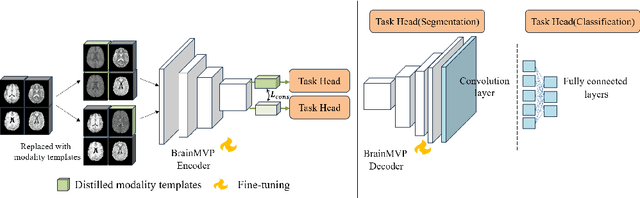
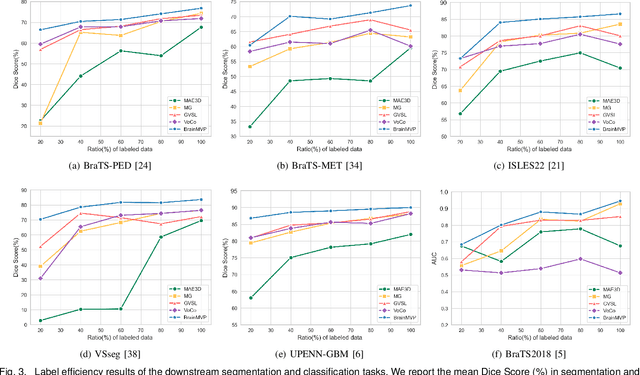
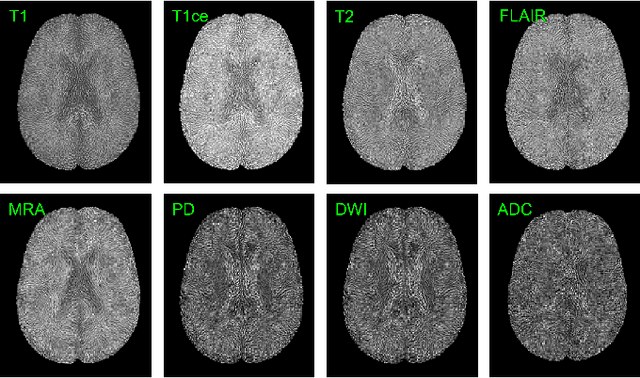
Accurate diagnosis of brain abnormalities is greatly enhanced by the inclusion of complementary multi-parametric MRI imaging data. There is significant potential to develop a universal pre-training model that can be quickly adapted for image modalities and various clinical scenarios. However, current models often rely on uni-modal image data, neglecting the cross-modal correlations among different image modalities or struggling to scale up pre-training in the presence of missing modality data. In this paper, we propose BrainMVP, a multi-modal vision pre-training framework for brain image analysis using multi-parametric MRI scans. First, we collect 16,022 brain MRI scans (over 2.4 million images), encompassing eight MRI modalities sourced from a diverse range of centers and devices. Then, a novel pre-training paradigm is proposed for the multi-modal MRI data, addressing the issue of missing modalities and achieving multi-modal information fusion. Cross-modal reconstruction is explored to learn distinctive brain image embeddings and efficient modality fusion capabilities. A modality-wise data distillation module is proposed to extract the essence representation of each MR image modality for both the pre-training and downstream application purposes. Furthermore, we introduce a modality-aware contrastive learning module to enhance the cross-modality association within a study. Extensive experiments on downstream tasks demonstrate superior performance compared to state-of-the-art pre-training methods in the medical domain, with Dice Score improvement of 0.28%-14.47% across six segmentation benchmarks and a consistent accuracy improvement of 0.65%-18.07% in four individual classification tasks.