 Add to Chrome
 Add to Firefox
 Add to Edge
Scaling the Horizon, Not the Parameters: Reaching Trillion-Parameter Performance with a 35B Agent
Jun 29, 2026
We introduce Agents-A1, a 35B Mixture-of-Experts Agentic Model that reaches trillion-parameter-level performance by scaling the agent horizon. We investigate agent-horizon scaling from two perspectives: scaling long-horizon trajectories and scaling heterogeneous agent abilities. To support this goal, we build a long-horizon knowledge-action infrastructure that connects external knowledge, actions, observations, and verifier outcomes, producing agentic trajectories with an average length of 45K tokens. Based on this, we train Agents-A1 with a three-stage recipe. First, we perform full-domain supervised fine-tuning to align the base model with broad agentic behaviors. Second, we train domain-level teacher models to capture specialized expertise in each domain. Third, we propose a multi-teacher domain-routed on-policy distillation with salient vocabulary alignment to improve knowledge transfer efficiency across different domains, unifying six heterogeneous domains into one deployable student model. Agents-A1 achieves strong and broad performance for long-horizon agent benchmarks. Compared with 1T-parameter model such as Kimi-K2.6 and DeepSeek-V4-pro, Agents-A1 achieves leading results on SEAL-0 (56.4), IFBench (80.6), HiPhO (46.4), FrontierScience-Olympiad (79.0), and MolBench-Bind (56.8), and remains highly competitive on SciCode (44.3), HLE (47.6) and BrowseComp (75.5). We hope this work provides the community with a practical path for scaling the horizon using a 35B agent that can reach or match the performance of 1T models on long-horizon tasks.

InternAgent-1.5: A Unified Agentic Framework for Long-Horizon Autonomous Scientific Discovery
Feb 09, 2026We introduce InternAgent-1.5, a unified system designed for end-to-end scientific discovery across computational and empirical domains. The system is built on a structured architecture composed of three coordinated subsystems for generation, verification, and evolution. These subsystems are supported by foundational capabilities for deep research, solution optimization, and long horizon memory. The architecture allows InternAgent-1.5 to operate continuously across extended discovery cycles while maintaining coherent and improving behavior. It also enables the system to coordinate computational modeling and laboratory experimentation within a single unified system. We evaluate InternAgent-1.5 on scientific reasoning benchmarks such as GAIA, HLE, GPQA, and FrontierScience, and the system achieves leading performance that demonstrates strong foundational capabilities. Beyond these benchmarks, we further assess two categories of discovery tasks. In algorithm discovery tasks, InternAgent-1.5 autonomously designs competitive methods for core machine learning problems. In empirical discovery tasks, it executes complete computational or wet lab experiments and produces scientific findings in earth, life, biological, and physical domains. Overall, these results show that InternAgent-1.5 provides a general and scalable framework for autonomous scientific discovery.
Kling-Omni Technical Report
Dec 18, 2025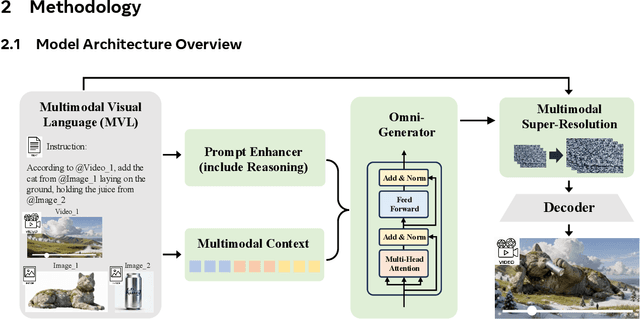
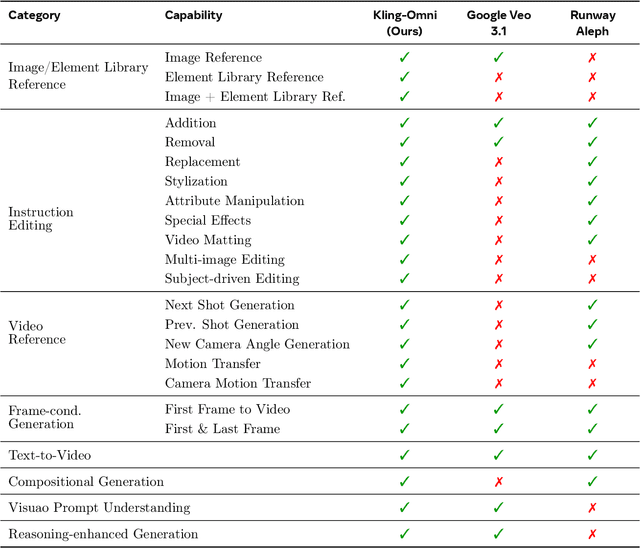
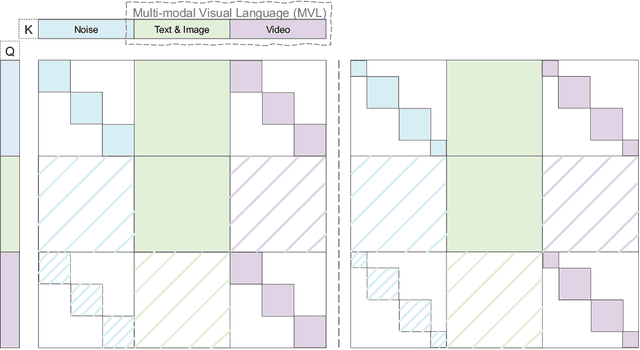
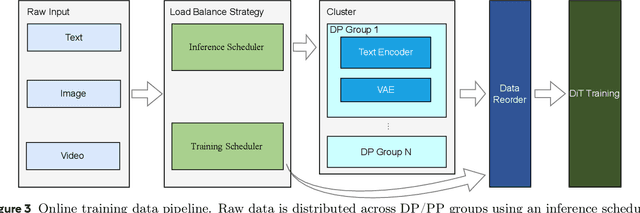
We present Kling-Omni, a generalist generative framework designed to synthesize high-fidelity videos directly from multimodal visual language inputs. Adopting an end-to-end perspective, Kling-Omni bridges the functional separation among diverse video generation, editing, and intelligent reasoning tasks, integrating them into a holistic system. Unlike disjointed pipeline approaches, Kling-Omni supports a diverse range of user inputs, including text instructions, reference images, and video contexts, processing them into a unified multimodal representation to deliver cinematic-quality and highly-intelligent video content creation. To support these capabilities, we constructed a comprehensive data system that serves as the foundation for multimodal video creation. The framework is further empowered by efficient large-scale pre-training strategies and infrastructure optimizations for inference. Comprehensive evaluations reveal that Kling-Omni demonstrates exceptional capabilities in in-context generation, reasoning-based editing, and multimodal instruction following. Moving beyond a content creation tool, we believe Kling-Omni is a pivotal advancement toward multimodal world simulators capable of perceiving, reasoning, generating and interacting with the dynamic and complex worlds.
AdaMHF: Adaptive Multimodal Hierarchical Fusion for Survival Prediction
Mar 27, 2025The integration of pathologic images and genomic data for survival analysis has gained increasing attention with advances in multimodal learning. However, current methods often ignore biological characteristics, such as heterogeneity and sparsity, both within and across modalities, ultimately limiting their adaptability to clinical practice. To address these challenges, we propose AdaMHF: Adaptive Multimodal Hierarchical Fusion, a framework designed for efficient, comprehensive, and tailored feature extraction and fusion. AdaMHF is specifically adapted to the uniqueness of medical data, enabling accurate predictions with minimal resource consumption, even under challenging scenarios with missing modalities. Initially, AdaMHF employs an experts expansion and residual structure to activate specialized experts for extracting heterogeneous and sparse features. Extracted tokens undergo refinement via selection and aggregation, reducing the weight of non-dominant features while preserving comprehensive information. Subsequently, the encoded features are hierarchically fused, allowing multi-grained interactions across modalities to be captured. Furthermore, we introduce a survival prediction benchmark designed to resolve scenarios with missing modalities, mirroring real-world clinical conditions. Extensive experiments on TCGA datasets demonstrate that AdaMHF surpasses current state-of-the-art (SOTA) methods, showcasing exceptional performance in both complete and incomplete modality settings.
DRUPI: Dataset Reduction Using Privileged Information
Oct 02, 2024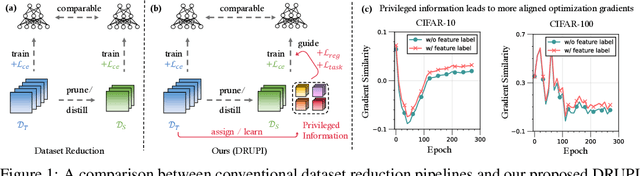
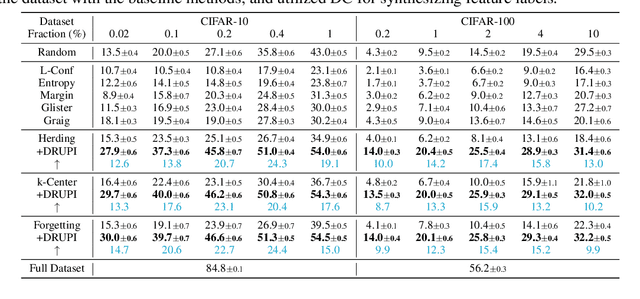
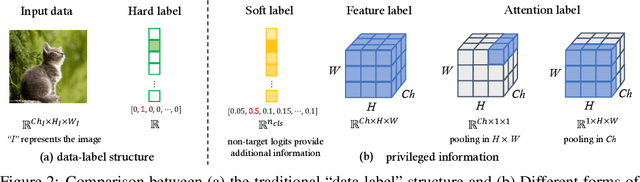
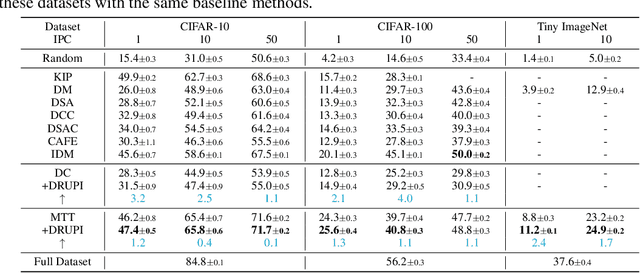
Dataset reduction (DR) seeks to select or distill samples from large datasets into smaller subsets while preserving performance on target tasks. Existing methods primarily focus on pruning or synthesizing data in the same format as the original dataset, typically the input data and corresponding labels. However, in DR settings, we find it is possible to synthesize more information beyond the data-label pair as an additional learning target to facilitate model training. In this paper, we introduce Dataset Reduction Using Privileged Information (DRUPI), which enriches DR by synthesizing privileged information alongside the reduced dataset. This privileged information can take the form of feature labels or attention labels, providing auxiliary supervision to improve model learning. Our findings reveal that effective feature labels must balance between being overly discriminative and excessively diverse, with a moderate level proving optimal for improving the reduced dataset's efficacy. Extensive experiments on ImageNet, CIFAR-10/100, and Tiny ImageNet demonstrate that DRUPI integrates seamlessly with existing dataset reduction methods, offering significant performance gains.