 Add to Chrome
 Add to Firefox
 Add to Edge
Token-Sparse Medical Multimodal Reasoning via Dual-Stream Reinforcement Learning
Jun 30, 2026
Vision-language models (VLMs) combining reinforcement learning (RL) ignite remarkable progress in multimodal reasoning, yet still struggle with medical images, which typically exhibit extremely sparse visual evidence to inform clinical decision-making. We recognize that pruning visual tokens outside the grounding region greatly enhances medical reasoning. However, a united RL framework for active visual token pruning (VTP) and medical multimodal reasoning remains unestablished. Here, we propose a dual-stream RL framework, ViToS, to fulfill token pruning and question answering. ViToS trains one policy model with two task branches, where one focuses on grounding while the other conducts token-sparse reasoning after VTP. Furthermore, we solve the coupled policy learning problem by introducing the cross-feedback sequential optimization, avoiding gradient conflict and facilitating convergence of the shared policy model. Evaluated on seven medical benchmarks, our method reduces visual tokens to 77% of the original sequence length while achieving a 108.27% relative performance on Lingshu-7B and 104.16% relative performance on HuatuoGPT-Vision-7B. Overall, ViToS delivers superior performance and inference speedup, establishing an efficient paradigm for medical multimodal reasoning.

Agent Skill Evaluation and Evolution: Frameworks and Benchmarks
Jun 09, 2026The growth of agent skills has transformed how agentic systems are built, evaluated, and deployed. As skill libraries continue to scale, rigorous evaluation becomes critical to ensuring their utility, quality, and safety in real-world applications. Consequently, the field is undergoing an emerging paradigm shift from isolated skill creation to automated, evaluation-driven skill evolution. In this survey, we systematically examine the landscape of skill evolution and evaluation beyond foundational skill creation. We categorize evolution into four distinct paradigms, spanning execution feedback, trajectory distillation, compression, and reinforcement learning, showing how each element contributes to improving skill utility and reliability. We also provide an analysis of six skill-centric benchmark categories, identifying structural gaps in benchmark coverage, trade-offs, and metric richness to advance skill research. Finally, we identify open directions for building skill ecosystems that are generalizable, efficient, and verifiably safe. The project URL is https://github.com/Cassie07/AgentSkill_Survey
Evidence Over Plans: Online Trajectory Verification for Skill Distillation
May 09, 2026Agent skills can remarkably improve task success rates by using human-written procedural documents, but their quality is difficult to assess without environment-grounded verification. Existing skill generation methods heavily rely on preference logs rather than direct environment interaction, often yielding negligible or even degraded gains. We identify that it is a fundamental timing bottleneck: robust skills should be posterior-based, distilled from empirical environment interaction rather than prior plans. In this study, we introduce the Posterior Distillation Index (PDI), a trajectory-level metric that quantifies how well a distilled skill is grounded in the task-environment evidence. To operationalize PDI, we present SPARK (Structured Pipelines for Autonomous Runnable tasKs and sKill generation) for preserving task execution evidence towards full trajectory-level analysis. SPARK generates environment-verified trajectories used to compute PDI, and it applies PDI as an online diagnostic and intervention signal to ensure posterior skill formation. Across 86 runnable tasks, SPARK-generated skills consistently surpass no-skill baselines and outperform human-written skills on student models (inference cost up to 1,000x cheaper than teacher models). These findings show that PDI-guided distillation produces efficient and transferable skills grounded in the task-environment interaction. We release our code at https://github.com/EtaYang10th/spark-skills .
LUCID-SAE: Learning Unified Vision-Language Sparse Codes for Interpretable Concept Discovery
Feb 07, 2026Sparse autoencoders (SAEs) offer a natural path toward comparable explanations across different representation spaces. However, current SAEs are trained per modality, producing dictionaries whose features are not directly understandable and whose explanations do not transfer across domains. In this study, we introduce LUCID (Learning Unified vision-language sparse Codes for Interpretable concept Discovery), a unified vision-language sparse autoencoder that learns a shared latent dictionary for image patch and text token representations, while reserving private capacity for modality-specific details. We achieve feature alignment by coupling the shared codes with a learned optimal transport matching objective without the need of labeling. LUCID yields interpretable shared features that support patch-level grounding, establish cross-modal neuron correspondence, and enhance robustness against the concept clustering problem in similarity-based evaluation. Leveraging the alignment properties, we develop an automated dictionary interpretation pipeline based on term clustering without manual observations. Our analysis reveals that LUCID's shared features capture diverse semantic categories beyond objects, including actions, attributes, and abstract concepts, demonstrating a comprehensive approach to interpretable multimodal representations.
Anatomy-VLM: A Fine-grained Vision-Language Model for Medical Interpretation
Nov 11, 2025Accurate disease interpretation from radiology remains challenging due to imaging heterogeneity. Achieving expert-level diagnostic decisions requires integration of subtle image features with clinical knowledge. Yet major vision-language models (VLMs) treat images as holistic entities and overlook fine-grained image details that are vital for disease diagnosis. Clinicians analyze images by utilizing their prior medical knowledge and identify anatomical structures as important region of interests (ROIs). Inspired from this human-centric workflow, we introduce Anatomy-VLM, a fine-grained, vision-language model that incorporates multi-scale information. First, we design a model encoder to localize key anatomical features from entire medical images. Second, these regions are enriched with structured knowledge for contextually-aware interpretation. Finally, the model encoder aligns multi-scale medical information to generate clinically-interpretable disease prediction. Anatomy-VLM achieves outstanding performance on both in- and out-of-distribution datasets. We also validate the performance of Anatomy-VLM on downstream image segmentation tasks, suggesting that its fine-grained alignment captures anatomical and pathology-related knowledge. Furthermore, the Anatomy-VLM's encoder facilitates zero-shot anatomy-wise interpretation, providing its strong expert-level clinical interpretation capabilities.
Show and Segment: Universal Medical Image Segmentation via In-Context Learning
Mar 25, 2025Medical image segmentation remains challenging due to the vast diversity of anatomical structures, imaging modalities, and segmentation tasks. While deep learning has made significant advances, current approaches struggle to generalize as they require task-specific training or fine-tuning on unseen classes. We present Iris, a novel In-context Reference Image guided Segmentation framework that enables flexible adaptation to novel tasks through the use of reference examples without fine-tuning. At its core, Iris features a lightweight context task encoding module that distills task-specific information from reference context image-label pairs. This rich context embedding information is used to guide the segmentation of target objects. By decoupling task encoding from inference, Iris supports diverse strategies from one-shot inference and context example ensemble to object-level context example retrieval and in-context tuning. Through comprehensive evaluation across twelve datasets, we demonstrate that Iris performs strongly compared to task-specific models on in-distribution tasks. On seven held-out datasets, Iris shows superior generalization to out-of-distribution data and unseen classes. Further, Iris's task encoding module can automatically discover anatomical relationships across datasets and modalities, offering insights into medical objects without explicit anatomical supervision.
MedForge: Building Medical Foundation Models Like Open Source Software Development
Feb 22, 2025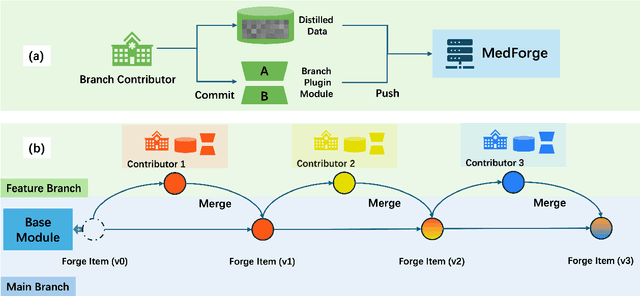
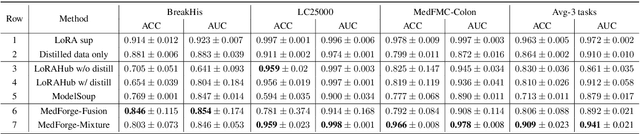
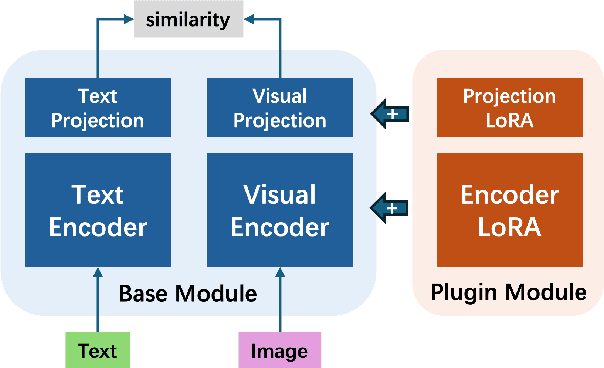
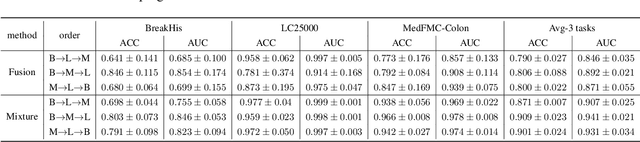
Foundational models (FMs) have made significant strides in the healthcare domain. Yet the data silo challenge and privacy concern remain in healthcare systems, hindering safe medical data sharing and collaborative model development among institutions. The collection and curation of scalable clinical datasets increasingly become the bottleneck for training strong FMs. In this study, we propose Medical Foundation Models Merging (MedForge), a cooperative framework enabling a community-driven medical foundation model development, meanwhile preventing the information leakage of raw patient data and mitigating synchronization model development issues across clinical institutions. MedForge offers a bottom-up model construction mechanism by flexibly merging task-specific Low-Rank Adaptation (LoRA) modules, which can adapt to downstream tasks while retaining original model parameters. Through an asynchronous LoRA module integration scheme, the resulting composite model can progressively enhance its comprehensive performance on various clinical tasks. MedForge shows strong performance on multiple clinical datasets (e.g., breast cancer, lung cancer, and colon cancer) collected from different institutions. Our major findings highlight the value of collaborative foundation models in advancing multi-center clinical collaboration effectively and cohesively. Our code is publicly available at https://github.com/TanZheling/MedForge.
RadAlign: Advancing Radiology Report Generation with Vision-Language Concept Alignment
Jan 13, 2025Automated chest radiographs interpretation requires both accurate disease classification and detailed radiology report generation, presenting a significant challenge in the clinical workflow. Current approaches either focus on classification accuracy at the expense of interpretability or generate detailed but potentially unreliable reports through image captioning techniques. In this study, we present RadAlign, a novel framework that combines the predictive accuracy of vision-language models (VLMs) with the reasoning capabilities of large language models (LLMs). Inspired by the radiologist's workflow, RadAlign first employs a specialized VLM to align visual features with key medical concepts, achieving superior disease classification with an average AUC of 0.885 across multiple diseases. These recognized medical conditions, represented as text-based concepts in the aligned visual-language space, are then used to prompt LLM-based report generation. Enhanced by a retrieval-augmented generation mechanism that grounds outputs in similar historical cases, RadAlign delivers superior report quality with a GREEN score of 0.678, outperforming state-of-the-art methods' 0.634. Our framework maintains strong clinical interpretability while reducing hallucinations, advancing automated medical imaging and report analysis through integrated predictive and generative AI. Code is available at https://github.com/difeigu/RadAlign.
Cost-effective Instruction Learning for Pathology Vision and Language Analysis
Jul 25, 2024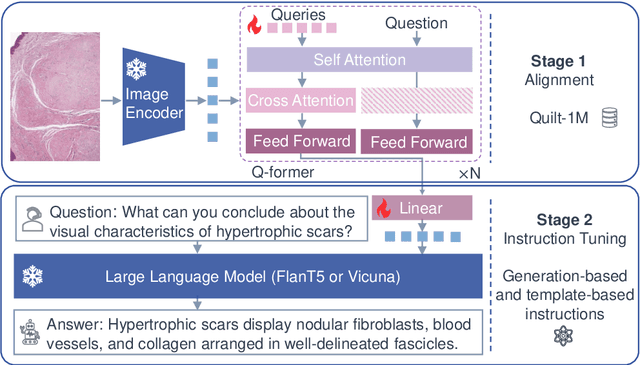
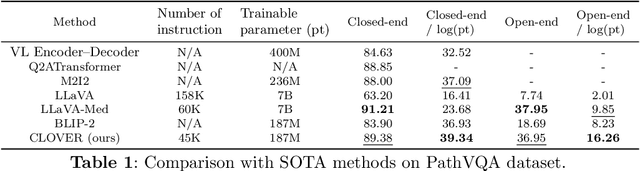
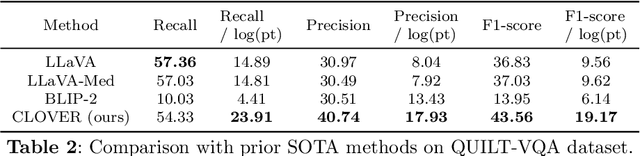
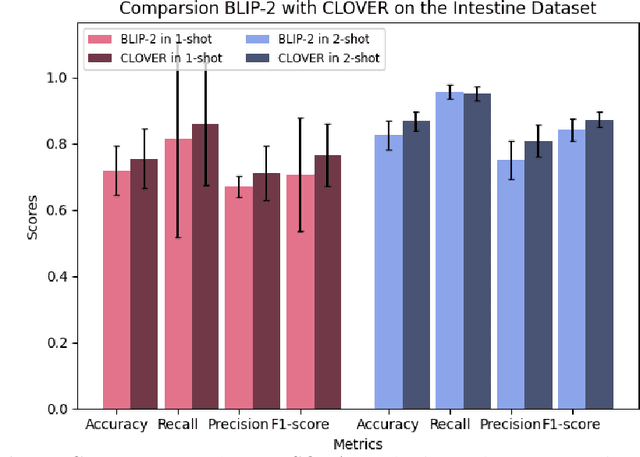
The advent of vision-language models fosters the interactive conversations between AI-enabled models and humans. Yet applying these models into clinics must deal with daunting challenges around large-scale training data, financial, and computational resources. Here we propose a cost-effective instruction learning framework for conversational pathology named as CLOVER. CLOVER only trains a lightweight module and uses instruction tuning while freezing the parameters of the large language model. Instead of using costly GPT-4, we propose well-designed prompts on GPT-3.5 for building generation-based instructions, emphasizing the utility of pathological knowledge derived from the Internet source. To augment the use of instructions, we construct a high-quality set of template-based instructions in the context of digital pathology. From two benchmark datasets, our findings reveal the strength of hybrid-form instructions in the visual question-answer in pathology. Extensive results show the cost-effectiveness of CLOVER in answering both open-ended and closed-ended questions, where CLOVER outperforms strong baselines that possess 37 times more training parameters and use instruction data generated from GPT-4. Through the instruction tuning, CLOVER exhibits robustness of few-shot learning in the external clinical dataset. These findings demonstrate that cost-effective modeling of CLOVER could accelerate the adoption of rapid conversational applications in the landscape of digital pathology.
Aligning Human Knowledge with Visual Concepts Towards Explainable Medical Image Classification
Jun 08, 2024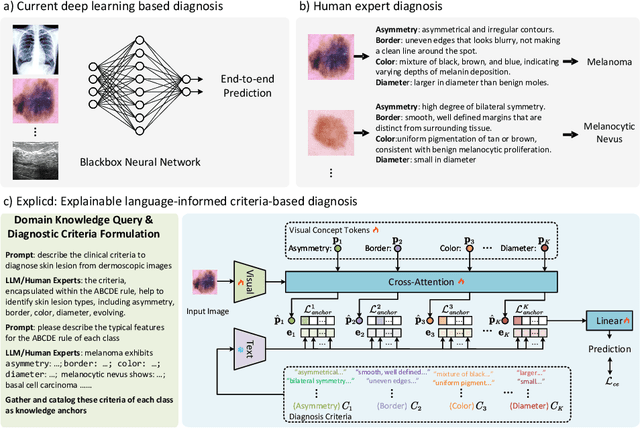
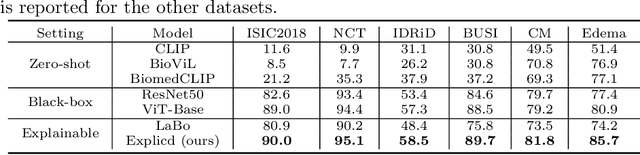
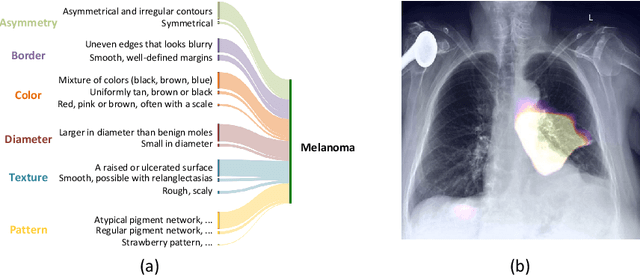
Although explainability is essential in the clinical diagnosis, most deep learning models still function as black boxes without elucidating their decision-making process. In this study, we investigate the explainable model development that can mimic the decision-making process of human experts by fusing the domain knowledge of explicit diagnostic criteria. We introduce a simple yet effective framework, Explicd, towards Explainable language-informed criteria-based diagnosis. Explicd initiates its process by querying domain knowledge from either large language models (LLMs) or human experts to establish diagnostic criteria across various concept axes (e.g., color, shape, texture, or specific patterns of diseases). By leveraging a pretrained vision-language model, Explicd injects these criteria into the embedding space as knowledge anchors, thereby facilitating the learning of corresponding visual concepts within medical images. The final diagnostic outcome is determined based on the similarity scores between the encoded visual concepts and the textual criteria embeddings. Through extensive evaluation of five medical image classification benchmarks, Explicd has demonstrated its inherent explainability and extends to improve classification performance compared to traditional black-box models.