 Add to Chrome
 Add to Firefox
 Add to Edge
Scaling the Horizon, Not the Parameters: Reaching Trillion-Parameter Performance with a 35B Agent
Jun 29, 2026
We introduce Agents-A1, a 35B Mixture-of-Experts Agentic Model that reaches trillion-parameter-level performance by scaling the agent horizon. We investigate agent-horizon scaling from two perspectives: scaling long-horizon trajectories and scaling heterogeneous agent abilities. To support this goal, we build a long-horizon knowledge-action infrastructure that connects external knowledge, actions, observations, and verifier outcomes, producing agentic trajectories with an average length of 45K tokens. Based on this, we train Agents-A1 with a three-stage recipe. First, we perform full-domain supervised fine-tuning to align the base model with broad agentic behaviors. Second, we train domain-level teacher models to capture specialized expertise in each domain. Third, we propose a multi-teacher domain-routed on-policy distillation with salient vocabulary alignment to improve knowledge transfer efficiency across different domains, unifying six heterogeneous domains into one deployable student model. Agents-A1 achieves strong and broad performance for long-horizon agent benchmarks. Compared with 1T-parameter model such as Kimi-K2.6 and DeepSeek-V4-pro, Agents-A1 achieves leading results on SEAL-0 (56.4), IFBench (80.6), HiPhO (46.4), FrontierScience-Olympiad (79.0), and MolBench-Bind (56.8), and remains highly competitive on SciCode (44.3), HLE (47.6) and BrowseComp (75.5). We hope this work provides the community with a practical path for scaling the horizon using a 35B agent that can reach or match the performance of 1T models on long-horizon tasks.

FlowRAG: Synergizing Explicit Reasoning via Frequency-Aware Multi-Granularity Graph Flow
Jun 16, 2026Graph-based retrieval-augmented generation (GraphRAG) is effective for knowledge-intensive and multi-hop query tasks; however, many existing methods primarily seed entity-based graphs and rely on implicit semantic relevance propagation. This often (i) under-retrieves when user queries are abstract and semantically sparse at the entity level, and (ii) suffers from brittle multi-hop reasoning, where noisy activations can derail entity-to-entity transitions and corrupt the inferred relation chain, yielding unreliable conclusions. To this end, we propose \texttt{FlowRAG}, a semantic-aware retrieval framework that improves both semantic recall and explicit reasoning. Specifically, \texttt{FlowRAG} constructs a quad-level heterogeneous graph over passages, summaries, sentences, and entities, where summary nodes serve as a coarse semantic hub. At retrieval time, a dual-granularity activation module combines summary--query alignment with sentence-level matching to activate relevant entities under paraphrase and abstraction robustly. We then introduce a frequency-aware weighted flow module that routes relevance through entity--passage links weighted by within-passage term frequency, pruning noisy connections and extracting high-confidence reasoning paths as an explicit logic skeleton for generation. Extensive experiments show that \texttt{FlowRAG} obtains state-of-the-art performance on complex reasoning benchmarks.
Agents-K1: Towards Agent-native Knowledge Orchestration
Jun 11, 2026Current LLM-based research agents have advanced through agent orchestration, yet largely overlook scientific knowledge orchestration. Existing works often reduce papers to abstracts, surface mentions, and flat \texttt{cites} edges, omitting key entities, claims, evidence, mechanisms, and method lineages essential for scientific reasoning. To this end, we introduce \textbf{Agents-K1}, an end-to-end knowledge orchestration pipeline that converts raw documents into agent-native scientific knowledge graphs. Agents-K1 integrates three components under a unifying theoretical foundation: a multimodal parser whose five-module schema captures entities, multimodal evidence, citations, and typed inter-entity relations across the full paper rather than abstracts alone; a 4B information-extraction backbone trained with GRPO under a rule-based reward; and a graphanything CLI, a tri-source agent interface that unifies web search, multimodal graph retrieval, and cross-document traversal. On top of this, we process 2.46 million scientific papers across six subjects to produce \textbf{Scholar-KG}, of which we release a one-million-paper subset, and the full Scholar-KG is accessible via the SCP link below. The same pipeline can be extended to general-domain corpora and to schema-conformant data synthesis. Extensive experiments demonstrate that Agents-K1 achieves superior performance in scientific information extraction, knowledge graph construction, and multi-hop scientific reasoning.
MLEvolve: A Self-Evolving Framework for Automated Machine Learning Algorithm Discovery
Jun 04, 2026Large language model (LLM) agents are increasingly applied to long-horizon tasks such as scientific discovery and machine learning engineering (MLE), where sustained self-evolution becomes a key capability. However, existing MLE agents suffer from inter-branch information isolation, memoryless search, and lack of hierarchical control, which together hinder long-horizon optimization. We present MLEvolve, an LLM-based self-evolving multi-agent framework for end-to-end machine learning algorithm discovery. By extending tree search to Progressive MCGS, MLEvolve enables cross-branch information flow through graph-based reference edges and gradually shifts the search from broad exploration to focused exploitation with an entropy-inspired progressive schedule. To allow the agent to evolve with accumulated experience, we introduce Retrospective Memory, which combines a cold-start domain knowledge base with a dynamic global memory for task-specific experience retrieval and reuse. For stable long-horizon iteration, we further decouple strategic planning from code generation with adaptive coding modes. Evaluation on MLE-Bench shows that MLEvolve achieves state-of-the-art performance across multiple dimensions including average medal rate and valid submission rate under a 12-hour budget (half the standard runtime). Moreover, MLEvolve also outperforms specialized algorithm discovery methods including AlphaEvolve on mathematical algorithm optimization tasks, demonstrating strong cross-domain generalization. Our code is available at https://github.com/InternScience/MLEvolve.
RaDAR: Relation-aware Diffusion-Asymmetric Graph Contrastive Learning for Recommendation
Mar 17, 2026Collaborative filtering (CF) recommendation has been significantly advanced by integrating Graph Neural Networks (GNNs) and Graph Contrastive Learning (GCL). However, (i) random edge perturbations often distort critical structural signals and degrade semantic consistency across augmented views, and (ii) data sparsity hampers the propagation of collaborative signals, limiting generalization. To tackle these challenges, we propose RaDAR (Relation-aware Diffusion-Asymmetric Graph Contrastive Learning Framework for Recommendation Systems), a novel framework that combines two complementary view generation mechanisms: a graph generative model to capture global structure and a relation-aware denoising model to refine noisy edges. RaDAR introduces three key innovations: (1) asymmetric contrastive learning with global negative sampling to maintain semantic alignment while suppressing noise; (2) diffusion-guided augmentation, which employs progressive noise injection and denoising for enhanced robustness; and (3) relation-aware edge refinement, dynamically adjusting edge weights based on latent node semantics. Extensive experiments on three public benchmarks demonstrate that RaDAR consistently outperforms state-of-the-art methods, particularly under noisy and sparse conditions.
* 12 pages, 5 figures. Accepted at WWW 2026
InternAgent-1.5: A Unified Agentic Framework for Long-Horizon Autonomous Scientific Discovery
Feb 09, 2026We introduce InternAgent-1.5, a unified system designed for end-to-end scientific discovery across computational and empirical domains. The system is built on a structured architecture composed of three coordinated subsystems for generation, verification, and evolution. These subsystems are supported by foundational capabilities for deep research, solution optimization, and long horizon memory. The architecture allows InternAgent-1.5 to operate continuously across extended discovery cycles while maintaining coherent and improving behavior. It also enables the system to coordinate computational modeling and laboratory experimentation within a single unified system. We evaluate InternAgent-1.5 on scientific reasoning benchmarks such as GAIA, HLE, GPQA, and FrontierScience, and the system achieves leading performance that demonstrates strong foundational capabilities. Beyond these benchmarks, we further assess two categories of discovery tasks. In algorithm discovery tasks, InternAgent-1.5 autonomously designs competitive methods for core machine learning problems. In empirical discovery tasks, it executes complete computational or wet lab experiments and produces scientific findings in earth, life, biological, and physical domains. Overall, these results show that InternAgent-1.5 provides a general and scalable framework for autonomous scientific discovery.
CoFi-Dec: Hallucination-Resistant Decoding via Coarse-to-Fine Generative Feedback in Large Vision-Language Models
Dec 29, 2025Large Vision-Language Models (LVLMs) have achieved impressive progress in multi-modal understanding and generation. However, they still tend to produce hallucinated content that is inconsistent with the visual input, which limits their reliability in real-world applications. We propose \textbf{CoFi-Dec}, a training-free decoding framework that mitigates hallucinations by integrating generative self-feedback with coarse-to-fine visual conditioning. Inspired by the human visual process from global scene perception to detailed inspection, CoFi-Dec first generates two intermediate textual responses conditioned on coarse- and fine-grained views of the original image. These responses are then transformed into synthetic images using a text-to-image model, forming multi-level visual hypotheses that enrich grounding cues. To unify the predictions from these multiple visual conditions, we introduce a Wasserstein-based fusion mechanism that aligns their predictive distributions into a geometrically consistent decoding trajectory. This principled fusion reconciles high-level semantic consistency with fine-grained visual grounding, leading to more robust and faithful outputs. Extensive experiments on six hallucination-focused benchmarks show that CoFi-Dec substantially reduces both entity-level and semantic-level hallucinations, outperforming existing decoding strategies. The framework is model-agnostic, requires no additional training, and can be seamlessly applied to a wide range of LVLMs. The implementation is available at https://github.com/AI-Researcher-Team/CoFi-Dec.
PurifyGen: A Risk-Discrimination and Semantic-Purification Model for Safe Text-to-Image Generation
Dec 29, 2025Recent advances in diffusion models have notably enhanced text-to-image (T2I) generation quality, but they also raise the risk of generating unsafe content. Traditional safety methods like text blacklisting or harmful content classification have significant drawbacks: they can be easily circumvented or require extensive datasets and extra training. To overcome these challenges, we introduce PurifyGen, a novel, training-free approach for safe T2I generation that retains the model's original weights. PurifyGen introduces a dual-stage strategy for prompt purification. First, we evaluate the safety of each token in a prompt by computing its complementary semantic distance, which measures the semantic proximity between the prompt tokens and concept embeddings from predefined toxic and clean lists. This enables fine-grained prompt classification without explicit keyword matching or retraining. Tokens closer to toxic concepts are flagged as risky. Second, for risky prompts, we apply a dual-space transformation: we project toxic-aligned embeddings into the null space of the toxic concept matrix, effectively removing harmful semantic components, and simultaneously align them into the range space of clean concepts. This dual alignment purifies risky prompts by both subtracting unsafe semantics and reinforcing safe ones, while retaining the original intent and coherence. We further define a token-wise strategy to selectively replace only risky token embeddings, ensuring minimal disruption to safe content. PurifyGen offers a plug-and-play solution with theoretical grounding and strong generalization to unseen prompts and models. Extensive testing shows that PurifyGen surpasses current methods in reducing unsafe content across five datasets and competes well with training-dependent approaches. The code can refer to https://github.com/AI-Researcher-Team/PurifyGen.
TV-RAG: A Temporal-aware and Semantic Entropy-Weighted Framework for Long Video Retrieval and Understanding
Dec 29, 2025Large Video Language Models (LVLMs) have rapidly emerged as the focus of multimedia AI research. Nonetheless, when confronted with lengthy videos, these models struggle: their temporal windows are narrow, and they fail to notice fine-grained semantic shifts that unfold over extended durations. Moreover, mainstream text-based retrieval pipelines, which rely chiefly on surface-level lexical overlap, ignore the rich temporal interdependence among visual, audio, and subtitle channels. To mitigate these limitations, we propose TV-RAG, a training-free architecture that couples temporal alignment with entropy-guided semantics to improve long-video reasoning. The framework contributes two main mechanisms: \emph{(i)} a time-decay retrieval module that injects explicit temporal offsets into the similarity computation, thereby ranking text queries according to their true multimedia context; and \emph{(ii)} an entropy-weighted key-frame sampler that selects evenly spaced, information-dense frames, reducing redundancy while preserving representativeness. By weaving these temporal and semantic signals together, TV-RAG realises a dual-level reasoning routine that can be grafted onto any LVLM without re-training or fine-tuning. The resulting system offers a lightweight, budget-friendly upgrade path and consistently surpasses most leading baselines across established long-video benchmarks such as Video-MME, MLVU, and LongVideoBench, confirming the effectiveness of our model. The code can be found at https://github.com/AI-Researcher-Team/TV-RAG.
KAAE: Numerical Reasoning for Knowledge Graphs via Knowledge-aware Attributes Learning
Nov 20, 2024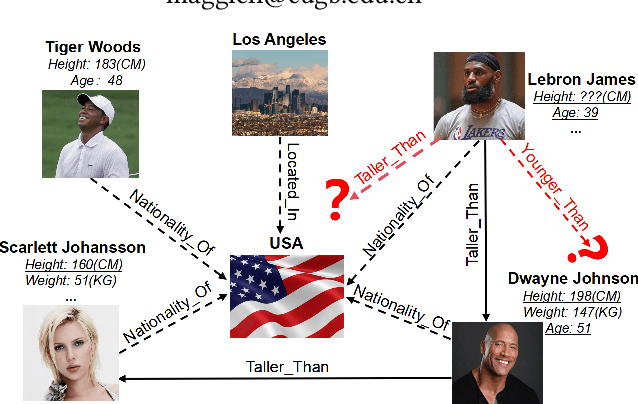
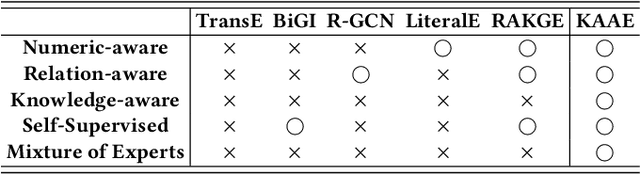
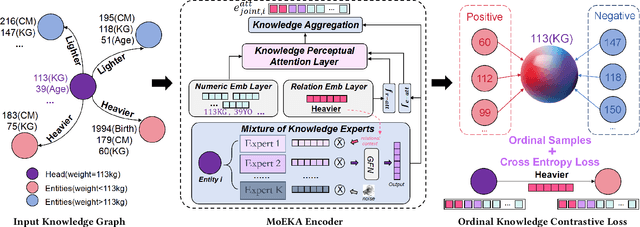
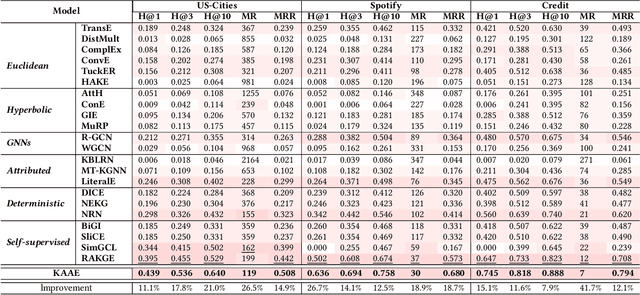
Numerical reasoning is pivotal in various artificial intelligence applications, such as natural language processing and recommender systems, where it involves using entities, relations, and attribute values (e.g., weight, length) to infer new factual relations (e.g., the Nile is longer than the Amazon). However, existing approaches encounter two critical challenges in modeling: (1) semantic relevance-the challenge of insufficiently capturing the necessary contextual interactions among entities, relations, and numerical attributes, often resulting in suboptimal inference; and (2) semantic ambiguity-the difficulty in accurately distinguishing ordinal relationships during numerical reasoning, which compromises the generation of high-quality samples and limits the effectiveness of contrastive learning. To address these challenges, we propose the novel Knowledge-Aware Attributes Embedding model (KAAE) for knowledge graph embeddings in numerical reasoning. Specifically, to overcome the challenge of semantic relevance, we introduce a Mixture-of-Experts-Knowledge-Aware (MoEKA) Encoder, designed to integrate the semantics of entities, relations, and numerical attributes into a joint semantic space. To tackle semantic ambiguity, we implement a new ordinal knowledge contrastive learning (OKCL) strategy that generates high-quality ordinal samples from the original data with the aid of ordinal relations, capturing fine-grained semantic nuances essential for accurate numerical reasoning. Experiments on three public benchmark datasets demonstrate the superior performance of KAAE across various attribute value distributions.