 Add to Chrome
 Add to Firefox
 Add to Edge
MAGA: Multi-Platform Self-Fusion of GUI Agents via Structured Action Distillation
Jul 31, 2026
Graphical user interface (GUI) agents based on large language models are increasingly deployed across mobile, web, and desktop environments. However, existing agents are typically domain-specific, limiting the deployment and user experience. This motivates the consolidation of specialized models into a single cross-environment policy. Weight merging directly merges domain-specific experts but can corrupt executable actions under expert disagreement, while on-policy distillation (OPD) avoids conflicting teacher supervision yet still treats all response tokens equally during distillation, ignoring that action tokens are the only interface between the environment and the agent. To address this, We introduce MAGA that re-allocates training signal according to the structured action. Based on the correctness of the generated action, it suppresses unnecessary or invalid distillation signals and focuses learning on erroneous actions. Besides, a training-only hint optimizes the supervision signal provided by domain-specific teachers without changing the student input. Across two model scales, MAGA achieves the highest mean success rate, outperforming the strongest baseline by 2.0% at 8B and achieves almost the same average performance with teachers.

Scaling the Horizon, Not the Parameters: Reaching Trillion-Parameter Performance with a 35B Agent
Jun 29, 2026We introduce Agents-A1, a 35B Mixture-of-Experts Agentic Model that reaches trillion-parameter-level performance by scaling the agent horizon. We investigate agent-horizon scaling from two perspectives: scaling long-horizon trajectories and scaling heterogeneous agent abilities. To support this goal, we build a long-horizon knowledge-action infrastructure that connects external knowledge, actions, observations, and verifier outcomes, producing agentic trajectories with an average length of 45K tokens. Based on this, we train Agents-A1 with a three-stage recipe. First, we perform full-domain supervised fine-tuning to align the base model with broad agentic behaviors. Second, we train domain-level teacher models to capture specialized expertise in each domain. Third, we propose a multi-teacher domain-routed on-policy distillation with salient vocabulary alignment to improve knowledge transfer efficiency across different domains, unifying six heterogeneous domains into one deployable student model. Agents-A1 achieves strong and broad performance for long-horizon agent benchmarks. Compared with 1T-parameter model such as Kimi-K2.6 and DeepSeek-V4-pro, Agents-A1 achieves leading results on SEAL-0 (56.4), IFBench (80.6), HiPhO (46.4), FrontierScience-Olympiad (79.0), and MolBench-Bind (56.8), and remains highly competitive on SciCode (44.3), HLE (47.6) and BrowseComp (75.5). We hope this work provides the community with a practical path for scaling the horizon using a 35B agent that can reach or match the performance of 1T models on long-horizon tasks.
InternAgent-1.5: A Unified Agentic Framework for Long-Horizon Autonomous Scientific Discovery
Feb 09, 2026We introduce InternAgent-1.5, a unified system designed for end-to-end scientific discovery across computational and empirical domains. The system is built on a structured architecture composed of three coordinated subsystems for generation, verification, and evolution. These subsystems are supported by foundational capabilities for deep research, solution optimization, and long horizon memory. The architecture allows InternAgent-1.5 to operate continuously across extended discovery cycles while maintaining coherent and improving behavior. It also enables the system to coordinate computational modeling and laboratory experimentation within a single unified system. We evaluate InternAgent-1.5 on scientific reasoning benchmarks such as GAIA, HLE, GPQA, and FrontierScience, and the system achieves leading performance that demonstrates strong foundational capabilities. Beyond these benchmarks, we further assess two categories of discovery tasks. In algorithm discovery tasks, InternAgent-1.5 autonomously designs competitive methods for core machine learning problems. In empirical discovery tasks, it executes complete computational or wet lab experiments and produces scientific findings in earth, life, biological, and physical domains. Overall, these results show that InternAgent-1.5 provides a general and scalable framework for autonomous scientific discovery.
KAC: Kolmogorov-Arnold Classifier for Continual Learning
Mar 27, 2025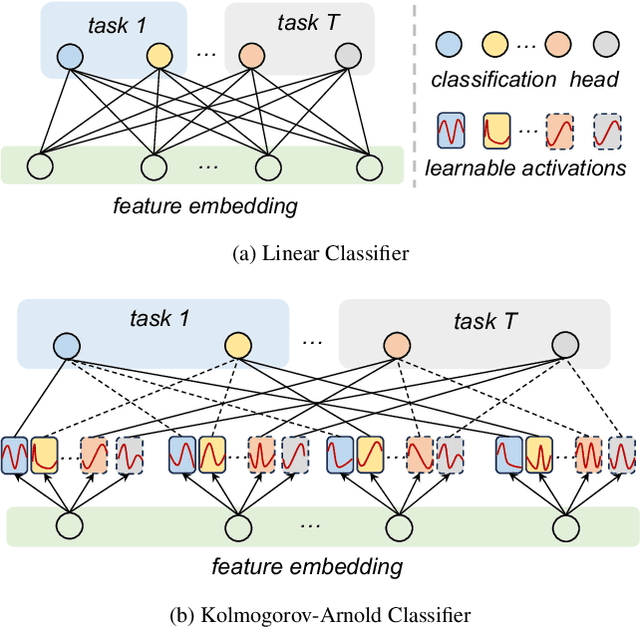
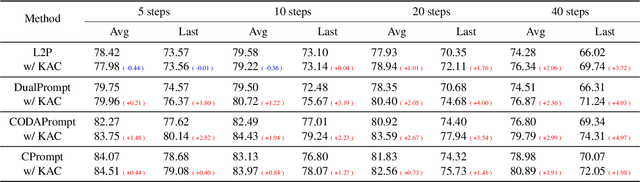
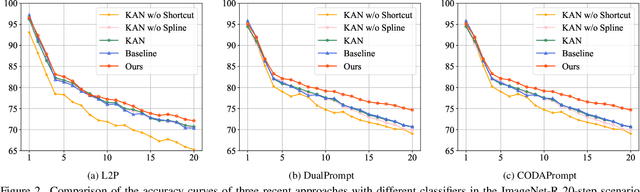
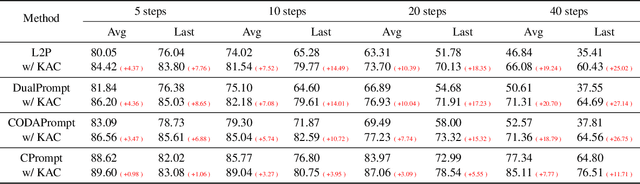
Continual learning requires models to train continuously across consecutive tasks without forgetting. Most existing methods utilize linear classifiers, which struggle to maintain a stable classification space while learning new tasks. Inspired by the success of Kolmogorov-Arnold Networks (KAN) in preserving learning stability during simple continual regression tasks, we set out to explore their potential in more complex continual learning scenarios. In this paper, we introduce the Kolmogorov-Arnold Classifier (KAC), a novel classifier developed for continual learning based on the KAN structure. We delve into the impact of KAN's spline functions and introduce Radial Basis Functions (RBF) for improved compatibility with continual learning. We replace linear classifiers with KAC in several recent approaches and conduct experiments across various continual learning benchmarks, all of which demonstrate performance improvements, highlighting the effectiveness and robustness of KAC in continual learning. The code is available at https://github.com/Ethanhuhuhu/KAC.