 Add to Chrome
 Add to Firefox
 Add to Edge
FinToolBench: Evaluating LLM Agents for Real-World Financial Tool Use
Mar 09, 2026
The integration of Large Language Models (LLMs) into the financial domain is driving a paradigm shift from passive information retrieval to dynamic, agentic interaction. While general-purpose tool learning has witnessed a surge in benchmarks, the financial sector, characterized by high stakes, strict compliance, and rapid data volatility, remains critically underserved. Existing financial evaluations predominantly focus on static textual analysis or document-based QA, ignoring the complex reality of tool execution. Conversely, general tool benchmarks lack the domain-specific rigor required for finance, often relying on toy environments or a negligible number of financial APIs. To bridge this gap, we introduce FinToolBench, the first real-world, runnable benchmark dedicated to evaluating financial tool learning agents. Unlike prior works limited to a handful of mock tools, FinToolBench establishes a realistic ecosystem coupling 760 executable financial tools with 295 rigorous, tool-required queries. We propose a novel evaluation framework that goes beyond binary execution success, assessing agents on finance-critical dimensions: timeliness, intent type, and regulatory domain alignment. Furthermore, we present FATR, a finance-aware tool retrieval and reasoning baseline that enhances stability and compliance. By providing the first testbed for auditable, agentic financial execution, FinToolBench sets a new standard for trustworthy AI in finance. The tool manifest, execution environment, and evaluation code will be open-sourced to facilitate future research.

BrainMVP: Multi-modal Vision Pre-training for Brain Image Analysis using Multi-parametric MRI
Oct 14, 2024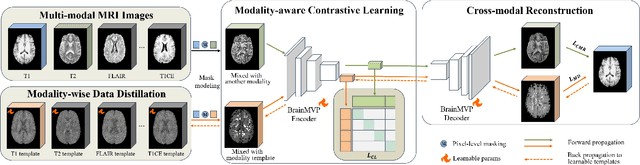
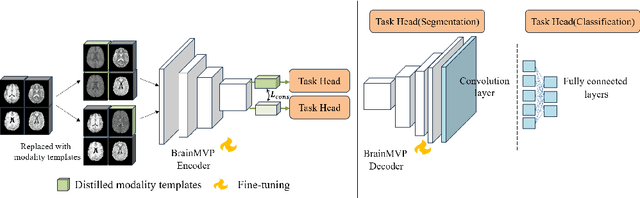
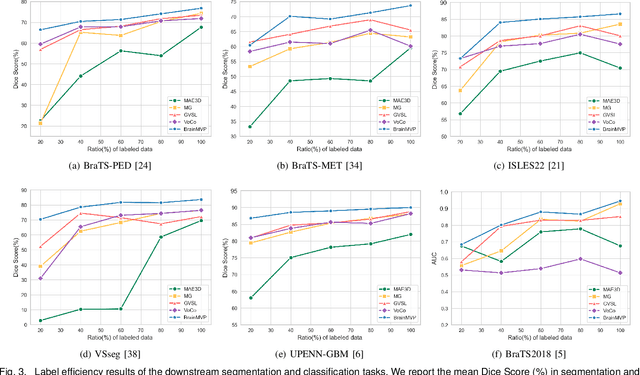
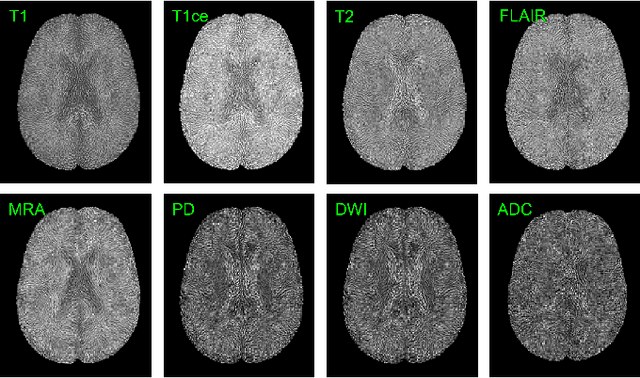
Accurate diagnosis of brain abnormalities is greatly enhanced by the inclusion of complementary multi-parametric MRI imaging data. There is significant potential to develop a universal pre-training model that can be quickly adapted for image modalities and various clinical scenarios. However, current models often rely on uni-modal image data, neglecting the cross-modal correlations among different image modalities or struggling to scale up pre-training in the presence of missing modality data. In this paper, we propose BrainMVP, a multi-modal vision pre-training framework for brain image analysis using multi-parametric MRI scans. First, we collect 16,022 brain MRI scans (over 2.4 million images), encompassing eight MRI modalities sourced from a diverse range of centers and devices. Then, a novel pre-training paradigm is proposed for the multi-modal MRI data, addressing the issue of missing modalities and achieving multi-modal information fusion. Cross-modal reconstruction is explored to learn distinctive brain image embeddings and efficient modality fusion capabilities. A modality-wise data distillation module is proposed to extract the essence representation of each MR image modality for both the pre-training and downstream application purposes. Furthermore, we introduce a modality-aware contrastive learning module to enhance the cross-modality association within a study. Extensive experiments on downstream tasks demonstrate superior performance compared to state-of-the-art pre-training methods in the medical domain, with Dice Score improvement of 0.28%-14.47% across six segmentation benchmarks and a consistent accuracy improvement of 0.65%-18.07% in four individual classification tasks.