 Add to Chrome
 Add to Firefox
 Add to Edge
Learning Anatomy-Grounded CT Vision-Language Representations with Organ-Hierarchical Report Knowledge
Jul 12, 2026
Medical vision-language pretraining (VLP) from paired CT images and radiology reports enables scalable representation learning, but most existing methods align either whole scans with entire reports or local image regions with text fragments. These formulations underuse a key property of radiology reports: findings are organized around anatomical structures, with abnormalities described by organs, disease concepts, locations, and severity-related attributes. We propose OKA-CT, an organ-hierarchical knowledge-augmented framework for CT-report VLP. OKA-CT first converts free-text reports into organ-conditioned knowledge using radiology report parsing and LLM-assisted semantic structuring. The extracted hierarchy is used across two learning stages. Stage~1 injects anatomy-grounded evidence into the CT visual representation through fine-grained organ-conditioned supervision, while Stage~2 uses organ-specific report evidence to guide structured report-CT contrastive learning, where hierarchy-derived semantic soft targets treat non-paired cases with shared organ-level findings as weak semantic positives rather than uniform negatives. A lightweight query-based global branch further aggregates disease-relevant volumetric evidence for whole-scan representation. On CT-RATE and RAD-ChestCT datasets, OKA-CT achieves zero-shot abnormality diagnosis AUROCs of 84.9 and 72.2, outperforming prior CT VLP baselines. Retrieval and patch-occlusion analyses further show improved report-image alignment and stronger sensitivity to disease-associated anatomical regions.

A Progressive Single-Modality to Multi-Modality Classification Framework for Alzheimer's Disease Sub-type Diagnosis
Jul 26, 2024
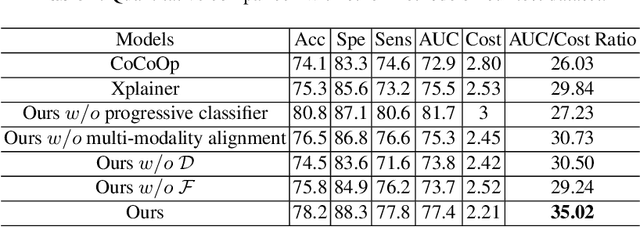

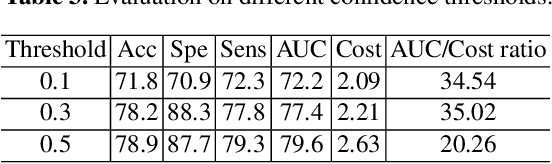
The current clinical diagnosis framework of Alzheimer's disease (AD) involves multiple modalities acquired from multiple diagnosis stages, each with distinct usage and cost. Previous AD diagnosis research has predominantly focused on how to directly fuse multiple modalities for an end-to-end one-stage diagnosis, which practically requires a high cost in data acquisition. Moreover, a significant part of these methods diagnose AD without considering clinical guideline and cannot offer accurate sub-type diagnosis. In this paper, by exploring inter-correlation among multiple modalities, we propose a novel progressive AD sub-type diagnosis framework, aiming to give diagnosis results based on easier-to-access modalities in earlier low-cost stages, instead of modalities from all stages. Specifically, first, we design 1) a text disentanglement network for better processing tabular data collected in the initial stage, and 2) a modality fusion module for fusing multi-modality features separately. Second, we align features from modalities acquired in earlier low-cost stage(s) with later high-cost stage(s) to give accurate diagnosis without actual modality acquisition in later-stage(s) for saving cost. Furthermore, we follow the clinical guideline to align features at each stage for achieving sub-type diagnosis. Third, we leverage a progressive classifier that can progressively include additional acquired modalities (if needed) for diagnosis, to achieve the balance between diagnosis cost and diagnosis performance. We evaluate our proposed framework on large diverse public and in-home datasets (8280 in total) and achieve superior performance over state-of-the-art methods. Our codes will be released after the acceptance.