 Add to Chrome
 Add to Firefox
 Add to Edge
Stereo Risk: A Continuous Modeling Approach to Stereo Matching
Jul 03, 2024
We introduce Stereo Risk, a new deep-learning approach to solve the classical stereo-matching problem in computer vision. As it is well-known that stereo matching boils down to a per-pixel disparity estimation problem, the popular state-of-the-art stereo-matching approaches widely rely on regressing the scene disparity values, yet via discretization of scene disparity values. Such discretization often fails to capture the nuanced, continuous nature of scene depth. Stereo Risk departs from the conventional discretization approach by formulating the scene disparity as an optimal solution to a continuous risk minimization problem, hence the name "stereo risk". We demonstrate that $L^1$ minimization of the proposed continuous risk function enhances stereo-matching performance for deep networks, particularly for disparities with multi-modal probability distributions. Furthermore, to enable the end-to-end network training of the non-differentiable $L^1$ risk optimization, we exploited the implicit function theorem, ensuring a fully differentiable network. A comprehensive analysis demonstrates our method's theoretical soundness and superior performance over the state-of-the-art methods across various benchmark datasets, including KITTI 2012, KITTI 2015, ETH3D, SceneFlow, and Middlebury 2014.

EgoGaussian: Dynamic Scene Understanding from Egocentric Video with 3D Gaussian Splatting
Jun 28, 2024



Human activities are inherently complex, and even simple household tasks involve numerous object interactions. To better understand these activities and behaviors, it is crucial to model their dynamic interactions with the environment. The recent availability of affordable head-mounted cameras and egocentric data offers a more accessible and efficient means to understand dynamic human-object interactions in 3D environments. However, most existing methods for human activity modeling either focus on reconstructing 3D models of hand-object or human-scene interactions or on mapping 3D scenes, neglecting dynamic interactions with objects. The few existing solutions often require inputs from multiple sources, including multi-camera setups, depth-sensing cameras, or kinesthetic sensors. To this end, we introduce EgoGaussian, the first method capable of simultaneously reconstructing 3D scenes and dynamically tracking 3D object motion from RGB egocentric input alone. We leverage the uniquely discrete nature of Gaussian Splatting and segment dynamic interactions from the background. Our approach employs a clip-level online learning pipeline that leverages the dynamic nature of human activities, allowing us to reconstruct the temporal evolution of the scene in chronological order and track rigid object motion. Additionally, our method automatically segments object and background Gaussians, providing 3D representations for both static scenes and dynamic objects. EgoGaussian outperforms previous NeRF and Dynamic Gaussian methods in challenging in-the-wild videos and we also qualitatively demonstrate the high quality of the reconstructed models.
Implicit-Zoo: A Large-Scale Dataset of Neural Implicit Functions for 2D Images and 3D Scenes
Jun 25, 2024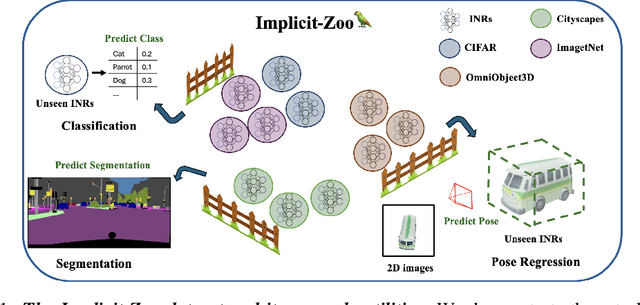

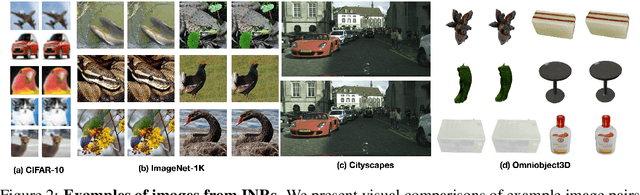
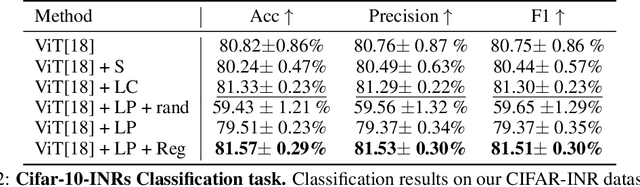
Neural implicit functions have demonstrated significant importance in various areas such as computer vision, graphics. Their advantages include the ability to represent complex shapes and scenes with high fidelity, smooth interpolation capabilities, and continuous representations. Despite these benefits, the development and analysis of implicit functions have been limited by the lack of comprehensive datasets and the substantial computational resources required for their implementation and evaluation. To address these challenges, we introduce "Implicit-Zoo": a large-scale dataset requiring thousands of GPU training days designed to facilitate research and development in this field. Our dataset includes diverse 2D and 3D scenes, such as CIFAR-10, ImageNet-1K, and Cityscapes for 2D image tasks, and the OmniObject3D dataset for 3D vision tasks. We ensure high quality through strict checks, refining or filtering out low-quality data. Using Implicit-Zoo, we showcase two immediate benefits as it enables to: (1) learn token locations for transformer models; (2) directly regress 3D cameras poses of 2D images with respect to NeRF models. This in turn leads to an improved performance in all three task of image classification, semantic segmentation, and 3D pose regression, thereby unlocking new avenues for research.
TrafficBots V1.5: Traffic Simulation via Conditional VAEs and Transformers with Relative Pose Encoding
Jun 16, 2024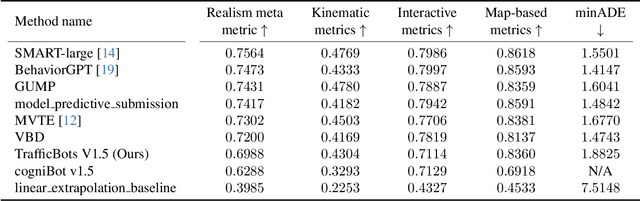
In this technical report we present TrafficBots V1.5, a baseline method for the closed-loop simulation of traffic agents. TrafficBots V1.5 achieves baseline-level performance and a 3rd place ranking in the Waymo Open Sim Agents Challenge (WOSAC) 2024. It is a simple baseline that combines TrafficBots, a CVAE-based multi-agent policy conditioned on each agent's individual destination and personality, and HPTR, the heterogeneous polyline transformer with relative pose encoding. To improve the performance on the WOSAC leaderboard, we apply scheduled teacher-forcing at the training time and we filter the sampled scenarios at the inference time. The code is available at https://github.com/zhejz/TrafficBotsV1.5.
Matching Anything by Segmenting Anything
Jun 06, 2024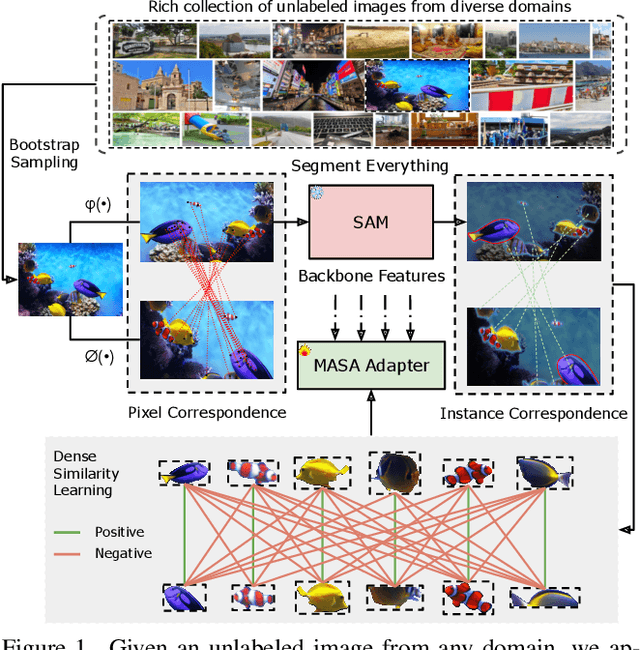


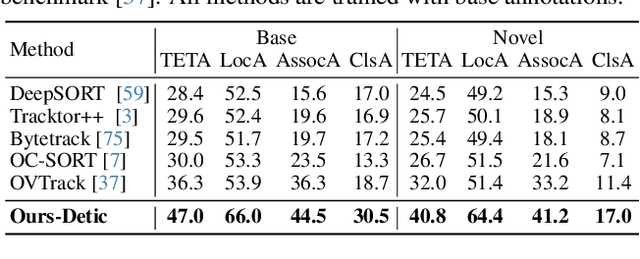
The robust association of the same objects across video frames in complex scenes is crucial for many applications, especially Multiple Object Tracking (MOT). Current methods predominantly rely on labeled domain-specific video datasets, which limits the cross-domain generalization of learned similarity embeddings. We propose MASA, a novel method for robust instance association learning, capable of matching any objects within videos across diverse domains without tracking labels. Leveraging the rich object segmentation from the Segment Anything Model (SAM), MASA learns instance-level correspondence through exhaustive data transformations. We treat the SAM outputs as dense object region proposals and learn to match those regions from a vast image collection. We further design a universal MASA adapter which can work in tandem with foundational segmentation or detection models and enable them to track any detected objects. Those combinations present strong zero-shot tracking ability in complex domains. Extensive tests on multiple challenging MOT and MOTS benchmarks indicate that the proposed method, using only unlabeled static images, achieves even better performance than state-of-the-art methods trained with fully annotated in-domain video sequences, in zero-shot association. Project Page: https://matchinganything.github.io/
Sharing Key Semantics in Transformer Makes Efficient Image Restoration
May 30, 2024


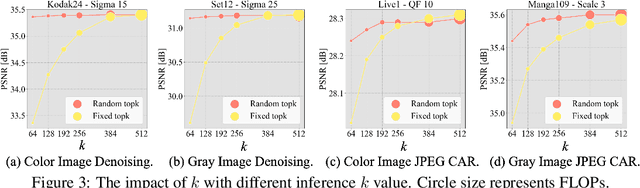
Image Restoration (IR), a classic low-level vision task, has witnessed significant advancements through deep models that effectively model global information. Notably, the Vision Transformers (ViTs) emergence has further propelled these advancements. When computing, the self-attention mechanism, a cornerstone of ViTs, tends to encompass all global cues, even those from semantically unrelated objects or regions. This inclusivity introduces computational inefficiencies, particularly noticeable with high input resolution, as it requires processing irrelevant information, thereby impeding efficiency. Additionally, for IR, it is commonly noted that small segments of a degraded image, particularly those closely aligned semantically, provide particularly relevant information to aid in the restoration process, as they contribute essential contextual cues crucial for accurate reconstruction. To address these challenges, we propose boosting IR's performance by sharing the key semantics via Transformer for IR (i.e., SemanIR) in this paper. Specifically, SemanIR initially constructs a sparse yet comprehensive key-semantic dictionary within each transformer stage by establishing essential semantic connections for every degraded patch. Subsequently, this dictionary is shared across all subsequent transformer blocks within the same stage. This strategy optimizes attention calculation within each block by focusing exclusively on semantically related components stored in the key-semantic dictionary. As a result, attention calculation achieves linear computational complexity within each window. Extensive experiments across 6 IR tasks confirm the proposed SemanIR's state-of-the-art performance, quantitatively and qualitatively showcasing advancements.
Towards a Generalist and Blind RGB-X Tracker
May 28, 2024With the emergence of a single large model capable of successfully solving a multitude of tasks in NLP, there has been growing research interest in achieving similar goals in computer vision. On the one hand, most of these generic models, referred to as generalist vision models, aim at producing unified outputs serving different tasks. On the other hand, some existing models aim to combine different input types (aka data modalities), which are then processed by a single large model. Yet, this step of combination remains specialized, which falls short of serving the initial ambition. In this paper, we showcase that such specialization (during unification) is unnecessary, in the context of RGB-X video object tracking. Our single model tracker, termed XTrack, can remain blind to any modality X during inference time. Our tracker employs a mixture of modal experts comprising those dedicated to shared commonality and others capable of flexibly performing reasoning conditioned on input modality. Such a design ensures the unification of input modalities towards a common latent space, without weakening the modality-specific information representation. With this idea, our training process is extremely simple, integrating multi-label classification loss with a routing function, thereby effectively aligning and unifying all modalities together, even from only paired data. Thus, during inference, we can adopt any modality without relying on the inductive bias of the modal prior and achieve generalist performance. Without any bells and whistles, our generalist and blind tracker can achieve competitive performance compared to well-established modal-specific models on 5 benchmarks across 3 auxiliary modalities, covering commonly used depth, thermal, and event data.
Splat-SLAM: Globally Optimized RGB-only SLAM with 3D Gaussians
May 26, 2024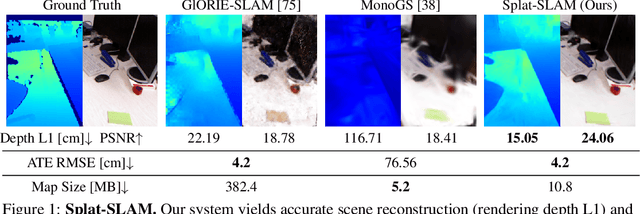
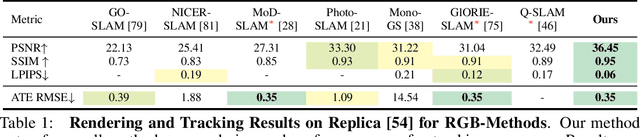
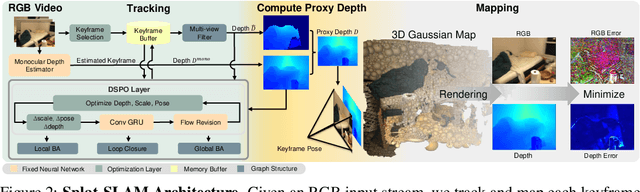
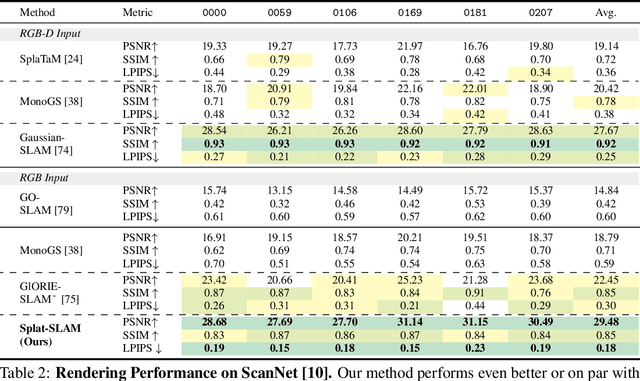
3D Gaussian Splatting has emerged as a powerful representation of geometry and appearance for RGB-only dense Simultaneous Localization and Mapping (SLAM), as it provides a compact dense map representation while enabling efficient and high-quality map rendering. However, existing methods show significantly worse reconstruction quality than competing methods using other 3D representations, e.g. neural points clouds, since they either do not employ global map and pose optimization or make use of monocular depth. In response, we propose the first RGB-only SLAM system with a dense 3D Gaussian map representation that utilizes all benefits of globally optimized tracking by adapting dynamically to keyframe pose and depth updates by actively deforming the 3D Gaussian map. Moreover, we find that refining the depth updates in inaccurate areas with a monocular depth estimator further improves the accuracy of the 3D reconstruction. Our experiments on the Replica, TUM-RGBD, and ScanNet datasets indicate the effectiveness of globally optimized 3D Gaussians, as the approach achieves superior or on par performance with existing RGB-only SLAM methods methods in tracking, mapping and rendering accuracy while yielding small map sizes and fast runtimes. The source code is available at https://github.com/eriksandstroem/Splat-SLAM.
Radar Fields: Frequency-Space Neural Scene Representations for FMCW Radar
May 07, 2024Neural fields have been broadly investigated as scene representations for the reproduction and novel generation of diverse outdoor scenes, including those autonomous vehicles and robots must handle. While successful approaches for RGB and LiDAR data exist, neural reconstruction methods for radar as a sensing modality have been largely unexplored. Operating at millimeter wavelengths, radar sensors are robust to scattering in fog and rain, and, as such, offer a complementary modality to active and passive optical sensing techniques. Moreover, existing radar sensors are highly cost-effective and deployed broadly in robots and vehicles that operate outdoors. We introduce Radar Fields - a neural scene reconstruction method designed for active radar imagers. Our approach unites an explicit, physics-informed sensor model with an implicit neural geometry and reflectance model to directly synthesize raw radar measurements and extract scene occupancy. The proposed method does not rely on volume rendering. Instead, we learn fields in Fourier frequency space, supervised with raw radar data. We validate the effectiveness of the method across diverse outdoor scenarios, including urban scenes with dense vehicles and infrastructure, and in harsh weather scenarios, where mm-wavelength sensing is especially favorable.
Empowering Image Recovery_ A Multi-Attention Approach
Apr 09, 2024We propose Diverse Restormer (DART), a novel image restoration method that effectively integrates information from various sources (long sequences, local and global regions, feature dimensions, and positional dimensions) to address restoration challenges. While Transformer models have demonstrated excellent performance in image restoration due to their self-attention mechanism, they face limitations in complex scenarios. Leveraging recent advancements in Transformers and various attention mechanisms, our method utilizes customized attention mechanisms to enhance overall performance. DART, our novel network architecture, employs windowed attention to mimic the selective focusing mechanism of human eyes. By dynamically adjusting receptive fields, it optimally captures the fundamental features crucial for image resolution reconstruction. Efficiency and performance balance are achieved through the LongIR attention mechanism for long sequence image restoration. Integration of attention mechanisms across feature and positional dimensions further enhances the recovery of fine details. Evaluation across five restoration tasks consistently positions DART at the forefront. Upon acceptance, we commit to providing publicly accessible code and models to ensure reproducibility and facilitate further research.