 Add to Chrome
 Add to Firefox
 Add to Edge
Teeth2Point: A Two-Stage Dental CBCT ROI-to-Point Segmentation Framework
Aug 19, 2026
Modern deep learning architectures have demonstrated strong performance in dental CBCT segmentation. One remaining crucial challenge is accurate tooth labeling in cases with missing or malpositioned teeth, which are highly relevant for dental practice. Transformer-based architectures should in theory be able to resolve such ambiguities using global anatomical context. However, due to the high resolution of CBCT volumes and the wide spatial distribution of teeth within volumes, dense patch-based volumetric processing faces an inherent trade-off. Computational costs limit the number of patches that can be used in self-attention and thus, one can either increase the extent of the context captured in self-attention or capture fine-grained structural details by using small patches, but not both. In this work, we present Teeth2Point, an efficient point-based transformer framework for dental CBCT semantic segmentation that can avoid this trade-off. Teeth2Point first localizes volumetric regions of interest (ROIs) surrounding teeth using a convolutional model, then converts ROIs into point tokens using adaptive sampling. A transformer model predicts accurate segmentations using the point tokens, which allow capturing global context while retaining high resolution. The transformer is first pretrained using self-supervised learning (SSL), in the style of DINO but using domain-specific augmentation strategies, followed by supervised finetuning. The SSL pretraining, which includes random token masking, provides robustness to complex anatomical variations. Compared with the strongest two-stage baseline, Teeth2Point improves abnormal-case performance by 1.44 DSC points on average across four datasets; relative to the first-stage nnU-Net, the gain is 1.9 points.

Gaussian-JEPA: Joint-Embedding Predictive Learning for 3D Gaussian Splats
Aug 16, 20263D Gaussian Splatting (3DGS) represents 3D content with anisotropic primitives that jointly encode geometry and appearance. Fixed-budget encoders consume sampled observations of Gaussian assets, so the same object may be observed through different primitive realizations. Existing self-supervised methods mainly reconstruct masked Gaussian attributes, tying supervision to one sampled realization and requiring an input-space decoder. Latent prediction offers an alternative, but its application to Gaussian tokens requires targets that accommodate coupled attributes and heterogeneous spatial support. We introduce Gaussian-JEPA, which predicts representations of held-out Gaussian token blocks from visible context. An online encoder processes the context, while a shared exponential-moving-average encoder supplies stop-gradient features for multi-scale targets. Complementary target projections and feature-space grounding provide latent supervision without reconstructing Gaussian attributes. We evaluate the features under Gaussian resampling, partial observations, and renderable shape completion, together with transfer to part segmentation and object classification. Compared with matched reconstruction pretraining, Gaussian-JEPA is more consistent across resampled inputs, retains more instance information under partial observations, and provides stronger frozen features for Gaussian completion. These results support latent prediction as an effective objective for reusable 3D Gaussian representations. Code is on the project page (https://amazingren.github.io/Gaussian-JEPA/).
Learning to Reason by Analogy via Retrieval-Augmented Reinforcement Fine-Tuning
Jun 11, 2026Retrieval-augmented generation (RAG) has become a standard mechanism for grounding language models in external knowledge, yet conventional retrieval based on lexical or semantic similarity is poorly suited for complex reasoning tasks: a semantically similar problem may demand an entirely different solution strategy, while a superficially different problem may share the same underlying reasoning pattern. We propose Retrieval-Augmented Reinforcement Fine-Tuning (RA-RFT), a post-training framework that teaches language models to reason by analogy. RA-RFT uses gold-relevance distillation to train a retriever that ranks contexts by expected reasoning benefit rather than semantic overlap, and then fine-tunes the policy model via reinforcement fine-tuning methods with retrieved analogous demonstrations, so the model learns to leverage reasoning traces under verifiable outcome rewards. We further analyze the diversity of retrieved contexts and find that reasoning-aware retrieval surfaces complementary solution strategies that provide distinct reasoning scaffolds for individual problems. Across challenging mathematical reasoning benchmarks, RA-RFT consistently outperforms standard reinforcement fine-tuning methods. For example, it improves AIME 2025 average@32 accuracy by 7.1 and 2.8 points over GRPO for Qwen3-1.7B and Qwen3-4B respectively -- suggesting that reasoning-aware retrieval is a complementary axis of improvement and orthogonal to advances in reward design or training curricula.
Superintelligent Retrieval Agent: The Next Frontier of Information Retrieval
May 07, 2026Retrieval-augmented agents are increasingly the interface to large organizational knowledge bases, yet most still treat retrieval as a black box: they issue exploratory queries, inspect returned snippets, and iteratively reformulate until useful evidence emerges. This approach resembles how a newcomer searches an unfamiliar database rather than how an expert navigates it with strong priors about terminology and likely evidence, and results in unnecessary retrieval rounds, increased latency, and poor recall. We introduce \textit{SuperIntelligent Retrieval Agent} (SIRA), which defines \emph{superintelligence} in retrieval as the ability to compress multi-round exploratory search into a single corpus-discriminative retrieval action. SIRA does not merely ask what terms are relevant to the query; it asks which terms are likely to separate the desired evidence from corpus-level confusers. On the corpus side, an LLM enriches each document offline with missing search vocabulary; on the query side, it predicts evidence vocabulary omitted by the query; and document-frequency statistics as a tool call to filter proposed terms that are absent, overly common, or unlikely to create retrieval margin. The final retrieval step is a single weighted BM25 call combining the original query with the validated expansion. Across ten BEIR benchmarks and downstream question-answering tasks, SIRA achieves the significantly superior performance outperforming dense retrievers and state-of-the-art multi-round agentic baselines, demonstrating that one well-formed lexical query, guided by LLM cognition and lightweight corpus statistics, can exceed substantially more expensive multi-round search while remaining interpretable, training-free, and efficient.
Chorus: Multi-Teacher Pretraining for Holistic 3D Gaussian Scene Encoding
Dec 22, 2025While 3DGS has emerged as a high-fidelity scene representation, encoding rich, general-purpose features directly from its primitives remains under-explored. We address this gap by introducing Chorus, a multi-teacher pretraining framework that learns a holistic feed-forward 3D Gaussian Splatting (3DGS) scene encoder by distilling complementary signals from 2D foundation models. Chorus employs a shared 3D encoder and teacher-specific projectors to learn from language-aligned, generalist, and object-aware teachers, encouraging a shared embedding space that captures signals from high-level semantics to fine-grained structure. We evaluate Chorus on a wide range of tasks: open-vocabulary semantic and instance segmentation, linear and decoder probing, as well as data-efficient supervision. Besides 3DGS, we also test Chorus on several benchmarks that only support point clouds by pretraining a variant using only Gaussians' centers, colors, estimated normals as inputs. Interestingly, this encoder shows strong transfer and outperforms the point clouds baseline while using 39.9 times fewer training scenes. Finally, we propose a render-and-distill adaptation that facilitates out-of-domain finetuning. Our code and model will be released upon publication.
Language Self-Play For Data-Free Training
Sep 09, 2025Large language models (LLMs) have advanced rapidly in recent years, driven by scale, abundant high-quality training data, and reinforcement learning. Yet this progress faces a fundamental bottleneck: the need for ever more data from which models can continue to learn. In this work, we propose a reinforcement learning approach that removes this dependency by enabling models to improve without additional data. Our method leverages a game-theoretic framework of self-play, where a model's capabilities are cast as performance in a competitive game and stronger policies emerge by having the model play against itself - a process we call Language Self-Play (LSP). Experiments with Llama-3.2-3B-Instruct on instruction-following benchmarks show that pretrained models can not only enhance their performance on challenging tasks through self-play alone, but can also do so more effectively than data-driven baselines.
SceneSplat++: A Large Dataset and Comprehensive Benchmark for Language Gaussian Splatting
Jun 10, 20253D Gaussian Splatting (3DGS) serves as a highly performant and efficient encoding of scene geometry, appearance, and semantics. Moreover, grounding language in 3D scenes has proven to be an effective strategy for 3D scene understanding. Current Language Gaussian Splatting line of work fall into three main groups: (i) per-scene optimization-based, (ii) per-scene optimization-free, and (iii) generalizable approach. However, most of them are evaluated only on rendered 2D views of a handful of scenes and viewpoints close to the training views, limiting ability and insight into holistic 3D understanding. To address this gap, we propose the first large-scale benchmark that systematically assesses these three groups of methods directly in 3D space, evaluating on 1060 scenes across three indoor datasets and one outdoor dataset. Benchmark results demonstrate a clear advantage of the generalizable paradigm, particularly in relaxing the scene-specific limitation, enabling fast feed-forward inference on novel scenes, and achieving superior segmentation performance. We further introduce GaussianWorld-49K a carefully curated 3DGS dataset comprising around 49K diverse indoor and outdoor scenes obtained from multiple sources, with which we demonstrate the generalizable approach could harness strong data priors. Our codes, benchmark, and datasets will be made public to accelerate research in generalizable 3DGS scene understanding.
CityLoc: 6 DoF Localization of Text Descriptions in Large-Scale Scenes with Gaussian Representation
Jan 15, 2025Localizing text descriptions in large-scale 3D scenes is inherently an ambiguous task. This nonetheless arises while describing general concepts, e.g. all traffic lights in a city. To facilitate reasoning based on such concepts, text localization in the form of distribution is required. In this paper, we generate the distribution of the camera poses conditioned upon the textual description. To facilitate such generation, we propose a diffusion-based architecture that conditionally diffuses the noisy 6DoF camera poses to their plausible locations. The conditional signals are derived from the text descriptions, using the pre-trained text encoders. The connection between text descriptions and pose distribution is established through pretrained Vision-Language-Model, i.e. CLIP. Furthermore, we demonstrate that the candidate poses for the distribution can be further refined by rendering potential poses using 3D Gaussian splatting, guiding incorrectly posed samples towards locations that better align with the textual description, through visual reasoning. We demonstrate the effectiveness of our method by comparing it with both standard retrieval methods and learning-based approaches. Our proposed method consistently outperforms these baselines across all five large-scale datasets. Our source code and dataset will be made publicly available.
ShapeSplat: A Large-scale Dataset of Gaussian Splats and Their Self-Supervised Pretraining
Aug 20, 2024
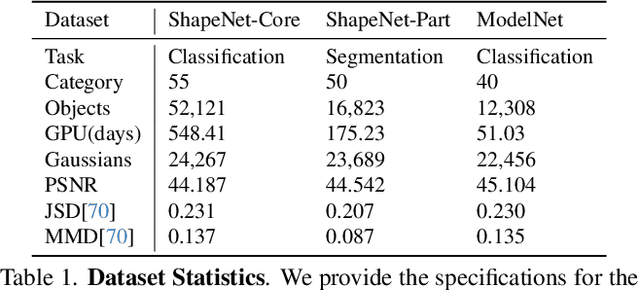
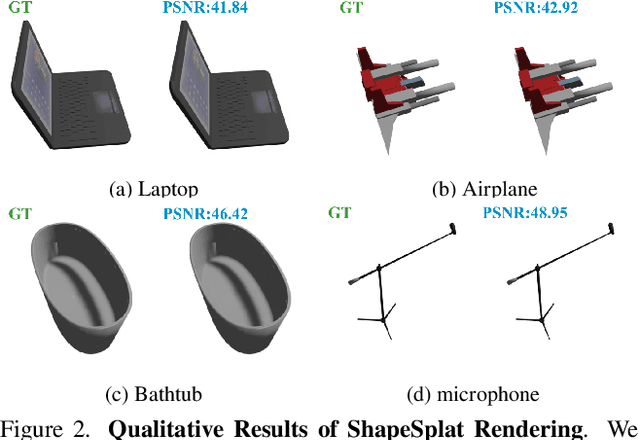
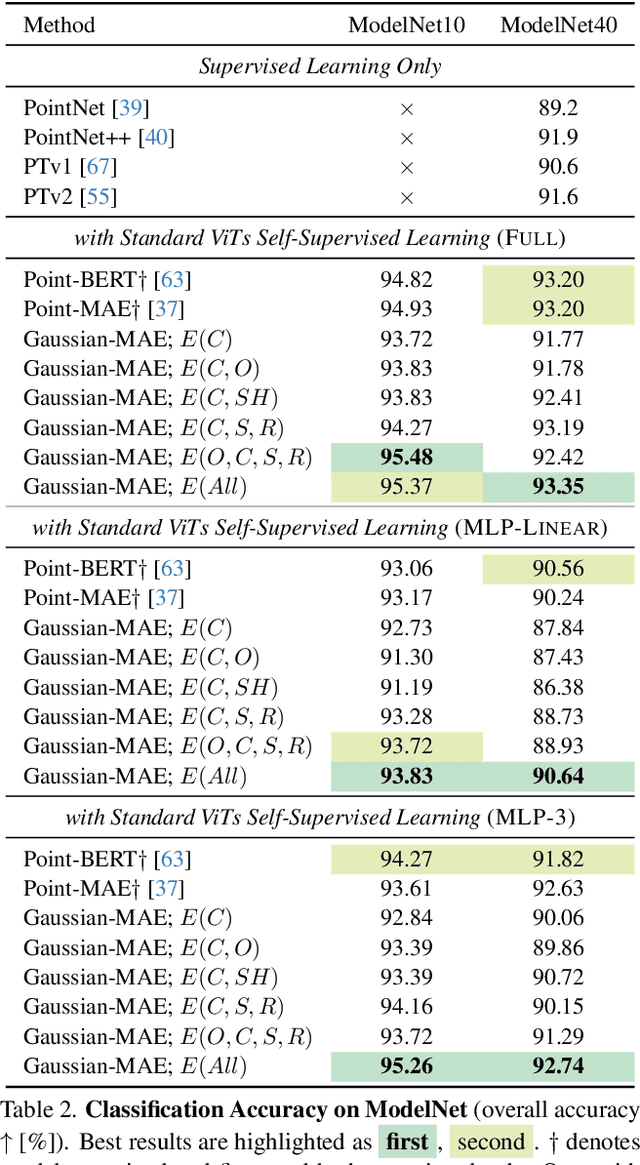
3D Gaussian Splatting (3DGS) has become the de facto method of 3D representation in many vision tasks. This calls for the 3D understanding directly in this representation space. To facilitate the research in this direction, we first build a large-scale dataset of 3DGS using the commonly used ShapeNet and ModelNet datasets. Our dataset ShapeSplat consists of 65K objects from 87 unique categories, whose labels are in accordance with the respective datasets. The creation of this dataset utilized the compute equivalent of 2 GPU years on a TITAN XP GPU. We utilize our dataset for unsupervised pretraining and supervised finetuning for classification and segmentation tasks. To this end, we introduce \textbf{\textit{Gaussian-MAE}}, which highlights the unique benefits of representation learning from Gaussian parameters. Through exhaustive experiments, we provide several valuable insights. In particular, we show that (1) the distribution of the optimized GS centroids significantly differs from the uniformly sampled point cloud (used for initialization) counterpart; (2) this change in distribution results in degradation in classification but improvement in segmentation tasks when using only the centroids; (3) to leverage additional Gaussian parameters, we propose Gaussian feature grouping in a normalized feature space, along with splats pooling layer, offering a tailored solution to effectively group and embed similar Gaussians, which leads to notable improvement in finetuning tasks.
Multimodal Relational Triple Extraction with Query-based Entity Object Transformer
Aug 16, 2024Multimodal Relation Extraction is crucial for constructing flexible and realistic knowledge graphs. Recent studies focus on extracting the relation type with entity pairs present in different modalities, such as one entity in the text and another in the image. However, existing approaches require entities and objects given beforehand, which is costly and impractical. To address the limitation, we propose a novel task, Multimodal Entity-Object Relational Triple Extraction, which aims to extract all triples (entity span, relation, object region) from image-text pairs. To facilitate this study, we modified a multimodal relation extraction dataset MORE, which includes 21 relation types, to create a new dataset containing 20,264 triples, averaging 5.75 triples per image-text pair. Moreover, we propose QEOT, a query-based model with a selective attention mechanism, to dynamically explore the interaction and fusion of textual and visual information. In particular, the proposed method can simultaneously accomplish entity extraction, relation classification, and object detection with a set of queries. Our method is suitable for downstream applications and reduces error accumulation due to the pipeline-style approaches. Extensive experimental results demonstrate that our proposed method outperforms the existing baselines by 8.06% and achieves state-of-the-art performance.