 Add to Chrome
 Add to Firefox
 Add to Edge
MSP-Net: Manifold-Guided Spectral Prompt Network for Hyperspectral Object Tracking
Aug 10, 2026
Hyperspectral object tracking leverages abundant spectral information to provide unique advantages for target discrimination in complex scenes. However, existing methods typically treat hyperspectral images as multi-channel extensions of RGB images, performing feature fusion in fixed band order. This approach leads to models dependent on specific sensor configurations while neglecting manifold relationships between bands, making generalization to heterogeneous sensors difficult. Moreover, the discriminative contribution of bands dynamically changes with target attributes and scene variations, further limiting the representational capacity of static fusion strategies. To address this, we propose the Manifold-Guided Spectral Prompt Network (MSP-Net). This network first reconstructs band relationships and forms adaptive spectral grouping through graph-driven manifold routing, then jointly integrates grouped spectral statistics with template appearance to construct target-related dynamic conditional prompts, enhancing target features while suppressing background interference. Furthermore, as tracking progresses, spectral conditions continuously evolve based on intermediate target representations, enabling target prompts to adapt in real-time to appearance and scene changes. Meanwhile, reliable historical states are used to constrain target localization and scale fluctuations, significantly improving temporal stability in cross-sensor tracking. Experiments on HOT2020 and HOT2023 demonstrate that MSP-Net achieves AUC and Precision exceeding 0.80 and 0.96, respectively, exhibiting exceptional robustness under heterogeneous sensors, target deformation, and complex background conditions. The code will be released at https://github.com/GGML668897/MSP-Net.

Towards Compact Unified Multimodal Tracking: Synergizing Knowledge Distillation with Structural Pruning
Aug 02, 2026Unified multimodal object tracking has achieved remarkable robustness by leveraging complementary sensor data (e.g., RGB, Thermal, Depth), yet the heavy computational burden of state-of-the-art models hinders their deployment on resource-constrained edge devices. In this work, we identify the prediction head as a critical but often overlooked efficiency bottleneck. By strategically streamlining the decoder architecture, we unlock the potential for real-time inference but simultaneously introduce a capacity gap between the lightweight student and the heavy teacher. To resolve this, we conduct a systematic analysis of 17 distillation strategies and introduce a Dual-Alignment Distillation framework. Our key insight is that effective compression requires decoupling knowledge transfer into two complementary streams: (1) Spatial Representation Alignment, which employs feature distillation to sharpen the student's spatial focus on foreground targets ("Where to track"); and (2) Semantic Distribution Alignment, which utilizes logit-based distillation to align decision boundaries and transfer discriminative dark knowledge ("What to track"). Extensive experiments across five benchmarks demonstrate that our approach significantly outperforms complex state-of-the-art methods. Notably, our distilled model achieves 91.5% MPR on RGBT234 and operates at 54 FPS on a single RTX 4090, representing a 5x speedup over the teacher model while maintaining superior accuracy.
VideoScan: Enabling Efficient Streaming Video Understanding via Frame-level Semantic Carriers
Mar 12, 2025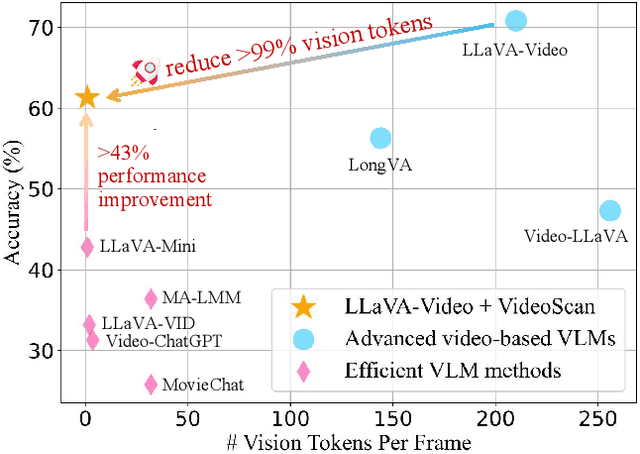
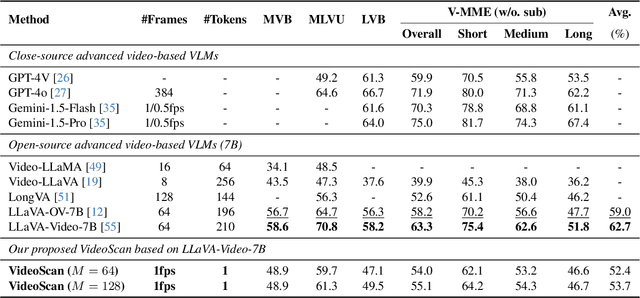
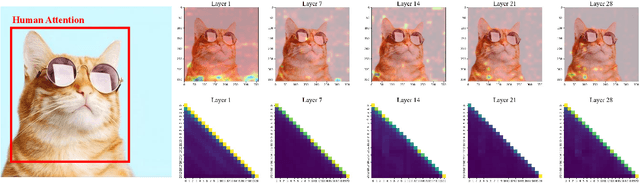
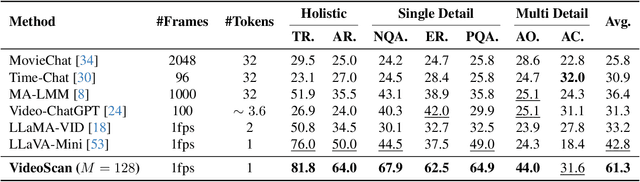
This paper introduces VideoScan, an efficient vision-language model (VLM) inference framework designed for real-time video interaction that effectively comprehends and retains streamed video inputs while delivering rapid and accurate responses. A longstanding challenge in video understanding--particularly for long-term or real-time applications--stems from the substantial computational overhead caused by the extensive length of visual tokens. To address this, VideoScan employs a single semantic carrier token to represent each frame, progressively reducing computational and memory overhead during its two-phase inference process: prefilling and decoding. The embedding of the semantic carrier token is derived from an optimized aggregation of frame-level visual features, ensuring compact yet semantically rich representations. Critically, the corresponding key-value pairs are trained to retain contextual semantics from prior frames, enabling efficient memory management without sacrificing temporal coherence. During inference, the visual tokens of each frame are processed only once during the prefilling phase and subsequently discarded in the decoding stage, eliminating redundant computations. This design ensures efficient VLM inference even under stringent real-time constraints. Comprehensive experiments on diverse offline and online benchmarks demonstrate that LLaVA-Video, supported by our method, achieves up to $\sim 5\times$ and $1.29\times$ speedups compared to its original version and previous efficient streaming video understanding approaches, respectively. Crucially, these improvements are attained while maintaining competitive performance and ensuring stable GPU memory consumption (consistently $\sim 18$GB, independent of video duration).
Complexity Experts are Task-Discriminative Learners for Any Image Restoration
Nov 27, 2024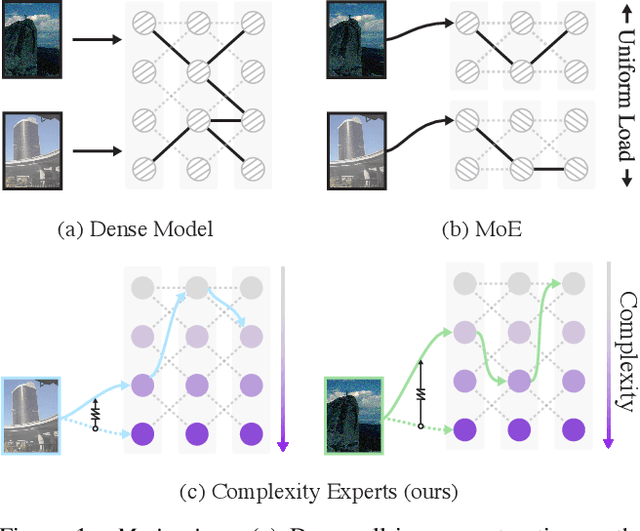
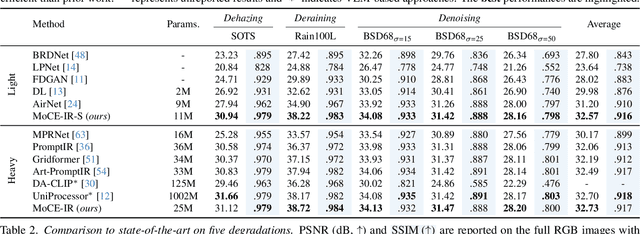
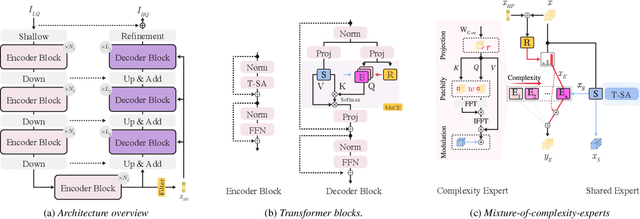
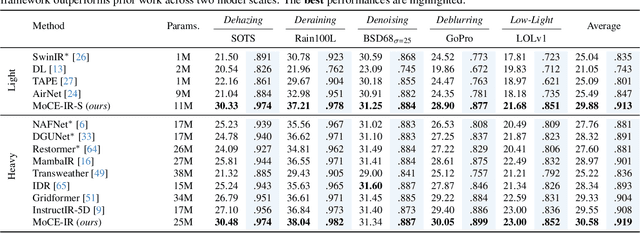
Recent advancements in all-in-one image restoration models have revolutionized the ability to address diverse degradations through a unified framework. However, parameters tied to specific tasks often remain inactive for other tasks, making mixture-of-experts (MoE) architectures a natural extension. Despite this, MoEs often show inconsistent behavior, with some experts unexpectedly generalizing across tasks while others struggle within their intended scope. This hinders leveraging MoEs' computational benefits by bypassing irrelevant experts during inference. We attribute this undesired behavior to the uniform and rigid architecture of traditional MoEs. To address this, we introduce ``complexity experts" -- flexible expert blocks with varying computational complexity and receptive fields. A key challenge is assigning tasks to each expert, as degradation complexity is unknown in advance. Thus, we execute tasks with a simple bias toward lower complexity. To our surprise, this preference effectively drives task-specific allocation, assigning tasks to experts with the appropriate complexity. Extensive experiments validate our approach, demonstrating the ability to bypass irrelevant experts during inference while maintaining superior performance. The proposed MoCE-IR model outperforms state-of-the-art methods, affirming its efficiency and practical applicability. The source will be publicly made available at \href{https://eduardzamfir.github.io/moceir/}{\texttt{eduardzamfir.github.io/MoCE-IR/}}
Towards a Generalist and Blind RGB-X Tracker
May 28, 2024With the emergence of a single large model capable of successfully solving a multitude of tasks in NLP, there has been growing research interest in achieving similar goals in computer vision. On the one hand, most of these generic models, referred to as generalist vision models, aim at producing unified outputs serving different tasks. On the other hand, some existing models aim to combine different input types (aka data modalities), which are then processed by a single large model. Yet, this step of combination remains specialized, which falls short of serving the initial ambition. In this paper, we showcase that such specialization (during unification) is unnecessary, in the context of RGB-X video object tracking. Our single model tracker, termed XTrack, can remain blind to any modality X during inference time. Our tracker employs a mixture of modal experts comprising those dedicated to shared commonality and others capable of flexibly performing reasoning conditioned on input modality. Such a design ensures the unification of input modalities towards a common latent space, without weakening the modality-specific information representation. With this idea, our training process is extremely simple, integrating multi-label classification loss with a routing function, thereby effectively aligning and unifying all modalities together, even from only paired data. Thus, during inference, we can adopt any modality without relying on the inductive bias of the modal prior and achieve generalist performance. Without any bells and whistles, our generalist and blind tracker can achieve competitive performance compared to well-established modal-specific models on 5 benchmarks across 3 auxiliary modalities, covering commonly used depth, thermal, and event data.
HHTrack: Hyperspectral Object Tracking Using Hybrid Attention
Aug 30, 2023
Hyperspectral imagery provides abundant spectral information beyond the visible RGB bands, offering rich discriminative details about objects in a scene. Leveraging such data has the potential to enhance visual tracking performance. In this paper, we propose a hyperspectral object tracker based on hybrid attention (HHTrack). The core of HHTrack is a hyperspectral hybrid attention (HHA) module that unifies feature extraction and fusion within one component through token interactions. A hyperspectral bands fusion (HBF) module is also introduced to selectively aggregate spatial and spectral signatures from the full hyperspectral input. Extensive experiments demonstrate the state-of-the-art performance of HHTrack on benchmark Near Infrared (NIR), Red Near Infrared (Red-NIR), and Visible (VIS) hyperspectral tracking datasets. Our work provides new insights into harnessing the strengths of transformers and hyperspectral fusion to advance robust object tracking.