 Add to Chrome
 Add to Firefox
 Add to Edge
AutoVSR: Automatic Visual-to-Symbolic Reasoning for Symbolic Expression Generation from Circuit Schematic
Jul 13, 2026
Symbolic expressions can effectively characterize and predict circuit behavior, but deriving them directly from circuit schematics is challenging. This process requires accurate visual-to-symbolic construction of circuit structure from images and correct multi-step symbolic derivation, both of which impose strict correctness requirements. This work proposes AutoVSR, an automated framework for visual-to-symbolic generation of circuit expressions using Vision Language Models (VLMs). By reconstructing circuit diagrams into an executable intermediate representation (Executable IR) and leveraging a symbolic solver for reasoning, AutoVSR significantly improves the accuracy of symbolic expression generation. AutoVSR introduces two key innovations: an IR construction method guided by component rule retrieval and verification-based feedback, and a symbolic solver implemented as a planning agent equipped with a symbolic tool library for reliable multi-step derivation. Compared with end-to-end VLM approaches and specialized methods on the main symbolic expression generation task, AutoVSR achieves accuracy improvements of 30.01--59.45% and 41.96--51.84%, respectively. Moreover, AutoVSR surpasses closed-source state-of-the-art VLMs in inference cost and computational efficiency. Code is available at https://github.com/LongfeiLi1/AutoVSR.

QK-Normed MLA: QK normalization without full key caching
Jun 15, 2026Query-key (QK) normalization stabilizes attention by controlling the scale of queries and keys before the dot product, but is not immediately compatible with Multi-head Latent Attention (MLA). MLA achieves efficient decoding by caching low-dimensional latent states instead of full keys, whereas post-projection QK RMSNorm appears to require the fully projected key for every cached token. We show this apparent incompatibility is an implementation artifact, not an architectural constraint. RMSNorm decomposes into a static affine weight and a dynamic scalar RMS statistic. The static key-side weight can be absorbed into the MLA query-side projection; the dynamic key statistic reduces to one inverse-RMS scalar per token and KV group. The resulting formulation is exactly equivalent to explicit post-projection QK RMSNorm in exact arithmetic and preserves MLA's latent decode path. In our 400M runs trained for up to 100B tokens, QK-Normed MLA achieves lower training loss and better downstream accuracy than QK clipping, while H800 decode benchmarks show less than 2% latency overhead up to 256k context. These results make QK normalization a practical stabilization option for MLA models without requiring full-key caching.
Ling and Ring 2.6 Technical Report: Efficient and Instant Agentic Intelligence at Trillion-Parameter Scale
Jun 13, 2026Efficient and scalable agentic intelligence requires models that can deliver both low-latency responses and strong reasoning capabilities while remaining practical to train, serve, and deploy. In this report, we present Ling-2.6 and Ring-2.6, a family of models designed to address this challenge at scale. Ling-2.6 is optimized for instant response generation and high capability per output token, whereas Ring-2.6 is tailored for deeper reasoning and more advanced agentic workflows. Instead of training from scratch, we upgrade the Ling-2.0 base model through architectural migration pre-training and large-scale post-training. This upgrade is guided by a unified co-design of model architecture, optimization objectives, serving systems, and agent training environments, enabling improvements in both model capability and deployment efficiency. At the architectural level, we introduce a hybrid linear attention design that integrates Lightning Attention with MLA, improving the efficiency of long-context training and decoding. To further enhance token efficiency, we optimize capability per output token through Evolutionary Chain-of-Thought, Linguistic Unit Policy Optimization, bidirectional preference alignment, and shortest-correct-response distillation. For agentic capabilities, we propose KPop, a reinforcement learning framework designed to support stable training of Ring-2.6-1T on large-scale environment-grounded data. KPop improves training efficiency through asynchronous scheduling across coding, search, tool use, and workflow execution, enabling scalable learning from complex agent-environment interactions. Together, Ling-2.6 and Ring-2.6 provide a practical pathway toward efficient, scalable, and open agentic systems. We open-source all checkpoints in the 2.6 family to support further research and development in practical agentic intelligence.
Taming the Long Tail: Efficient Item-wise Sharpness-Aware Minimization for LLM-based Recommender Systems
Mar 13, 2026Large Language Model-based Recommender Systems (LRSs) have recently emerged as a new paradigm in sequential recommendation by directly adopting LLMs as backbones. While LRSs demonstrate strong knowledge utilization and instruction-following abilities, they have not been systematically studied under the long-standing long-tail problem. In this paper, we conduct an empirical study and reveal that LRSs face two distinct types of long-tail: i) prior long-tail, inherited implicitly from pretraining corpora, and ii) data long-tail, originating from skewed recommendation datasets. Our analysis shows that both contribute to the performance disparity between head and tail items, with the intersection of the two heads exhibiting an even stronger head effect. Nevertheless, the overall performance distribution in LRSs, especially on the tail, remains dominated by the data long-tail. To address this challenge, we propose Efficient Item-wise Sharpness-Aware Minimization (EISAM), a novel optimization framework that improves tail-item performance by adaptively regularizing the loss landscape at the item level. EISAM introduces an efficient penalty design that captures fine-grained item-specific sharpness while maintaining computational scalability for LLMs. In addition, we derive a generalization bound for EISAM. Our theoretical analysis shows that the bound decreases at a faster rate under our item-wise regularization, offering theoretical support for its effectiveness. Extensive experiments on three real-world datasets demonstrate that EISAM significantly boosts tail-item recommendation performance while preserving overall quality, establishing the first systematic solution to the long-tail problem in LRSs.
Fine-Grained Zero-Shot Composed Image Retrieval with Complementary Visual-Semantic Integration
Jan 20, 2026Zero-shot composed image retrieval (ZS-CIR) is a rapidly growing area with significant practical applications, allowing users to retrieve a target image by providing a reference image and a relative caption describing the desired modifications. Existing ZS-CIR methods often struggle to capture fine-grained changes and integrate visual and semantic information effectively. They primarily rely on either transforming the multimodal query into a single text using image-to-text models or employing large language models for target image description generation, approaches that often fail to capture complementary visual information and complete semantic context. To address these limitations, we propose a novel Fine-Grained Zero-Shot Composed Image Retrieval method with Complementary Visual-Semantic Integration (CVSI). Specifically, CVSI leverages three key components: (1) Visual Information Extraction, which not only extracts global image features but also uses a pre-trained mapping network to convert the image into a pseudo token, combining it with the modification text and the objects most likely to be added. (2) Semantic Information Extraction, which involves using a pre-trained captioning model to generate multiple captions for the reference image, followed by leveraging an LLM to generate the modified captions and the objects most likely to be added. (3) Complementary Information Retrieval, which integrates information extracted from both the query and database images to retrieve the target image, enabling the system to efficiently handle retrieval queries in a variety of situations. Extensive experiments on three public datasets (e.g., CIRR, CIRCO, and FashionIQ) demonstrate that CVSI significantly outperforms existing state-of-the-art methods. Our code is available at https://github.com/yyc6631/CVSI.
SpatialTree: How Spatial Abilities Branch Out in MLLMs
Dec 23, 2025Cognitive science suggests that spatial ability develops progressively-from perception to reasoning and interaction. Yet in multimodal LLMs (MLLMs), this hierarchy remains poorly understood, as most studies focus on a narrow set of tasks. We introduce SpatialTree, a cognitive-science-inspired hierarchy that organizes spatial abilities into four levels: low-level perception (L1), mental mapping (L2), simulation (L3), and agentic competence (L4). Based on this taxonomy, we construct the first capability-centric hierarchical benchmark, thoroughly evaluating mainstream MLLMs across 27 sub-abilities. The evaluation results reveal a clear structure: L1 skills are largely orthogonal, whereas higher-level skills are strongly correlated, indicating increasing interdependency. Through targeted supervised fine-tuning, we uncover a surprising transfer dynamic-negative transfer within L1, but strong cross-level transfer from low- to high-level abilities with notable synergy. Finally, we explore how to improve the entire hierarchy. We find that naive RL that encourages extensive "thinking" is unreliable: it helps complex reasoning but hurts intuitive perception. We propose a simple auto-think strategy that suppresses unnecessary deliberation, enabling RL to consistently improve performance across all levels. By building SpatialTree, we provide a proof-of-concept framework for understanding and systematically scaling spatial abilities in MLLMs.
Using GUI Agent for Electronic Design Automation
Dec 12, 2025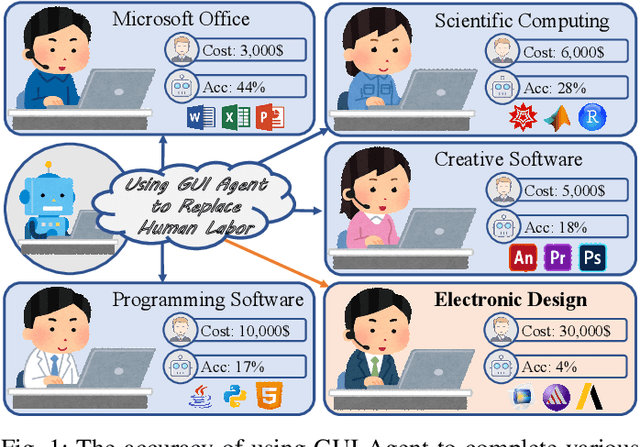
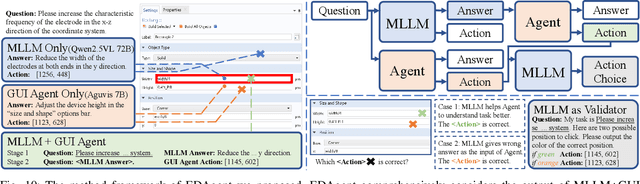
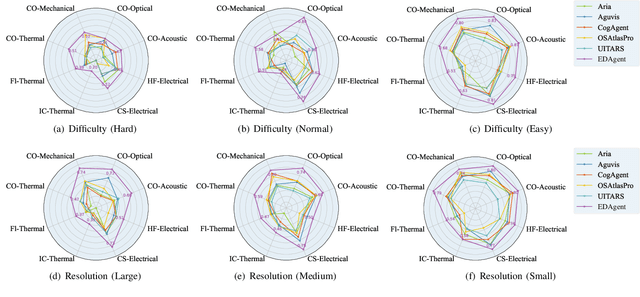
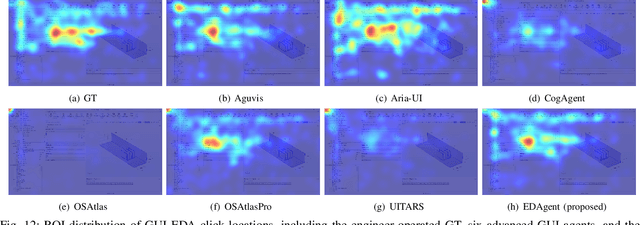
Graphical User Interface (GUI) agents adopt an end-to-end paradigm that maps a screenshot to an action sequence, thereby automating repetitive tasks in virtual environments. However, existing GUI agents are evaluated almost exclusively on commodity software such as Microsoft Word and Excel. Professional Computer-Aided Design (CAD) suites promise an order-of-magnitude higher economic return, yet remain the weakest performance domain for existing agents and are still far from replacing expert Electronic-Design-Automation (EDA) engineers. We therefore present the first systematic study that deploys GUI agents for EDA workflows. Our contributions are: (1) a large-scale dataset named GUI-EDA, including 5 CAD tools and 5 physical domains, comprising 2,000+ high-quality screenshot-answer-action pairs recorded by EDA scientists and engineers during real-world component design; (2) a comprehensive benchmark that evaluates 30+ mainstream GUI agents, demonstrating that EDA tasks constitute a major, unsolved challenge; and (3) an EDA-specialized metric named EDAgent, equipped with a reflection mechanism that achieves reliable performance on industrial CAD software and, for the first time, outperforms Ph.D. students majored in Electrical Engineering. This work extends GUI agents from generic office automation to specialized, high-value engineering domains and offers a new avenue for advancing EDA productivity. The dataset will be released at: https://github.com/aiben-ch/GUI-EDA.
StereoWorld: Geometry-Aware Monocular-to-Stereo Video Generation
Dec 11, 2025The growing adoption of XR devices has fueled strong demand for high-quality stereo video, yet its production remains costly and artifact-prone. To address this challenge, we present StereoWorld, an end-to-end framework that repurposes a pretrained video generator for high-fidelity monocular-to-stereo video generation. Our framework jointly conditions the model on the monocular video input while explicitly supervising the generation with a geometry-aware regularization to ensure 3D structural fidelity. A spatio-temporal tiling scheme is further integrated to enable efficient, high-resolution synthesis. To enable large-scale training and evaluation, we curate a high-definition stereo video dataset containing over 11M frames aligned to natural human interpupillary distance (IPD). Extensive experiments demonstrate that StereoWorld substantially outperforms prior methods, generating stereo videos with superior visual fidelity and geometric consistency. The project webpage is available at https://ke-xing.github.io/StereoWorld/.
Martian World Models: Controllable Video Synthesis with Physically Accurate 3D Reconstructions
Jul 10, 2025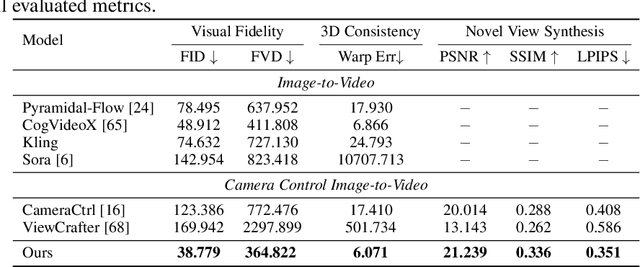
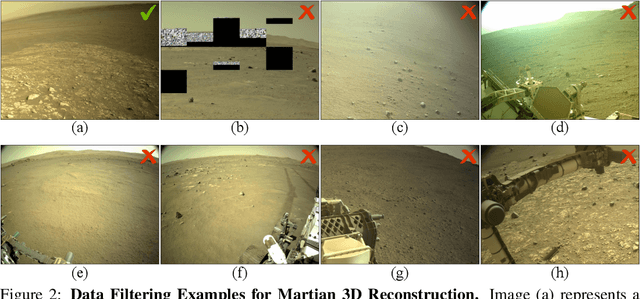
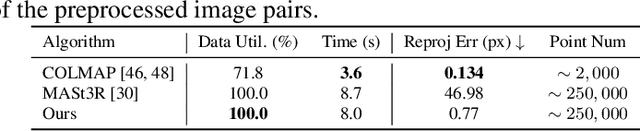
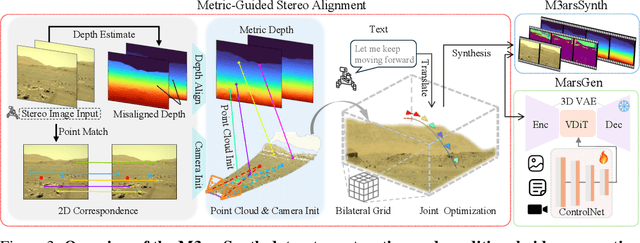
Synthesizing realistic Martian landscape videos is crucial for mission rehearsal and robotic simulation. However, this task poses unique challenges due to the scarcity of high-quality Martian data and the significant domain gap between Martian and terrestrial imagery. To address these challenges, we propose a holistic solution composed of two key components: 1) A data curation pipeline Multimodal Mars Synthesis (M3arsSynth), which reconstructs 3D Martian environments from real stereo navigation images, sourced from NASA's Planetary Data System (PDS), and renders high-fidelity multiview 3D video sequences. 2) A Martian terrain video generator, MarsGen, which synthesizes novel videos visually realistic and geometrically consistent with the 3D structure encoded in the data. Our M3arsSynth engine spans a wide range of Martian terrains and acquisition dates, enabling the generation of physically accurate 3D surface models at metric-scale resolution. MarsGen, fine-tuned on M3arsSynth data, synthesizes videos conditioned on an initial image frame and, optionally, camera trajectories or textual prompts, allowing for video generation in novel environments. Experimental results show that our approach outperforms video synthesis models trained on terrestrial datasets, achieving superior visual fidelity and 3D structural consistency.
Efficient Text-Attributed Graph Learning through Selective Annotation and Graph Alignment
Jun 08, 2025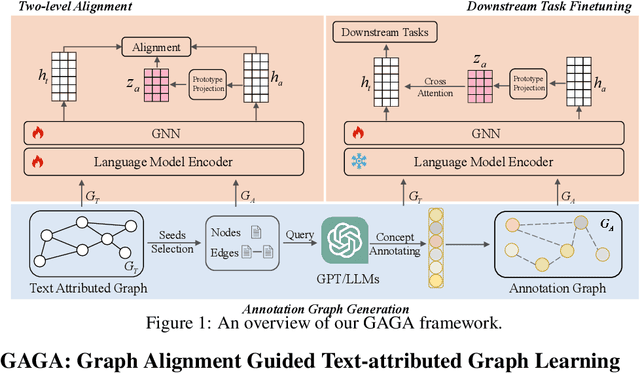
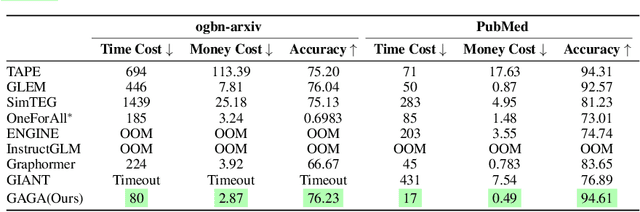
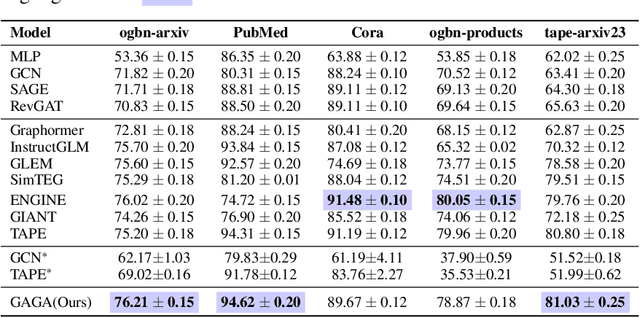
In the realm of Text-attributed Graphs (TAGs), traditional graph neural networks (GNNs) often fall short due to the complex textual information associated with each node. Recent methods have improved node representations by leveraging large language models (LLMs) to enhance node text features, but these approaches typically require extensive annotations or fine-tuning across all nodes, which is both time-consuming and costly. To overcome these challenges, we introduce GAGA, an efficient framework for TAG representation learning. GAGA reduces annotation time and cost by focusing on annotating only representative nodes and edges. It constructs an annotation graph that captures the topological relationships among these annotations. Furthermore, GAGA employs a two-level alignment module to effectively integrate the annotation graph with the TAG, aligning their underlying structures. Experiments show that GAGA achieves classification accuracies on par with or surpassing state-of-the-art methods while requiring only 1% of the data to be annotated, demonstrating its high efficiency.