 Add to Chrome
 Add to Firefox
 Add to Edge
Bridging the Information Gap: Semantic Densification and Hindsight Distillation for Cold-Start Prediction
Jul 19, 2026
New-user cold-start is a critical bottleneck for e-commerce platforms: predicting user lifetime value (LTV) and conversion rate (CVR) for users with sparse interaction history. Two prior directions -- LLM-based semantic augmentation and learning using privileged information (LUPI) -- each face a key limitation. First, LLM augmentation produces unstructured rationales that are noisy and hard to operationalize in production. Second, naive student-teacher distillation can be brittle due to an information gap between the privileged teacher and the sparse student; moreover, this gap is heterogeneous across users. We propose SemRaD, a Semantic Reasoning-aware Distillation framework addressing both limitations. First, a Structured Semantic Reasoning Pipeline replaces free-form rationales with a structured schema built via a discover-curate-audit workflow, producing per user a Densified Semantic Profile (consumed by the deployed student via a Semantic-Gated Encoder that focuses on the most informative dimensions) and a Hindsight Distillation Target reconciled from pre- and post-conversion reasoning (used only at training). Second, to bridge this gap and handle its heterogeneity, a Hindsight-Aware Distillation Network transfers privileged knowledge via the hindsight target, with Distillation Experts improving transfer under per-user variability. On a large-scale industrial dataset, SemRaD lifts +1.9% LTV (Gini) and +1.0% CVR (AUROC) over a production-grade base; a four-week online A/B at Keeta confirms +1.0% LTV / +0.43% CVR. SemRaD also matches the production system's LTV using only 9% of the training data while improving CVR by 0.8%.

UME: A Unified Meta-Generalization Framework for Cross-Domain ETA
May 31, 2026Accurate Estimated Time of Arrival (ETA) prediction on checkout page is crucial in instant logistics for enhancing user satisfaction, optimizing dispatching, and controlling operational costs. In international on-demand delivery platforms, where ETA data originates from diverse countries or regions with different patterns, multi-domain modeling is of great importance and has been widely adopted. However, existing methods still face three critical challenges in real-world deployment. First, current multi-domain models struggle to generalize to completely unseen domains, failing to achieve zero-shot prediction during the initial cold-start phase. Second, cross-domain feature spaces are often assumed to be consistent, whereas new domains commonly suffer from structural missingness of offline (statistical) features due to the lack of historical data. Third, such feature missingness often compels industrial systems to model mature and cold-start domains separately, hindering knowledge transfer and increasing maintenance overhead. To address these challenges, we propose \textbf{UME}, a \textbf{U}nified \textbf{M}eta-generalization framework for \textbf{E}TA. Specifically, UME integrates a unified dual-branch architecture with a novel meta-learning mechanism that employs a hypernetwork-based meta learner. By leveraging domain-level knowledge and instance-level context, the meta learner empowers three meta modules to dynamically modulate feature gating, expert attention, and final prediction, capturing cross-domain correlations and facilitating intra-domain adaptation. A knowledge distillation strategy is further introduce to enhance performance. UME has now been deployed in Meituan-keeta delivery platform (the largest international food delivery platform in China). Extensive offline experiments and online A/B tests demonstrate that UME significantly outperforms existing baselines.
StereoWorld: Geometry-Aware Monocular-to-Stereo Video Generation
Dec 11, 2025The growing adoption of XR devices has fueled strong demand for high-quality stereo video, yet its production remains costly and artifact-prone. To address this challenge, we present StereoWorld, an end-to-end framework that repurposes a pretrained video generator for high-fidelity monocular-to-stereo video generation. Our framework jointly conditions the model on the monocular video input while explicitly supervising the generation with a geometry-aware regularization to ensure 3D structural fidelity. A spatio-temporal tiling scheme is further integrated to enable efficient, high-resolution synthesis. To enable large-scale training and evaluation, we curate a high-definition stereo video dataset containing over 11M frames aligned to natural human interpupillary distance (IPD). Extensive experiments demonstrate that StereoWorld substantially outperforms prior methods, generating stereo videos with superior visual fidelity and geometric consistency. The project webpage is available at https://ke-xing.github.io/StereoWorld/.
TiP4GEN: Text to Immersive Panorama 4D Scene Generation
Aug 17, 2025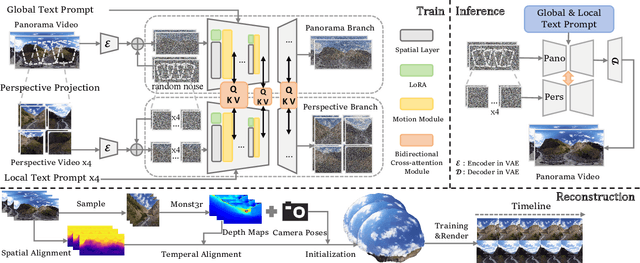
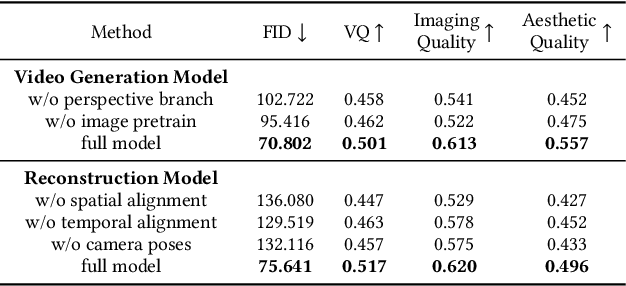
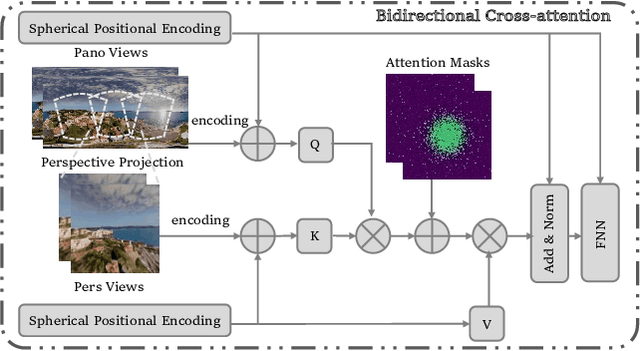
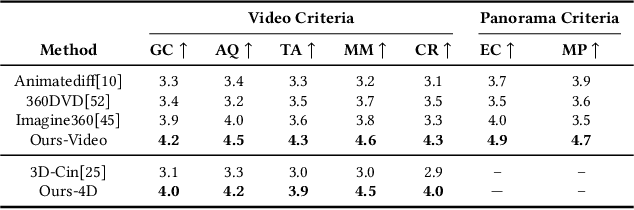
With the rapid advancement and widespread adoption of VR/AR technologies, there is a growing demand for the creation of high-quality, immersive dynamic scenes. However, existing generation works predominantly concentrate on the creation of static scenes or narrow perspective-view dynamic scenes, falling short of delivering a truly 360-degree immersive experience from any viewpoint. In this paper, we introduce \textbf{TiP4GEN}, an advanced text-to-dynamic panorama scene generation framework that enables fine-grained content control and synthesizes motion-rich, geometry-consistent panoramic 4D scenes. TiP4GEN integrates panorama video generation and dynamic scene reconstruction to create 360-degree immersive virtual environments. For video generation, we introduce a \textbf{Dual-branch Generation Model} consisting of a panorama branch and a perspective branch, responsible for global and local view generation, respectively. A bidirectional cross-attention mechanism facilitates comprehensive information exchange between the branches. For scene reconstruction, we propose a \textbf{Geometry-aligned Reconstruction Model} based on 3D Gaussian Splatting. By aligning spatial-temporal point clouds using metric depth maps and initializing scene cameras with estimated poses, our method ensures geometric consistency and temporal coherence for the reconstructed scenes. Extensive experiments demonstrate the effectiveness of our proposed designs and the superiority of TiP4GEN in generating visually compelling and motion-coherent dynamic panoramic scenes. Our project page is at https://ke-xing.github.io/TiP4GEN/.
Beyond Wide-Angle Images: Unsupervised Video Portrait Correction via Spatiotemporal Diffusion Adaptation
Apr 01, 2025Wide-angle cameras, despite their popularity for content creation, suffer from distortion-induced facial stretching-especially at the edge of the lens-which degrades visual appeal. To address this issue, we propose an image portrait correction framework using diffusion models named ImagePD. It integrates the long-range awareness of transformer and multi-step denoising of diffusion models into a unified framework, achieving global structural robustness and local detail refinement. Besides, considering the high cost of obtaining video labels, we then repurpose ImagePD for unlabeled wide-angle videos (termed VideoPD), by spatiotemporal diffusion adaption with spatial consistency and temporal smoothness constraints. For the former, we encourage the denoised image to approximate pseudo labels following the wide-angle distortion distribution pattern, while for the latter, we derive rectification trajectories with backward optical flows and smooth them. Compared with ImagePD, VideoPD maintains high-quality facial corrections in space and mitigates the potential temporal shakes sequentially. Finally, to establish an evaluation benchmark and train the framework, we establish a video portrait dataset with a large diversity in people number, lighting conditions, and background. Experiments demonstrate that the proposed methods outperform existing solutions quantitatively and qualitatively, contributing to high-fidelity wide-angle videos with stable and natural portraits. The codes and dataset will be available.