 Add to Chrome
 Add to Firefox
 Add to Edge
TemPrompt: Multi-Task Prompt Learning for Temporal Relation Extraction in RAG-based Crowdsourcing Systems
Jun 25, 2024
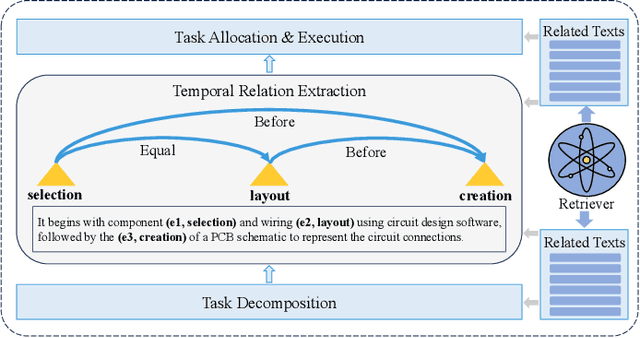
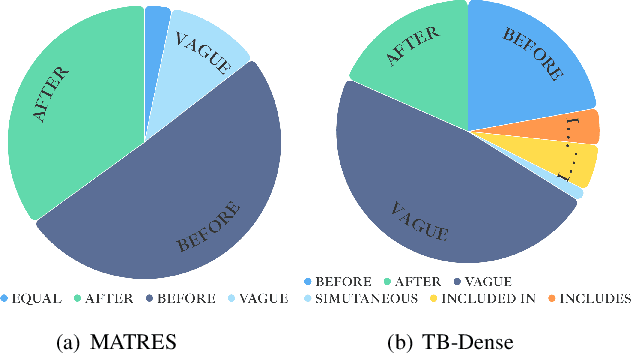
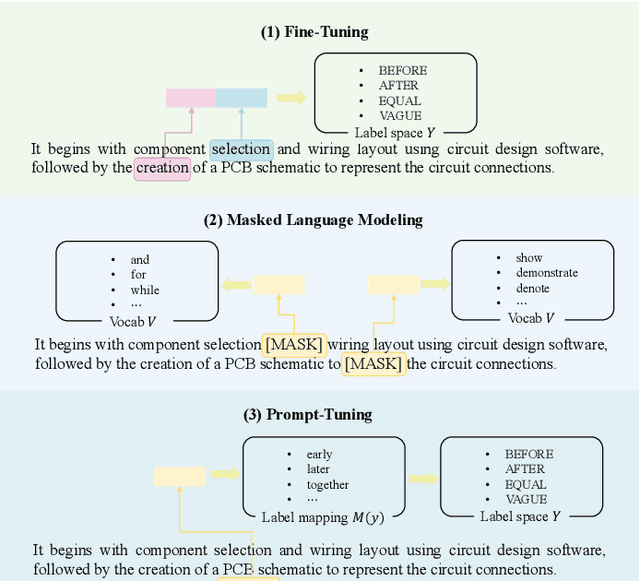
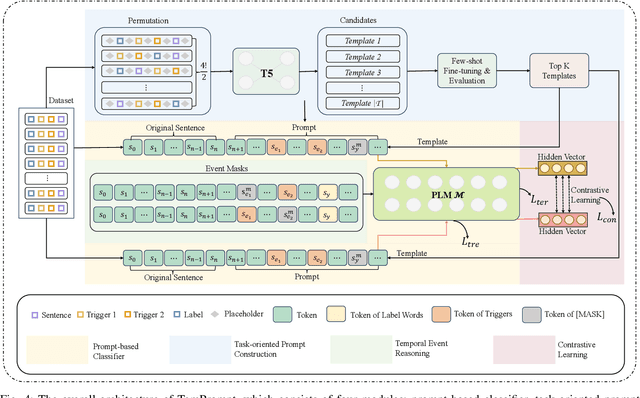
Temporal relation extraction (TRE) aims to grasp the evolution of events or actions, and thus shape the workflow of associated tasks, so it holds promise in helping understand task requests initiated by requesters in crowdsourcing systems. However, existing methods still struggle with limited and unevenly distributed annotated data. Therefore, inspired by the abundant global knowledge stored within pre-trained language models (PLMs), we propose a multi-task prompt learning framework for TRE (TemPrompt), incorporating prompt tuning and contrastive learning to tackle these issues. To elicit more effective prompts for PLMs, we introduce a task-oriented prompt construction approach that thoroughly takes the myriad factors of TRE into consideration for automatic prompt generation. In addition, we present temporal event reasoning as a supplement to bolster the model's focus on events and temporal cues. The experimental results demonstrate that TemPrompt outperforms all compared baselines across the majority of metrics under both standard and few-shot settings. A case study is provided to validate its effectiveness in crowdsourcing scenarios.

CoMM: A Coherent Interleaved Image-Text Dataset for Multimodal Understanding and Generation
Jun 15, 2024
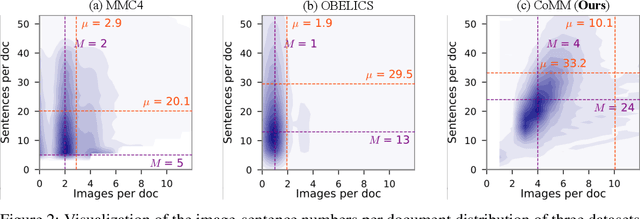
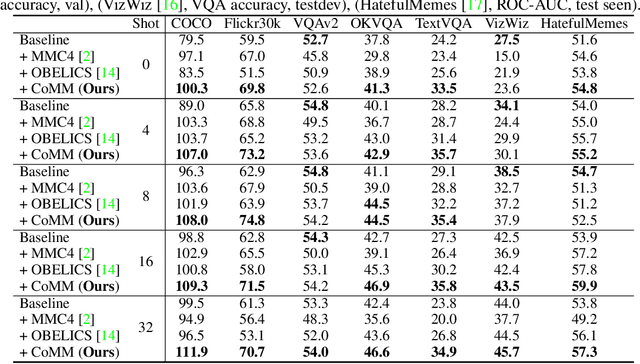
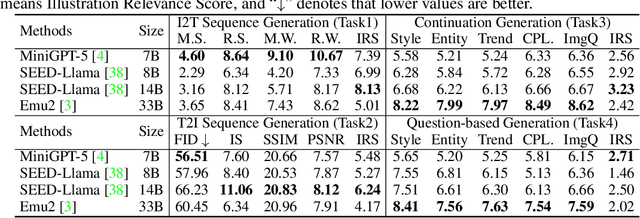
Interleaved image-text generation has emerged as a crucial multimodal task, aiming at creating sequences of interleaved visual and textual content given a query. Despite notable advancements in recent multimodal large language models (MLLMs), generating integrated image-text sequences that exhibit narrative coherence and entity and style consistency remains challenging due to poor training data quality. To address this gap, we introduce CoMM, a high-quality Coherent interleaved image-text MultiModal dataset designed to enhance the coherence, consistency, and alignment of generated multimodal content. Initially, CoMM harnesses raw data from diverse sources, focusing on instructional content and visual storytelling, establishing a foundation for coherent and consistent content. To further refine the data quality, we devise a multi-perspective filter strategy that leverages advanced pre-trained models to ensure the development of sentences, consistency of inserted images, and semantic alignment between them. Various quality evaluation metrics are designed to prove the high quality of the filtered dataset. Meanwhile, extensive few-shot experiments on various downstream tasks demonstrate CoMM's effectiveness in significantly enhancing the in-context learning capabilities of MLLMs. Moreover, we propose four new tasks to evaluate MLLMs' interleaved generation abilities, supported by a comprehensive evaluation framework. We believe CoMM opens a new avenue for advanced MLLMs with superior multimodal in-context learning and understanding ability.
MIND: Multimodal Shopping Intention Distillation from Large Vision-language Models for E-commerce Purchase Understanding
Jun 15, 2024

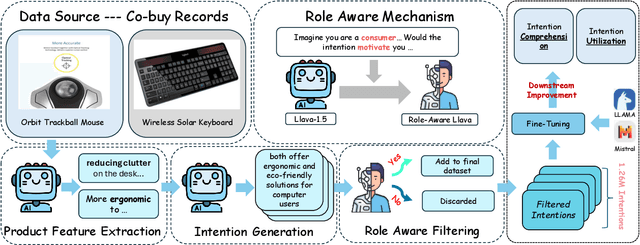

Improving user experience and providing personalized search results in E-commerce platforms heavily rely on understanding purchase intention. However, existing methods for acquiring large-scale intentions bank on distilling large language models with human annotation for verification. Such an approach tends to generate product-centric intentions, overlook valuable visual information from product images, and incurs high costs for scalability. To address these issues, we introduce MIND, a multimodal framework that allows Large Vision-Language Models (LVLMs) to infer purchase intentions from multimodal product metadata and prioritize human-centric ones. Using Amazon Review data, we apply MIND and create a multimodal intention knowledge base, which contains 1,264,441 million intentions derived from 126,142 co-buy shopping records across 107,215 products. Extensive human evaluations demonstrate the high plausibility and typicality of our obtained intentions and validate the effectiveness of our distillation framework and filtering mechanism. Additional experiments reveal that our obtained intentions significantly enhance large language models in two intention comprehension tasks.
CarLLaVA: Vision language models for camera-only closed-loop driving
Jun 14, 2024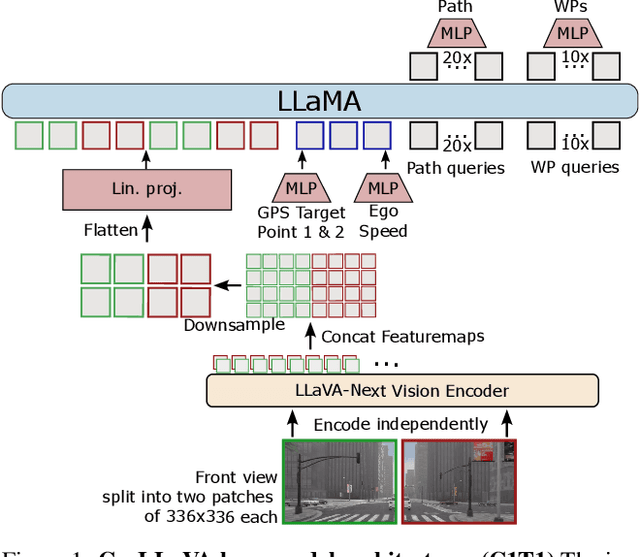
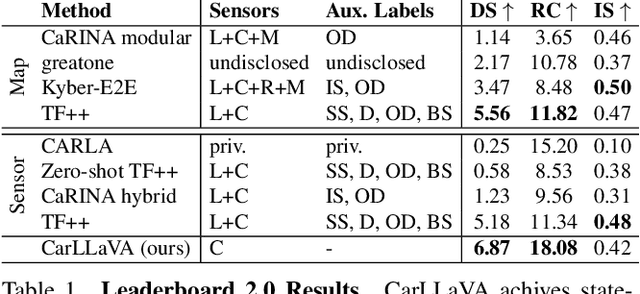
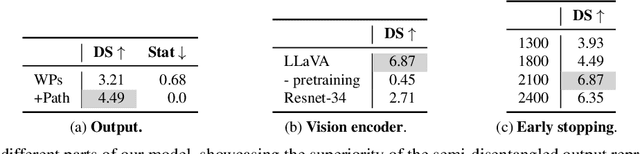

In this technical report, we present CarLLaVA, a Vision Language Model (VLM) for autonomous driving, developed for the CARLA Autonomous Driving Challenge 2.0. CarLLaVA uses the vision encoder of the LLaVA VLM and the LLaMA architecture as backbone, achieving state-of-the-art closed-loop driving performance with only camera input and without the need for complex or expensive labels. Additionally, we show preliminary results on predicting language commentary alongside the driving output. CarLLaVA uses a semi-disentangled output representation of both path predictions and waypoints, getting the advantages of the path for better lateral control and the waypoints for better longitudinal control. We propose an efficient training recipe to train on large driving datasets without wasting compute on easy, trivial data. CarLLaVA ranks 1st place in the sensor track of the CARLA Autonomous Driving Challenge 2.0 outperforming the previous state of the art by 458% and the best concurrent submission by 32.6%.
DiffPoGAN: Diffusion Policies with Generative Adversarial Networks for Offline Reinforcement Learning
Jun 13, 2024Offline reinforcement learning (RL) can learn optimal policies from pre-collected offline datasets without interacting with the environment, but the sampled actions of the agent cannot often cover the action distribution under a given state, resulting in the extrapolation error issue. Recent works address this issue by employing generative adversarial networks (GANs). However, these methods often suffer from insufficient constraints on policy exploration and inaccurate representation of behavior policies. Moreover, the generator in GANs fails in fooling the discriminator while maximizing the expected returns of a policy. Inspired by the diffusion, a generative model with powerful feature expressiveness, we propose a new offline RL method named Diffusion Policies with Generative Adversarial Networks (DiffPoGAN). In this approach, the diffusion serves as the policy generator to generate diverse distributions of actions, and a regularization method based on maximum likelihood estimation (MLE) is developed to generate data that approximate the distribution of behavior policies. Besides, we introduce an additional regularization term based on the discriminator output to effectively constrain policy exploration for policy improvement. Comprehensive experiments are conducted on the datasets for deep data-driven reinforcement learning (D4RL), and experimental results show that DiffPoGAN outperforms state-of-the-art methods in offline RL.
Instruct Large Language Models to Drive like Humans
Jun 11, 2024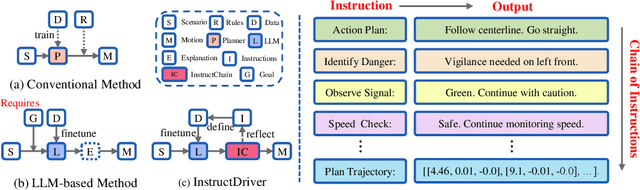
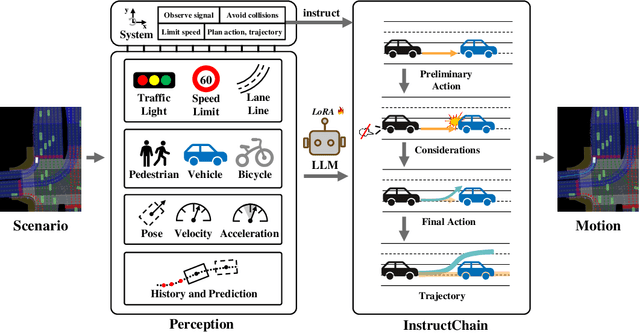

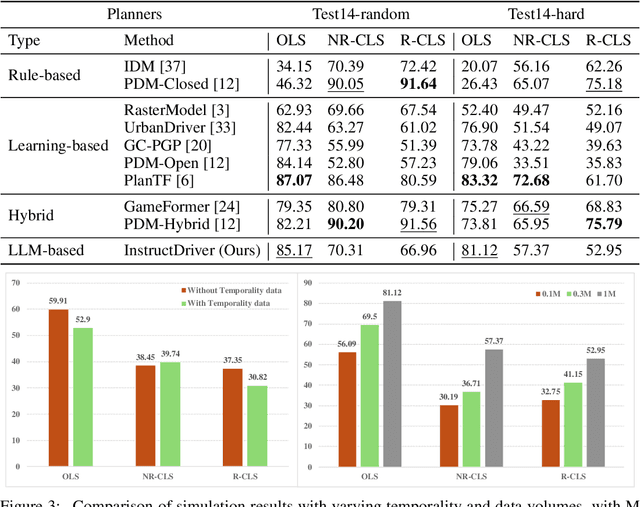
Motion planning in complex scenarios is the core challenge in autonomous driving. Conventional methods apply predefined rules or learn from driving data to plan the future trajectory. Recent methods seek the knowledge preserved in large language models (LLMs) and apply them in the driving scenarios. Despite the promising results, it is still unclear whether the LLM learns the underlying human logic to drive. In this paper, we propose an InstructDriver method to transform LLM into a motion planner with explicit instruction tuning to align its behavior with humans. We derive driving instruction data based on human logic (e.g., do not cause collisions) and traffic rules (e.g., proceed only when green lights). We then employ an interpretable InstructChain module to further reason the final planning reflecting the instructions. Our InstructDriver allows the injection of human rules and learning from driving data, enabling both interpretability and data scalability. Different from existing methods that experimented on closed-loop or simulated settings, we adopt the real-world closed-loop motion planning nuPlan benchmark for better evaluation. InstructDriver demonstrates the effectiveness of the LLM planner in a real-world closed-loop setting. Our code is publicly available at https://github.com/bonbon-rj/InstructDriver.
Towards Efficient Deep Spiking Neural Networks Construction with Spiking Activity based Pruning
Jun 03, 2024


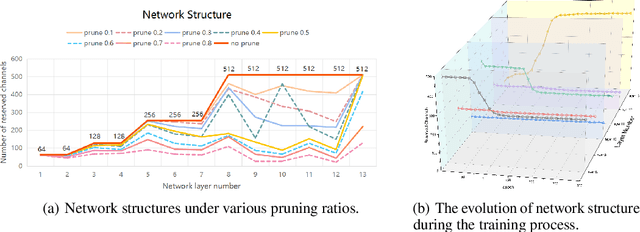
The emergence of deep and large-scale spiking neural networks (SNNs) exhibiting high performance across diverse complex datasets has led to a need for compressing network models due to the presence of a significant number of redundant structural units, aiming to more effectively leverage their low-power consumption and biological interpretability advantages. Currently, most model compression techniques for SNNs are based on unstructured pruning of individual connections, which requires specific hardware support. Hence, we propose a structured pruning approach based on the activity levels of convolutional kernels named Spiking Channel Activity-based (SCA) network pruning framework. Inspired by synaptic plasticity mechanisms, our method dynamically adjusts the network's structure by pruning and regenerating convolutional kernels during training, enhancing the model's adaptation to the current target task. While maintaining model performance, this approach refines the network architecture, ultimately reducing computational load and accelerating the inference process. This indicates that structured dynamic sparse learning methods can better facilitate the application of deep SNNs in low-power and high-efficiency scenarios.
RAP: Efficient Text-Video Retrieval with Sparse-and-Correlated Adapter
May 29, 2024Text-Video Retrieval (TVR) aims to align relevant video content with natural language queries. To date, most state-of-the-art TVR methods learn image-to-video transfer learning based on large-scale pre-trained visionlanguage models (e.g., CLIP). However, fully fine-tuning these pre-trained models for TVR incurs prohibitively expensive computation costs. To this end, we propose to conduct efficient text-video Retrieval with a sparse-andcorrelated AdaPter (RAP), i.e., fine-tuning the pre-trained model with a few parameterized layers. To accommodate the text-video scenario, we equip our RAP with two indispensable characteristics: temporal sparsity and correlation. Specifically, we propose a low-rank modulation module to refine the per-image features from the frozen CLIP backbone, which accentuates salient frames within the video features while alleviating temporal redundancy. Besides, we introduce an asynchronous self-attention mechanism that first selects the top responsive visual patches and augments the correlation modeling between them with learnable temporal and patch offsets. Extensive experiments on four TVR datasets demonstrate that RAP achieves superior or comparable performance compared to the fully fine-tuned counterpart and other parameter-efficient fine-tuning methods.
$\text{Di}^2\text{Pose}$: Discrete Diffusion Model for Occluded 3D Human Pose Estimation
May 27, 2024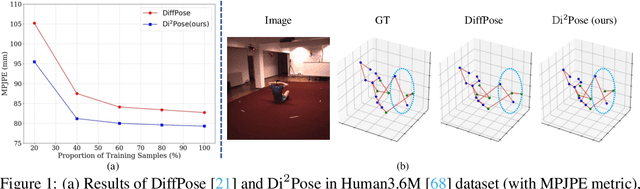
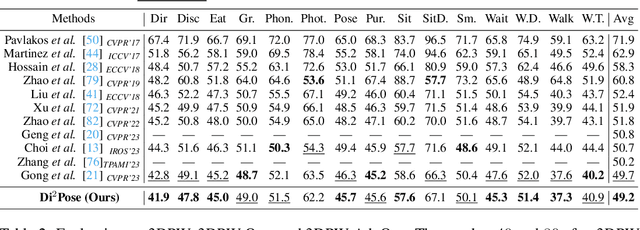
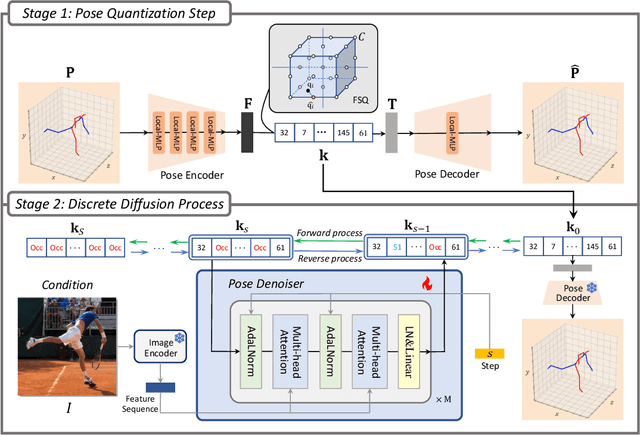
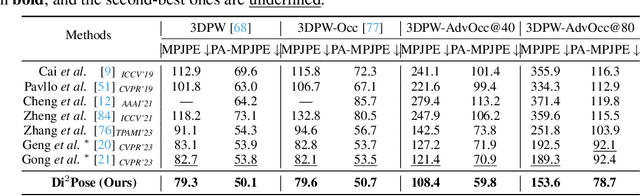
Continuous diffusion models have demonstrated their effectiveness in addressing the inherent uncertainty and indeterminacy in monocular 3D human pose estimation (HPE). Despite their strengths, the need for large search spaces and the corresponding demand for substantial training data make these models prone to generating biomechanically unrealistic poses. This challenge is particularly noticeable in occlusion scenarios, where the complexity of inferring 3D structures from 2D images intensifies. In response to these limitations, we introduce the Discrete Diffusion Pose ($\text{Di}^2\text{Pose}$), a novel framework designed for occluded 3D HPE that capitalizes on the benefits of a discrete diffusion model. Specifically, $\text{Di}^2\text{Pose}$ employs a two-stage process: it first converts 3D poses into a discrete representation through a \emph{pose quantization step}, which is subsequently modeled in latent space through a \emph{discrete diffusion process}. This methodological innovation restrictively confines the search space towards physically viable configurations and enhances the model's capability to comprehend how occlusions affect human pose within the latent space. Extensive evaluations conducted on various benchmarks (e.g., Human3.6M, 3DPW, and 3DPW-Occ) have demonstrated its effectiveness.
3D Unsupervised Learning by Distilling 2D Open-Vocabulary Segmentation Models for Autonomous Driving
May 24, 2024
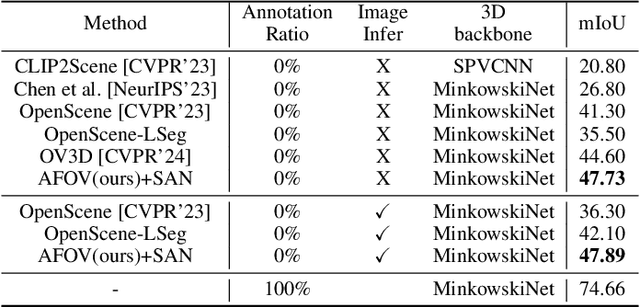
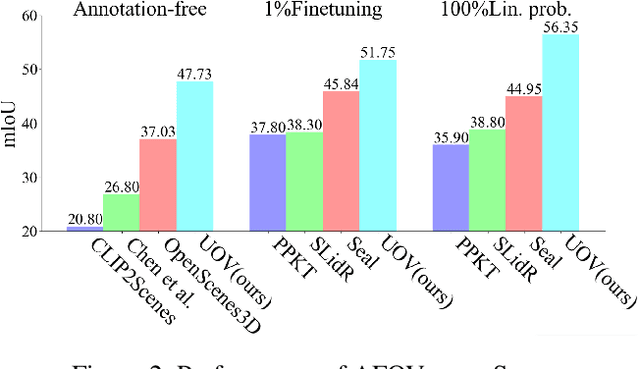
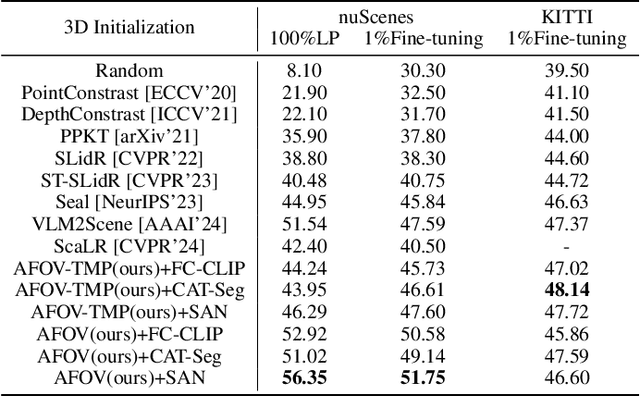
Point cloud data labeling is considered a time-consuming and expensive task in autonomous driving, whereas unsupervised learning can avoid it by learning point cloud representations from unannotated data. In this paper, we propose UOV, a novel 3D Unsupervised framework assisted by 2D Open-Vocabulary segmentation models. It consists of two stages: In the first stage, we innovatively integrate high-quality textual and image features of 2D open-vocabulary models and propose the Tri-Modal contrastive Pre-training (TMP). In the second stage, spatial mapping between point clouds and images is utilized to generate pseudo-labels, enabling cross-modal knowledge distillation. Besides, we introduce the Approximate Flat Interaction (AFI) to address the noise during alignment and label confusion. To validate the superiority of UOV, extensive experiments are conducted on multiple related datasets. We achieved a record-breaking 47.73% mIoU on the annotation-free point cloud segmentation task in nuScenes, surpassing the previous best model by 10.70% mIoU. Meanwhile, the performance of fine-tuning with 1% data on nuScenes and SemanticKITTI reached a remarkable 51.75% mIoU and 48.14% mIoU, outperforming all previous pre-trained models.