 Add to Chrome
 Add to Firefox
 Add to Edge
Manta: Enhancing Mamba for Few-Shot Action Recognition of Long Sub-Sequence
Dec 10, 2024
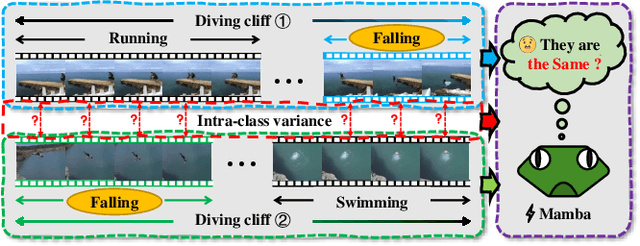
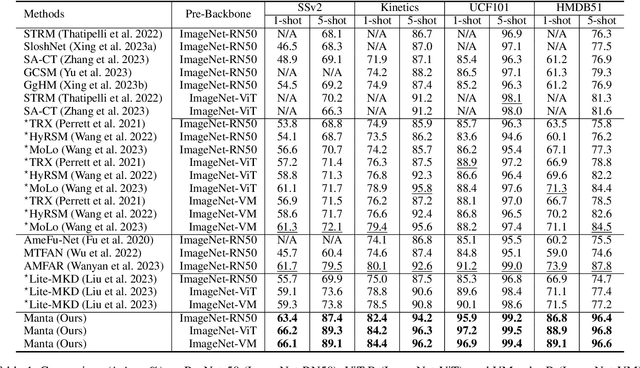
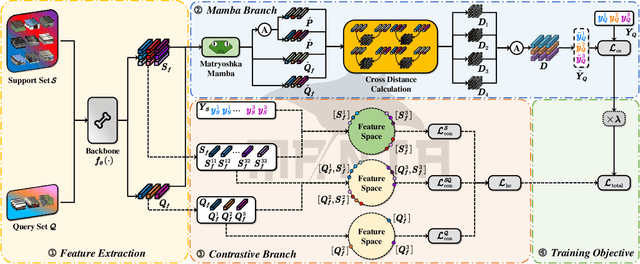
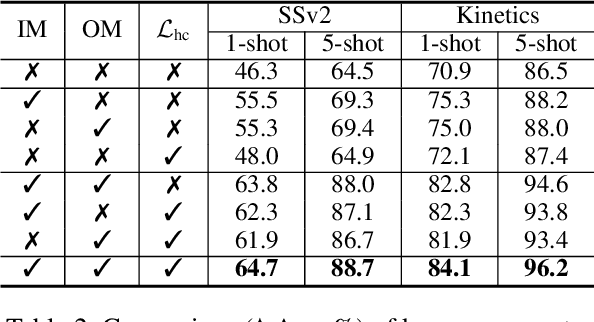
In few-shot action recognition~(FSAR), long sub-sequences of video naturally express entire actions more effectively. However, the computational complexity of mainstream Transformer-based methods limits their application. Recent Mamba demonstrates efficiency in modeling long sequences, but directly applying Mamba to FSAR overlooks the importance of local feature modeling and alignment. Moreover, long sub-sequences within the same class accumulate intra-class variance, which adversely impacts FSAR performance. To solve these challenges, we propose a \underline{\textbf{M}}atryoshka M\underline{\textbf{A}}mba and Co\underline{\textbf{N}}tras\underline{\textbf{T}}ive Le\underline{\textbf{A}}rning framework~(\textbf{Manta}). Firstly, the Matryoshka Mamba introduces multiple Inner Modules to enhance local feature representation, rather than directly modeling global features. An Outer Module captures dependencies of timeline between these local features for implicit temporal alignment. Secondly, a hybrid contrastive learning paradigm, combining both supervised and unsupervised methods, is designed to mitigate the negative effects of intra-class variance accumulation. The Matryoshka Mamba and the hybrid contrastive learning paradigm operate in parallel branches within Manta, enhancing Mamba for FSAR of long sub-sequence. Manta achieves new state-of-the-art performance on prominent benchmarks, including SSv2, Kinetics, UCF101, and HMDB51. Extensive empirical studies prove that Manta significantly improves FSAR of long sub-sequence from multiple perspectives. The code is released at https://github.com/wenbohuang1002/Manta.

Evaluating and Aligning CodeLLMs on Human Preference
Dec 06, 2024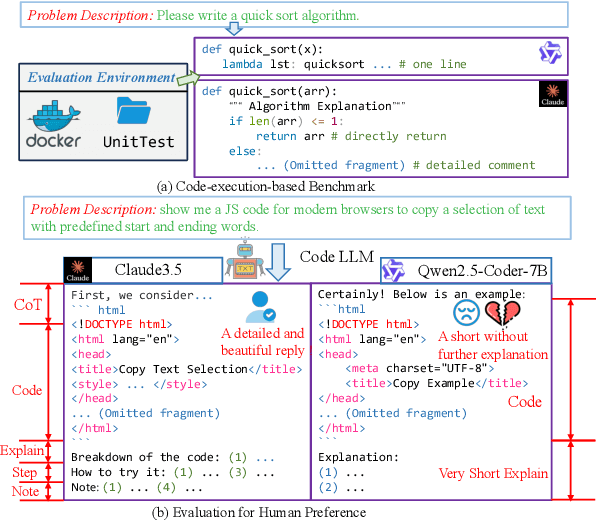
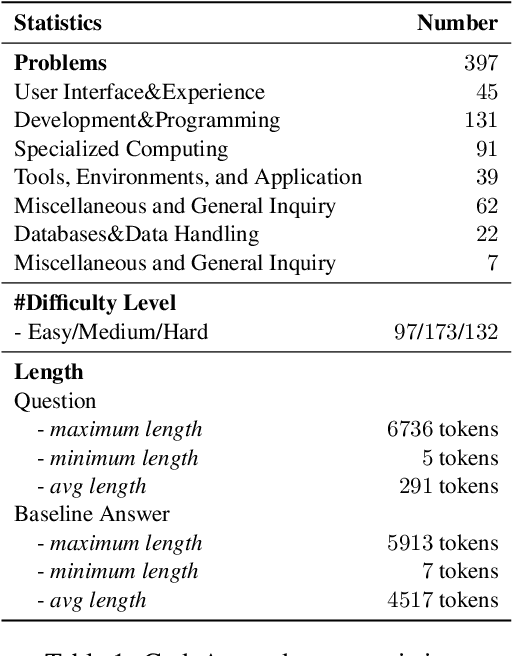
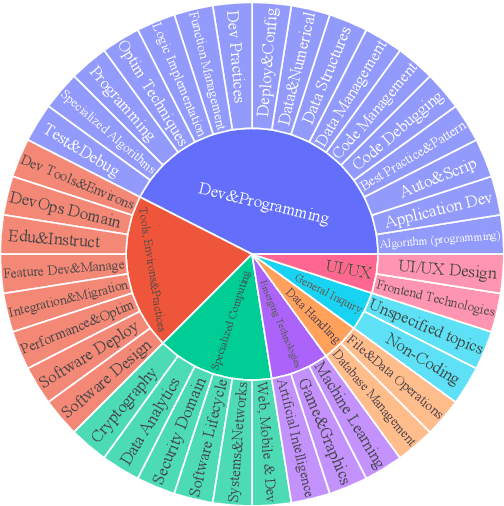
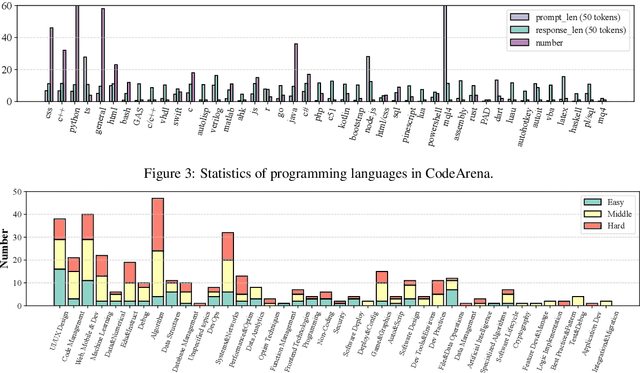
Code large language models (codeLLMs) have made significant strides in code generation. Most previous code-related benchmarks, which consist of various programming exercises along with the corresponding test cases, are used as a common measure to evaluate the performance and capabilities of code LLMs. However, the current code LLMs focus on synthesizing the correct code snippet, ignoring the alignment with human preferences, where the query should be sampled from the practical application scenarios and the model-generated responses should satisfy the human preference. To bridge the gap between the model-generated response and human preference, we present a rigorous human-curated benchmark CodeArena to emulate the complexity and diversity of real-world coding tasks, where 397 high-quality samples spanning 40 categories and 44 programming languages, carefully curated from user queries. Further, we propose a diverse synthetic instruction corpus SynCode-Instruct (nearly 20B tokens) by scaling instructions from the website to verify the effectiveness of the large-scale synthetic instruction fine-tuning, where Qwen2.5-SynCoder totally trained on synthetic instruction data can achieve top-tier performance of open-source code LLMs. The results find performance differences between execution-based benchmarks and CodeArena. Our systematic experiments of CodeArena on 40+ LLMs reveal a notable performance gap between open SOTA code LLMs (e.g. Qwen2.5-Coder) and proprietary LLMs (e.g., OpenAI o1), underscoring the importance of the human preference alignment.\footnote{\url{https://codearenaeval.github.io/ }}
Pixel-level and Semantic-level Adjustable Super-resolution: A Dual-LoRA Approach
Dec 04, 2024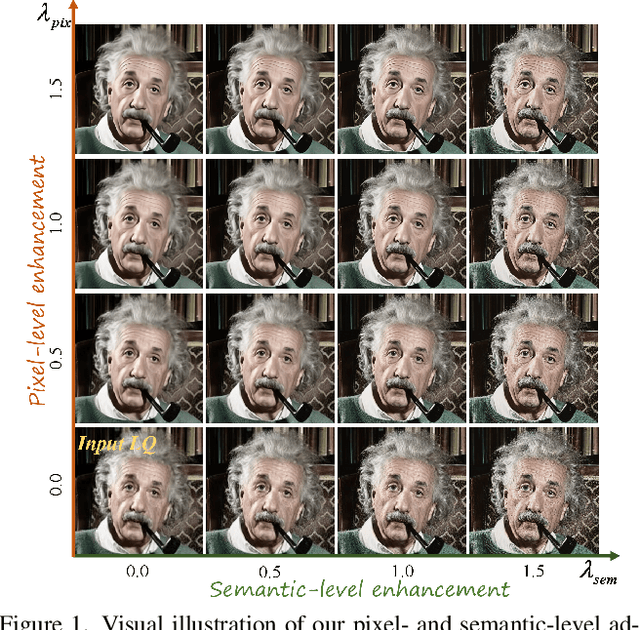


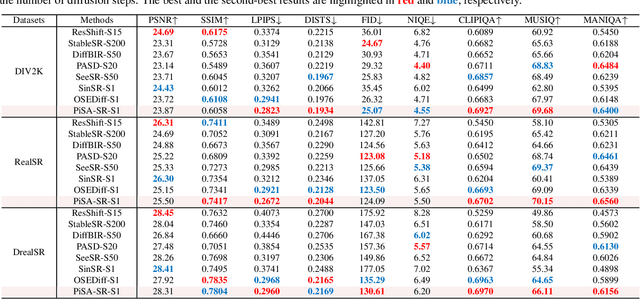
Diffusion prior-based methods have shown impressive results in real-world image super-resolution (SR). However, most existing methods entangle pixel-level and semantic-level SR objectives in the training process, struggling to balance pixel-wise fidelity and perceptual quality. Meanwhile, users have varying preferences on SR results, thus it is demanded to develop an adjustable SR model that can be tailored to different fidelity-perception preferences during inference without re-training. We present Pixel-level and Semantic-level Adjustable SR (PiSA-SR), which learns two LoRA modules upon the pre-trained stable-diffusion (SD) model to achieve improved and adjustable SR results. We first formulate the SD-based SR problem as learning the residual between the low-quality input and the high-quality output, then show that the learning objective can be decoupled into two distinct LoRA weight spaces: one is characterized by the $\ell_2$-loss for pixel-level regression, and another is characterized by the LPIPS and classifier score distillation losses to extract semantic information from pre-trained classification and SD models. In its default setting, PiSA-SR can be performed in a single diffusion step, achieving leading real-world SR results in both quality and efficiency. By introducing two adjustable guidance scales on the two LoRA modules to control the strengths of pixel-wise fidelity and semantic-level details during inference, PiSASR can offer flexible SR results according to user preference without re-training. Codes and models can be found at https://github.com/csslc/PiSA-SR.
Single-Cell Omics Arena: A Benchmark Study for Large Language Models on Cell Type Annotation Using Single-Cell Data
Dec 03, 2024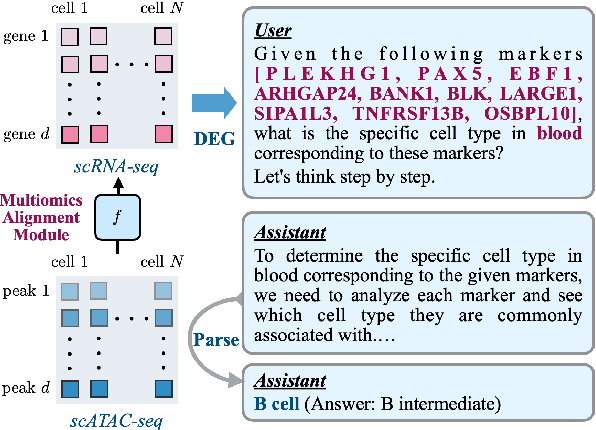
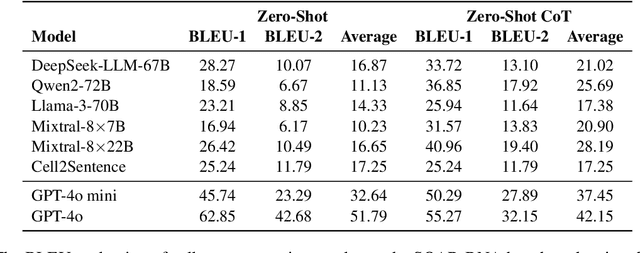

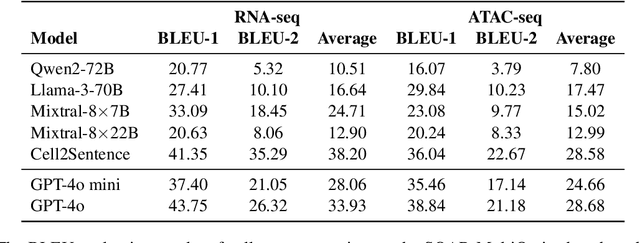
Over the past decade, the revolution in single-cell sequencing has enabled the simultaneous molecular profiling of various modalities across thousands of individual cells, allowing scientists to investigate the diverse functions of complex tissues and uncover underlying disease mechanisms. Among all the analytical steps, assigning individual cells to specific types is fundamental for understanding cellular heterogeneity. However, this process is usually labor-intensive and requires extensive expert knowledge. Recent advances in large language models (LLMs) have demonstrated their ability to efficiently process and synthesize vast corpora of text to automatically extract essential biological knowledge, such as marker genes, potentially promoting more efficient and automated cell type annotations. To thoroughly evaluate the capability of modern instruction-tuned LLMs in automating the cell type identification process, we introduce SOAR, a comprehensive benchmarking study of LLMs for cell type annotation tasks in single-cell genomics. Specifically, we assess the performance of 8 instruction-tuned LLMs across 11 datasets, spanning multiple cell types and species. Our study explores the potential of LLMs to accurately classify and annotate cell types in single-cell RNA sequencing (scRNA-seq) data, while extending their application to multiomics data through cross-modality translation. Additionally, we evaluate the effectiveness of chain-of-thought (CoT) prompting techniques in generating detailed biological insights during the annotation process. The results demonstrate that LLMs can provide robust interpretations of single-cell data without requiring additional fine-tuning, advancing the automation of cell type annotation in genomics research.
HandOS: 3D Hand Reconstruction in One Stage
Dec 02, 2024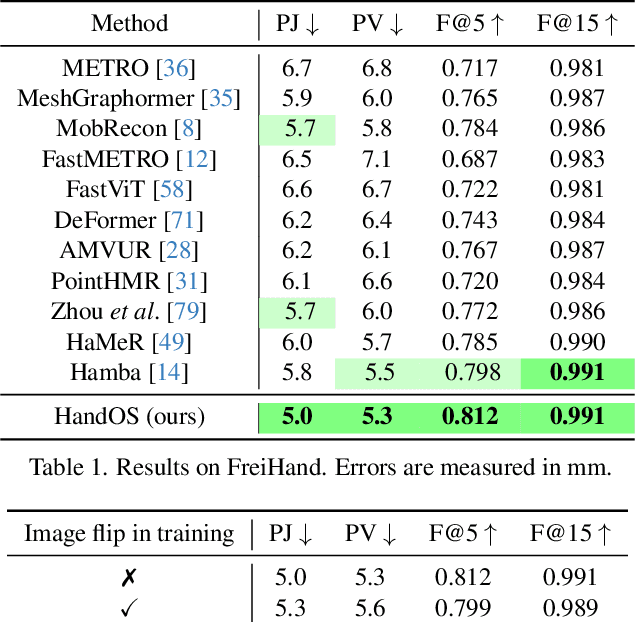
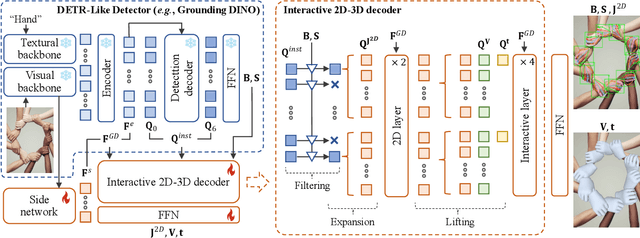
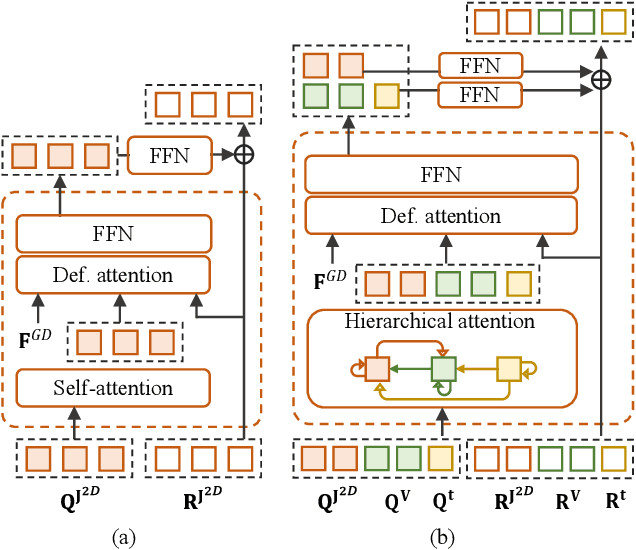
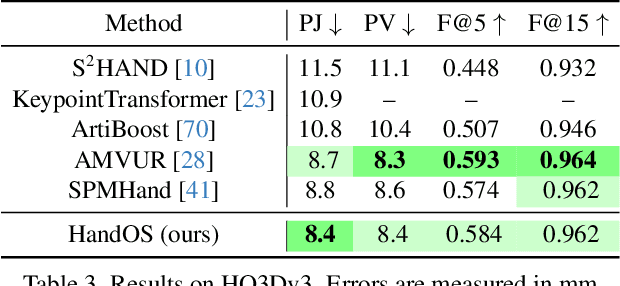
Existing approaches of hand reconstruction predominantly adhere to a multi-stage framework, encompassing detection, left-right classification, and pose estimation. This paradigm induces redundant computation and cumulative errors. In this work, we propose HandOS, an end-to-end framework for 3D hand reconstruction. Our central motivation lies in leveraging a frozen detector as the foundation while incorporating auxiliary modules for 2D and 3D keypoint estimation. In this manner, we integrate the pose estimation capacity into the detection framework, while at the same time obviating the necessity of using the left-right category as a prerequisite. Specifically, we propose an interactive 2D-3D decoder, where 2D joint semantics is derived from detection cues while 3D representation is lifted from those of 2D joints. Furthermore, hierarchical attention is designed to enable the concurrent modeling of 2D joints, 3D vertices, and camera translation. Consequently, we achieve an end-to-end integration of hand detection, 2D pose estimation, and 3D mesh reconstruction within a one-stage framework, so that the above multi-stage drawbacks are overcome. Meanwhile, the HandOS reaches state-of-the-art performances on public benchmarks, e.g., 5.0 PA-MPJPE on FreiHand and 64.6\% PCK@0.05 on HInt-Ego4D. Project page: idea-research.github.io/HandOSweb.
ChatRex: Taming Multimodal LLM for Joint Perception and Understanding
Dec 02, 2024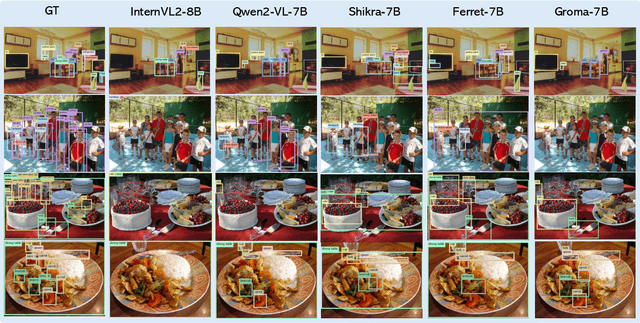
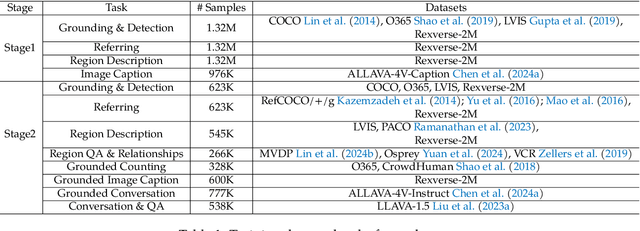
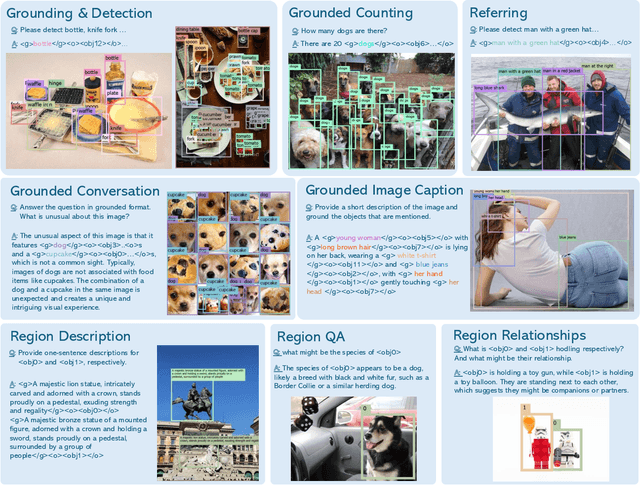
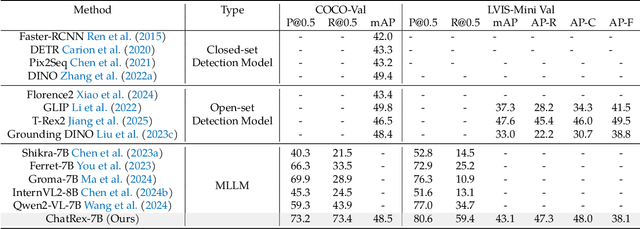
Perception and understanding are two pillars of computer vision. While multimodal large language models (MLLM) have demonstrated remarkable visual understanding capabilities, they arguably lack accurate perception abilities, e.g. the stage-of-the-art model Qwen2-VL only achieves a 43.9 recall rate on the COCO dataset, limiting many tasks requiring the combination of perception and understanding. In this work, we aim to bridge this perception gap from both model designing and data development perspectives. We first introduce ChatRex, an MLLM with a decoupled perception design. Instead of having the LLM directly predict box coordinates, we feed the output boxes from a universal proposal network into the LLM, allowing it to output the corresponding box indices to represent its detection results, turning the regression task into a retrieval-based task that LLM handles more proficiently. From the data perspective, we build a fully automated data engine and construct the Rexverse-2M dataset which possesses multiple granularities to support the joint training of perception and understanding. After standard two-stage training, ChatRex demonstrates strong perception capabilities while preserving multimodal understanding performance. The combination of these two capabilities simultaneously unlocks many attractive applications, demonstrating the complementary roles of both perception and understanding in MLLM. Code is available at \url{https://github.com/IDEA-Research/ChatRex}.
Learning on Less: Constraining Pre-trained Model Learning for Generalizable Diffusion-Generated Image Detection
Dec 01, 2024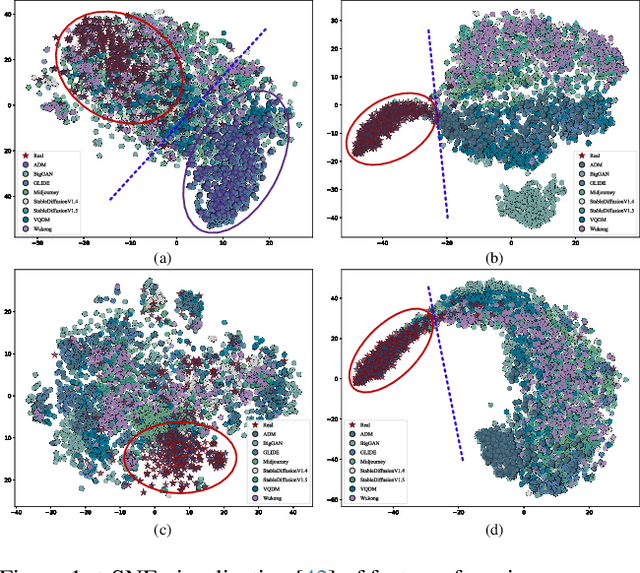
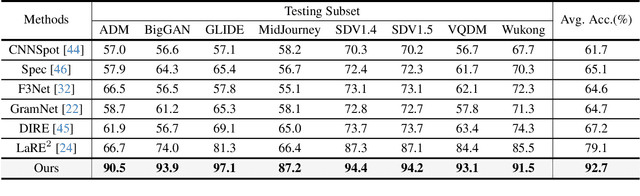
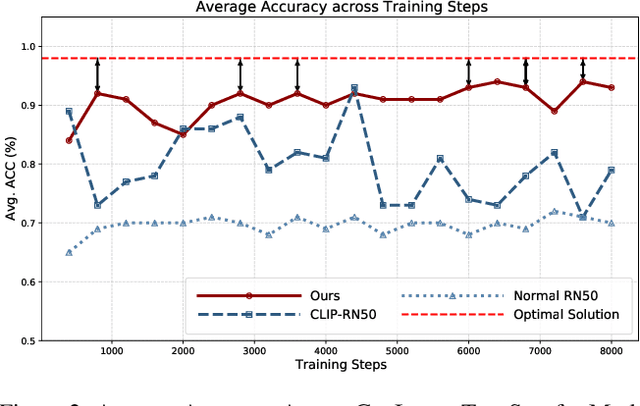
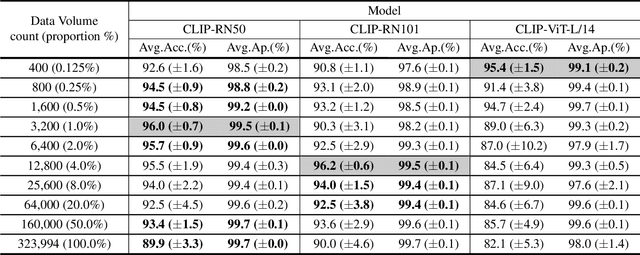
Diffusion Models enable realistic image generation, raising the risk of misinformation and eroding public trust. Currently, detecting images generated by unseen diffusion models remains challenging due to the limited generalization capabilities of existing methods. To address this issue, we rethink the effectiveness of pre-trained models trained on large-scale, real-world images. Our findings indicate that: 1) Pre-trained models can cluster the features of real images effectively. 2) Models with pre-trained weights can approximate an optimal generalization solution at a specific training step, but it is extremely unstable. Based on these facts, we propose a simple yet effective training method called Learning on Less (LoL). LoL utilizes a random masking mechanism to constrain the model's learning of the unique patterns specific to a certain type of diffusion model, allowing it to focus on less image content. This leverages the inherent strengths of pre-trained weights while enabling a more stable approach to optimal generalization, which results in the extraction of a universal feature that differentiates various diffusion-generated images from real images. Extensive experiments on the GenImage benchmark demonstrate the remarkable generalization capability of our proposed LoL. With just 1% training data, LoL significantly outperforms the current state-of-the-art, achieving a 13.6% improvement in average ACC across images generated by eight different models.
Don't Let Your Robot be Harmful: Responsible Robotic Manipulation
Nov 27, 2024Unthinking execution of human instructions in robotic manipulation can lead to severe safety risks, such as poisonings, fires, and even explosions. In this paper, we present responsible robotic manipulation, which requires robots to consider potential hazards in the real-world environment while completing instructions and performing complex operations safely and efficiently. However, such scenarios in real world are variable and risky for training. To address this challenge, we propose Safety-as-policy, which includes (i) a world model to automatically generate scenarios containing safety risks and conduct virtual interactions, and (ii) a mental model to infer consequences with reflections and gradually develop the cognition of safety, allowing robots to accomplish tasks while avoiding dangers. Additionally, we create the SafeBox synthetic dataset, which includes one hundred responsible robotic manipulation tasks with different safety risk scenarios and instructions, effectively reducing the risks associated with real-world experiments. Experiments demonstrate that Safety-as-policy can avoid risks and efficiently complete tasks in both synthetic dataset and real-world experiments, significantly outperforming baseline methods. Our SafeBox dataset shows consistent evaluation results with real-world scenarios, serving as a safe and effective benchmark for future research.
TAPTRv3: Spatial and Temporal Context Foster Robust Tracking of Any Point in Long Video
Nov 27, 2024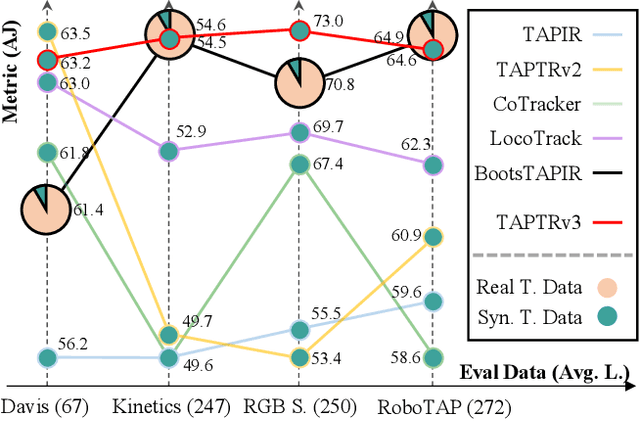
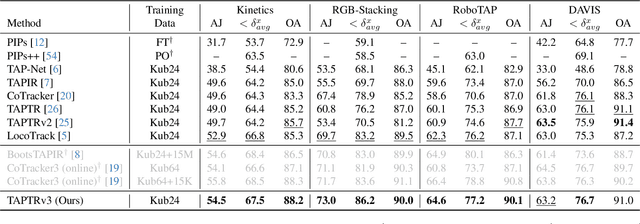
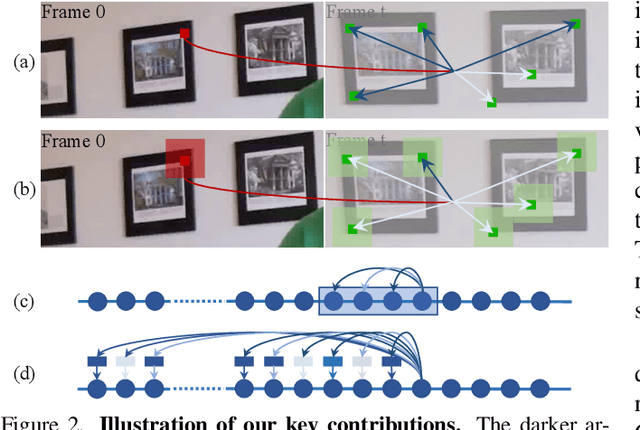
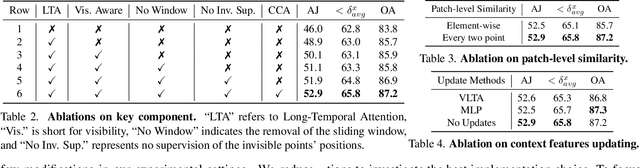
In this paper, we present TAPTRv3, which is built upon TAPTRv2 to improve its point tracking robustness in long videos. TAPTRv2 is a simple DETR-like framework that can accurately track any point in real-world videos without requiring cost-volume. TAPTRv3 improves TAPTRv2 by addressing its shortage in querying high quality features from long videos, where the target tracking points normally undergo increasing variation over time. In TAPTRv3, we propose to utilize both spatial and temporal context to bring better feature querying along the spatial and temporal dimensions for more robust tracking in long videos. For better spatial feature querying, we present Context-aware Cross-Attention (CCA), which leverages surrounding spatial context to enhance the quality of attention scores when querying image features. For better temporal feature querying, we introduce Visibility-aware Long-Temporal Attention (VLTA) to conduct temporal attention to all past frames while considering their corresponding visibilities, which effectively addresses the feature drifting problem in TAPTRv2 brought by its RNN-like long-temporal modeling. TAPTRv3 surpasses TAPTRv2 by a large margin on most of the challenging datasets and obtains state-of-the-art performance. Even when compared with methods trained with large-scale extra internal data, TAPTRv3 is still competitive.
Scaling Speech-Text Pre-training with Synthetic Interleaved Data
Nov 26, 2024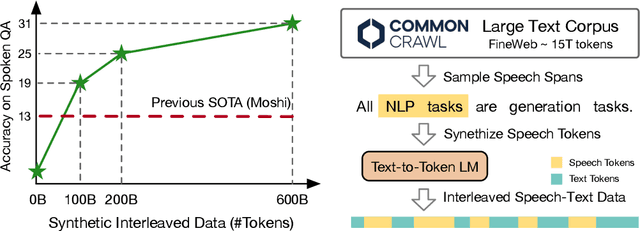
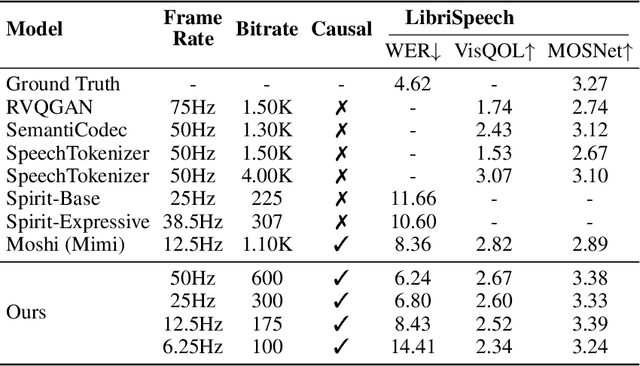
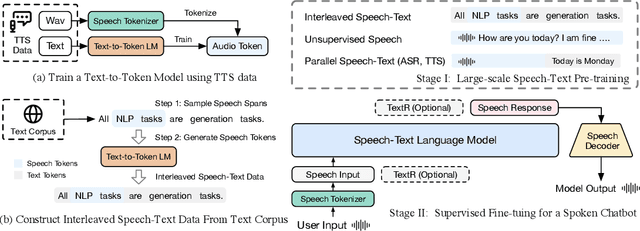
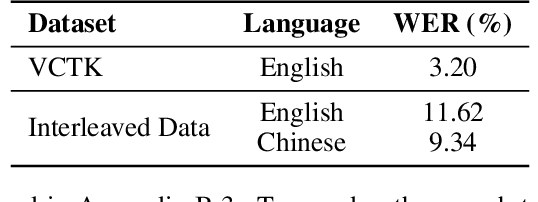
Speech language models (SpeechLMs) accept speech input and produce speech output, allowing for more natural human-computer interaction compared to text-based large language models (LLMs). Traditional approaches for developing SpeechLMs are constrained by the limited availability of unsupervised speech data and parallel speech-text data, which are significantly less abundant than text pre-training data, thereby limiting their scalability as LLMs. We propose a novel approach to scaling speech-text pre-training by leveraging large-scale synthetic interleaved data derived from text corpora, eliminating the need for parallel speech-text datasets. Our method efficiently constructs speech-text interleaved data by sampling text spans from existing text corpora and synthesizing corresponding speech spans using a text-to-token model, bypassing the need to generate actual speech. We also employ a supervised speech tokenizer derived from an automatic speech recognition (ASR) model by incorporating a vector-quantized bottleneck into the encoder. This supervised training approach results in discrete speech tokens with strong semantic preservation even at lower sampling rates (e.g. 12.5Hz), while still maintaining speech reconstruction quality. Starting from a pre-trained language model and scaling our pre-training to 1 trillion tokens (with 600B synthetic interleaved speech-text data), we achieve state-of-the-art performance in speech language modeling and spoken question answering, improving performance on spoken questions tasks from the previous SOTA of 13% (Moshi) to 31%. We further demonstrate that by fine-tuning the pre-trained model with speech dialogue data, we can develop an end-to-end spoken chatbot that achieves competitive performance comparable to existing baselines in both conversational abilities and speech quality, even operating exclusively in the speech domain.