 Add to Chrome
 Add to Firefox
 Add to Edge
PixRestore: Unified Image Restoration via Pixel Diffusion Transformer
Aug 17, 2026
Unified image restoration (UIR) aims to recover high-quality (HQ) content from low-quality (LQ) images with different degradations using a single model. Most recent methods adapt large pretrained text-to-image (T2I) latent diffusion models for their strong capacity and generative priors. However, the variational autoencoder (VAE) in latent T2I models may discard restoration-sensitive details, while the open-ended synthesis prior can introduce content-inconsistent artifacts. We present PixRestore, a VAE-free pixel-space Diffusion Transformer (DiT) for UIR, where the diffusion backbone is trained entirely from scratch, without relying on T2I pretraining. PixRestore performs flow matching directly on patchified pixels, preserving fine-grained details while keeping the token sequence tractable. To adapt to different degradations, PixRestore learns to predict the reliability of layer features using LQ--HQ DINO feature similarity. Features from more reliable layers are fused as dense conditioning, while less reliable layers receive stronger HQ-feature supervision to encourage degradation removal. We train PixRestore on a large-scale corpus of diverse scenes and degradations, and further finetune it into a one-step generator using DINO-based adversarial objectives for efficient inference. Experiments on public benchmarks and real-world test sets show that, with only about 50M parameters and single-step inference, PixRestore achieves the best overall fidelity, perceptual quality, and robustness to degradations among competing UIR models while being far more efficient. Larger PixRestore variants can further boost performance, demonstrating the scalability of our pixel-space design. Code and the curated benchmark can be found at https://github.com/csslc/PixRestore.

Text-Vision Co-Instructed Image Editing
Jun 15, 2026Existing image editing methods can be generally categorized into textual instruction-based and visual prompt-based ones. Textual instructions are semantically expressive, but are limited by the coarse granularity of spatial control of the editing results. In contrast, visual prompts such as drag and point can provide precise spatial guidance, but are limited by the inherent ambiguity in semantic intent. To unify the strength of textual and visual prompts, we present Text-Vision Co-Instructed Image Editing, which jointly models textual instructions as semantic intent and sparse visual instructions as spatial guidance, aiming to achieve precise and intent-faithful image manipulation. To this end, we first construct a textual-visual instruction paired dataset with more than 23K samples derived from dynamic videos, enabling aligned supervision for cross-modal instruction. We then propose TV-Edit, a Textual-Visual instruction unified Editing framework to contextualize drag or point-based visual instructions with image-text semantics and lift them into semantic-aware control representations for pretrained editing backbones. By integrating semantic intent and spatial constraints, TV-Edit leads to more precise spatial control, less instruction ambiguity, and stronger structural consistency than text-only or drag-based alternatives. Finally, we establish TV-Edit-Bench, a deliberately designed benchmark to evaluate semantic faithfulness, spatial alignment, and visual consistency with ground-truth references and controlled textual-visual variations for reliable assessment. Our experiments across multiple editing backbones demonstrate that TV-Edit consistently yields more precise and intent-faithful edits, significantly outperforming state-of-the-art instruction-based and drag-based baselines.
LoViF 2026 Challenge on Real-World All-in-One Image Restoration: Methods and Results
Apr 21, 2026This paper presents a review for the LoViF Challenge on Real-World All-in-One Image Restoration. The challenge aimed to advance research on real-world all-in-one image restoration under diverse real-world degradation conditions, including blur, low-light, haze, rain, and snow. It provided a unified benchmark to evaluate the robustness and generalization ability of restoration models across multiple degradation categories within a common framework. The competition attracted 124 registered participants and received 9 valid final submissions with corresponding fact sheets, significantly contributing to the progress of real-world all-in-one image restoration. This report provides a detailed analysis of the submitted methods and corresponding results, emphasizing recent progress in unified real-world image restoration. The analysis highlights effective approaches and establishes a benchmark for future research in real-world low-level vision.
NTIRE 2026 The Second Challenge on Day and Night Raindrop Removal for Dual-Focused Images: Methods and Results
Apr 12, 2026This paper presents an overview of the NTIRE 2026 Second Challenge on Day and Night Raindrop Removal for Dual-Focused Images. Building upon the success of the first edition, this challenge attracted a wide range of impressive solutions, all developed and evaluated on our real-world Raindrop Clarity dataset~\cite{jin2024raindrop}. For this edition, we adjust the dataset with 14,139 images for training, 407 images for validation, and 593 images for testing. The primary goal of this challenge is to establish a strong and practical benchmark for the removal of raindrops under various illumination and focus conditions. In total, 168 teams have registered for the competition, and 17 teams submitted valid final solutions and fact sheets for the testing phase. The submitted methods achieved strong performance on the Raindrop Clarity dataset, demonstrating the growing progress in this challenging task.
GDPO-SR: Group Direct Preference Optimization for One-Step Generative Image Super-Resolution
Mar 16, 2026Recently, reinforcement learning (RL) has been employed for improving generative image super-resolution (ISR) performance. However, the current efforts are focused on multi-step generative ISR, while one-step generative ISR remains underexplored due to its limited stochasticity. In addition, RL methods such as Direct Preference Optimization (DPO) require the generation of positive and negative sample pairs offline, leading to a limited number of samples, while Group Relative Policy Optimization (GRPO) only calculates the likelihood of the entire image, ignoring local details that are crucial for ISR. In this paper, we propose Group Direct Preference Optimization (GDPO), a novel approach to integrate RL into one-step generative ISR model training. First, we introduce a noise-aware one-step diffusion model that can generate diverse ISR outputs. To prevent performance degradation caused by noise injection, we introduce an unequal-timestep strategy to decouple the timestep of noise addition from that of diffusion. We then present the GDPO strategy, which integrates the principle of GRPO into DPO, to calculate the group-relative advantage of each online generated sample for model optimization. Meanwhile, an attribute-aware reward function is designed to dynamically evaluate the score of each sample based on its statistics of smooth and texture areas. Experiments demonstrate the effectiveness of GDPO in enhancing the performance of one-step generative ISR models. Code: https://github.com/Joyies/GDPO.
CoCoEdit: Content-Consistent Image Editing via Region Regularized Reinforcement Learning
Feb 15, 2026Image editing has achieved impressive results with the development of large-scale generative models. However, existing models mainly focus on the editing effects of intended objects and regions, often leading to unwanted changes in unintended regions. We present a post-training framework for Content-Consistent Editing (CoCoEdit) via region regularized reinforcement learning. We first augment existing editing datasets with refined instructions and masks, from which 40K diverse and high quality samples are curated as training set. We then introduce a pixel-level similarity reward to complement MLLM-based rewards, enabling models to ensure both editing quality and content consistency during the editing process. To overcome the spatial-agnostic nature of the rewards, we propose a region-based regularizer, aiming to preserve non-edited regions for high-reward samples while encouraging editing effects for low-reward samples. For evaluation, we annotate editing masks for GEdit-Bench and ImgEdit-Bench, introducing pixel-level similarity metrics to measure content consistency and editing quality. Applying CoCoEdit to Qwen-Image-Edit and FLUX-Kontext, we achieve not only competitive editing scores with state-of-the-art models, but also significantly better content consistency, measured by PSNR/SSIM metrics and human subjective ratings.
DP$^2$O-SR: Direct Perceptual Preference Optimization for Real-World Image Super-Resolution
Oct 21, 2025Benefiting from pre-trained text-to-image (T2I) diffusion models, real-world image super-resolution (Real-ISR) methods can synthesize rich and realistic details. However, due to the inherent stochasticity of T2I models, different noise inputs often lead to outputs with varying perceptual quality. Although this randomness is sometimes seen as a limitation, it also introduces a wider perceptual quality range, which can be exploited to improve Real-ISR performance. To this end, we introduce Direct Perceptual Preference Optimization for Real-ISR (DP$^2$O-SR), a framework that aligns generative models with perceptual preferences without requiring costly human annotations. We construct a hybrid reward signal by combining full-reference and no-reference image quality assessment (IQA) models trained on large-scale human preference datasets. This reward encourages both structural fidelity and natural appearance. To better utilize perceptual diversity, we move beyond the standard best-vs-worst selection and construct multiple preference pairs from outputs of the same model. Our analysis reveals that the optimal selection ratio depends on model capacity: smaller models benefit from broader coverage, while larger models respond better to stronger contrast in supervision. Furthermore, we propose hierarchical preference optimization, which adaptively weights training pairs based on intra-group reward gaps and inter-group diversity, enabling more efficient and stable learning. Extensive experiments across both diffusion- and flow-based T2I backbones demonstrate that DP$^2$O-SR significantly improves perceptual quality and generalizes well to real-world benchmarks.
Fine-structure Preserved Real-world Image Super-resolution via Transfer VAE Training
Jul 27, 2025Impressive results on real-world image super-resolution (Real-ISR) have been achieved by employing pre-trained stable diffusion (SD) models. However, one critical issue of such methods lies in their poor reconstruction of image fine structures, such as small characters and textures, due to the aggressive resolution reduction of the VAE (eg., 8$\times$ downsampling) in the SD model. One solution is to employ a VAE with a lower downsampling rate for diffusion; however, adapting its latent features with the pre-trained UNet while mitigating the increased computational cost poses new challenges. To address these issues, we propose a Transfer VAE Training (TVT) strategy to transfer the 8$\times$ downsampled VAE into a 4$\times$ one while adapting to the pre-trained UNet. Specifically, we first train a 4$\times$ decoder based on the output features of the original VAE encoder, then train a 4$\times$ encoder while keeping the newly trained decoder fixed. Such a TVT strategy aligns the new encoder-decoder pair with the original VAE latent space while enhancing image fine details. Additionally, we introduce a compact VAE and compute-efficient UNet by optimizing their network architectures, reducing the computational cost while capturing high-resolution fine-scale features. Experimental results demonstrate that our TVT method significantly improves fine-structure preservation, which is often compromised by other SD-based methods, while requiring fewer FLOPs than state-of-the-art one-step diffusion models. The official code can be found at https://github.com/Joyies/TVT.
NTIRE 2025 Challenge on Day and Night Raindrop Removal for Dual-Focused Images: Methods and Results
Apr 19, 2025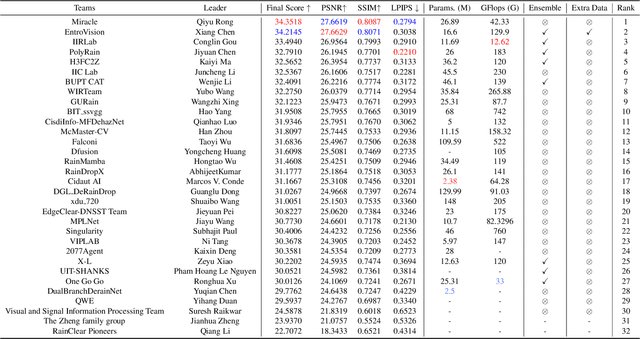
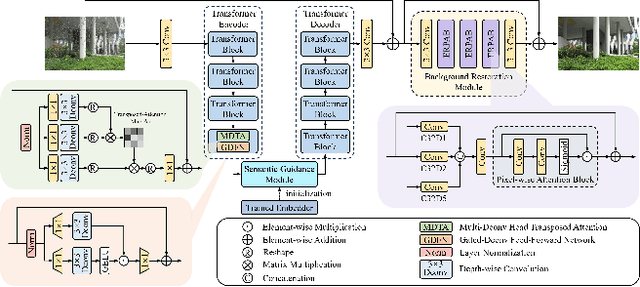
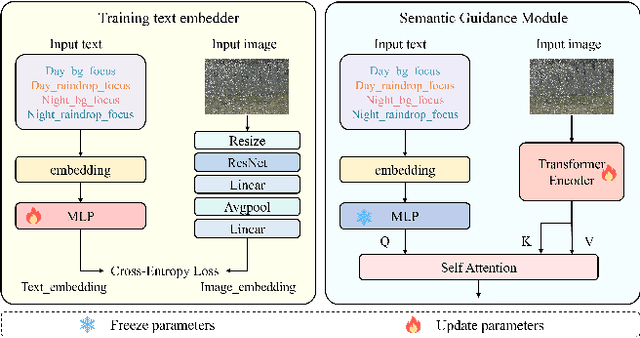
This paper reviews the NTIRE 2025 Challenge on Day and Night Raindrop Removal for Dual-Focused Images. This challenge received a wide range of impressive solutions, which are developed and evaluated using our collected real-world Raindrop Clarity dataset. Unlike existing deraining datasets, our Raindrop Clarity dataset is more diverse and challenging in degradation types and contents, which includes day raindrop-focused, day background-focused, night raindrop-focused, and night background-focused degradations. This dataset is divided into three subsets for competition: 14,139 images for training, 240 images for validation, and 731 images for testing. The primary objective of this challenge is to establish a new and powerful benchmark for the task of removing raindrops under varying lighting and focus conditions. There are a total of 361 participants in the competition, and 32 teams submitting valid solutions and fact sheets for the final testing phase. These submissions achieved state-of-the-art (SOTA) performance on the Raindrop Clarity dataset. The project can be found at https://lixinustc.github.io/CVPR-NTIRE2025-RainDrop-Competition.github.io/.
Pixel-level and Semantic-level Adjustable Super-resolution: A Dual-LoRA Approach
Dec 04, 2024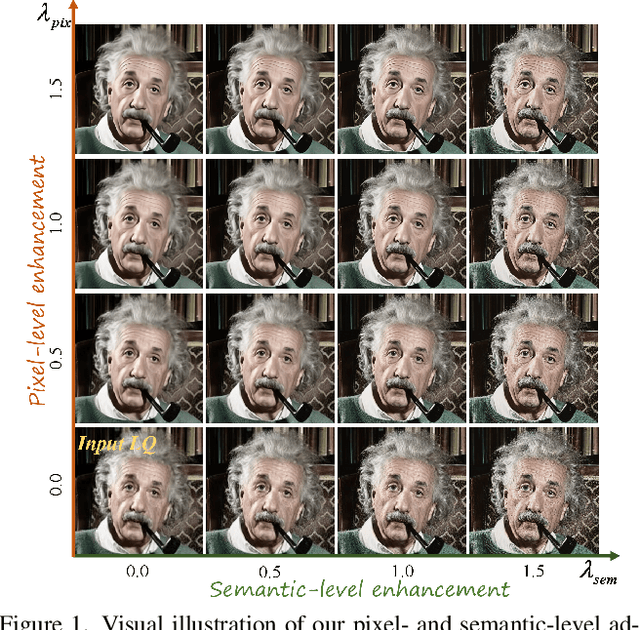


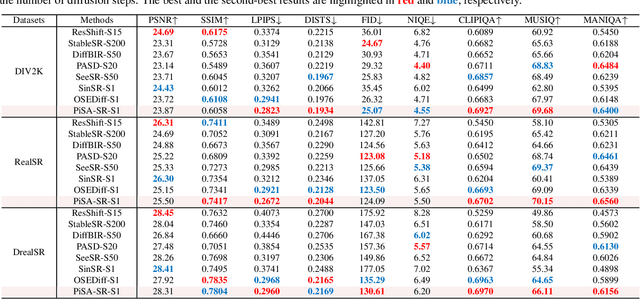
Diffusion prior-based methods have shown impressive results in real-world image super-resolution (SR). However, most existing methods entangle pixel-level and semantic-level SR objectives in the training process, struggling to balance pixel-wise fidelity and perceptual quality. Meanwhile, users have varying preferences on SR results, thus it is demanded to develop an adjustable SR model that can be tailored to different fidelity-perception preferences during inference without re-training. We present Pixel-level and Semantic-level Adjustable SR (PiSA-SR), which learns two LoRA modules upon the pre-trained stable-diffusion (SD) model to achieve improved and adjustable SR results. We first formulate the SD-based SR problem as learning the residual between the low-quality input and the high-quality output, then show that the learning objective can be decoupled into two distinct LoRA weight spaces: one is characterized by the $\ell_2$-loss for pixel-level regression, and another is characterized by the LPIPS and classifier score distillation losses to extract semantic information from pre-trained classification and SD models. In its default setting, PiSA-SR can be performed in a single diffusion step, achieving leading real-world SR results in both quality and efficiency. By introducing two adjustable guidance scales on the two LoRA modules to control the strengths of pixel-wise fidelity and semantic-level details during inference, PiSASR can offer flexible SR results according to user preference without re-training. Codes and models can be found at https://github.com/csslc/PiSA-SR.