 Add to Chrome
 Add to Firefox
 Add to Edge
UC-VLM: Consistency-Driven Learning for AI-Generated Image Detection with Vision-Language Large Models
Aug 15, 2026
Vision-Language Large Models (VLLMs) are promising for AI-generated image (AIGI) detection because they can produce both a prediction and a natural-language output. However, most existing VLLM-based detectors primarily fine-tune the language side while giving limited attention to low-level visual forensic cues. They also often depend on manually crafted prompts or human-annotated rationales, which limits scalability.We present UC-VLM, a unified multi-stage framework for AIGI detection that relies solely on binary supervision. UC-VLM first identifies effective instruction variants automatically. It then reuses the same binary label within a multi-stage training framework: (i) a visual discrimination objective that strengthens sensitivity to non-semantic forensic cues, and (ii) a label-conditioned generation objective that uses the binary label to supervise textual outputs. This design turns weak binary supervision into a shared supervision signal for both the visual pathway and the language output. Our key novelty is a unified multi-stage binary-supervised framework that consistently reuses the same authenticity labels for visual adaptation and label-conditioned text generation, while leveraging automatically optimized instructions to reduce prompt sensitivity without requiring human-written rationales or hand-crafted prompts.Experiments show that UC-VLM achieves 96.1% average accuracy on GenImage, exceeding the strongest prior result by 4.6%, and obtains 69.6% / 77.9% accuracy on Chameleon under ProGAN / SDV1.4 training, surpassing the best baseline by 11.2% / 15.3%, respectively.

FUSE: Frequency-domain Unification and Spectral Energy Alignment for Multi-modal Object Re-Identification
Jun 18, 2026Despite significant progress in multi-modal Re-Identification (ReID), existing methods tend to emphasize low-frequency cues. Consequently, they focus on attributes such as color, illumination, and coarse appearance, while overlooking mid and high-frequency structures that encode geometric, textural, and identity-discriminative details. This imbalance leads to incomplete spectral representations and unstable cross-modal alignment. To overcome these limitations, we introduce FUSE, a frequency-domain framework that reformulates multi-modal ReID as a two-stage process of spectral disentanglement and energy alignment. The proposed Spectral Decomposition Module (SDM) adaptively partitions features into low, mid, and high-frequency subspaces, enabling hierarchical spectral modeling. The Cross-Modal Alignment Module (CAM) further enforces energy alignment and subspace complementarity across modalities via frequency-consistency regularization. In addition, FUSE incorporates learnable frequency modulation to enhance robustness under varying illumination and heterogeneous sensor conditions. Extensive experiments on RGBNT201, RGBNT100, and MSVR310 show that FUSE achieves 9.1\% mAP and 9.5\% Rank-1 improvements, establishing an interpretable frequency-domain paradigm for multi-modal representation learning.
White-Balance First, Adjust Later: Cross-Camera Color Constancy via Vision-Language Evaluation
May 19, 2026Color constancy aims to keep object colors consistent under varying illumination. Cross-camera generalization in color constancy remains challenging because learning-based models often overfit to the color response characteristics of the training camera, resulting in degraded performance on images captured by other cameras. We propose VLM-CC, a feedback-guided framework that formulates color constancy as an iterative refinement process. Instead of directly estimating the illuminant from raw input, VLM-CC performs iterative correction driven by vision-language model (VLM)-based evaluation. At each iteration, the image is white-balanced using the current estimate and converted to pseudo-sRGB. A lightweight LoRA-tuned VLM then assesses the corrected image, identifying the dominant residual color cast and providing qualitative feedback. This feedback is mapped to a residual illumination direction (red, green, or blue) and used to update the illuminant estimate until convergence. Our key idea is to reframe color constancy as an iterative perceptual feedback problem, leveraging VLM evaluation instead of direct RGB regression. By replacing direct RGB estimation with VLM-guided perceptual feedback, VLM-CC achieves state-of-the-art robustness in cross-camera color constancy across multiple datasets. Code will be available at https://github.com/NothingIknow/VLM-CC.
DPM++: Dynamic Masked Metric Learning for Occluded Person Re-identification
May 07, 2026Although person re-identification has made impressive progress, occlusion caused by obstacles remains an unsettled issue in real applications. The difficulty lies in the mismatch between incomplete occluded samples and holistic identity representations. Severe occlusion removes discriminative body cues and introduces interference from background clutter and occluders, making global metric learning unreliable. Existing methods mainly rely on extra pre-trained models to estimate visible parts for alignment or construct occluded samples via data augmentation, but still lack a unified framework that learns robust visibility-consistent matching under realistic occlusion patterns. In this paper, we propose DPM++, a Dynamic Masked Metric Learning framework for occluded person re-identification. DPM++ learns an input-adaptive masked metric that dynamically selects reliable identity subspaces for each occluded instance, enabling matching to emphasize visibility-consistent evidence while suppressing unreliable components. Built upon the classifier-prototype space, DPM++ introduces a CLIP-based two-stage supervision scheme, where ID-level semantic priors are learned from the text branch and transferred into the classifier-prototype space for dynamic masked matching. To strengthen the masked metric, we introduce a saliency-guided patch transfer strategy to synthesize controllable and photo-realistic occluded samples during training. Exploiting real scene priors, this strategy exposes the model to realistic partial observations and provides richer supervision than random erasing. In addition, occlusion-aware sample pairing and mask-guided optimization improve the stability and effectiveness of the framework. Experiments on occluded and holistic person re-identification benchmarks show that DPM++ consistently outperforms previous state-of-the-art methods in both holistic and occlusion scenarios.
FIND: A Simple yet Effective Baseline for Diffusion-Generated Image Detection
Mar 15, 2026The remarkable realism of images generated by diffusion models poses critical detection challenges. Current methods utilize reconstruction error as a discriminative feature, exploiting the observation that real images exhibit higher reconstruction errors when processed through diffusion models. However, these approaches require costly reconstruction computations and depend on specific diffusion models, making their performance highly model-dependent. We identify a fundamental difference: real images are more difficult to fit with Gaussian distributions compared to synthetic ones. In this paper, we propose Forgery Identification via Noise Disturbance (FIND), a novel method that requires only a simple binary classifier. It eliminates reconstruction by directly targeting the core distributional difference between real and synthetic images. Our key operation is to add Gaussian noise to real images during training and label these noisy versions as synthetic. This step allows the classifier to focus on the statistical patterns that distinguish real from synthetic images. We theoretically prove that the noise-augmented real images resemble diffusion-generated images in their ease of Gaussian fitting. Furthermore, simply by adding noise, they still retain visual similarity to the original images, highlighting the most discriminative distribution-related features. The proposed FIND improves performance by 11.7% on the GenImage benchmark while running 126x faster than existing methods. By removing the need for auxiliary diffusion models and reconstruction, it offers a practical, efficient, and generalizable way to detect diffusion-generated content.
Bridging Day and Night: Target-Class Hallucination Suppression in Unpaired Image Translation
Feb 17, 2026Day-to-night unpaired image translation is important to downstream tasks but remains challenging due to large appearance shifts and the lack of direct pixel-level supervision. Existing methods often introduce semantic hallucinations, where objects from target classes such as traffic signs and vehicles, as well as man-made light effects, are incorrectly synthesized. These hallucinations significantly degrade downstream performance. We propose a novel framework that detects and suppresses hallucinations of target-class features during unpaired translation. To detect hallucination, we design a dual-head discriminator that additionally performs semantic segmentation to identify hallucinated content in background regions. To suppress these hallucinations, we introduce class-specific prototypes, constructed by aggregating features of annotated target-domain objects, which act as semantic anchors for each class. Built upon a Schrodinger Bridge-based translation model, our framework performs iterative refinement, where detected hallucination features are explicitly pushed away from class prototypes in feature space, thus preserving object semantics across the translation trajectory.Experiments show that our method outperforms existing approaches both qualitatively and quantitatively. On the BDD100K dataset, it improves mAP by 15.5% for day-to-night domain adaptation, with a notable 31.7% gain for classes such as traffic lights that are prone to hallucinations.
Aggregating Diverse Cue Experts for AI-Generated Image Detection
Jan 13, 2026The rapid emergence of image synthesis models poses challenges to the generalization of AI-generated image detectors. However, existing methods often rely on model-specific features, leading to overfitting and poor generalization. In this paper, we introduce the Multi-Cue Aggregation Network (MCAN), a novel framework that integrates different yet complementary cues in a unified network. MCAN employs a mixture-of-encoders adapter to dynamically process these cues, enabling more adaptive and robust feature representation. Our cues include the input image itself, which represents the overall content, and high-frequency components that emphasize edge details. Additionally, we introduce a Chromatic Inconsistency (CI) cue, which normalizes intensity values and captures noise information introduced during the image acquisition process in real images, making these noise patterns more distinguishable from those in AI-generated content. Unlike prior methods, MCAN's novelty lies in its unified multi-cue aggregation framework, which integrates spatial, frequency-domain, and chromaticity-based information for enhanced representation learning. These cues are intrinsically more indicative of real images, enhancing cross-model generalization. Extensive experiments on the GenImage, Chameleon, and UniversalFakeDetect benchmark validate the state-of-the-art performance of MCAN. In the GenImage dataset, MCAN outperforms the best state-of-the-art method by up to 7.4% in average ACC across eight different image generators.
WeakMCN: Multi-task Collaborative Network for Weakly Supervised Referring Expression Comprehension and Segmentation
May 24, 2025Weakly supervised referring expression comprehension(WREC) and segmentation(WRES) aim to learn object grounding based on a given expression using weak supervision signals like image-text pairs. While these tasks have traditionally been modeled separately, we argue that they can benefit from joint learning in a multi-task framework. To this end, we propose WeakMCN, a novel multi-task collaborative network that effectively combines WREC and WRES with a dual-branch architecture. Specifically, the WREC branch is formulated as anchor-based contrastive learning, which also acts as a teacher to supervise the WRES branch. In WeakMCN, we propose two innovative designs to facilitate multi-task collaboration, namely Dynamic Visual Feature Enhancement(DVFE) and Collaborative Consistency Module(CCM). DVFE dynamically combines various pre-trained visual knowledge to meet different task requirements, while CCM promotes cross-task consistency from the perspective of optimization. Extensive experimental results on three popular REC and RES benchmarks, i.e., RefCOCO, RefCOCO+, and RefCOCOg, consistently demonstrate performance gains of WeakMCN over state-of-the-art single-task alternatives, e.g., up to 3.91% and 13.11% on RefCOCO for WREC and WRES tasks, respectively. Furthermore, experiments also validate the strong generalization ability of WeakMCN in both semi-supervised REC and RES settings against existing methods, e.g., +8.94% for semi-REC and +7.71% for semi-RES on 1% RefCOCO. The code is publicly available at https://github.com/MRUIL/WeakMCN.
Adversarial Shallow Watermarking
Apr 28, 2025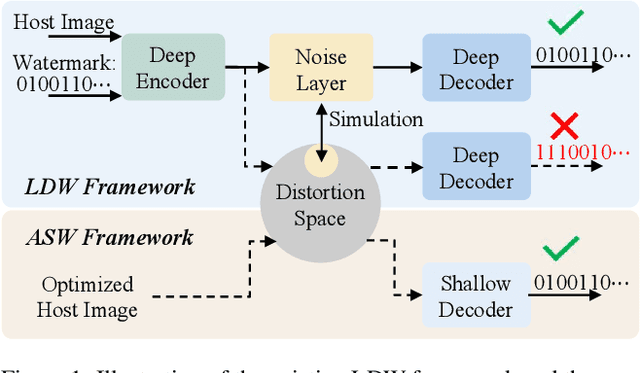
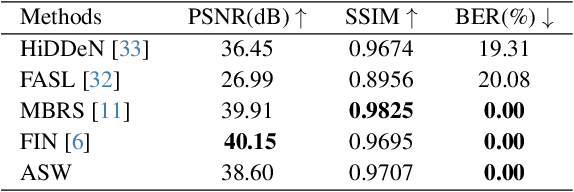
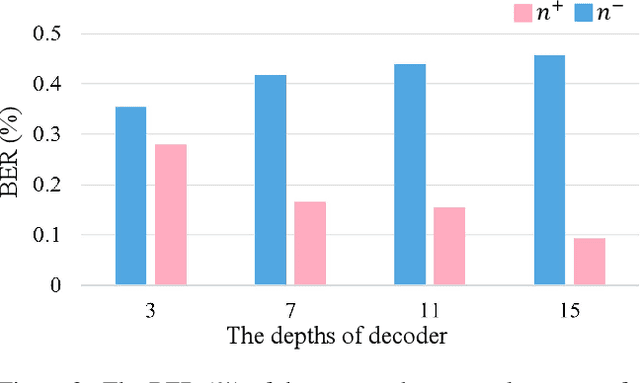
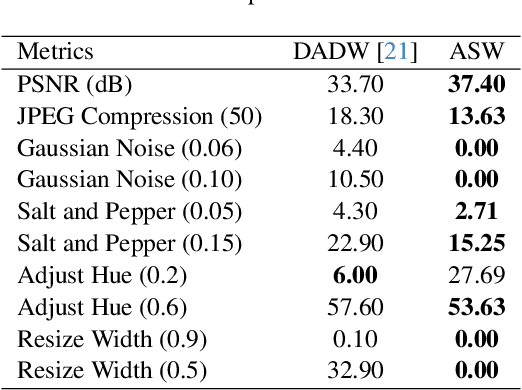
Recent advances in digital watermarking make use of deep neural networks for message embedding and extraction. They typically follow the ``encoder-noise layer-decoder''-based architecture. By deliberately establishing a differentiable noise layer to simulate the distortion of the watermarked signal, they jointly train the deep encoder and decoder to fit the noise layer to guarantee robustness. As a result, they are usually weak against unknown distortions that are not used in their training pipeline. In this paper, we propose a novel watermarking framework to resist unknown distortions, namely Adversarial Shallow Watermarking (ASW). ASW utilizes only a shallow decoder that is randomly parameterized and designed to be insensitive to distortions for watermarking extraction. During the watermark embedding, ASW freezes the shallow decoder and adversarially optimizes a host image until its updated version (i.e., the watermarked image) stably triggers the shallow decoder to output the watermark message. During the watermark extraction, it accurately recovers the message from the watermarked image by leveraging the insensitive nature of the shallow decoder against arbitrary distortions. Our ASW is training-free, encoder-free, and noise layer-free. Experiments indicate that the watermarked images created by ASW have strong robustness against various unknown distortions. Compared to the existing ``encoder-noise layer-decoder'' approaches, ASW achieves comparable results on known distortions and better robustness on unknown distortions.
Knowing Where to Focus: Attention-Guided Alignment for Text-based Person Search
Dec 19, 2024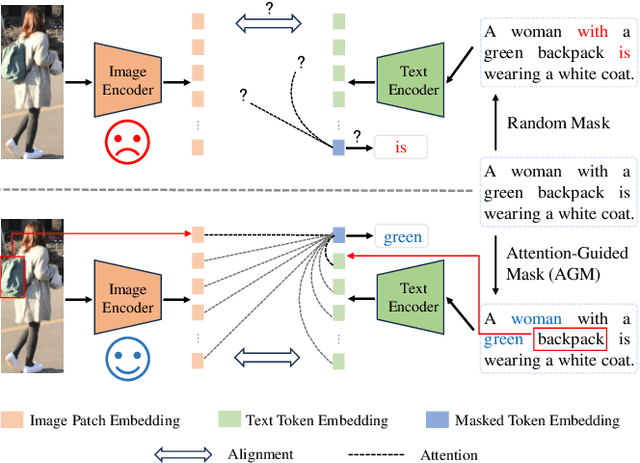
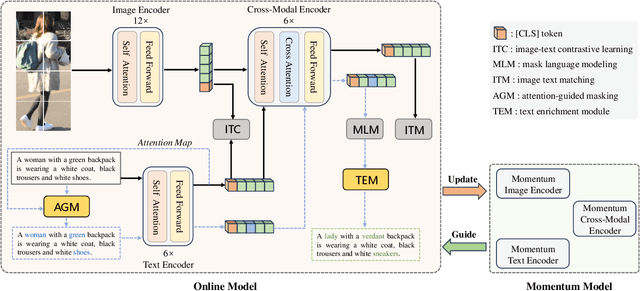
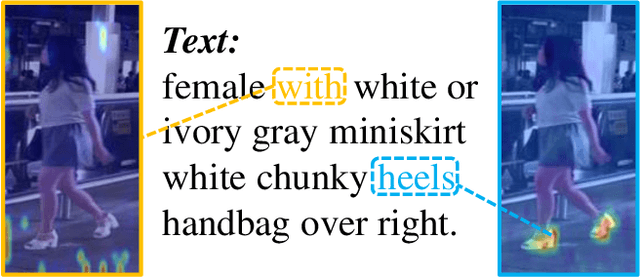
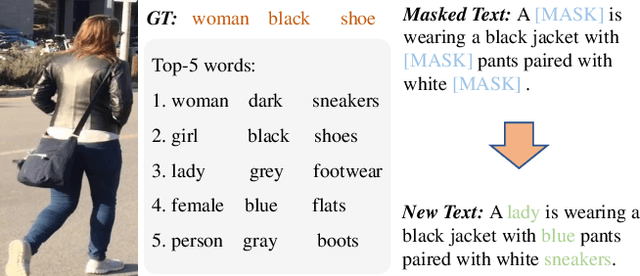
In the realm of Text-Based Person Search (TBPS), mainstream methods aim to explore more efficient interaction frameworks between text descriptions and visual data. However, recent approaches encounter two principal challenges. Firstly, the widely used random-based Masked Language Modeling (MLM) considers all the words in the text equally during training. However, massive semantically vacuous words ('with', 'the', etc.) be masked fail to contribute efficient interaction in the cross-modal MLM and hampers the representation alignment. Secondly, manual descriptions in TBPS datasets are tedious and inevitably contain several inaccuracies. To address these issues, we introduce an Attention-Guided Alignment (AGA) framework featuring two innovative components: Attention-Guided Mask (AGM) Modeling and Text Enrichment Module (TEM). AGM dynamically masks semantically meaningful words by aggregating the attention weight derived from the text encoding process, thereby cross-modal MLM can capture information related to the masked word from text context and images and align their representations. Meanwhile, TEM alleviates low-quality representations caused by repetitive and erroneous text descriptions by replacing those semantically meaningful words with MLM's prediction. It not only enriches text descriptions but also prevents overfitting. Extensive experiments across three challenging benchmarks demonstrate the effectiveness of our AGA, achieving new state-of-the-art results with Rank-1 accuracy reaching 78.36%, 67.31%, and 67.4% on CUHK-PEDES, ICFG-PEDES, and RSTPReid, respectively.