 Add to Chrome
 Add to Firefox
 Add to Edge
Measure, Don't Optimize: Forecasting Recovery in LLM Unlearning
Aug 11, 2026
Prior white-box studies show that large language models can retain latent traces of target knowledge after unlearning, even when the knowledge is no longer expressed in their outputs. However, existing audits remain limited to one-off diagnostics: it is unclear whether these residual signals can predict future recovery under continued training or serve as reliable optimization targets. Resolving this gap is essential to determine whether internal auditing can move beyond post-hoc evaluation toward proactive risk monitoring and safer unlearning. We propose J-Access, an inference-time audit that uses the Jacobian lens to map intermediate representations into vocabulary space and measures how often target concepts remain accessible along the model's output pathway. We hypothesize that residual accessibility reflects recovery susceptibility: knowledge that remains closer to the output pathway requires less fine-tuning to restore, leading to faster recovery. We audit 398 public unlearned models spanning eight unlearning methods. We find that: (1) most unlearned models retain access above the retain-only gold level; (2) pre-attack accessibility predicts recovery speed and extent at the model level, but cannot identify which specific facts will be recovered; and (3) directly minimizing J-Access does not promote genuine deletion. Instead, the model learns to hide knowledge from the audit, producing lower audit scores but greater post-attack recovery. These findings position J-Access as a model-level diagnostic for assessing residual susceptibility in unlearned models. We argue internal audits should serve as an independent diagnostic dimension in unlearning evaluation, and should not be converted into optimization targets without validation.

HTT-Net: Hierarchical Text-guided Transition Modeling for Surgical Video Phase Recognition
Jul 18, 2026Surgical video phase recognition is a fundamental task in computer-assisted intervention, supporting workflow understanding, intraoperative guidance, and surgical quality assessment. Although recent visual-temporal models have achieved promising progress, accurate and temporally coherent phase recognition remains challenging due to local visual ambiguity, transient prediction noise, and insufficient use of procedural semantics. To address these challenges, we propose HTT-Net, a Hierarchical Text-guided Transition modeling Network for surgical video phase recognition. The key idea is to introduce structured surgical semantic knowledge into phase-aware segment construction and semantic refinement. Specifically, we construct a hierarchical surgical semantic memory with intra-phase descriptions, inter-phase transition descriptions, and fine-grained semantic units. Based on this memory, the proposed Transition-Aware Segment Construction (TAS-Con) organizes frame-level evidence into coherent segment representations and handles boundary clips with inter-phase transition descriptions. Furthermore, we introduce Transition-Aware Segment Calibration (TAS-Calib), which calibrates phase-aware segment representations through hierarchical surgical semantics and improves discrimination under visual ambiguity without dense frame-level vision-language fusion. Experiments on Cholec80 and LCRS-100 demonstrate the effectiveness of HTT-Net for robust surgical video phase recognition.
QuReC: All-in-One Image Restoration with Query-Specific Guidance and Local-Global Response Calibration
Jul 16, 2026All-in-one image restoration aims to recover clean images degraded by multiple corruption types using a single unified model. Existing methods typically rely on image-level prompts or shared guidance to handle diverse degradations. However, such a paradigm becomes inadequate when degradations are spatially heterogeneous or even coexist in mixed forms within a single image. Yet spatially adaptive guidance alone is not sufficient, since accurate restoration also requires each spatial query to reliably aggregate complementary information from local neighborhoods and global contexts. To this end, we propose QuReC, a unified framework for all-in-one image restoration. QuReC consists of a Degradation-Guided Query Reconstruction Module (DQRM) and a Local-Global Response Calibration Module (LGRCM). Specifically, DQRM matches each spatial query against a degradation prototype space to reconstruct a query-specific degradation-aware representation, thereby providing fine-grained spatially adaptive restoration guidance. To further stabilize this query-wise matching process, we introduce a weakly supervised prototype matching learning strategy to improve optimization stability and degradation semantic consistency. Meanwhile, LGRCM performs local-global dual-branch aggregation and calibrates the aggregated responses with learnable priors, improving the reliability of feature aggregation and the coordination between local detail modeling and global context modeling. Extensive experiments demonstrate that QuReC achieves superior performance on multiple all-in-one image restoration benchmarks. The code is released at https://github.com/zhoushen1/QuReC.
How to Score Experts for One-Shot MoE Expert Pruning: A Unified Formulation and Selection Principle
Jun 14, 2026Mixture-of-Experts (MoE) language models reduce per-token computation through sparse expert activation, yet deployment still requires storing the full expert pool, making one-shot expert pruning a practical approach for reducing memory usage. Although effective, existing criteria are largely heuristic, and no single criterion is universally optimal. Thus, establishing a principle for selecting pruning criteria suited to different deployment objectives remains an important yet largely underexplored problem in one-shot expert pruning. To this end, we introduce a unified formulation for one-shot MoE expert pruning organized around three factors: routing frequency, gate weighting, and activation strength. The formulation yields a criteria selection principle: task-agnostic pruning should favor routed-token-averaged, gate-free activation-based criteria, whereas task-specific pruning can benefit from retaining routing-frequency and gate-weight information. Beyond this principle, the formulation also provides a systematic view of existing heuristic criteria and gives rise to two new task-agnostic criteria, Mean Activation Norm (MAN) and Mean Squared Activation Norm (MSAN). Across four representative MoE models and 16 diverse benchmarks, MAN and MSAN are consistently strong in the task-agnostic setting, obtain the top-two average ranks, and improve average performance by up to 8.8 points over the strongest baseline.
The Cylindrical Representation Hypothesis for Language Model Steering
May 03, 2026Steering is a widely used technique for controlling large language models, yet its effects are often unstable and hard to predict. Existing theoretical accounts are largely based on the Linear Representation Hypothesis (LRH). While LRH assumes that concepts can be orthogonalized for lossless control, this idealized mapping fails in real representations and cannot account for the observed unpredictability of steering. By relaxing LRH's orthogonality assumption while preserving linear representations, we show that overlapping concept contributions naturally yield a sample-specific axis-orthogonal structure. We formalize this as the Cylindrical Representation Hypothesis (CRH). In CRH, a central axis captures the main difference between concept absence and presence and drives concept generation. A surrounding normal plane controls steering sensitivity by determining how easily the axis can activate the target concept. Within this plane, only specific sensitive sectors strongly facilitate concept activation, while other sectors can suppress or delay it. While the surrounding normal plane can be reliably identified from difference vectors, the sensitive sector cannot, introducing intrinsic uncertainty at the sector level. This uncertainty provides a principled explanation for why steering outcomes often fluctuate even when using well-aligned directions. Our experiments verify the existence of the cylindrical structure and demonstrate that CRH provides a valid and practical way to interpret model steering behavior in real settings: https://github.com/mbzuai-nlp/CRH.
ServImage: An Image Generation and Editing Benchmark from Real-world Commercial Imaging Services
Apr 27, 2026Recent image generation and editing models demonstrate robust adherence to instructions and high visual quality on academic benchmarks. However, their performance on paid, real-world design projects remains uncertain. We introduce \textbf{ServImage}, a benchmark that explicitly correlates model outputs with economic value in commercial design projects. ServImage consists of (i) \textbf{\textit{ServImageBench}}: a dataset of 1.07k paid commercial design tasks and 2.05k designer deliverables totaling over \$295k, covering portrait, product, and digital content, along with 33k candidate images and 33k human annotations. (ii) \textbf{\textit{ServImageScore}}: an integrated scoring system that combines three quality dimensions: baseline requirements fulfilment, visual execution quality, and commercial necessity satisfaction. These three dimensions are designed to characterize the factors that drive human payment decisions and indicate whether an image is commercially acceptable. (iii) \textbf{\textit{ServImageModel}}: under this scoring system, we propose a payment prediction model trained on the human-annotated candidate images, achieving 82.00\% accuracy in predicting human payment decisions and producing calibrated payment probabilities. ServImage provides a comprehensive foundation for assessing the commercial viability of image generation models and offers a scalable resource for future research on economically grounded vision systems \href{https://github.com/FengxianJi/ServImage}{Github.}
M3MAD-Bench: Are Multi-Agent Debates Really Effective Across Domains and Modalities?
Jan 06, 2026As an agent-level reasoning and coordination paradigm, Multi-Agent Debate (MAD) orchestrates multiple agents through structured debate to improve answer quality and support complex reasoning. However, existing research on MAD suffers from two fundamental limitations: evaluations are conducted under fragmented and inconsistent settings, hindering fair comparison, and are largely restricted to single-modality scenarios that rely on textual inputs only. To address these gaps, we introduce M3MAD-Bench, a unified and extensible benchmark for evaluating MAD methods across Multi-domain tasks, Multi-modal inputs, and Multi-dimensional metrics. M3MAD-Bench establishes standardized protocols over five core task domains: Knowledge, Mathematics, Medicine, Natural Sciences, and Complex Reasoning, and systematically covers both pure text and vision-language datasets, enabling controlled cross-modality comparison. We evaluate MAD methods on nine base models spanning different architectures, scales, and modality capabilities. Beyond accuracy, M3MAD-Bench incorporates efficiency-oriented metrics such as token consumption and inference time, providing a holistic view of performance--cost trade-offs. Extensive experiments yield systematic insights into the effectiveness, robustness, and efficiency of MAD across text-only and multimodal scenarios. We believe M3MAD-Bench offers a reliable foundation for future research on standardized MAD evaluation. The code is available at http://github.com/liaolea/M3MAD-Bench.
Otter: Mitigating Background Distractions of Wide-Angle Few-Shot Action Recognition with Enhanced RWKV
Nov 11, 2025Wide-angle videos in few-shot action recognition (FSAR) effectively express actions within specific scenarios. However, without a global understanding of both subjects and background, recognizing actions in such samples remains challenging because of the background distractions. Receptance Weighted Key Value (RWKV), which learns interaction between various dimensions, shows promise for global modeling. While directly applying RWKV to wide-angle FSAR may fail to highlight subjects due to excessive background information. Additionally, temporal relation degraded by frames with similar backgrounds is difficult to reconstruct, further impacting performance. Therefore, we design the CompOund SegmenTation and Temporal REconstructing RWKV (Otter). Specifically, the Compound Segmentation Module~(CSM) is devised to segment and emphasize key patches in each frame, effectively highlighting subjects against background information. The Temporal Reconstruction Module (TRM) is incorporated into the temporal-enhanced prototype construction to enable bidirectional scanning, allowing better reconstruct temporal relation. Furthermore, a regular prototype is combined with the temporal-enhanced prototype to simultaneously enhance subject emphasis and temporal modeling, improving wide-angle FSAR performance. Extensive experiments on benchmarks such as SSv2, Kinetics, UCF101, and HMDB51 demonstrate that Otter achieves state-of-the-art performance. Extra evaluation on the VideoBadminton dataset further validates the superiority of Otter in wide-angle FSAR.
When Personalization Tricks Detectors: The Feature-Inversion Trap in Machine-Generated Text Detection
Oct 14, 2025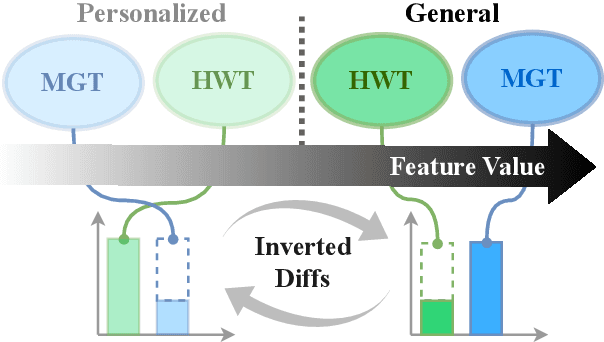
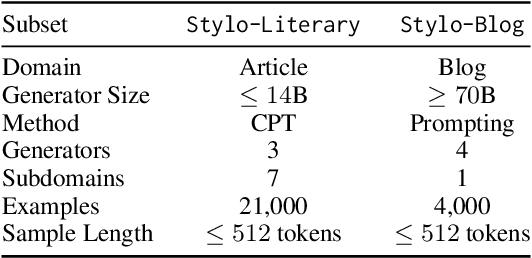
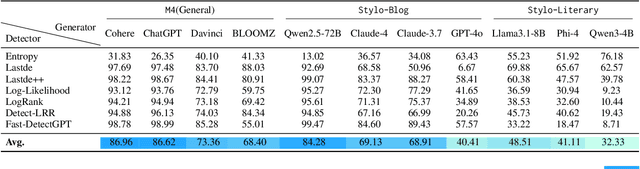
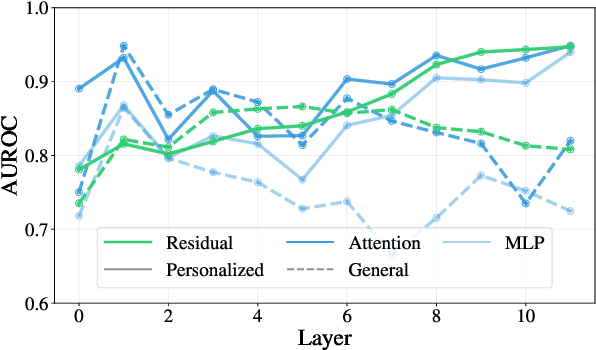
Large language models (LLMs) have grown more powerful in language generation, producing fluent text and even imitating personal style. Yet, this ability also heightens the risk of identity impersonation. To the best of our knowledge, no prior work has examined personalized machine-generated text (MGT) detection. In this paper, we introduce \dataset, the first benchmark for evaluating detector robustness in personalized settings, built from literary and blog texts paired with their LLM-generated imitations. Our experimental results demonstrate large performance gaps across detectors in personalized settings: some state-of-the-art models suffer significant drops. We attribute this limitation to the \textit{feature-inversion trap}, where features that are discriminative in general domains become inverted and misleading when applied to personalized text. Based on this finding, we propose \method, a simple and reliable way to predict detector performance changes in personalized settings. \method identifies latent directions corresponding to inverted features and constructs probe datasets that differ primarily along these features to evaluate detector dependence. Our experiments show that \method can accurately predict both the direction and the magnitude of post-transfer changes, showing 85\% correlation with the actual performance gaps. We hope that this work will encourage further research on personalized text detection.
TransPrune: Token Transition Pruning for Efficient Large Vision-Language Model
Jul 28, 2025Large Vision-Language Models (LVLMs) have advanced multimodal learning but face high computational costs due to the large number of visual tokens, motivating token pruning to improve inference efficiency. The key challenge lies in identifying which tokens are truly important. Most existing approaches rely on attention-based criteria to estimate token importance. However, they inherently suffer from certain limitations, such as positional bias. In this work, we explore a new perspective on token importance based on token transitions in LVLMs. We observe that the transition of token representations provides a meaningful signal of semantic information. Based on this insight, we propose TransPrune, a training-free and efficient token pruning method. Specifically, TransPrune progressively prunes tokens by assessing their importance through a combination of Token Transition Variation (TTV)-which measures changes in both the magnitude and direction of token representations-and Instruction-Guided Attention (IGA), which measures how strongly the instruction attends to image tokens via attention. Extensive experiments demonstrate that TransPrune achieves comparable multimodal performance to original LVLMs, such as LLaVA-v1.5 and LLaVA-Next, across eight benchmarks, while reducing inference TFLOPs by more than half. Moreover, TTV alone can serve as an effective criterion without relying on attention, achieving performance comparable to attention-based methods. The code will be made publicly available upon acceptance of the paper at https://github.com/liaolea/TransPrune.