 Add to Chrome
 Add to Firefox
 Add to Edge
CACSurv: Concordance-Aligned Comparative Learning with Large Language Models for Cancer Survival Prediction
Aug 17, 2026
Cancer survival prediction supports treatment planning, risk stratification, and follow-up management. Existing methods use structured clinical variables, whole-slide images, genomic profiles, or multimodal inputs, while patient reports remain underexplored. We study report-centric survival prediction using reports that organize pathological, clinical, and molecular evidence. Large language models (LLMs) can reason over such reports, but case-wise time regression introduces two mismatches. First, a formulation mismatch arises because survival evaluation depends on ordering comparable patients, whereas independent time predictions do not enforce ranking consistency. Second, a supervision mismatch arises because a censored patient's observed time indicates survival beyond that point and cannot serve as an exact regression target, although it still implies orderings relative to patients who died earlier. To address these mismatches, we propose CACSurv, a Concordance-Aligned Comparative framework for report-centric survival prediction. CACSurv reformulates survival modeling as mini-cohort comparative reasoning, where an LLM predicts relative prognostic orderings. We introduce concordance-aligned rewards derived from comparable relations under right censoring, enabling censored outcomes to provide ranking supervision without exact event-time targets. At inference, Monte Carlo Reference Aggregation compares each patient with sampled references and aggregates positions into a cohort-level ranking. We establish TCGA-SurvReport, a benchmark covering six TCGA cancer cohorts. CACSurv achieves the highest C-index on all six cohorts and an average C-index of 0.722, outperforming the strongest published survival model by 6.5 percentage points and the strongest LLM time-regression baseline by 4.2 percentage points. Our code, models, and dataset will be available at https://github.com/xmed-lab/CACSurv.

Beyond Frame Selection: Generative Latent Evidence Aggregation for Long-Video Understanding
Jul 30, 2026Long-video understanding commonly compresses videos into a small set of frames or visual tokens for answer generation. Existing compact pipelines focus on retaining relevant visual content as explicit evidence. Yet making evidence available does not ensure that complementary cues across moments are integrated for answering. Our key idea is to organize selected frames into query-relevant cross-frame evidence before generation. We formulate this post-selection stage as a latent evidence interface and instantiate it with GenEvA ($\textbf{Gen}erative$ $Latent$ $\textbf{Ev}idence$ $\textbf{A}ggregation$), a distribution-guided latent evidence aggregation framework. Specifically, GenEvA uses a query-conditioned evidence distribution to focus aggregation on relevant frames, forming compact cross-frame latent evidence from their frame-specific information. Since cross-frame integration is not always needed, the same distribution determines whether to insert this latent complement. Across four benchmarks and two Video-MLLM backbones, GenEvA consistently improves matched-frame baselines. At 8 frames, it raises the four-benchmark LLaVA-Video average by $+5.2$ points and Qwen2.5-VL accuracy on LVBench by $+10.1$ points. These gains require only $0.11\%$--$0.40\%$ average video-token overhead; analyses further show task-aware allocation and benefits from Adaptive Evidence Invocation.
ST-SimDiff: Balancing Spatiotemporal Similarity and Difference for Efficient Video Understanding with MLLMs
May 21, 2026Multimodal Large Language Models (MLLMs) face significant computational overhead when processing long videos due to the massive number of visual tokens required. To improve efficiency, existing methods primarily reduce redundancy by pruning or merging tokens based on importance or similarity. However, these approaches largely overlook a critical dimension of video content, i.e., changes and turning points, and they lack a collaborative model for spatio-temporal relationships. To address this, we propose a new perspective: similarity is for identifying redundancy, while difference is for capturing key events. Based on this, we designed a training-free framework named ST-SimDiff. We first construct a spatio-temporal graph from the visual tokens to uniformly model their complex associations. Subsequently, we employ a parallel dual-selection strategy: 1) similarity-based selection uses community detection to retain representative tokens, compressing static information; 2) temporal difference-based selection precisely locates content-changing points to preserve tokens that capture key dynamic shifts. This allows it to preserve both static and dynamic content with a minimal number of tokens. Extensive experiments show our method significantly outperforms state-of-the-art approaches while substantially reducing computational costs. Our code is available in https://github.com/bingjunluo/ST-SimDiff.
Enhancing Visual Token Representations for Video Large Language Models via Training-Free Spatial-Temporal Pooling and Gridding
May 21, 2026Recent advances in Multimodal Large Language Models (MLLMs) have significantly advanced video understanding tasks, yet challenges remain in efficiently compressing visual tokens while preserving spatiotemporal interactions. Existing methods, such as LLaVA family, utilize simplistic pooling or interpolation techniques that overlook the intricate dynamics of visual tokens. To bridge this gap, we propose ST-GridPool, a novel training-free visual token enhancement method designed specifically for Video LLMs. Our approach integrates Pyramid Temporal Gridding (PTG), which captures multi-grained spatiotemporal interactions through hierarchical temporal gridding, and Norm-based Spatial Pooling (NSP), which preserves high-information visual regions by leveraging the correlation between token norms and semantic richness. Extensive experiments on various benchmarks demonstrate that ST-GridPool consistently enhances performance of Video LLMs without requiring costly retraining. Our method offers an efficient and plug-and-play solution for improving visual token representations. Our code is available in https://github.com/bingjunluo/ST-GridPool.
MedHorizon: Towards Long-context Medical Video Understanding in the Wild
May 07, 2026Medical multimodal large language models (MLLMs) have advanced image understanding and short-video analysis, but real clinical review often requires full-procedure video understanding. Unlike general long videos, medical procedures contain highly redundant anatomical views, while decisive evidence is temporally sparse, spatially subtle, and context dependent. Existing benchmarks often assume this evidence has already been localized through images, short clips, or pre-segmented videos, leaving the retrieval-before-reasoning problem under-tested. We introduce MedHorizon, an in-the-wild benchmark for long-context medical video understanding. MedHorizon preserves 759 hours of full-length clinical procedures and provides 1,253 evidence-grounded multiple-choice questionsthat jointly evaluate sparse evidence understanding and multi-hop clinical reasoning. Its evidence is extremely sparse, with only 0.166% evidence frames on average, requiring models to search noisy procedural streams before interpreting and aggregating findings. We evaluate representative general-domain, medical-domain, and long-video MLLMs. The best model reaches only 41.1% accuracy, showing that current systems remain far from robust full-procedure understanding. Further analysis yields four key findings: performance does not scale reliably with more frames, evidence retrieval and clinical interpretation remain primary bottlenecks; these bottlenecks are rooted in weak procedural reasoning and attention drift under redundancy, and generic sampling methods only partially balances local detail with global coverage. MedHorizon provides a rigorous testbed for MLLMs that retrieve sparse evidence and reason over complete clinical workflows.
DenseMLLM: Standard Multimodal LLMs are Intrinsic Dense Predictors
Feb 15, 2026Multimodal Large Language Models (MLLMs) have demonstrated exceptional capabilities in high-level visual understanding. However, extending these models to fine-grained dense prediction tasks, such as semantic segmentation and depth estimation, typically necessitates the incorporation of complex, task-specific decoders and other customizations. This architectural fragmentation increases model complexity and deviates from the generalist design of MLLMs, ultimately limiting their practicality. In this work, we challenge this paradigm by accommodating standard MLLMs to perform dense predictions without requiring additional task-specific decoders. The proposed model is called DenseMLLM, grounded in the standard architecture with a novel vision token supervision strategy for multiple labels and tasks. Despite its minimalist design, our model achieves highly competitive performance across a wide range of dense prediction and vision-language benchmarks, demonstrating that a standard, general-purpose MLLM can effectively support dense perception without architectural specialization.
Multi-Modal Explainable Medical AI Assistant for Trustworthy Human-AI Collaboration
May 11, 2025Generalist Medical AI (GMAI) systems have demonstrated expert-level performance in biomedical perception tasks, yet their clinical utility remains limited by inadequate multi-modal explainability and suboptimal prognostic capabilities. Here, we present XMedGPT, a clinician-centric, multi-modal AI assistant that integrates textual and visual interpretability to support transparent and trustworthy medical decision-making. XMedGPT not only produces accurate diagnostic and descriptive outputs, but also grounds referenced anatomical sites within medical images, bridging critical gaps in interpretability and enhancing clinician usability. To support real-world deployment, we introduce a reliability indexing mechanism that quantifies uncertainty through consistency-based assessment via interactive question-answering. We validate XMedGPT across four pillars: multi-modal interpretability, uncertainty quantification, and prognostic modeling, and rigorous benchmarking. The model achieves an IoU of 0.703 across 141 anatomical regions, and a Kendall's tau-b of 0.479, demonstrating strong alignment between visual rationales and clinical outcomes. For uncertainty estimation, it attains an AUC of 0.862 on visual question answering and 0.764 on radiology report generation. In survival and recurrence prediction for lung and glioma cancers, it surpasses prior leading models by 26.9%, and outperforms GPT-4o by 25.0%. Rigorous benchmarking across 347 datasets covers 40 imaging modalities and external validation spans 4 anatomical systems confirming exceptional generalizability, with performance gains surpassing existing GMAI by 20.7% for in-domain evaluation and 16.7% on 11,530 in-house data evaluation. Together, XMedGPT represents a significant leap forward in clinician-centric AI integration, offering trustworthy and scalable support for diverse healthcare applications.
PaMi-VDPO: Mitigating Video Hallucinations by Prompt-Aware Multi-Instance Video Preference Learning
Apr 08, 2025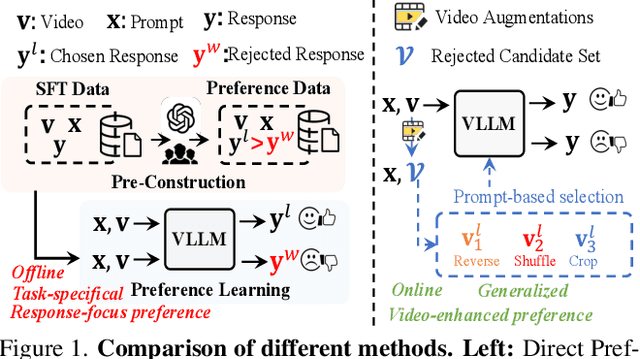
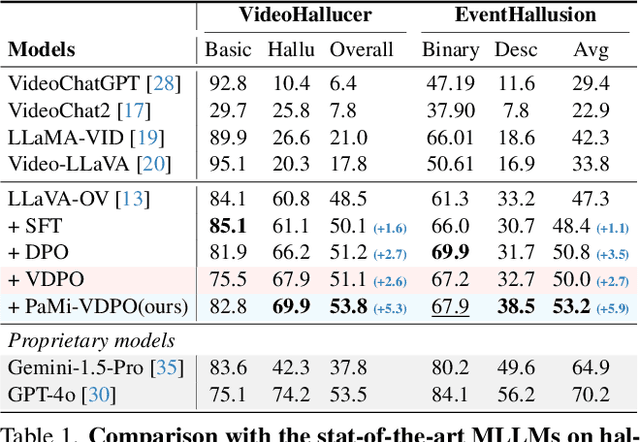
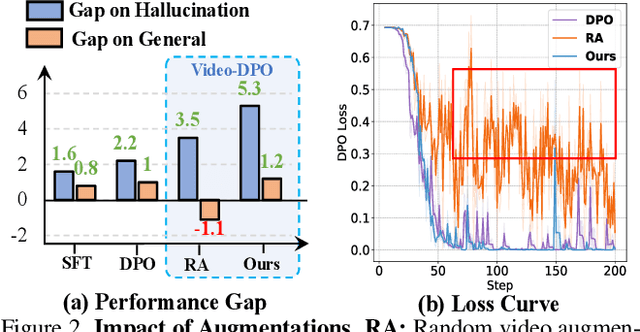
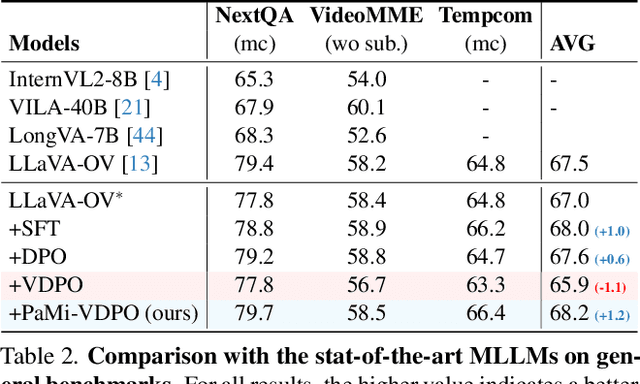
Direct Preference Optimization (DPO) helps reduce hallucinations in Video Multimodal Large Language Models (VLLMs), but its reliance on offline preference data limits adaptability and fails to capture true video-response misalignment. We propose Video Direct Preference Optimization (VDPO), an online preference learning framework that eliminates the need for preference annotation by leveraging video augmentations to generate rejected samples while keeping responses fixed. However, selecting effective augmentations is non-trivial, as some clips may be semantically identical to the original under specific prompts, leading to false rejections and disrupting alignment. To address this, we introduce Prompt-aware Multi-instance Learning VDPO (PaMi-VDPO), which selects augmentations based on prompt context. Instead of a single rejection, we construct a candidate set of augmented clips and apply a close-to-far selection strategy, initially ensuring all clips are semantically relevant while then prioritizing the most prompt-aware distinct clip. This allows the model to better capture meaningful visual differences, mitigating hallucinations, while avoiding false rejections, and improving alignment. PaMi-VDPOseamlessly integrates into existing VLLMs without additional parameters, GPT-4/human supervision. With only 10k SFT data, it improves the base model by 5.3% on VideoHallucer, surpassing GPT-4o, while maintaining stable performance on general video benchmarks.
Tri-Plane Mamba: Efficiently Adapting Segment Anything Model for 3D Medical Images
Sep 13, 2024General networks for 3D medical image segmentation have recently undergone extensive exploration. Behind the exceptional performance of these networks lies a significant demand for a large volume of pixel-level annotated data, which is time-consuming and labor-intensive. The emergence of the Segment Anything Model (SAM) has enabled this model to achieve superior performance in 2D medical image segmentation tasks via parameter- and data-efficient feature adaptation. However, the introduction of additional depth channels in 3D medical images not only prevents the sharing of 2D pre-trained features but also results in a quadratic increase in the computational cost for adapting SAM. To overcome these challenges, we present the Tri-Plane Mamba (TP-Mamba) adapters tailored for the SAM, featuring two major innovations: 1) multi-scale 3D convolutional adapters, optimized for efficiently processing local depth-level information, 2) a tri-plane mamba module, engineered to capture long-range depth-level representation without significantly increasing computational costs. This approach achieves state-of-the-art performance in 3D CT organ segmentation tasks. Remarkably, this superior performance is maintained even with scarce training data. Specifically using only three CT training samples from the BTCV dataset, it surpasses conventional 3D segmentation networks, attaining a Dice score that is up to 12% higher.
HiRes-LLaVA: Restoring Fragmentation Input in High-Resolution Large Vision-Language Models
Jul 11, 2024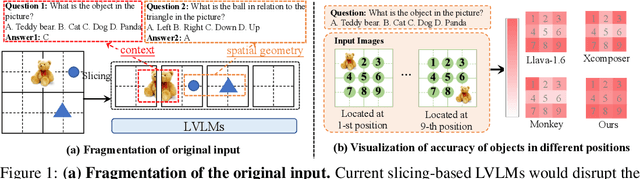
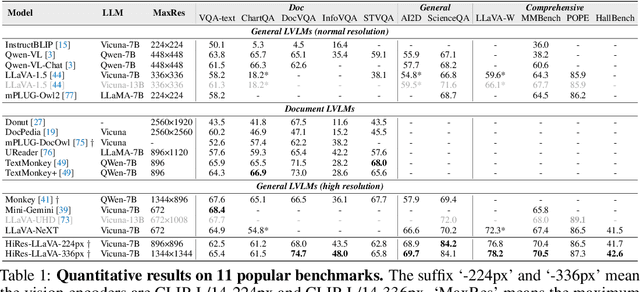
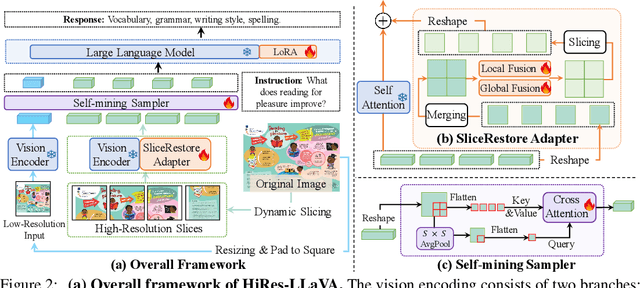

High-resolution inputs enable Large Vision-Language Models (LVLMs) to discern finer visual details, enhancing their comprehension capabilities. To reduce the training and computation costs caused by high-resolution input, one promising direction is to use sliding windows to slice the input into uniform patches, each matching the input size of the well-trained vision encoder. Although efficient, this slicing strategy leads to the fragmentation of original input, i.e., the continuity of contextual information and spatial geometry is lost across patches, adversely affecting performance in cross-patch context perception and position-specific tasks. To overcome these shortcomings, we introduce HiRes-LLaVA, a novel framework designed to efficiently process any size of high-resolution input without altering the original contextual and geometric information. HiRes-LLaVA comprises two innovative components: (i) a SliceRestore adapter that reconstructs sliced patches into their original form, efficiently extracting both global and local features via down-up-sampling and convolution layers, and (ii) a Self-Mining Sampler to compresses the vision tokens based on themselves, preserving the original context and positional information while reducing training overhead. To assess the ability of handling context fragmentation, we construct a new benchmark, EntityGrid-QA, consisting of edge-related and position-related tasks. Our comprehensive experiments demonstrate the superiority of HiRes-LLaVA on both existing public benchmarks and on EntityGrid-QA, particularly on document-oriented tasks, establishing new standards for handling high-resolution inputs.