 Add to Chrome
 Add to Firefox
 Add to Edge
How Much Dense Attention is Necessary? Oracle-Guided Sparse Prefill for Full/GQA Layers in Hybrid Long-Context Models
Jun 05, 2026
Long-context prefill remains expensive because full/GQA layers still score the historical sequence, even in hybrid models with local, sparse, linear, or recurrent components. We study how much dense attention is needed to preserve task-level behavior under explicit support granularity and top-k budgets. We introduce an attention-mass top-k oracle for existing GQA checkpoints: for each layer and query position, it computes dense attention, selects head-averaged token support, and recomputes attention only on that support. The oracle is a diagnostic reference, not a deployable accelerator, and separates sparse-budget feasibility from indexer error and runtime realization effects. On Qwen-family retrieval-heavy evaluations, the longest per-query oracle rows stay within 1 point of dense, and a Qwen3.5-9B RULER-style sweep from 4K to 100K stays within 0.48 points. Guided by the oracle, we derive a head-collapsed auxiliary indexer trained by KL distillation from dense attention-mass distributions while keeping the backbone frozen. With separately distilled Qwen3.5-0.8B and Qwen3.5-9B indexers, the reported 16K/32K validation macro gaps are +2.04 and +1.13 points, treated as quality preservation rather than improvement; fused selection-block-shared support can introduce a larger realization gap. Preliminary single-card TTFT measurements show distilled-indexer sparse serving speedups of 1.71x for Qwen3.5-0.8B on NPU and 1.93x for Qwen3.5-9B on GPU against its dense FlashAttention-2 baseline. Additional random-init stress rows reach 3.44x, indicating sparse-runtime headroom but not validated output quality. This first release separates oracle feasibility, distilled-indexer quality, and runtime headroom, leaving a fully matched quality-latency frontier to future work.

LVSA: Training-Free Sparse Attention for Long Video Diffusion
May 29, 2026Dense self-attention is the compute and quality bottleneck of long-video diffusion inference: cost grows quadratically with the sequence length, and beyond the training horizon the model converges to near-static output, that is, "frozen" repetitive video. State of the art approaches are either too costly, e.g., they require retraining, or fail to satisfy both performance and quality objectives in a scalable manner. To this end, we introduce Long Video Sparse Attention (LVSA), a training-free model-agnostic block-sparse attention for video diffusion transformers that combines a structured window pattern with rotating global anchors, thus removing the fixed-grid bias which causes long-range temporal artifacts. LVSA, combined with a FlashInfer kernel, reduces compute up to 3.17x on Wan 2.1 1.3B at a 6x horizon, 2.98x on Wan 2.1 14B at a 6x horizon, and 3.33x on HunyuanVideo 1.5 at a 1.5x horizon, compared to dense attention. Beyond reducing compute, LVSA enables HunyuanVideo 1.5 generation at a 2x horizon, which is otherwise out-of-memory on a single GPU. Moreover, LVSA provides speedups up to 2.41x compared to RIFLEx and 3.27x compared to UltraViCo on Wan 2.1 1.3B. To demonstrate applicability across diverse platforms, we apply LVSA on NPUs and achieve speedups up to 2.71x on Wan 2.2 A14B and 3.24x on Wan 2.1 1.3B compared to dense attention. To evaluate quality in a fair way, we introduce VQeval, a tool properly scoring loopy video failures, which instead are rewarded in state of the art evaluators like VBench-Long. LVSA is quality-neutral for generation at training horizon length and quality-positive at extended lengths.
Reflect to Inform: Boosting Multimodal Reasoning via Information-Gain-Driven Verification
Mar 27, 2026Multimodal Large Language Models (MLLMs) achieve strong multimodal reasoning performance, yet we identify a recurring failure mode in long-form generation: as outputs grow longer, models progressively drift away from image evidence and fall back on textual priors, resulting in ungrounded reasoning and hallucinations. Interestingly, Based on attention analysis, we find that MLLMs have a latent capability for late-stage visual verification that is present but not consistently activated. Motivated by this observation, we propose Visual Re-Examination (VRE), a self-evolving training framework that enables MLLMs to autonomously perform visual introspection during reasoning without additional visual inputs. Rather than distilling visual capabilities from a stronger teacher, VRE promotes iterative self-improvement by leveraging the model itself to generate reflection traces, making visual information actionable through information gain. Extensive experiments across diverse multimodal benchmarks demonstrate that VRE consistently improves reasoning accuracy and perceptual reliability, while substantially reducing hallucinations, especially in long-chain settings. Code is available at https://github.com/Xiaobu-USTC/VRE.
Does Your 3D Encoder Really Work? When Pretrain-SFT from 2D VLMs Meets 3D VLMs
Jun 06, 2025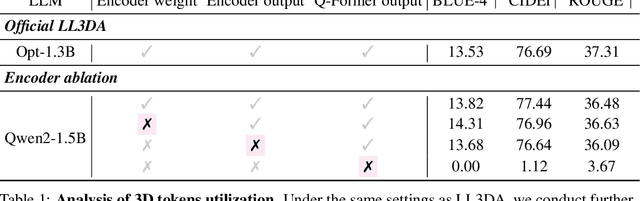
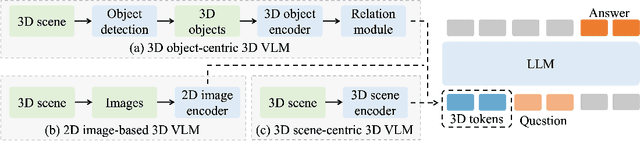
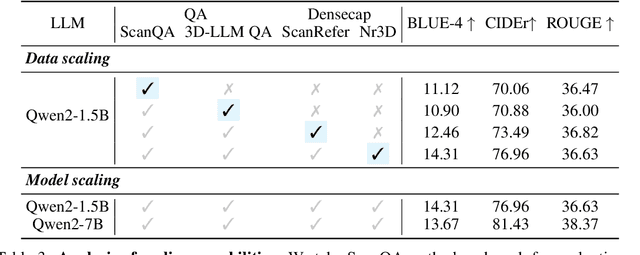
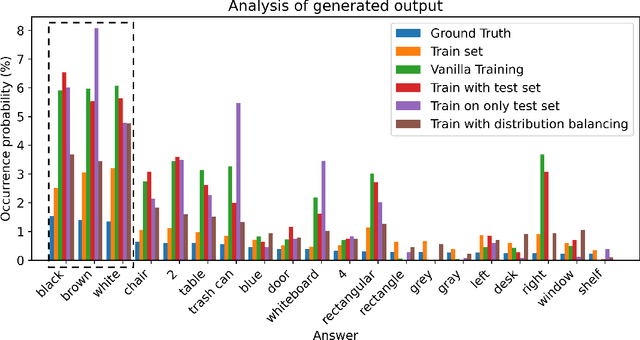
Remarkable progress in 2D Vision-Language Models (VLMs) has spurred interest in extending them to 3D settings for tasks like 3D Question Answering, Dense Captioning, and Visual Grounding. Unlike 2D VLMs that typically process images through an image encoder, 3D scenes, with their intricate spatial structures, allow for diverse model architectures. Based on their encoder design, this paper categorizes recent 3D VLMs into 3D object-centric, 2D image-based, and 3D scene-centric approaches. Despite the architectural similarity of 3D scene-centric VLMs to their 2D counterparts, they have exhibited comparatively lower performance compared with the latest 3D object-centric and 2D image-based approaches. To understand this gap, we conduct an in-depth analysis, revealing that 3D scene-centric VLMs show limited reliance on the 3D scene encoder, and the pre-train stage appears less effective than in 2D VLMs. Furthermore, we observe that data scaling benefits are less pronounced on larger datasets. Our investigation suggests that while these models possess cross-modal alignment capabilities, they tend to over-rely on linguistic cues and overfit to frequent answer distributions, thereby diminishing the effective utilization of the 3D encoder. To address these limitations and encourage genuine 3D scene understanding, we introduce a novel 3D Relevance Discrimination QA dataset designed to disrupt shortcut learning and improve 3D understanding. Our findings highlight the need for advanced evaluation and improved strategies for better 3D understanding in 3D VLMs.